

Tsaghkadzor
Tsaghkadzor (Armenian: Ծաղկաձոր — “Valley of Flowers”) is Armenia’s flagship ski resort and its most developed mountain-climatic destination — a small city at 1,750–1,800 m on the south-eastern flank of Mount Teghenis (2,851 m) in the Kotayk Province, roughly 50 km and one hour north of Yerevan. The ski area runs from 1,969 m to 2,819 m, giving an 853 m vertical drop over 15 prepared trails totalling ~30 km, served by a five-stage Leitner ropeway built between 2004 and 2008. On the same mountain, five minutes from the lifts, stands Kecharis Monastery — an 11th–13th-century monastic ensemble founded in 1033 by Grigor Magistros Pahlavuni. Nowhere else in Armenia does a modern ski resort share a hillside with a thousand-year-old monastic complex — a combination that defines the visit.
Tsaghkadzor’s identity was set in the Soviet era. The Olympic Sports Complex was built in the 1960s–70s to prepare Soviet national teams for the Winter Olympics — the town’s altitude and clean mountain air proved ideal for increasing haemoglobin levels ahead of competition. Multiple Soviet Olympic teams trained here, and the tradition continues with Armenian national squads and visiting international teams today. Add 230–270 sunny days a year, a 7–10 °C summer temperature drop from Yerevan, hotels ranging from Marriott to family guesthouses, and the neighbouring resorts of Hankavan (30 min west) and Myler Mountain Resort (~1.5 h west) on the opposite slopes of the same massif, and Tsaghkadzor becomes the natural centre of gravity for any Armenian mountain trip.
Things to See in Tsaghkadzor and Around
Tsaghkadzor and its surroundings combine mountain scenery, medieval landmarks and nearby spa resorts in Kotayk Province. Explore the main places in this area below, with separate detailed guides for planning each visit.




Other attractions
- Leonid Yengibarov Monument — a memorial to the celebrated Armenian clown and mime Leonid Yengibarov (1935–1972), who was often called “the sad clown” and drew comparisons to Marcel Marceau. The monument marks his connection to the town.
- Saint Harutyun Church — a modern Armenian Apostolic church in the town centre.
- Olympic Sports Complex — built in the 1960s to train Soviet national teams (skiing, weightlifting, wrestling, swimming). Still operating today as a training base for Armenian and visiting international teams.
- The abandoned bobsleigh track (“zhelob”) — a Soviet-era engineering project never completed, now a distinctive off-piste feature and unlikely landmark on the lower mountain.
Geography and climate
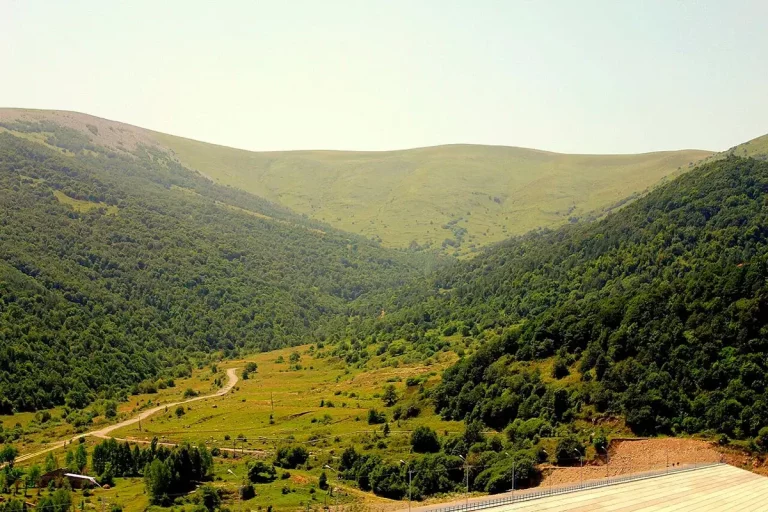
Tsaghkadzor sits in a north-south valley on the south-eastern slopes of Mount Teghenis — the highest peak of the Tsakhkunyats range, which runs west of Lake Sevan and separates the Kotayk plateau from the Marmarik and Dalar river valleys behind. The town itself is a small city (population ~2,700) built on the hillside; the ski area rises directly above it, and the historic Kecharis Monastery stands on a small ridge on the north-western side, five minutes from the base of the lifts.
The 1,750–1,800 m town elevation puts Tsaghkadzor squarely into alpine climate territory. Summer highs average +20 °C — a full 7–10 °C cooler than Yerevan at the same moment, which is why the town fills with Yerevanis every weekend in July and August. Winter averages –5 to –15 °C, dry and sheltered, with snow cover from December through March reliably above 1.5 m at the upper stations. Cloud cover is unusually low: Tsaghkadzor records 230–270 sunny days a year, comparable to most Alpine resorts. Fog is rare. The combination of altitude, sunshine, and mountain air makes the town a natural high-altitude training destination — a fact the Soviets recognised early, and one that still draws Armenian and international sports teams for pre-competition camps.
Skiing at Tsaghkadzor

The ski resort operates from the base area ~2 km north of the town centre, up the road toward Kecharis. The skiable elevation runs from 1,969 m at the base to 2,819 m at the top station, an 853 m vertical drop.
Trails
15 prepared trails, ~30 km total.
- ~14 km green and blue — beginner and easy intermediate. Long gentle runs on the lower and middle sections; the beloved “Presidential” green trail is a favourite for children and first-timers.
- ~14 km red — intermediate. “Spring,” “Asma,” and “Tsaghkadzor-1” are the main red descents.
- ~2 km black — advanced. Steeper terrain at the top; “Adrenalin” is the flagship black run.
The longest single trail is 8 km — a top-to-bottom run that traverses the full vertical. Off-piste and freeride terrain exists on the sides of the marked runs; local guides recommend it in good snow. The “zhelob” — an abandoned bobsleigh track from the Soviet era — provides a distinctive expert descent on the lower section: a serpentine run following the disused concrete channel.
Season
Mid-December to end of March, sometimes stretching from mid-November to mid-April in good years. The upper mountain often holds skiing conditions well into April even when the base has thinned. Snow cover typically reaches 1.5 m or more at the upper stations by mid-winter.
Ski pass prices (indicative)
| Duration | Price |
|---|---|
| Day Card — 10 rides | 10,000 AMD |
| 1 day | 12,000 AMD |
| 3 consecutive days | 30,000 AMD |
| 5 consecutive days | 50,000 AMD |
| 7 consecutive days | 63,000 AMD |
| 10 consecutive days | 85,000 AMD |
Rental (~5,000 AMD skis, ~7,000 AMD snowboard, helmet extra) is available at the base. Ski school with instructors speaking Russian and some English handles beginners and children. Rescue and first-aid posts operate at every station.
Best days to visit for shorter queues: Tuesday to Thursday. Weekend and New Year holiday lift queues can reach 15–30 minutes; midweek slopes are notably quiet.
The ropeway
The Leitner ropeway — built by the Italian firm between 2004 and 2008 — replaced the original 1970s Soviet cable-car system and remains the modern spine of the resort. Five consecutive stages cover roughly 4.5 km of total length:
Stage 1 — a 4-person chairlift approximately 1,137 m long, rising from the base to the mid-mountain area at ~2,230 m. Capacity 1,200 passengers per hour.
Stages 2, 3, 4, 5 — 2-person chairlifts carrying skiers progressively higher toward the 2,819 m top station.
Total ascent time from base to top: approximately 40 minutes.
The trails are not lit, so the ropeway runs from 09:00 until dusk — earlier close in December, later close in March.
Summer operation. The ropeway runs year-round for sightseeing. In summer, tickets are around 2,000 AMD return (subject to change) and the top station delivers panoramic views: Mount Ararat to the south and Lake Sevan to the east on a clear morning. Best light: before 11:00.
Tsaghkadzor in summer
Summer arrivals actually outnumber ski-season arrivals by some measures — the 7–10 °C temperature drop from Yerevan makes Tsaghkadzor the country’s default weekend escape from July and August heat.
- Hiking — trails cross the flanks of Mount Teghenis through alpine meadows and pine forest. The ropeway does the vertical work if you prefer to walk down.
- Ropeway sightseeing — panoramic views of Ararat and Sevan from the top station.
- Zipline — added in 2016, at heights of up to 130 m above the gorge. Around 10,000 AMD (~$25). All ages, no experience required.
- Horseback riding — through the surrounding meadows and forest.
- ATV tours — off-road routes to viewpoints above the resort.
- Cycling — mountain-bike rentals for the paved and gravel roads around town.
- Picnics and photography — the “Valley of Flowers” earns its name in July, with wildflower meadows across every open slope.
Kecharis Monastery
Five minutes from the ski lifts stands Kecharis Monastery — the ensemble that gave the town its original name (Kecharis means “birch grove” in older Armenian). The complex is one of Armenia’s most important medieval monastic sites.
Founded 1033 by Grigor Magistros Pahlavuni — the same 11th-century polymath prince who built the Bjni Fortress and fortified several Pahlavuni family sites across central Armenia. Construction continued into the 13th century under the Khaghbakyan-Proshyan family. The complex today comprises:
- Surb Grigor Lusavorich Church (Saint Gregory the Illuminator, 1033) — the main cross-domed church
- Three additional churches
- Two chapels — including the mausoleum of Grigor Magistros himself
- A gavit (narthex)
- A cemetery with 12th–13th-century khachkars
In the 12th–13th centuries Kecharis housed one of the largest scriptoria and religious schools in Armenia, alongside Haghpat and Sanahin in the Lori canyon.
The monastery was damaged by the 1828 earthquake and stood partly in ruins for well over a century. It was fully restored between 1998 and 2001 with funding from an Austrian-based Armenian benefactor. Today it is the seat of the Kotayk Diocese of the Armenian Apostolic Church, active for worship, and open to visitors.
The winter view from the ski slopes down to Kecharis in snow — the domes and khachkars breaking through the pines — is one of the most photographed images of Armenia.
The Orbeli Brothers Museum
Tsaghkadzor is the birthplace of three brothers whose careers are extraordinary even in Armenian scientific history:
- Hovsep Orbeli — orientalist, director of the Hermitage Museum in Leningrad for 20 years, first president of the Academy of Sciences of Soviet Armenia
- Levon Orbeli — physiologist, student of Ivan Pavlov, vice-president of the USSR Academy of Sciences
- Ruben Orbeli — founder of underwater archaeology in the Soviet Union
The Orbeli Brothers Museum, in their family home in the town centre, houses their books, manuscripts, personal effects, and correspondence. A modest and rewarding stop.
History
Human settlement in the Tsaghkadzor valley goes back to the 4th–5th centuries at least. In the early medieval period the area belonged to the Varazhnuni noble family, who managed estates on behalf of the Arsacid kings of Armenia. By the 6th century the land had passed to the Kamsarakan family, and by the 10th century to the Pahlavuni dynasty — the family that would produce Grigor Magistros Pahlavuni, founder of Kecharis Monastery in 1033.
The 17th century brought raids from Ottoman and Kurdish forces. Following the Russo-Persian War and the 1828 Treaty of Turkmenchay, the area entered the Russian Empire. From 1846, Russian Molokan religious refugees settled in the valley, and the settlement was renamed Konstantinovka by order of the imperial governor Count Vorontsov. In the Soviet era it was renamed Darachichag (a Turkic phrase also meaning “valley of flowers”), and in 1948 the Armenian name Tsaghkadzor was restored. Town status followed in 1984.
The Soviet development of Tsaghkadzor as a sports resort was systematic. The Olympic Sports Complex opened in the 1960s–70s to prepare Soviet Olympic teams for winter competition — the town’s altitude, mountain air, and consistent snow all recommended it. The first ropeway opened in 1972. In the modern era, the Leitner ropeway system (2004–2008) delivered a full technological refresh, and Tsaghkadzor experienced its “second birth” as an international-standard resort.
Osip Mandelstam spent time in Tsaghkadzor in 1930, and wrote a cycle of poems here declaring his love for Armenia — poems that still stand as some of the most quoted lines about the country.
The legend of “Valley of Flowers”
Ծաղկաձոր — Tsagh-ka-dzor — literally means “valley of flowers.” Local tradition has a story to match. A princess who lived in a castle on the hills above tried to grow the most beautiful private garden in her kingdom. The wind kept carrying her flower seeds down the slopes and into the valley below, filling it with wildflowers and stealing her monopoly on beauty. In frustration she is said to have built a monastery — Kecharis, in some versions — and asked the monks to pray that all the flowers outside her castle grounds might die. Nature refused to cooperate. The wind still scatters seeds every spring; the valley erupts in colour every summer; the princess’s private garden is long forgotten. The name of the town, and its identity, have carried this legend forward.
Where to stay
Tsaghkadzor has the deepest hotel infrastructure of any Armenian resort town — several dozen properties, from full 4–5-star resorts to family guesthouses.
Signature hotels — Marriott Tsaghkadzor, Golden Palace Hotel Resort & Spa, Elegant Hotel & Resort. All offer heated indoor pools, spa facilities, on-site restaurants, and free or paid shuttle to the ropeway base.
Hotels and boutique resorts — a wide range along the main street and dispersed in the surrounding forest. Alva Hotel & Spa, Multi Rest House, and several mid-scale properties.
Guesthouses and apartments — abundant, especially on the residential streets away from the ropeway. Cheaper, often family-run, breakfast typically included.
Ski-in/ski-out options exist at a small number of properties directly adjacent to the ropeway base.
Restaurants. Armenian and European cuisine at most hotels. Popular independent restaurants: Kecharis Restaurant, Multi Rest House, Yasaman, Tumanyan Khinkali — the last two praised for authentic Armenian cooking at fair prices, especially popular with day-trippers looking for lunch after the ropeway.
Bars and evening entertainment — mostly concentrated in the larger hotels: bowling, billiards, casino at Golden Palace, live music in season.
Booking tip. Weekends in ski season and any weekend in July–August sell out 2–4 weeks in advance. Weekdays open at short notice. New Year holidays book months in advance for the premium properties.
How to get from Yerevan to Tsaghkadzor
Tsaghkadzor sits 50 km north of Yerevan — a 1-hour drive on the paved M-4 highway through Abovyan and Hrazdan. From Zvartnots International Airport it is roughly 71 km / 1.5 hours.
By private car or transfer: the standard option. Fixed price from around 25,000 AMD (~$65) for a sedan, direct pickup from your Yerevan hotel or from Zvartnots. In winter after snow, the last 5 km up to the ropeway can be slick — a driver with chains or all-wheel drive handles this comfortably; hire cars from budget rentals may struggle.
By car with driver in Yerevan: the flexible option if you plan to combine Tsaghkadzor with Hankavan, Bjni Fortress, Lake Sevan, or Dilijan in the same day.
By minibus rental: for groups of 6–19, the most cost-effective option — particularly useful for a family or ski weekend with equipment.
By public transport: marshrutka minibuses run from Yerevan’s Kilikia Bus Station to Tsaghkadzor. Journey ~1.5 hours. Cheap but tight with ski gear.
From the town centre to the ropeway base is ~2 km — taxi around 500–800 AMD (GG Taxi works). Many hotels run a free shuttle to the base station in season; confirm with your property.
Frequently Asked Questions
Tsaghkadzor is one entry in Armenia’s broader network of spa, ski, and mountain retreats. Browse the full list at resorts in Armenia, which also covers Myler Mountain Resort, Hankavan, Aghveran, Arzni, Jermuk, Yenokavan, Lastiver, and Dilijan. To combine Tsaghkadzor with sightseeing across the country, see day tours from Yerevan or the full list of things to do in Armenia.