

Myler
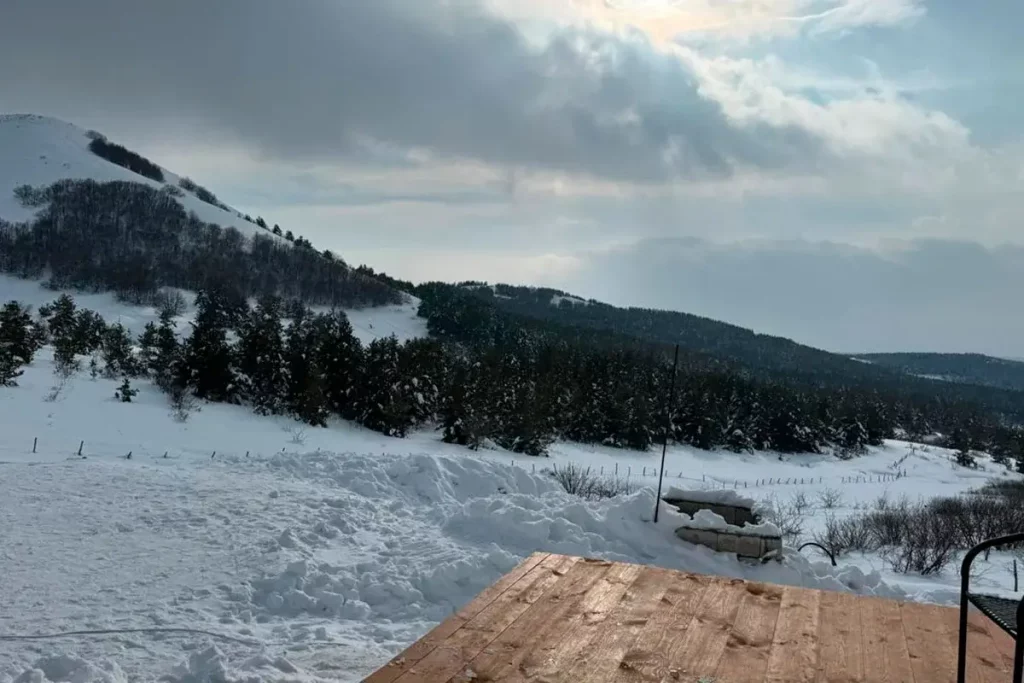
Myler Mountain Resort (Armenian: Մայլեր) is Armenia’s newest ski resort — a “greenfield” project on the western slopes of Mount Teghenis (2,851 m) in Aragatsotn Province, roughly 55 km and one hour north of Yerevan. On the eastern slopes of the same massif sits Tsaghkadzor, Armenia’s main and oldest ski resort. Myler is the ambitious younger sibling: designed by Ecosign, the Whistler-based Canadian firm behind dozens of Olympic and top-tier resorts worldwide, and equipped by the industry’s benchmark brands — Doppelmayr for the lifts, PistenBully for grooming, Demaclenko for snowmaking. The soft opening was in February 2024; the resort was officially inaugurated with a state ceremony in January 2025.
The current mountain has three main lifts — the six-seater Nare’s Express chairlift and the ten-seater Angeline 1 and Angeline 2 gondolas — climbing to a top station at 2,850 m. About 22 km of slopes are open across all four European difficulty grades (green, blue, red, black). By the completion of the master plan (2032–2035), Myler is projected to grow to roughly 102 km of runs and 17 lifts — the largest ski area in Armenia by a wide margin. For now, the appeal is a mix of modern hardware, low crowds, and panoramic views of Mount Aragats (4,090 m), Armenia’s highest peak, from the top of the gondolas.
The vision — a greenfield resort by Ecosign
Myler is what mountain-resort planners call a “greenfield” project — built from nothing, on a bare mountain, to a master plan drafted by the same firm that designed Whistler Blackcomb. The client’s mandate to Ecosign Mountain Resort Planners in 2022 was to identify the best location in the whole of Armenia for a new year-round mountain resort. Ecosign’s team ran a satellite-mapping “Golden Analysis” of the country, narrowed to three finalists, and picked Yeghipatrush on the western slopes of Mount Teghenis. The reasons were straightforward: best skiing terrain, room to build a full resort village, and under an hour’s drive from Yerevan.
Construction of Phase 1 began in 2022. The soft opening — the first paying skiers welcomed on the mountain — was February 20, 2024. The resort was officially inaugurated with a state ceremony on January 13, 2025. Phase 1 today includes three lifts, a magic carpet, 22 km of trails, snowmaking across the full vertical, six restaurants across the mountain and base village, and the developing base area. Subsequent phases through 2032–2035 will bring the resort to a projected ~102 km of trails and 17 lifts — putting Myler in the same size class as European mid-tier destinations and making it, by design, the flagship ski resort of the Caucasus.
The initial investment is €60 million (€34 million of it in lifts alone), and the developer’s stated ambition is to compete regionally with Gudauri (Georgia) in the short term and Sochi at completion. Peak-season target capacity: 6,000 skiers simultaneously.
Lifts and slopes
Phase 1 of Myler runs on three main lifts plus magic carpets for the learning zone:
Nare’s Express — a six-seater high-speed detachable chairlift by Doppelmayr, 2,040 metres long, carrying skiers from the base area at ~2,000 m to the mid-mountain at ~2,400 m. Capacity 2,400 passengers per hour, speed up to 6.5 m/s. Named after the Armenian goddess Nar. This was the lift that unlocked upper-mountain skiing when it opened in the 2023–24 season.
Angeline 1 and Angeline 2 — ten-seater gondola cabins, launched 2024, extending access to the top station at 2,850 m. The gondolas make the mountain comfortable for non-skiers who want to reach the panorama, and they open the full vertical for advanced riders. From the top station, visitors can enjoy panoramic views of Mount Aragats, Mount Ara and the surrounding highlands.
Magic carpets — conveyor lifts in the beginner’s zone, essential for children’s classes.
The trails. About 22 km of prepared runs across the four European difficulty grades — green (learner), blue (easy), red (intermediate), and black (advanced). Black runs are limited in Phase 1; more challenging terrain arrives with each subsequent build phase. Vertical drop from top to base is ~900 m. The snowmaking system by Demaclenko covers the entire vertical — with guns from the top of the gondolas down to the base village. This helps the resort maintain more consistent ski conditions during mild winters, when natural snow cover can be variable.
For freeride and ski touring, the terrain around Mount Teghenis is nearly untracked — the resort’s low visitor numbers mean fresh lines are the norm rather than the exception. Guides can be arranged through the resort or from Yerevan-based clubs.
Season and conditions
The ski season runs December through April, with January and February the peak weeks.
- December. Opening month. Snowmaking is running full time; natural snow accumulates through the month. Trails are open but the base can be thin in early December.
- January–February. Peak season. Maximum natural snow, stable low temperatures (–5 to –12 °C at the top station on average days), best coverage.
- March. Long daylight, mild afternoons, softer snow — the best month for beginners, families with children, and photographers.
- April. Season winds down. The base slopes lose their snow first; the upper mountain often stays open into mid-April.
Weekdays are notably quieter than weekends. The resort becomes much busier with visitors from Yerevan on Fridays and Saturdays, especially during school holidays; from Monday through Thursday, lift queues are usually much shorter.
Non-ski season. Ecosign designed Myler as a year-round destination. Summer brings hiking, paragliding, helicopter tours over the massif and Aragats, mountain biking, and events at the base village.
What to bring
Rentals are available on the mountain — Rossignol, Fischer, and Head are official partners — but supply runs tight on weekends, especially children’s sizes. If you can, bring your own or reserve rentals in advance.
Recommended packing:
- Ski or snowboard kit (skis/board, boots, poles)
- Helmet — required for children, strongly recommended for adults
- Goggles — the top station gets very bright with the reflection off snow
- Membrane jacket and trousers, thermal base layers, gloves
- SPF 50 sunscreen — UV levels at 2,850 m are much stronger than at valley elevation, and snow reflection amplifies exposure
- Water bottle — dry mountain air dehydrates quickly
- Cards and some cash — ski passes and restaurants take cards; small vendors sometimes take only Armenian drams
Where to eat
Phase 1 currently operates six restaurants across the mountain and base village. Rather than a single ski-canteen model, Myler is developing a hospitality-platform format — the resort partners with different Armenian restaurant brands to open on the mountain.
Taq Tegh — the main base-village restaurant, wide terrace with slope views.
Sar Tegh 2400 — mid-station restaurant at ~2,400 m, opened after Nare’s Express began running. Views over the ski area.
Velvet and Amnesia — signature Armenian dining, added in more recent seasons; substantial menus rather than skier fuel.
Two more restaurants have opened in the base village as the resort scales. Budget 4,000–8,000 AMD per person for a mid-mountain lunch, more at the signature restaurants. Reservations are advisable on weekends.
Accommodation on the mountain is still limited — some guesthouses and chalets in Yeghipatrush village and adjacent hamlets. Many visitors treat Myler as a day trip from Yerevan given the short drive.
What to see near Myler
The road from Yerevan to Myler runs through historic Aragatsotn — Armenia’s northwestern province, dense with early-Christian and medieval landmarks. If you are making a day of it, several places sit close enough to justify a stop:
Aparan Reservoir — a large artificial lake 5 km from the resort, popular for weekend picnics and fishing.
Kasakh Basilica in Aparan — a 4th-century early-Christian basilica, one of the oldest surviving churches in Armenia, roughly 7 km from Myler.
Armenian Alphabet Monument at Artashavan — 39 large carved stones, one for each letter of the Armenian alphabet, arranged in a field near the road to Mount Aragats. Created for the 1600th anniversary of the alphabet in 2005 (invented in AD 405 by Mesrop Mashtots).
Saghmosavank Monastery — a 13th-century monastic complex on the edge of the Kasakh Gorge, spectacular clifftop position.
Lake Kari — a small alpine lake on the flank of Mount Aragats at 3,207 m, adjacent to the historic Byurakan cosmic-ray research station. Summer only — the road is closed in winter.
Mount Aragats itself — Armenia’s highest peak at 4,090 m, with four summits crowning an extinct volcano; the massif is visible from every part of the Myler trail network.
The neighbouring ski resort — Tsaghkadzor — sits on the eastern slopes of the same Tsakhkunyats massif, about 30 km as the crow flies and roughly 1 hour 20 minutes by road. Skiing both in the same trip is realistic.
Myler vs Tsaghkadzor — which to pick
Two resorts on opposite sides of the same mountain, and they have grown into distinct personalities.
Tsaghkadzor is Armenia’s flagship: the oldest and most famous ski resort in the country, with the deepest infrastructure (dozens of hotels, restaurants across town, town centre nightlife) and a rich resort history — the Soviet Olympic training base was here in the 1960s. Kecharis Monastery — the 11th-century monastic ensemble founded by Grigor Magistros Pahlavuni — sits five minutes from the lifts. Weekends are busy; queues at the main gondola are common.
Myler is the modern challenger: newer lifts, wider groomed slopes, quieter ski areas, and a modern snowmaking system covering much of the resort. The base village is small; nightlife is minimal; the resort is deliberately future-oriented rather than heritage-rich. Advantages: fewer people, cutting-edge equipment, and the most spectacular views of Mount Aragats in Armenian skiing.
Pick Myler if you value modern hardware, low crowds, learning terrain, family days, and photographic mountain views. Pick Tsaghkadzor if you value proven infrastructure, town-centre atmosphere, monastery visits alongside skiing, and a wider choice of hotels and restaurants. Best of both: many visitors ski both on the same trip — the drive between the two resorts is 1.5 hours, comfortable as a two-centre week.
How to get from Yerevan to Myler
The route runs along the M-3 highway through Ashtarak and Aparan — asphalt the whole way, no mountain passes, and generally passable in winter with normal snow tyres.
By private car or by private transfer from Yerevan to Myler: the most comfortable option. Fixed-price pickup is available from your hotel in Yerevan or from Zvartnots Airport (around 62 km / about 1 hour to Myler). Vehicles are equipped with winter tyres during the ski season.
By car with driver in Yerevan: the most flexible option if you plan to combine Myler with Aparan Basilica, the Armenian Alphabet Monument, or Saghmosavank on the way back. A driver waits at the resort while you ski, then handles the return route through the sights.
By minibus rental: for groups of 6–19 skiers with equipment, this is the most cost-effective option.
By public transport: marshrutka minibuses go as far as Aparan from Yerevan’s northern bus station — from Aparan it is another ~7 km by taxi to Yeghipatrush and the resort. Workable but time-consuming, especially with ski gear.
Frequently Asked Questions
Myler is one entry in Armenia’s broader network of spa, ski, and mountain retreats. Browse the full list at resorts in Armenia, which also covers Aghveran, Arzni, Jermuk, Tsaghkadzor, Dilijan, Hankavan, and Yenokavan. To combine Myler with sightseeing across the country, see day tours from Yerevan or the full list of things to do in Armenia.