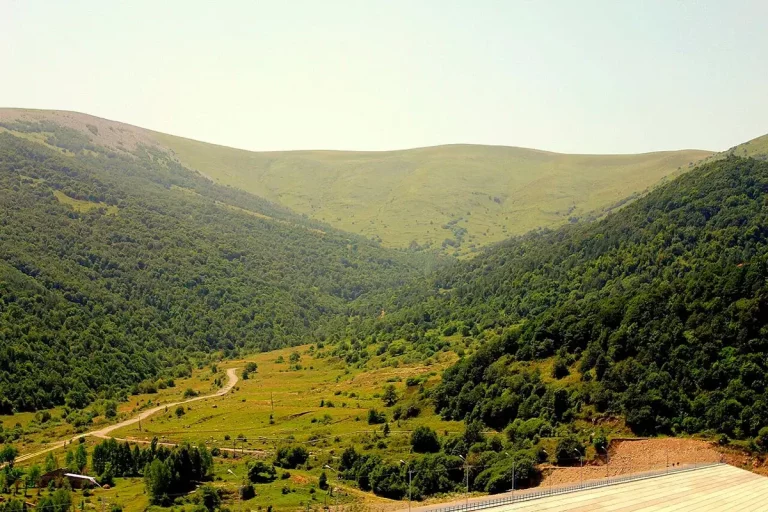

Bjni Fortress
Bjni Fortress (Armenian: Բջնի բերդ) is a medieval Armenian stronghold built in the 9th–10th centuries on a basalt mesa above the Hrazdan river gorge in the village of Bjni, Kotayk Province — 50 km north-east of Yerevan. The fortress was the seat of the Pahlavuni princely house — one of the most influential noble families of medieval Armenia — and the birthplace of the 11th-century polymath Grigor Magistros Pahlavuni, the same scholar whose name is bound up with the academies at Sanahin and Kecharis further north.
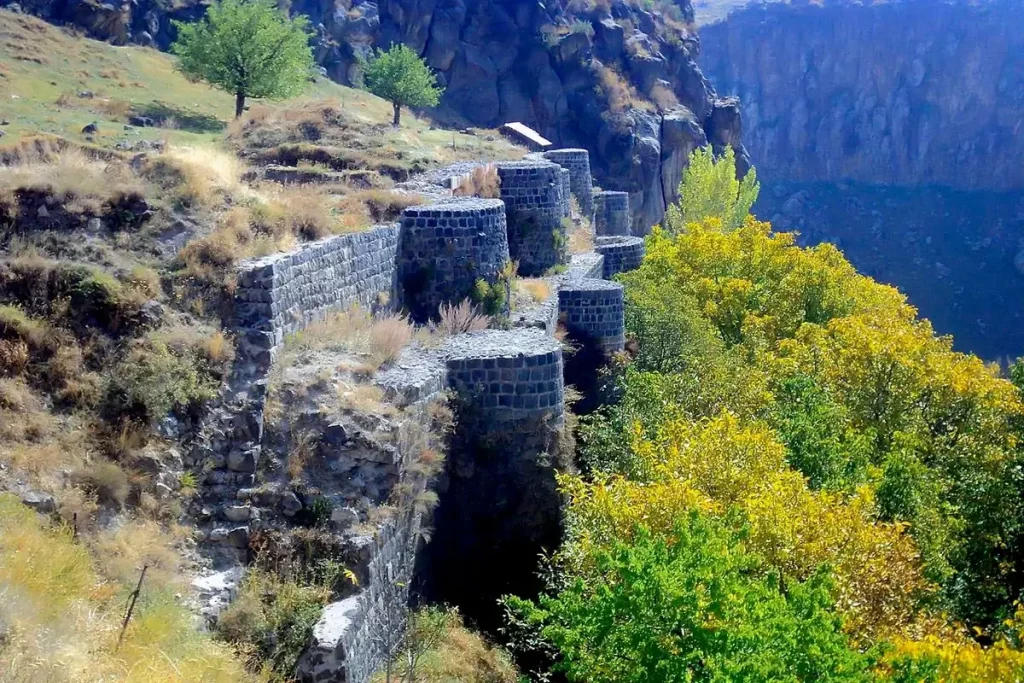
Unlike Geghard or Garni a short drive south, Bjni is not set up for tourism: no ticket office, no fences, no souvenir stalls. Sections of the 12–15-metre basalt walls still stand on the rim of the mesa, two semicircular towers survive, a vaulted cistern remains intact inside the upper enclosure, and a covered passage runs down toward the river. The lack of infrastructure is the point — it is one of the calmest medieval sites within an hour of Yerevan, and one of the very few where the visit is genuinely on the visitor’s own terms.
Quick Facts
- Built / Founded: 9th–10th c.
- Location: Bjni village, Kotayk Province
- Also known as: Bjni Fortress, Bzhni Fortress, Bjni Castle, Bjni Berd, Բջնի բերդ
- From Yerevan: ~50 min/50 km
- Elevation: 1504
- Entrance fee: Free
- Time needed: 1.5–2 hours
- Best time to visit: May to October
- Status: preserved ruins
- GPS coordinates:
40.4606576, 44.653638
A short history: from Ghazar Parpetsi to Tamerlane
The village of Bjni is mentioned in writing as early as the 5th–6th centuries by the Armenian historian Ghazar Parpetsi in his History of the Armenians. The mesa above the village had probably been fortified since at least the 5th century — the stone foundations of an early Christian church on the plateau confirm that this was already a consecrated and defended place.
The fortress as we see it today is the work of the Pahlavuni princely house. In the 10th century, Lord Vasak Holum Pahlavuni — described in medieval Armenian sources as commander-in-chief of the Bagratid armies — rebuilt the ancient defences into a serious fortress city. Bjni became one of the strongholds in the northern defensive system protecting the Bagratid capital at Ani. The 12th-century historian Matthew of Edessa (Matteos Urhayetsi) describes the 1021 raid of Daylami mercenary cavalry into Bjni’s hinterland — one of the first recorded Turkic incursions into Armenia.
In 1031 Vasak’s son, the great Armenian scholar Grigor Magistros Pahlavuni (990–1058), built the church of Surb Astvatsatsin (Holy Mother of God) in the village below the fortress. Bjni became Grigor Magistros’s centre of operations: a regional estate, a school, and the heart of a network that extended north to his academy at Sanahin Monastery and to the foundation of Kecharis Monastery in nearby Tsaghkadzor.
In 1066, four decades after the construction of the fortress church, the election of the Catholicos of All Armenians was held at Bjni — one of the few times in medieval Armenian history that this great church council convened outside Etchmiadzin. After the fall of the Bagratid kingdom in 1045, the surrounding estates passed temporarily to Byzantium; in 1072 Bjni was captured by Seljuk Turks and granted to the Shaddadids. At the beginning of the 13th century, the brothers Zakare and Ivane Zakaryan — the same princes whose patronage would soon shape Harichavank and the cathedral at Hovhannavank — liberated Bjni and made it Ivane Zakaryan’s official residence.
The end came in 1387–1388, when Tamerlane (Timur Lenk) sacked the village and the fortress and killed the bishop, according to the chronicler Thomas of Metsoph. By the 16th–17th centuries, with the rise of gunpowder artillery, the fortress lost its military value and was abandoned.
The Pahlavuni network: Bjni at its centre
For visitors familiar with the rest of medieval Armenia, Bjni is the geographic anchor of a wider story. The Pahlavuni princely house claimed descent from the Arsacid line of St. Gregory the Illuminator himself, and over the 10th–11th centuries its members shaped some of the most important Armenian monuments still standing:
- Bjni Fortress (9th–10th c.) — rebuilt by Vasak Pahlavuni as the family seat.
- The Surb Astvatsatsin church in Bjni (1031) — built by Grigor Magistros Pahlavuni, Vasak’s son, the polymath born here.
- Marmashen Monastery in Shirak (988–1029) — built by Vahram Pahlavuni, the sparapet (commander-in-chief) of the Bagratid kingdom, the same patron also responsible for the Vahramashen church at Amberd Fortress (1026).
- Kecharis Monastery (1033) — founded by Grigor Magistros, 30 km north of Bjni in Tsaghkadzor.
- The academy at Sanahin Monastery (11th c.) — Grigor Magistros’s teaching base in Lori, the most influential Armenian school of its century.
Putting all five sites together, Bjni is not just an isolated ruin — it is the home plateau of the family whose work shaped four marz of medieval Armenia.
What remains today
The fortress occupies a basalt mesa about 200 metres long, divided into a Larger (Upper) and a Smaller (Lower) enclosure 10–15 metres apart in elevation. The southern, eastern and partly western flanks are protected by sheer cliffs; the north and west required built defences. Today you can see:
- The north and west walls — about 120 metres long, 12–15 metres high, of dark basalt set in lime mortar. Sections are largely intact; others have collapsed into the mesa edge.
- Two semicircular towers flanking the northern walls — characteristic of 10th–13th-century Armenian military architecture.
- A vaulted stone cistern in the Upper Fortress — a long-siege water reservoir, with its barrel vault still intact.
- A fragment of a covered passage on the south-western face of the Lower Fortress — leading down toward the river. Legend tells of a longer underground passage running from the fortress all the way to the church of Surb Astvatsatsin in the village; only this short fragment has been confirmed archaeologically.
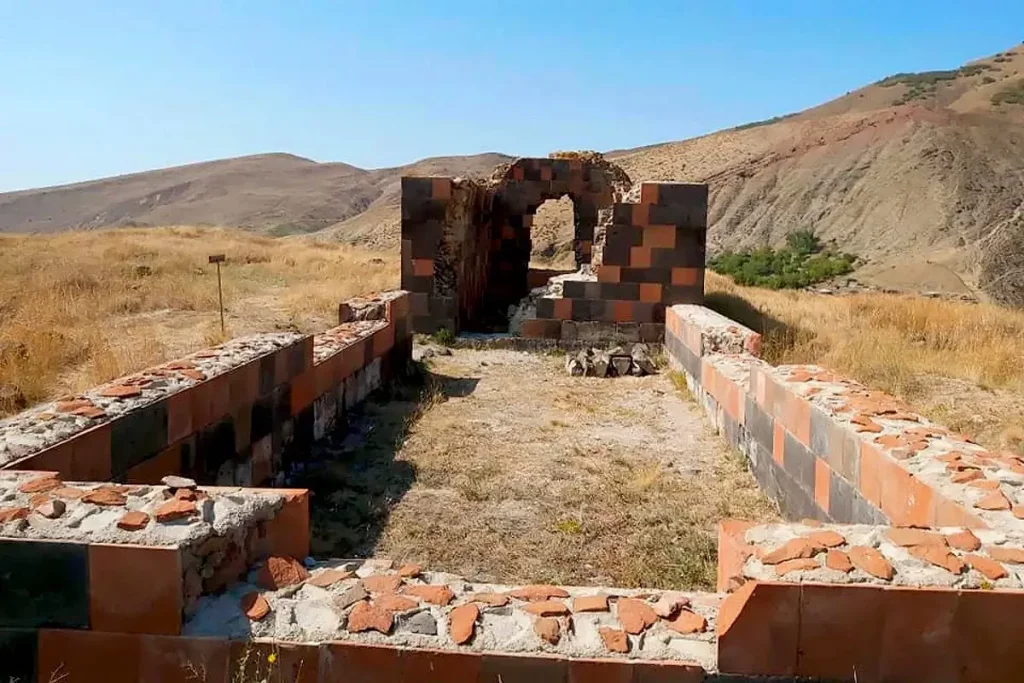
- Foundations of inner buildings — depressions in the ground mark where residential and service buildings once stood, including a partly-rebuilt medieval church on the plateau.
- The 5th-century church foundation — beneath later layers, archaeologists identified the footprint of an early Christian church, evidence that the mesa was sacred before it was militarised.
- The view — north over the Hrazdan canyon and the Tsaghkadzor mountains, south over the village below. This view, more than the walls themselves, is what most visitors remember.
Safety note: the site is not fenced. The drops from the mesa edge are sheer and the unmarked path runs close to them in places. With small children, keep them on the inner side of the trail; in wet weather the basalt becomes slippery.
Surb Astvatsatsin (1031): Grigor Magistros’s church
Down in the village, 700 metres west of the mesa, stands the Surb Astvatsatsin (“Holy Mother of God”) church built by Grigor Magistros Pahlavuni in 1031. It is a small domed church of dressed tuff with a single nave; its walls carry several medieval inscriptions, including a building dedication from Grigor Magistros himself. The most curious feature of the interior is a series of cantilevered stone shelves running along the walls at a height of about 5 metres — apparently designed to shelter the church’s manuscripts at a level out of reach of damp floors and casual readers. The library furniture of an 11th-century scriptorium is preserved in stone
The other churches and the Holey Stone
Bjni village holds several other monuments well worth the short walk between them:
- Surb Sarkis (7th century) — a tiny cruciform domed church on a rock outcrop east of the mesa. Said to be the smallest church of its type anywhere in Armenia, built of pink tuff. Easy to miss; ask any local for Surb Sargis.
- Surb Gevorg (13th century) — a small parish church with 16th–18th-century khachkars built into its walls.
- Tsakqar (“Holey Stone”) — a natural arch in the rock a short distance from the village. A spring beneath it is said in folk tradition to be cold enough to power seven mills without freezing in winter — an old riddle for the village.
- Bjni mineral water springs — the source of the well-known Bjni brand mineral water, sold across Armenia in distinctive blue bottles.
How to get to Bjni Fortress from Yerevan
Bjni is 50 km north-east of Yerevan on the M4 highway — the same road that leads to Tsaghkadzor, Sevan and Dilijan. The drive takes about 50 minutes by car. The village is accessed by an asphalt road, but the final approach to the fortress itself is on a dirt track that can soften after rain. The cleanest approach is to park at the fork below the mesa and walk the last 10–15 minutes up on foot. Take the right fork of the trail — the left one ends at a private plot.
A summary of options:
| Option | Time | Notes |
|---|---|---|
| Car with driver | ~50 min | Pickup at hotel; can combine with Tsaghkadzor, Kecharis, Garni, Geghard, or use as a stop on the Sevan / Dilijan route |
| Taxi / ride app | ~50 min | Fine for the outbound leg; arranging the return ride from Bjni is harder, ask the driver to wait |
| Marshrutka to Hrazdan + taxi | ~1.5–2 h | Budget option; with one transfer, no fixed schedule on the second leg |
A car with driver in Yerevan is the simplest option for most travellers, especially if combining Bjni with Tsaghkadzor or Garni–Geghard in the same day.
Practical tips on site
- Plan 1.5–2 hours for the fortress and the views. Half a day if you include Surb Astvatsatsin and a sit-down lunch in the village. A full day combines Bjni with Tsaghkadzor or Garni–Geghard.
- Sturdy shoes — basalt is unforgiving, and the dirt approach has loose stones.
- A windbreaker — the mesa is exposed, and even in midsummer there is usually a strong upper-valley wind.
- Water and a snack — no shops or cafés at the fortress itself; the nearest are in the village.
- The toilets are at the village cafés; nothing at the site itself.
- Mobile reception is reliable on Team and Ucom networks.
- Emergency number: Armenia uses 112.
- Best season: May to October. Spring brings wildflowers and green grass over the mesa; autumn the long view to the Tsaghkadzor mountains in colour. Winter is doable in dry weather but the dirt road becomes slippery after snow.
What to see nearby
- Surb Astvatsatsin Church (1031) — 700 m below the fortress, in the village.
- Surb Sarkis Church (7th c.) — Armenia’s smallest cruciform domed church, on a rock outcrop east of the mesa.
- Bjni mineral water springs — at the source of the well-known brand.
- Tsakqar / Holey Stone — natural rock arch a short walk from the village.
- Tsaghkadzor (~20 km) — winter ski resort with the Wings of Tsaghkadzor ropeway and the medieval Kecharis Monastery, founded by Grigor Magistros Pahlavuni in 1033.
- Hrazdan (~12 km) — the regional capital with a reservoir and viewpoints.
- Garni Temple and Geghard Monastery (~35 km south of Bjni, full day from Yerevan) — the standard Kotayk pairing.
Frequently asked questions
Bjni is the kind of site that does not appear on the standard half-day from Yerevan, and that is its quiet advantage: the basalt walls of the family seat from which an 11th-century Armenian polymath wrote his Letters, the spot where the Catholicos of All Armenians was elected in 1066, and a long-view terrace north over the Hrazdan to the Tsaghkadzor mountains — all reached on a dirt track without a ticket office in sight. The simplest way to fit it into a single day from the capital is with a private car and driver from Yerevan, pairing the fortress with Tsaghkadzor and Kecharis to the north or with Garni and Geghard to the south.