
Jermuk
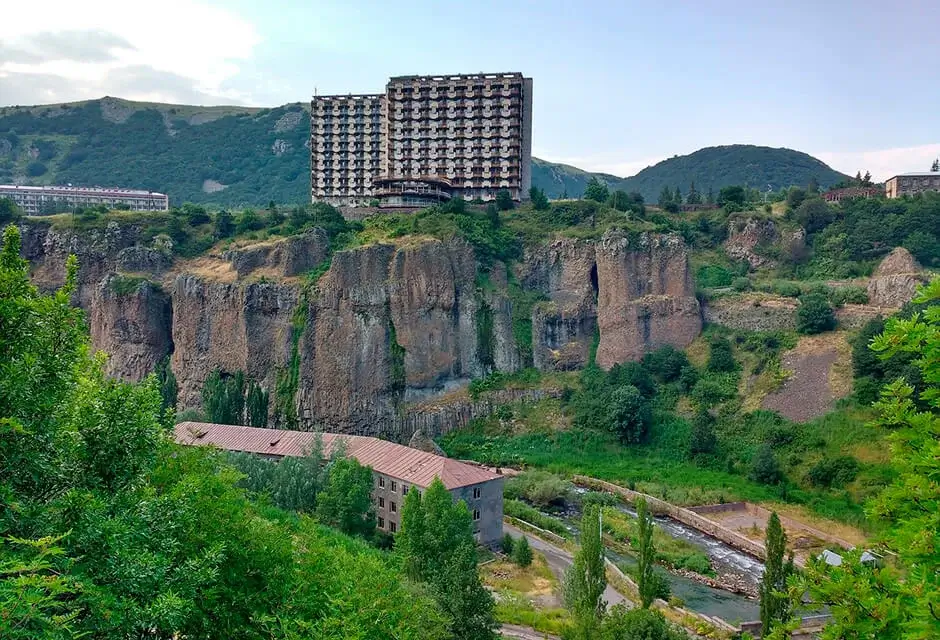
Jermuk (Armenian: Ջերմուկ — “warm spring”) is Armenia’s largest and best-known balneological resort, sitting on a plateau at 2,100 m in the Vayots Dzor Province, in the headwaters of the Arpa River, roughly 173 km and 3 hours south-east of Yerevan. The town is walled in on three sides by Syunik Range peaks rising to 3,000 m, and the Arpa Gorge cuts straight through the town centre, dividing it into two halves connected by an arched bridge. Jermuk’s foundation is its ~40 hot mineral springs, producing water at 57–64 °C with a daily flow of up to 2 million litres — a carbonated, bicarbonate-sulphate-sodium-siliceous chemistry that Soviet balneologists compared directly to the Sprudel spring of Karlovy Vary and to Russia’s Zheleznovodsk. The medicinal use of the springs is documented in the writings of the 13th-century Armenian chronicler Stepanos Orbelian, and older references go back to manuscripts from the 1st century BC.
Beyond the sanatoriums, Jermuk carries the most complete spa infrastructure in the country. The signature landmark is the 1956 Water Gallery — an open colonnaded pavilion designed by Gevorg Tamanyan, son of Alexander Tamanyan (author of Yerevan’s master plan) — where five stone urns dispense different mineral waters at temperatures from 30 to 53 °C, free to drink, 24 hours a day. Add the 68-metre Jermuk Waterfall (known locally as “Mermaid’s Hair”) in the Arpa gorge, the cable car up Mount Shish to 2,450 m with ski slopes in winter, and the 10th-century Gndevank Monastery eight kilometres down the road, and Jermuk stands out as the one Armenian resort that offers a full week’s programme without leaving the town limits.
What to See in Jermuk and Around
Jermuk and its surroundings combine waterfalls, mountain landscapes, reservoirs and medieval landmarks of Vayots Dzor Province. Explore the main places below, with separate detailed guides for planning each visit.
 Gndevank Monastery
 Herher Waterfall
 Jermuk Hot Springs (Geyser)
 Jermuk Mineral Water Gallery
 Jermuk Waterfall
 Kechut Reservoir
Other attractions in Jermuk
- Jermuk Art Gallery — a branch of the National Gallery of Armenia, established in 1972, with a permanent collection of about 100 paintings and sculptures by Armenian artists from the 1920s to the 1990s. Works by Martiros Saryan, Haroutiun Galentz, and Vahram Gaifejian are among the highlights. Located near the Arpa; the waterfall is a 10-minute walk through the back garden.
- Natural Stone Arch — a ~30-metre-wide natural rock arch on the outskirts of the town, an unusual geological formation and a favourite hiking objective.
- St Gayane Church — a modern parish church in the town centre.
- Deer Statue — a monumental sculpture of a deer on the ridge above the town, a nod to the founding legend: a wounded stag, so the story goes, threw itself into a hot spring and emerged healed — that same spring is now the source of Jermuk’s mineral water.
- Chess in Jermuk. Since the 2010s Jermuk has hosted several international chess tournaments, including FIDE circuits — a modern addition to the town’s identity that draws attention beyond the traditional wellness crowd.
Geography and climate
Jermuk sits on a high plateau in Armenia’s south-east, in the upper valley of the Arpa River just before it drops into the Kechut basin and continues west toward the Aras. The Vayk Range rises to the south; the Syunik Range rises to the north-east; the two together form an amphitheatre of mountains around the town, with peaks reaching 3,000 m. The Arpa Gorge — deep, forested, and dramatic — runs directly through the town centre, so a walk between hotels often involves crossing the arched road bridge that links the two halves of the town.
The elevation of 2,100 m puts Jermuk into the alpine climate zone. Summer daytime highs average +20 °C — a substantial refuge from Yerevan’s +38 °C in July. Winter averages –7 °C with generous snow cover from mid-December through March, sheltered from wind, and unusually sunny for the region. Fog is rare. The combination of altitude, sunshine, and dry mountain air is part of the resort’s therapeutic reputation on its own — patients were traditionally prescribed Jermuk’s climate as much as its waters.
The mineral waters and the Water Gallery
Jermuk’s identity as a resort rests on its carbonated thermal mineral waters — waters that Soviet balneologists directly compared to the Sprudel spring at Karlovy Vary in the Czech Republic and to Russia’s Zheleznovodsk.
The springs
Around 40 hot springs rise in and around the town, some as self-flowing artesian wells, some as capped taps. Source temperature ranges from 57 °C to 64 °C. Combined daily flow reaches roughly 2 million litres — enough to supply the sanatoriums, the Water Gallery, and the national “Jermuk” bottling plant from the same aquifer.
Chemical composition: carbonated, bicarbonate-sulphate-sodium-siliceous, with fluorine, iodine, bromine, calcium, magnesium, potassium, and trace lithium — the latter cited as one of the water’s distinguishing therapeutic markers. The composition profile is what earned the direct Karlovy Vary comparison.
Documented indications at the Soviet-era sanatoriums and today’s spa facilities: chronic gastritis, peptic ulcers of the stomach and duodenum, cholecystitis, diabetes, chronic liver and biliary tract disorders, hepatitis, chronic pancreatitis, kidney and urinary tract conditions, obesity, gout, iron-deficiency anaemia, nervous system disorders and depressive states, musculoskeletal conditions.
Treatments offered: drinking cures, mineral baths (whole-body and four-chamber), inhalation therapy, dental and gynaecological irrigations, intestinal irrigation, and full physiotherapy suites.
The Water Gallery — Jermuk’s signature landmark
The town’s postcard image is the Gallery of Mineral Waters, built in 1956 by Gevorg Tamanyan — the son of Alexander Tamanyan, the architect who designed the master plan of Yerevan in the 1920s. The gallery is an open colonnaded pavilion, walled on one side and open to a small artificial lake on the other — beige stone, classical arches, monumental in the “Stalinist Empire” idiom outside and reading like an ancient Greek temple inside. Five stone urns, sculpted like classical amphorae, receive water piped in from the springs. Each urn dispenses water of a different mineral composition and temperature, from 30 °C to 53 °C, arranged so the temperatures cool as you walk along the corridor.
The gallery is free and open 24 hours a day. Locals arrive with reusable bottles and cups; visitors are welcome to try each of the five waters (cups can be bought on the spot). The colourful mineral layers built up on the inside of the urns give a visible history of the spring chemistry. Behind the gallery, the small Seven Springs Lake reflects the pavilion — a classic Jermuk photograph in every season.
The geysers — bathing under the stars
On the outskirts of Jermuk, in less accessible terrain, are the open thermal springs that locals call the “geysers” — natural hot springs at 32–56 °C where visitors bathe outdoors, year-round. The water is carbonated with a total mineralisation of about 4.78 g/l. Reaching them requires either a 4×4 or a walking approach on rougher paths — ask at your hotel or driver. In winter, the experience is the resort’s most striking: soaking in +50 °C mineral water at –10 °C air temperature, surrounded by snow.
Gndevank Monastery — 10th-century treasure
Eight kilometres south of Jermuk, in the village of Gndevaz, stands Gndevank Monastery — a well-preserved 10th-century Armenian Apostolic complex on a dramatic ledge above the Arpa River. The main church was founded around AD 936; adjacent chapels, a gavit, and a khachkar field followed over the next three centuries. Interior wall reliefs, khachkars, and inscriptions are largely intact. The monastery still runs an active apiary — the monks (a small resident community) keep hives on the surrounding alpine slopes, and wildflower honey is available for purchase directly on site. It is one of Vayots Dzor’s most valuable historical sites.
Reaching the monastery: ~15 minutes’ drive from Jermuk on the H43 road, along the Arpa gorge. The HikeArmenia app publishes a marked “Gndevank Trail” for the walking route through the canyon — a strong half-day outing.
Cable car and ski slopes
A Leitner cable car (Austria) opened in 2007 rises from the western edge of Jermuk to the flank of Mount Shish (2,850 m), with the upper station at 2,450 m. Two cabins carry roughly 200 passengers per hour combined. The ride takes about ten minutes and delivers a panoramic view over the Arpa gorge, the town, and the surrounding ranges.
In winter (mid-December to end of March) — the upper station is the launching point for two ski runs of different difficulty grades. Rental for skis and snowboards is available at the base. The runs are modest in scale (nothing like Tsaghkadzor or Myler), but the combination of skiing + thermal baths in a single afternoon is the specific reason many visitors choose Jermuk in winter.
Cable car hours: daily 10:00–19:00, subject to weather and season. Confirm on the day.
Sanatoriums and where to stay
Jermuk is a town of sanatoriums — dozens of properties, many restored Soviet-era facilities and several newer international-standard developments.
Sanatoriums with full treatment programmes
Jermuk Armenia — 300 m from the Water Gallery. Balneocentre with mineral baths, physiotherapy, massage, drinking cures. One of the largest and best-known.
Olimpia — recently renovated to modern standards. A popular choice for treatment holidays.
Jermuk Ashkhar — “Country Jermuk,” home to the largest treatment base among the sanatoriums.
Ararat — specialised in mother-and-child treatment programmes.
Modern spa hotels
Jermuk Hotel & SPA — opened 2019, built to international standards. Spacious rooms with robes and tropical showers; two-floor balneocentre offering mineral baths (whole-body and four-chamber), inhalations, irrigations, and doctor consultations.
Guesthouses and private accommodation
A range of family-run guesthouses and private-sector rentals fills the middle and budget tiers.
Treatment without accommodation. Most sanatoriums offer their balneological services to day guests — you can arrive for a bath, an inhalation, or a course of drinking treatments without booking a room. This is the flexible option for travellers passing through.
Restaurants at the hotels serve Armenian and European cuisine; the local wine and brandy along the road from Areni are a fixture of any evening in Jermuk.
History
Jermuk’s use as a healing site goes back to antiquity. References to the springs appear in manuscripts from the 1st century BC; the 13th-century chronicler Stepanos Orbelian, in his history of Syunik, records the reputation of the waters and the noble travellers who visited them. Locals built stone bathing pools long before formal resort development — the pattern of hot-spring bathing was well established here for centuries.
The modern resort began in the 1920s, when the physician Levon Hovhannisyan brought the Jermuk springs to the attention of Soviet health authorities. In 1925, the first scientific expedition arrived to study the waters. The chemical similarity to Karlovy Vary was documented; sanatoriums, medical facilities, and infrastructure followed. The Water Gallery (Gevorg Tamanyan) opened in 1956. Through the mid-20th century Jermuk became one of the most popular resorts in the entire Soviet Union, drawing Soviet leadership and prominent public figures for treatment stays.
The cable car to Mount Shish opened in 2007, adding skiing to the resort’s summer-and-treatment programme.
Best time to visit Jermuk
Year-round destination — Jermuk changes character with the season, but it never really has an off-season.
- December–March for the ski + spa combination. Snow is reliable from mid-December; the cable car is running; skiing in the morning, mineral bath in the afternoon, hotel restaurant in the evening.
- April–May for the fullest waterfall, alpine wildflowers, and quieter shoulder rates. Cool temperatures — bring layers.
- June–September for hiking, sightseeing, and the coolest refuge from Yerevan’s heat. All facilities open; the Water Gallery is a beloved summer-evening stroll.
- October for golden foliage in the Arpa gorge and the last mild weekends before winter mode.
For treatment stays — any season works. The sanatoriums operate year-round, and the winter atmosphere of the town is genuinely restorative in itself.
How to get from Yerevan to Jermuk
Jermuk sits 173 km south-east of Yerevan — a 3-hour drive on paved road through Yeghegnadzor and turning up into the mountains at Vayk. From Zvartnots International Airport it is roughly 180 km / 3.5 hours.
By private transfer: for a direct trip without changes, you can book a Yerevan to Jermuk transfer with pickup from your hotel, apartment or another address in Yerevan. The driver will take you directly to your hotel, sanatorium or another agreed address in Jermuk. Stops at Areni, Noravank or other places along the way can be arranged in advance.
By car with driver in Yerevan: the most flexible option if you plan to combine Jermuk with Noravank, Areni-1 Cave, Tatev Monastery, or Khndzoresk on the same trip.
By minibus rental: for groups of 6–19 planning a treatment stay or ski weekend.
By public transport: marshrutka minibuses run from Yerevan’s Kilikia bus station to Jermuk. The journey takes roughly 3.5–4 hours with stops. Workable but not scenic; a private transfer with photo stops is a much better use of the drive.
Onward from Jermuk: the M-2 highway continues south to Sisian, Goris, and the aerial tramway to Tatev Monastery — the “Wings of Tatev” gondola is 120 km south, about 2 hours.
Frequently Asked Questions
Jermuk is one entry in Armenia’s broader network of spa, ski, and mountain retreats. Browse the full list at resorts in Armenia, which also covers Hankavan, Aghveran, Arzni, Myler Mountain Resort, Yenokavan, Lastiver, Tsaghkadzor, and Dilijan. To combine Jermuk with sightseeing across the country, see day tours from Yerevan or the full list of things to do in Armenia.