

Aghveran
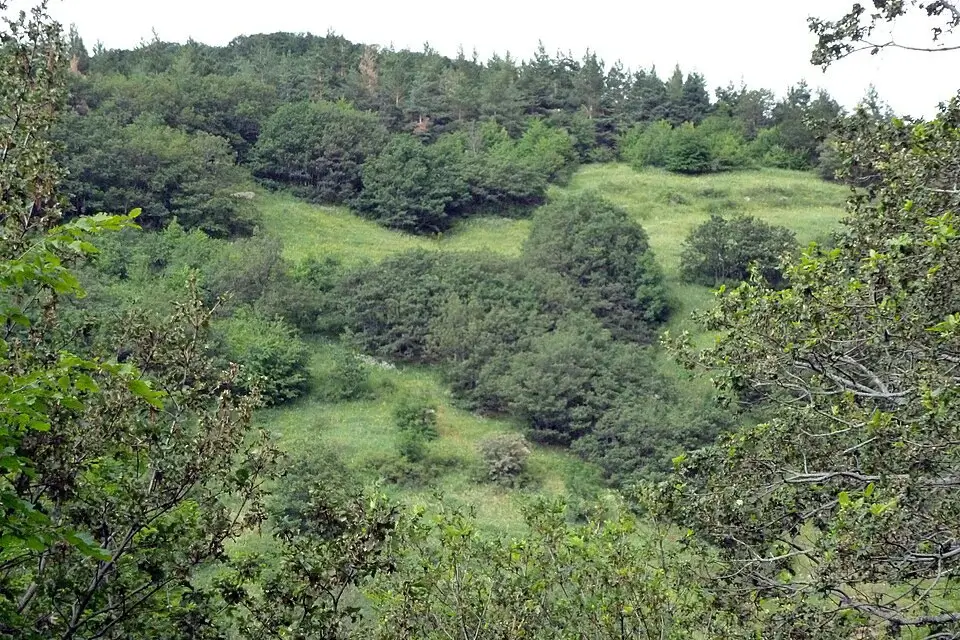
Aghveran (Armenian: Աղվերան) is a mountain climatic and balneological resort in the Kotayk Province of Armenia, set in the Dalar River valley at 1,550 m above sea level in the foothills of the Tsakhkunyats mountains, roughly 55 km and one hour from Yerevan. Administratively it belongs to the village of Arzakan, and it is one of the quietest destinations in the country — dense conifer forest, alpine meadows dotted with Red Book endemics, thermal mineral springs, and air so clean it registers physically after the drive up from the capital. Summers rarely climb above +23 °C in July; winters sit around –6 to –8 °C with generous snow.
Aghveran built its reputation in the Soviet era as a health-and-rest destination — the healing qualities of the local carbonated waters were already documented then, and the resort was popular among visitors from Moscow, Leningrad, and Tbilisi. Today it works as both a spa retreat and a launch point for the wider Kotayk region: within a 15–25-minute drive are the medieval Bjni Fortress, the Neghuts Monastery (10th–11th century), and the ski slopes of Tsaghkadzor. From Yerevan it is roughly a day trip or a weekend base — cool in summer, snowbound in winter, therapeutic all year.
Geography and climate
Aghveran sits in a narrow forested valley cut by the Dalar River, a right-bank tributary of the Hrazdan, which flows for 14 km before joining the main river. The valley is walled in by the Tsakhkunyats mountains on the west and northwest — a densely wooded ridge that peaks at Teghenis Mountain (2,851 m) — and by the smaller Tsakhkunyats plateau on the east. That geometry gives Aghveran its two defining features: shelter from wind and year-round humidity kept in by the forest cover.
At 1,550 metres, Aghveran is high enough for the climate to shift entirely from Yerevan’s baseline. When the capital is baking at +38 °C in July, the Dalar valley hovers at +20 to +23 °C, and evenings genuinely need a jacket. Winter is cold but not extreme — daytime highs usually stay above –8 °C, with heavy snow between December and March. Precipitation is heaviest in April, May, and November; summer is mostly dry with occasional afternoon thunderstorms rolling off the ridges.
Air quality in Aghveran is a big part of the draw. The nearest industry sits kilometres away in Charentsavan and Hrazdan; the wooded corridor filters air arriving from those valleys; and the height keeps particulate levels lower than in the Ararat basin. Soviet-era balneological literature listed Aghveran’s air as a therapeutic factor in its own right.
Thermal springs and the balneological tradition
Aghveran’s identity as a health resort rests on three overlapping factors: mountain air, mineral waters, and a sheltered valley microclimate. All three were already being marketed in the 1950s when the first sanatoriums opened, and the tradition continues in today’s spa hotels
The mineral water comes from a ~498-metre-deep source shared with the neighbouring village of Arzakan. Its composition is carbonated, hydrocarbonate–sulphate–chloride, sodium–potassium — a profile local literature has repeatedly compared to the celebrated Vichy waters of central France. Medical indications documented at Soviet-era sanatoriums include disorders of the digestive tract, metabolic disorders, and allergy prophylaxis. The waters are used for balneological baths, drinking cures, and physiotherapy.
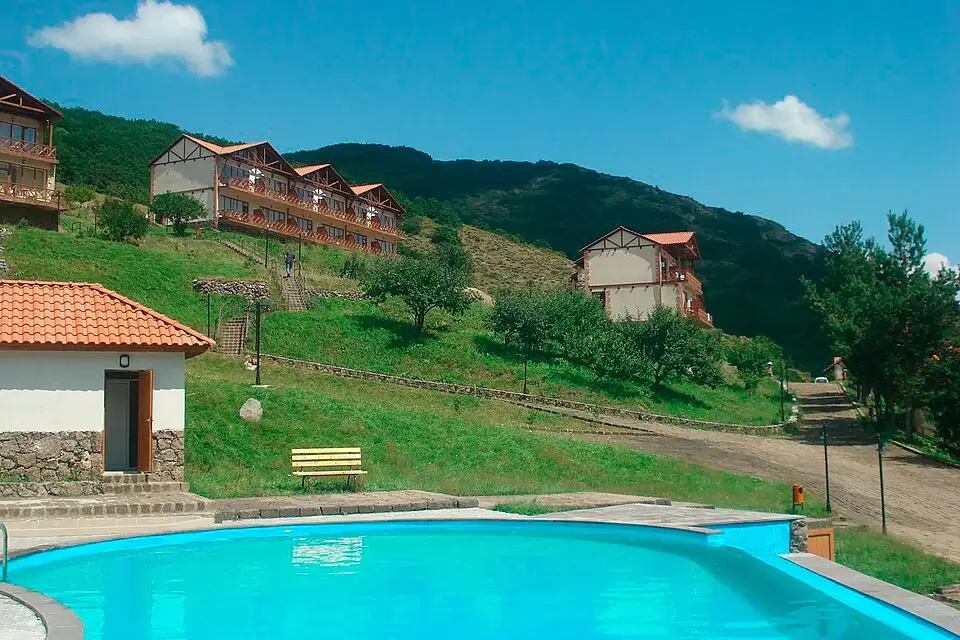
Today’s format is different from the classic sanatorium. Rather than a single central institution, spa services are distributed across the resort’s larger hotels — indoor thermal pools, saunas, hammams, massage rooms, and physiotherapy suites are standard in the four-star properties. Guests who want a doctor-supervised course of treatment can still find it; guests who just want a warm pool and a mountain view are the majority.
If you are travelling from Yerevan for a spa day, note that all the serious treatment facilities are inside the hotels — there is no municipal thermal bath complex in Aghveran itself. Book a day pass with one of the resorts (Best Resort Aghveran, Park Resort, or Arthurs are the standard choices).
What to do in summer
Aghveran’s summer season runs June through September, and it draws a very specific crowd: Yerevan families escaping the heat, occasional groups of Iranian visitors, and travellers who have added a couple of days of forest and mountains to a classic Armenia loop. Days are unhurried by design.
- Hiking. Trails climb through beech and hornbeam forest onto the Tsakhkunyats ridge. The signature route is the ascent to Tsakhkunyats Lake at 2,450 m (about 3.6 km northeast of the resort, 2–3 hours up with a local guide or GPS — the trail is not signed).
- Horseback riding. Several hotels offer guided rides through the forest and along the Dalar riverbank.
- ATV and quad-bike tours. Mid-difficulty routes over the ridge and into neighbouring valleys.
- Cycling. The paved road down to Bjni is a scenic descent; the return climb is the workout.
- Panda Park. A rope-course adventure park with beginner-to-advanced routes, popular with families.
- Riverside barbecue. Most hotels have covered picnic pavilions along the Dalar with grills, tables, and drinking water — a beloved Armenian weekend format.
- Court sports. Tennis, volleyball, and small-sided football fields at the larger resorts.
Book weekends in advance from mid-June to late August — Aghveran fills up with Yerevanis, and the four-star rooms sell out weeks ahead.
What to do in winter
Winter turns Aghveran into a snow-covered mountain village. Snow typically arrives in December and stays until March. Because temperatures rarely fall below –10 °C, this is a comfortable winter destination — cold enough for atmosphere, mild enough to enjoy.
- Skiing and snowboarding. Aghveran itself has beginner slopes near the larger hotels. For serious skiing, the Tsaghkadzor ski resort sits 25 km away (~25 minutes by car): 15 pistes, ~30 km of runs, and the modern Leitner gondola climbing Mount Teghenis to 2,819 m.
- Snowshoeing and winter hiking. The forest paths above the resort are perfect for it; guides can be arranged through hotels.
- Indoor pools and spa. All four-star hotels run their indoor pools and thermal facilities year-round — a strong argument for winter itself.
- New Year in the mountains. The larger resorts run holiday programmes with dinners, live music, and children’s entertainment, and December 31 – January 7 is the peak week of the winter season.
What to see near Aghveran
Aghveran’s compact geography makes it easy to combine spa time with real sightseeing. Everything on this list is within a 20-minute drive.
Neghuts Monastery (Neghuts Vank)
The ruins of a 10th–11th-century monastic complex on a hilltop about 1 km northwest of Arzakan — a domed church of Surb Astvatsatsin (Holy Mother of God), a large narthex with four freestanding columns, and a separate chapel. The dome and southern wall of the main church are partly collapsed, but the eastern facade preserves the classic Armenian triangular niches, and the narthex ceiling is crowned by a six-arched interlocking dome — a signature detail of medieval Armenian architecture. Thirteenth-century inscriptions survive on the narthex walls, and the site is surrounded by an old cemetery with khachkars. In the medieval period, Arzakan was known as Artavazdakan. Neghuts holds Republic-level heritage status.
Bjni Fortress
Around 15 minutes down the valley sits Bjni Fortress — one of the most spectacular medieval strongholds in central Armenia, perched on a rocky promontory above the Hrazdan gorge. Founded in the early medieval period and rebuilt in the 10th century by the Pahlavuni princes, its walls rise 12–15 metres, doubled in two concentric rings, and are still complete enough to walk. The prominent scholar-prince Grigor Magistros Pahlavuni built the Surb Astvatsatsin Church here in 1031 as the seat of the “Magistros Lyceum,” an important centre of medieval Armenian learning. The fortress passed to the Zakarian dynasty in the 13th century, was damaged by Timur’s campaigns in 1387–1388, and was abandoned in the 17th century. The view over the Hrazdan gorge from the fortress edge is the reason most visitors linger. The village of Bjni is also home to the springs feeding “Bjni” mineral water — one of Armenia’s best-known bottled brands.
Ghuk (Bolorahar) Monastery
An Armenian Apostolic church about 3–4 km northwest of Arzakan, deep in a forested ravine between two ridges. The monastery gained prominence in the 12th century under Grigor III Pahlavuni, son of Grigor Magistros and Catholicos of All Armenians. The walk in from the road takes 30–40 minutes through pristine forest — the approach is itself part of the experience.
Tsakhkunyats Lake
A small glacial-fed mountain lake on the eastern slope of the Tsakhkunyats range, sitting at 2,427–2,450 m, 3.6 km northeast of Aghveran. The lake has no inflowing river — it is filled entirely by snowmelt and rain. On a still day the water is clear enough to see stones on the bottom. In winter it freezes over. The hike up from Aghveran is a medium-difficulty 2–3-hour climb with strong finishing views over the Tsakhkunyats ridge. Recommended with a guide — the trail is not well marked.
Kecharis Monastery in Tsaghkadzor
Twenty-five kilometres to the east, in the ski resort of Tsaghkadzor, stands Kecharis Monastery — the 11th–13th-century complex founded by the same Grigor Magistros Pahlavuni who fortified Bjni. Four churches, two chapels, a gavit, and a khachkar field. The Pahlavuni patronage links Aghveran, Bjni, and Kecharis into a coherent one-day route.
Best time to visit Aghveran
June to September for cool-weather escapes from the Yerevan summer and full access to hiking. December to March for snow, ski trips to Tsaghkadzor, and holiday atmosphere. April, May, October, and November for spa-focused stays — quieter, cheaper, and comfortable for indoor thermal facilities. There is no bad season for Aghveran, only different ones.
If you are coming primarily for hiking to Tsakhkunyats Lake, aim for late June through September — the trail is snow-free and the lake is at its clearest.
How to get from Yerevan to Aghveran
Aghveran is one of the easier resort destinations to reach from Yerevan — a single main road through Charentsavan and Hrazdan, ~55 km, roughly an hour.
By private car or transfer: the simplest option. The road is paved throughout, but the final stretch turns mountainous — in winter, chains are advisable. Fixed price, direct pickup from your Yerevan hotel or from Zvartnots Airport (12 km west of Yerevan, ~70 km from Aghveran, ~1.5 hours).
By hotel transfer: most Aghveran resorts arrange transfers from Yerevan at booking — check with the property directly when reserving.
By car with driver in Yerevan: the most flexible option if you plan to combine Aghveran with Bjni, Tsaghkadzor, or Sevan. The classic day route is Yerevan → Bjni Fortress → Aghveran (lunch, thermal pool) → Tsaghkadzor (Kecharis Monastery, cable car in season) → back to Yerevan.
Public transport: minibuses (marshrutka) run from Yerevan’s northern bus station toward Arzakan, but service is sparse and requires transfers. For a weekend stay with luggage, transfer or car with driver is a much smoother option.
Frequently Asked Questions
Aghveran is one entry in Armenia’s broader network of spa, ski, and mountain retreats. Browse the full list at resorts in Armenia, which also covers Jermuk, Tsaghkadzor, Dilijan, Arzni, Hankavan, Yenokavan, and the lakeside stays around Sevan. To combine Aghveran with sightseeing across the country, see day tours from Yerevan or the full list of things to do in Armenia.