Kecharis Monastery
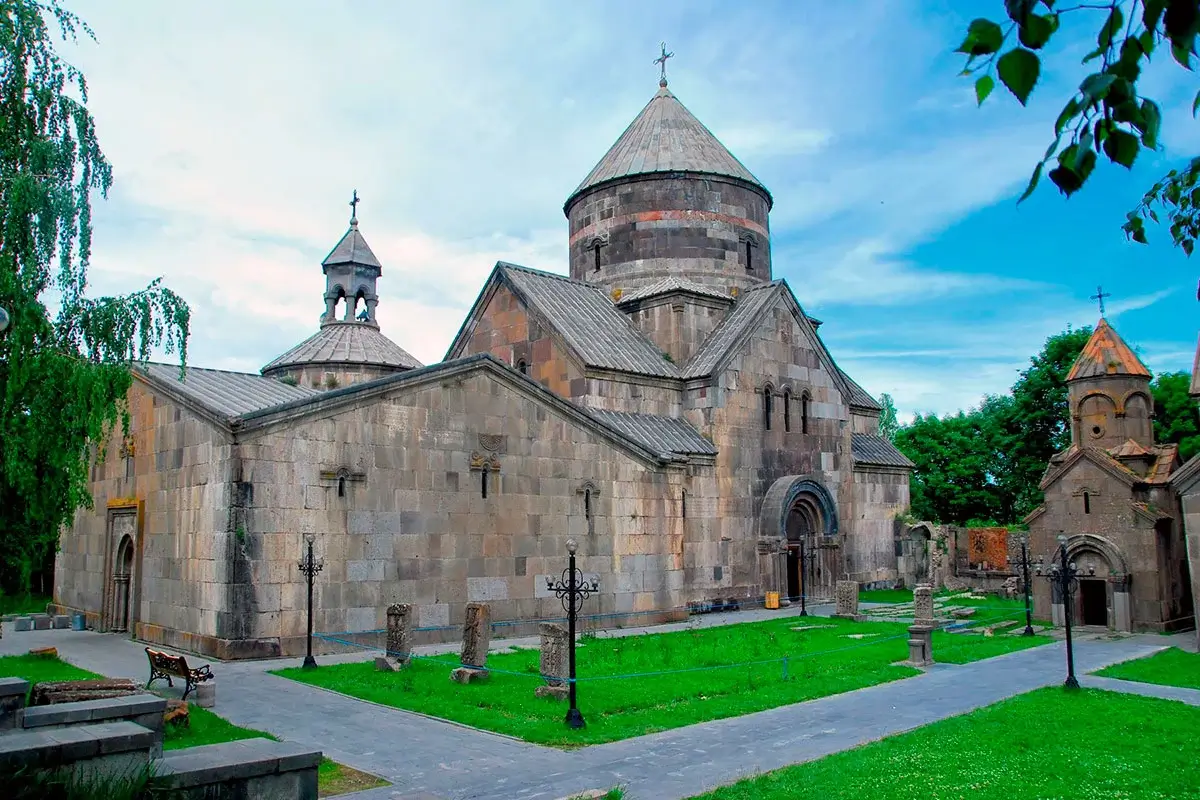
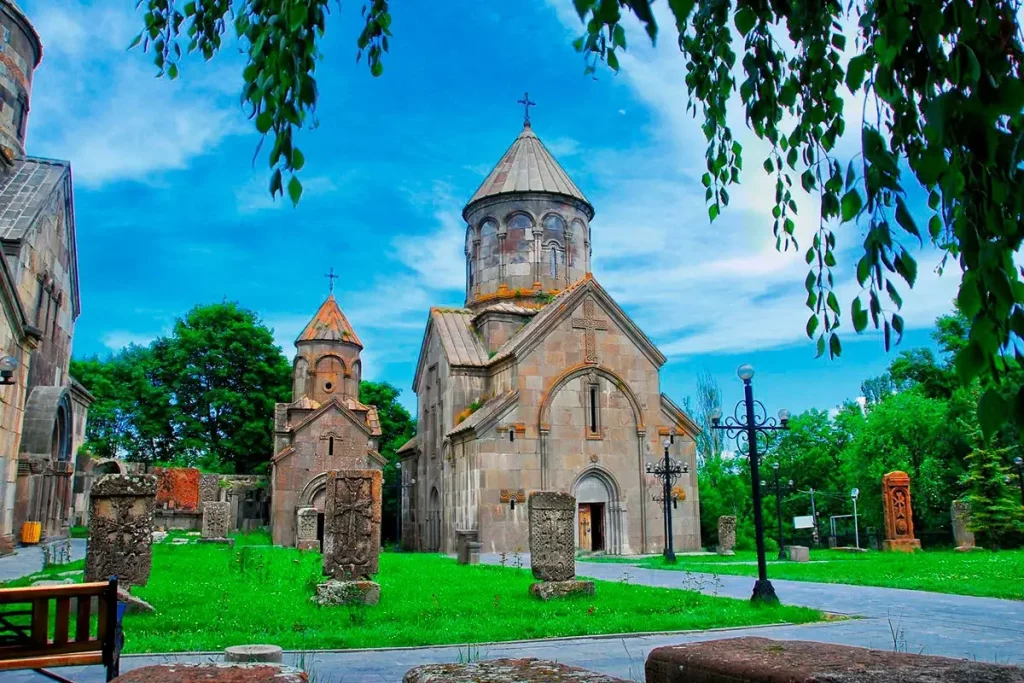
Kecharis Monastery (Armenian: Կեչառիսի վանք) is a medieval Armenian monastic complex of the 11th–13th centuries, built on a forested terrace above the town of Tsaghkadzor on the slope of the Pambak Ridge, 60 km north of Yerevan. Unlike the more dramatic Geghard or Tatev, Kecharis is a small, quiet ensemble — four stone churches, two chapels, and a scattering of medieval khachkars set among pine trees, with the ski slopes of Mount Teghenis rising directly behind it. Most visitors come not for sweeping mountain drama but for a calm 30-minute walk through one of the best-preserved monastic complexes in the Kotayk region, usually combined with the Tsaghkadzor ropeway and a continuation on to Lake Sevan or Dilijan.
Quick Facts
- Built / Founded: 11th–13th c.
- Location: Tsaghkadzor, Kotayk Province
- Also known as: Kecharis Monastery, Kecharuk, Կեչառիսի վանք, Կեչառիս
- From Yerevan: 60 km (50–70 min by car)
- Elevation: ~1,850 m
- Entrance fee: Free
- Time needed: 30–40 minutes
- Status: Active monastery
- GPS coordinates:
40.5338516, 44.7159767
A short history: Pahlavuni princes, earthquakes and revival
Kecharis was founded in the early 11th century by Grigor Magistros Pahlavuni (990–1058) — one of the great figures of medieval Armenian culture: scholar, philosopher, poet, military commander and statesman. He built the first and largest church of the complex, St. Gregory the Illuminator (Surb Grigor Lusavorich), which an inscription above the southern portal dates to 1033. Some historians have argued for an earlier completion date around 1013, based on the figures mentioned in that inscription; in any case, the church belongs to the first half of the 11th century. The chapel adjoining it became Grigor Magistros’s burial vault.
Through the 12th and 13th centuries Kecharis grew into one of the most important religious and educational centres of medieval Armenia, supported in its later phase by the Khaghbakyan (Proshyan) noble family. New buildings continued to rise: St. Nshan Church in 1051, the Katoghike Holy Mother of God Church between 1203 and 1214 (commissioned by Vasak Khaghbakyan and built by the architect Vetsik), and the small St. Harutyun (Resurrection) Church in 1220, set about 120 m west of the main group as a burial place for the abbots. Prince Prosh, founder of the Proshyan dynasty, was buried here in 1284, and at the end of the 13th century the abbot Khachatur Kecharetsi founded a monastic school whose pupils are still mentioned in manuscripts copied at other Armenian monasteries.
Like much of medieval Armenian heritage, Kecharis suffered through Seljuk and Mongol invasions, was abandoned in the 18th century, and badly damaged in the 1828 earthquake. The domes of the two main churches collapsed in another earthquake in 1927. Restoration began in the Soviet 1980s, was interrupted by the 1988 Spitak earthquake and the collapse of the USSR, and finally resumed in 1998 with funding from the Vienna-based Armenian benefactor Vladimir Harutyunian. The monastery was re-consecrated on 9 July 2000 by Catholicos Garegin II, and today serves as the seat of the Kotayk Diocese.
The four churches and their khachkars
The main group of buildings stands on a small terrace above the town and reads, in effect, as a layered diagram of medieval Armenian architecture:
- St. Gregory the Illuminator (1033, the largest church) — a domed-hall church typical of Armenia’s high feudal period. The interior is divided into three bays by two pairs of pilasters, with the central space crowned by a cupola on spherical pendentives. The original cupola fell in the 1927 earthquake and was rebuilt in 2000.
- St. Nshan (1051) — a small cross-winged domed church directly south of St. Gregory, traditionally also attributed to Grigor Magistros Pahlavuni.
- The Katoghike Holy Mother of God Church (1203–1214) — the most decorated of the four, built by the architect Vetsik with the patronage of Vasak Khaghbakyan. It is notable for its slim silhouette, fine carved rosettes, ornamental friezes, and detailed portal — the work of a high-skilled 13th-century workshop.
- St. Harutyun (Resurrection) Church (1220) — a small rectangular church about 120 m west of the main group, with an unusual floor plan; it served as a burial chapel for the monastery’s abbots.
Between and around the buildings stand around thirty khachkars — Armenian carved cross-stones — dating from the 11th to the 17th centuries, with the finest examples from the 12th and 13th. One of them is the memorial khachkar of the architect Vetsik, raised by his fellow architects.
Best viewpoints and photo spots
- From the upper terrace near the parking lot — all four churches in a single frame against the gorge below.
- At the Katoghike portal — the 13th-century stone carving photographs best in soft side light.
- From the town below — a wide view of the monastery on its forested terrace, especially atmospheric in winter snow.
A practical tip: visit before 11:00 or after 16:00. At midday the dark stone tends to flatten in the harsh overhead light; in softer side light the textures of the walls and khachkars come to life.
How to get to Kecharis Monastery from Yerevan
From Yerevan the drive is 60 km on the M4 highway towards Sevan, with a short turn-off and 7 km of mountain road up to Tsaghkadzor — typically 50–70 minutes door-to-door. The road is paved all the way to the monastery and accessible by ordinary car in any season.
By public transport, minibuses (marshrutkas) leave from the Azatutyan Avenue bus station in Yerevan and reach Tsaghkadzor in about 1h 15min for 500–1,500 AMD. From the town centre it is a 700-metre walk uphill — about 10–15 minutes — to the monastery. The last return marshrutka usually leaves around 18:00; check locally on the day if you want to spend the afternoon at the ropeway.
For a flexible day trip that combines Kecharis with the Tsaghkadzor ropeway and Lake Sevan, the easiest option is to book a Yerevan – Tsaghkadzor transfer or hire a car with driver in Yerevan — the driver waits at each stop and lets you set the pace.
When to visit
- Summer (June–August) — the best months in terms of access. At 1,850 m elevation Kecharis stays at a comfortable +20…+25 °C even when Yerevan hits 38 °C. Pine forests, shaded paths, lots of day-trippers in peak weeks.
- Autumn (September–October) — the strongest photo season. Tsaghkadzor means “Gorge of Flowers” but in autumn the forested slope around the monastery turns copper and gold. Clear air, long visibility.
- Winter (December–March) — the most atmospheric option. The monastery sits under snow, the ski resort is in full operation a few hundred metres above, and the churches against the snowy pines look like a 19th-century etching. The churches are not heated, so dress warmly.
- Spring (April–May) — a transitional season. Snow may linger in shaded corners of the monastery into mid-May and the weather is unsettled. The compensation is the smallest crowds of the year.
Practical tips on site
- Kecharis is an active monastery — keep voices low, particularly during services.
- Women are not required to cover their hair, but a headscarf is appreciated.
- Photography is allowed inside the churches, but without flash.
- There are no toilets or cafés on the monastery grounds; the nearest are in the centre of Tsaghkadzor, 700 m below.
- Small stalls near the parking lot sell khachkar replicas and souvenirs at noticeably tourist prices — the same items are cheaper at the Vernissage market in Yerevan.
What to see nearby
Kecharis is rarely visited on its own — it almost always sits inside a larger Tsaghkadzor / Sevan / Dilijan itinerary from Yerevan:
- Tsaghkadzor ropeway — a five-minute walk from the monastery. From its top station at 2,819 m on Mount Teghenis the view stretches to Lake Sevan, Mount Aragats, and, on the clearest days, Mount Ararat. Works year-round.
- Lake Sevan — 35 km away. The classic “Kecharis + Sevan” half-day route is one of the most popular trips from Yerevan.
- Dilijan and the surrounding monasteries — about 70–80 km. A full-day route can take in Tsaghkadzor → Lake Sevan → Dilijan → Haghartsin or Goshavank.
- Bjni Fortress — a medieval fortress on a basalt mesa, about 25 km from Tsaghkadzor, often combined for travellers with extra time in Kotayk.
Frequently asked questions
Kecharis is one of those Armenian monasteries that does not try to compete with the more famous UNESCO sites — it is smaller, calmer, and easier to take in than Tatev or Geghard. What it offers is a clean, four-century arc of medieval Armenian architecture in a single courtyard, an active monastic life that has continued for almost a thousand years, and a forested setting that ties the day naturally to the Tsaghkadzor ropeway and to Lake Sevan beyond. The easiest way to fit it into a single day from the capital is with a Yerevan – Tsaghkadzor transfer or a private car and driver in Yerevan.