

Lastiver
Lastiver (Armenian: Լաստիվեր) is a ~100-metre-deep forested canyon on the Khachaghbyur River in Armenia’s Tavush Province — three kilometres below the village of Yenokavan and roughly 140 km north of Yerevan. The name in Armenian means “up on the raft” — from last (raft) and ver (up) — a reference to the medieval cave shelter high on the canyon wall that locals reached by hauling logs stacked in a raft-like ladder, or, in another version of the story, by sitting on a plank pulled up by ropes while shouting “lastn ver!” (“pull the raft up!”). During the 13th–14th-century Mongol invasions the population sheltered in the cave, and the memory of the raft-ladder gave the whole canyon its name.
Today Lastiver is the natural companion to Yenokavan — the plateau resort sits on the canyon rim, and the canyon floor holds everything the resort’s guests come to see: the two-storey Anapat cave shelter with its striking wall reliefs, a cascade of waterfalls on the Khachaghbyur at around 1,116 m elevation, and a rustic tree-house camp along the river. Getting there is a 3–3.5 km hike through virgin oak, beech, and hornbeam forest — one of Armenia’s most-photographed trails. Bears, badgers, and lynx live in the surrounding woods; the water is clean enough to swim in.
Geography and etymology
Lastiver sits at the bottom of a narrow, steep-walled canyon carved by the Khachaghbyur River as it drains the Miapor Range toward the Aghstev valley. The canyon reaches roughly 100 metres deep, and the walls are draped in oak, beech, and hornbeam forest — the same broadleaf mix that gives Tavush its status as Armenia’s most heavily forested province. The canyon floor and waterfalls sit at around 1,116 m above sea level; Yenokavan village looks down from the rim at ~1,400 m.
The name. Armenian last (լաստ) means “raft”; ver (վեր) means “up.” One tradition traces the name to the raft-shaped ladder — logs lashed together like the deck of a raft — that villagers built up the sheer canyon wall to reach the cave shelter above. Another version imagines the villagers pulling refugees up on a plank while shouting “lastn ver!” — “pull the raft up!” Either origin gives you the same picture: a cliff-face refuge accessible only by improvised woodwork, memorised in the place-name.
The canyon and its cave were largely unknown to Armenian tourism until the early 2000s, when the first ecotourism enthusiasts began organising trips down from Yenokavan. Since then Lastiver has become one of the flagship photographs of Armenian tourism — a fixture on international “hidden gems” lists and one of the country’s most-Instagrammed sites.
The Anapat cave and its bas-reliefs
The centrepiece of Lastiver is the Anapat cave — a two-storey shelter cut into a nearly vertical wall of the canyon. Anapat (անապատ) in Armenian means both “desert” and, in monastic tradition, “hermitage” — a retreat where an ascetic could live outside the world. During the 13th–14th-century Mongol invasions the local Armenian population used the Anapat as a refuge, hauling themselves and their belongings up the cliff on the raft-ladder that gave the canyon its name. Fragments of a defensive stone wall at the cave’s entrance date from that period.
A myth worth correcting — when the reliefs were actually carved
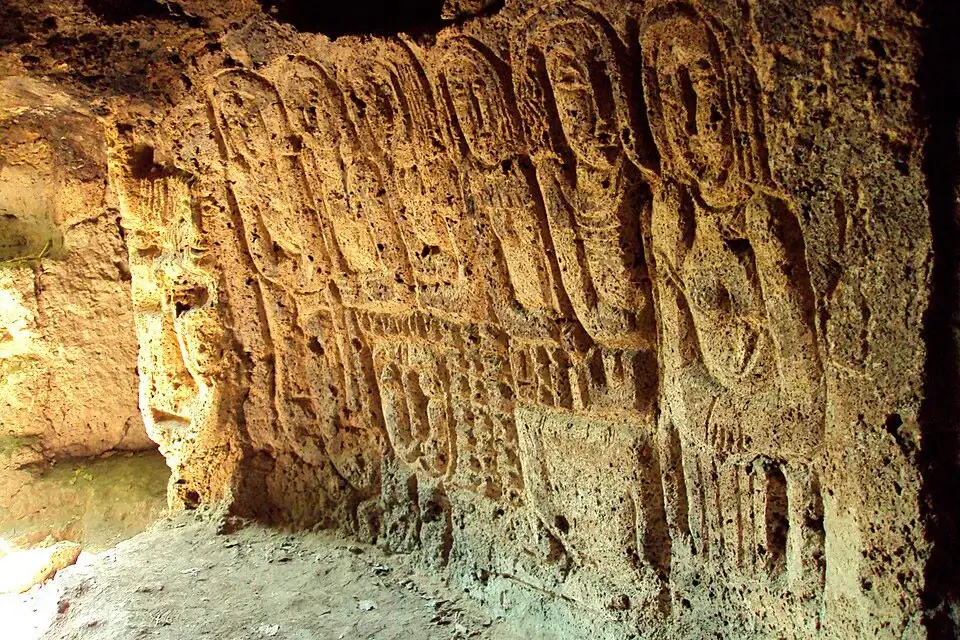
Walk into the Anapat cave and the first thing you notice are the bas-reliefs on the walls: a wedding scene with human figures, crosses, altars, a face here, a torso there. The style is striking enough that most visitors — and most travel-blog descriptions — assume the reliefs are medieval, coeval with the cave’s use as a Mongol-era refuge.
They are not.
The carvings were made in the 1970s by Soviet-Armenian sculptor Benik Petrosyan, who spent long stretches alone in the cave and slowly decorated its walls. The reliefs are extraordinary craftsmanship — beautifully preserved, atmospheric, and worth the hike — but they are the work of a 20th-century artist inspired by the setting, not a medieval carver. The confusion is understandable: the cave itself is genuinely medieval, the reliefs are worked in a timeless quasi-folk idiom, and virtually no signage tells the difference. This EN guide corrects the record.
Inside the cave, alongside the reliefs, is a small pond whose water level, according to local tradition, never changes — however much you draw, the pond replenishes itself. Whether the story is myth or a genuine spring aquifer is anyone’s guess; the atmosphere in the cave is exactly the atmosphere the story invites.
Other caves in the canyon
Beyond the Anapat, the canyon walls hide smaller cave chambers with rock-cut cells and stone platforms that may have been sleeping surfaces. Some walls carry very worn incised images that some observers describe as pre-Christian rock art — but formal archaeological documentation of these secondary caves is thin, and dating any of them is speculative.
The waterfalls of the Khachaghbyur
Just below the caves, the Khachaghbyur River drops through a cascade of small waterfalls — the noise reaches you before you see it. The falls sit at the canyon’s lowest point (~1,116 m), and between the drops are natural pools clear enough to see the pebbles on the bottom. In June through August, when the water is warm enough, the pools are used for swimming — the current is manageable, the water genuinely cold but tolerable in the summer heat, and the setting is difficult to overstate: cliff walls, mossy stones, moving water, unbroken forest.
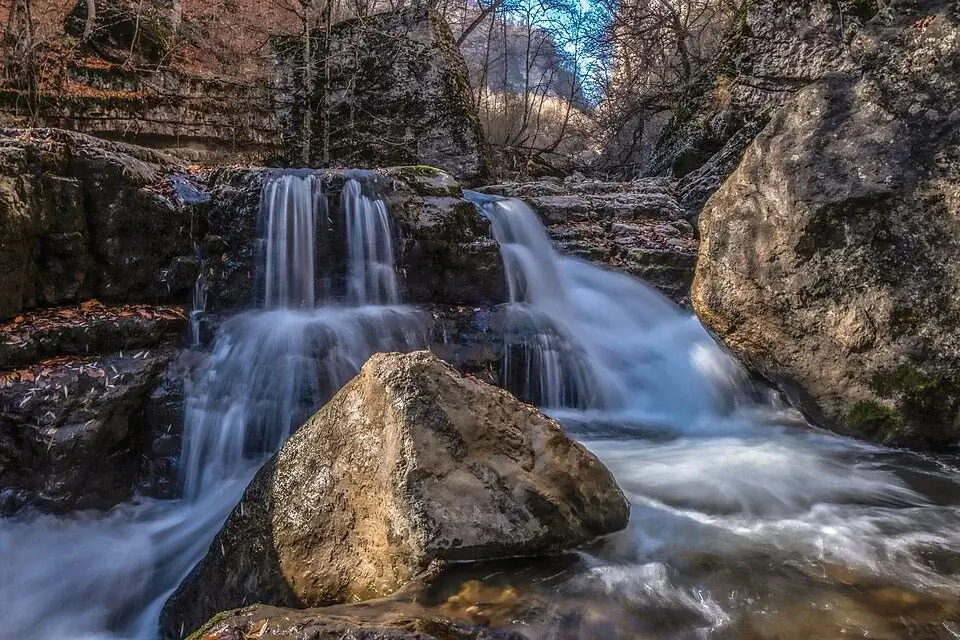
The Khachaghbyur is a tributary of the Aghstev, which itself flows east into Azerbaijan and eventually joins the Kura. Water in the upper Khachaghbyur is exceptionally clean and cold — springs feed it, farming and industry are minimal upstream, and the depth of forest cover keeps sediment low.
The hike from Yenokavan to Lastiver
The classic Lastiver visit is a hike from Yenokavan village or Apaga Resort down into the canyon and back — ~3–3.5 km one way, ~7 km round trip, 40–90 minutes per leg depending on pace.
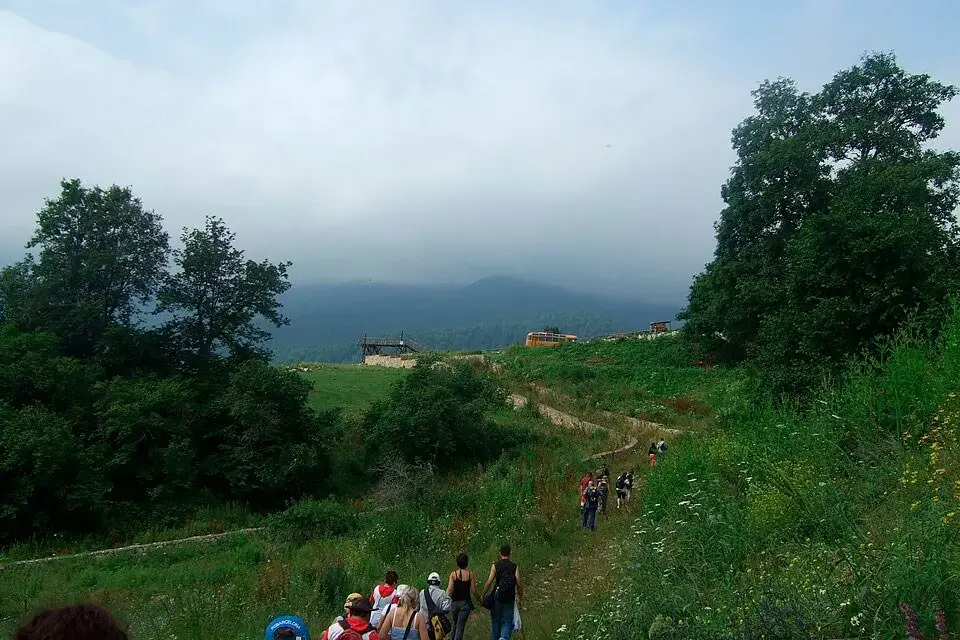
The trail. Descent through virgin deciduous forest — oak, beech, hornbeam. Wooden footbridges cross seasonal streams; natural stone steps drop through steeper sections; narrow passages squeeze between the cliff face and the drop-off (careful footing required but no technical difficulty). Along the way you pass tree houses high in the branches, wooden huts on the forest floor, and mountain springs pouring straight out of the rock.
Wildlife. Raccoons, badgers, foxes, and — very occasionally — lynx live in these woods. Bird song is constant. Snakes are rare in the immediate trail area but present in warm months. No known dangerous predators along the route.
Route summary. Yenokavan / Apaga Resort → forest trail → tree houses → Anapat cave → waterfalls → tent camp on the river.
What to bring:
- Hiking shoes with real grip — no sandals, no city sneakers. Sections get slippery after rain.
- Water and snacks — no shop on the trail; the camp sells basic drinks and food.
- Rain shell — Tavush weather changes quickly.
- Swimsuit in summer — the river pools are irresistible.
- Torch/headlamp if you plan to stay after dark.
Difficulty. Moderate. Doable by anyone in reasonable health; children from about 6–7 years old manage it comfortably with adult accompaniment.
Tree-house camp and where to stay
Lastiver tent camp — right on the canyon floor, along the Khachaghbyur, minutes from the cave and waterfalls. This is not a polished glamping site; it is a rustic camp, and that is what people come for. What is there:
- Tree-house cabins (open-slat wooden shelters raised into the trees, sleeping 2–4)
- Wooden platforms and huts along the riverbank
- Long timber tables for communal meals
- Fire pit with grills for khorovats (Armenian barbecue) over open coals
- Basic amenities: outdoor toilets, hand-wash stations, no on-site electricity for guests
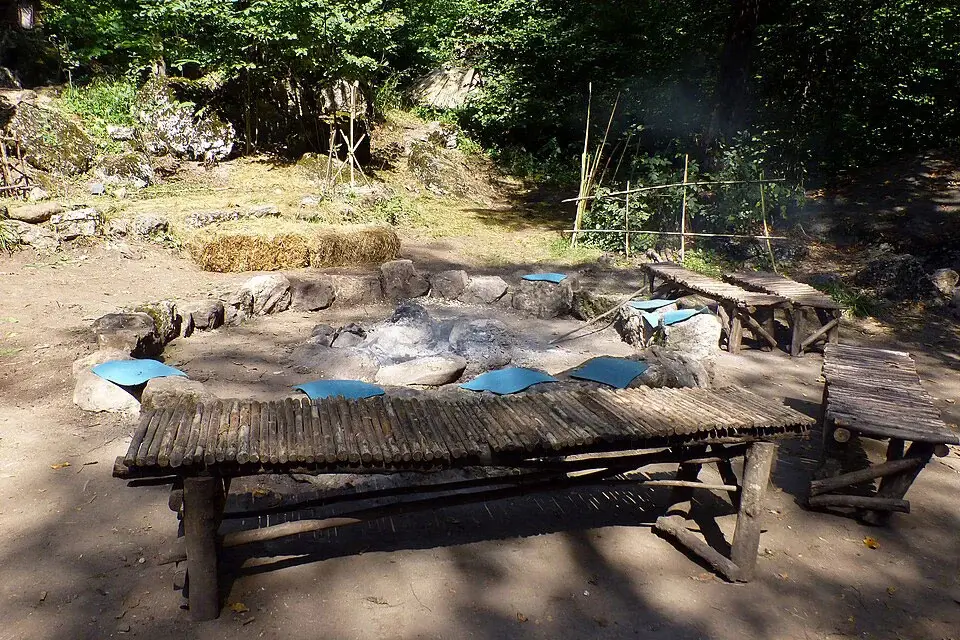
Rates: day entry to the camp around 1,000 AMD (~US$2.50); overnight from around 5,000 AMD (~US$12). Sleeping bag rental is available.
Plateau options (10–40 minutes up from the canyon):
- Apaga Resort — the main eco-hotel at Yenokavan (see the Yenokavan resort guide). Cottages, restaurant, 40-horse stable, adjoining Yell Extreme Park.
- Yenokavan Glamping — platform-tent glamping with canyon views.
- Lastiver Resort Yenokavan — a mid-scale hotel on the plateau with heated pool and 13 rooms, roughly 25 minutes’ walk from Yell Extreme Park. Not to be confused with the tent camp inside the canyon.
- Getahovit Resort and Hotel Doki — options in Ijevan (15 km) if resort options are full.
Weekends in July–August sell out 2–4 weeks in advance. Weekdays are quieter.
Nearby attractions
Lastiver sits in one of Armenia’s most attraction-dense provinces. Within an hour’s drive:
Makaravank Monastery (~30 min from Ijevan) — a 10th–13th-century monastic complex in pink andesite and red tuff, with some of Armenia’s most refined carved bas-reliefs — mythical creatures with human heads, fish, and a rare portrait of the medieval architect with his tools. Frequently compared with Noravank and Gandzasar for architectural quality. Almost no tourists.
Ijevan (~15 km) — the provincial capital: wine and brandy factory with tastings, Ijevan Dendropark of introduced trees and shrubs, nine bridges across the Aghstev.
Dilijan (~45 km) — “Armenia’s Switzerland”: national park, Old Town, and the monasteries of Haghartsin and Goshavank.
Lake Sevan (~90 km / 1.5 h) — the largest lake in the Caucasus.
Kirants Monastery — a 13th-century red-brick monastic ruin in a remote forest setting; the approach involves a challenging hike or off-road drive.
Dimats Mountain — a Tavush peak with a popular hiking trail from Ijevan.
Best time to visit Lastiver
May–September is the full season. The trail is dry, all camp facilities are open, the river is swimmable from June, and Yell Extreme Park runs a full menu of activities.
Peak: July–August. Weekends sell out; book 2–4 weeks ahead. Weekdays much quieter and worth planning around.
September–mid-October is arguably the best window: golden foliage across the canyon walls, fewer visitors, mild days, cool nights. Swimming is over but the atmosphere is at its peak.
Late October–April. Reduced access. The trail becomes difficult after rain and impassable after heavy snow; the camp closes; Yell Extreme Park runs a limited menu (some ziplines work in dry cold weather). If you go in winter, plan carefully and hire a guide familiar with the trail.
Fog note. Yenokavan sits high above the canyon, and fog can settle into the canyon and along the trail. In heavy fog, the descent is genuinely difficult; guides sometimes cancel hikes rather than risk the exposed sections. Check conditions the morning of your visit.
How to get from Yerevan to Lastiver
Lastiver is a 2.5–3-hour drive from Yerevan — north on the M-4 through the Sevan tunnel, into Dilijan, then east through Ijevan and up to Yenokavan. From Yenokavan the canyon is reached on foot (or by a rough off-road track for those with 4x4s).
By private car or transfer: the most comfortable option. Fixed price, direct pickup from your Yerevan hotel or Zvartnots Airport. The final stretch to Apaga Resort is now paved; from the resort you continue on foot.
By car with driver in Yerevan: the most flexible option if you plan to combine Lastiver with Dilijan, Makaravank Monastery, and Lake Sevan on the same trip.
By minibus rental: for groups of 6–19 planning a weekend at the resort.
By public transport: bus/marshrutka from Yerevan’s Northern Bus Station to Ijevan (~US$4), then a taxi from Ijevan to Yenokavan (~2,000 AMD one way). GG Taxi works. Realistic for solo travellers on a budget; not recommended for a family with luggage.
From Yenokavan to Lastiver. The main way is the 3-km hike described above. Alternatively, a 4×4 track brings vehicles closer to the camp — ask at Apaga Resort or the camp office; it is not always drivable and is genuinely rough.
Frequently Asked Questions
Lastiver is one entry in Armenia’s broader network of spa, ski, and mountain retreats. Browse the full list at resorts in Armenia, which also covers Yenokavan, Aghveran, Arzni, Myler Mountain Resort, Jermuk, Tsaghkadzor, Dilijan, and Hankavan. To combine Lastiver with sightseeing across the country, see day tours from Yerevan or the full list of things to do in Armenia.