
Geghard Monastery
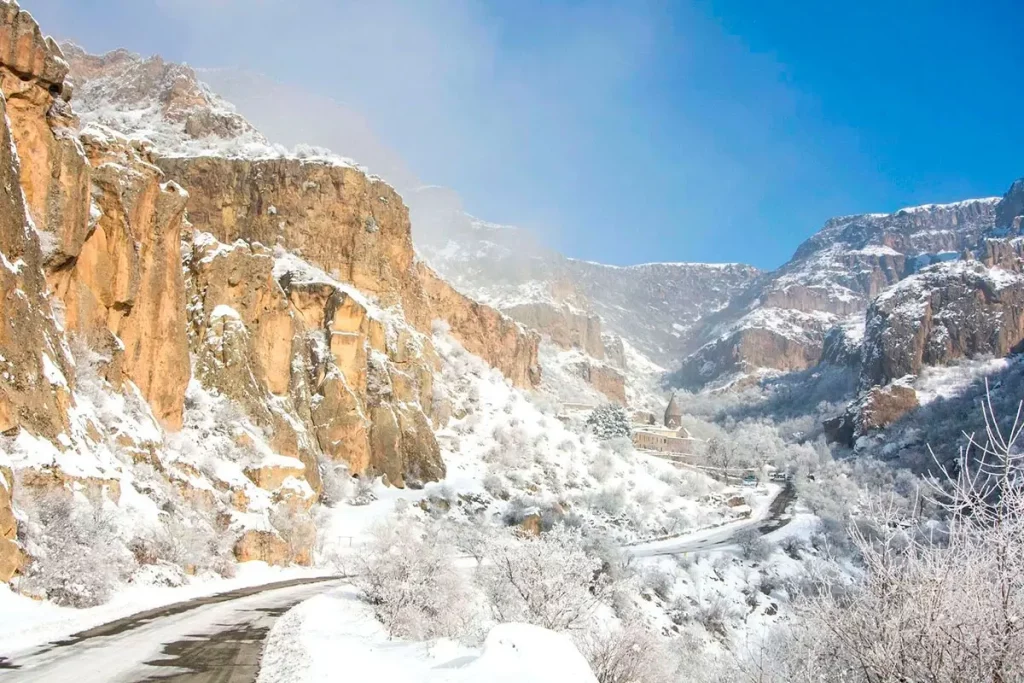
Geghard Monastery is one of the most striking medieval monuments in Armenia — a partially rock-cut monastic complex built directly into the cliffs of the upper Azat Valley, about 40 km east of Yerevan. Together with the surrounding gorge it has been a UNESCO World Heritage Site since 2000. Founded in the 4th century and rebuilt in its present form in the 13th century, Geghard is famous for its cave churches, intricate khachkars (cross-stones), and a centuries-long association with the Holy Lance — the spear believed to have pierced Christ at the crucifixion. The monastery sits at the end of a winding road past Garni Temple and is almost always visited together with it on a half-day trip from Yerevan.
Quick Facts
- Built / Founded: 4th century AD (main complex 13th century)
- Location: Goght village, Kotayk Province
- Also known as: Geghardavank, Monastery of the Spear, Ayrivank, Cave Monastery
- From Yerevan: About 40 km / 50 minutes
- Entrance fee: Free entrance
- Time needed: 1–1.5 hours
- Best time to visit: Spring and autumn; morning hours; September for harvest season
- Status: UNESCO World Heritage Site (since 2000)
- GPS coordinates:
40.1407, 44.8178
History of Geghard Monastery — From Ayrivank to Geghardavank
According to Armenian tradition, the monastery was founded in the early 4th century by Saint Gregory the Illuminator, the first Catholicos of the Armenian Apostolic Church and the figure behind Armenia’s adoption of Christianity as the state religion in 301 AD — the first such case in world history. The original site grew around a sacred spring inside a cave, and for centuries the complex was known as Ayrivank, meaning “Cave Monastery.”
Geghard’s early period was turbulent. The monastery was looted by Arab forces in the early 10th century, and most early structures were destroyed. Revival came in the 13th century, when Eastern Armenia was liberated from Seljuk rule. The princely Zakarian family rebuilt the main cathedral, Katoghike, in 1215, and in the 1240s the monastery was acquired by the Proshyan family, who added the rock-cut churches and family tomb that give Geghard its unique character today. By the late 13th century, the site had become a major religious, scholarly and artistic center, with a school, scriptorium, library and music academy.
The new name Geghardavank — “Monastery of the Spear” — came into use in the 13th century, after a relic believed to be the Holy Lance was brought to the monastery.
The Holy Lance and the Monastery’s Name
The Holy Lance (or Spear of Longinus) is, in Christian tradition, the spear that pierced the side of Jesus Christ during the crucifixion. According to Armenian tradition, the relic was brought to Armenia by Apostle Thaddeus, one of Christ’s disciples, and was kept at Geghard for several centuries.
The lance is no longer at Geghard. Today it is housed in the treasury museum of Etchmiadzin Cathedral in Vagharshapat, the spiritual center of the Armenian Apostolic Church. But the monastery still bears its name and remains one of the most important pilgrimage sites in Armenia.
Architecture — Rock-Cut Churches and Medieval Khachkars
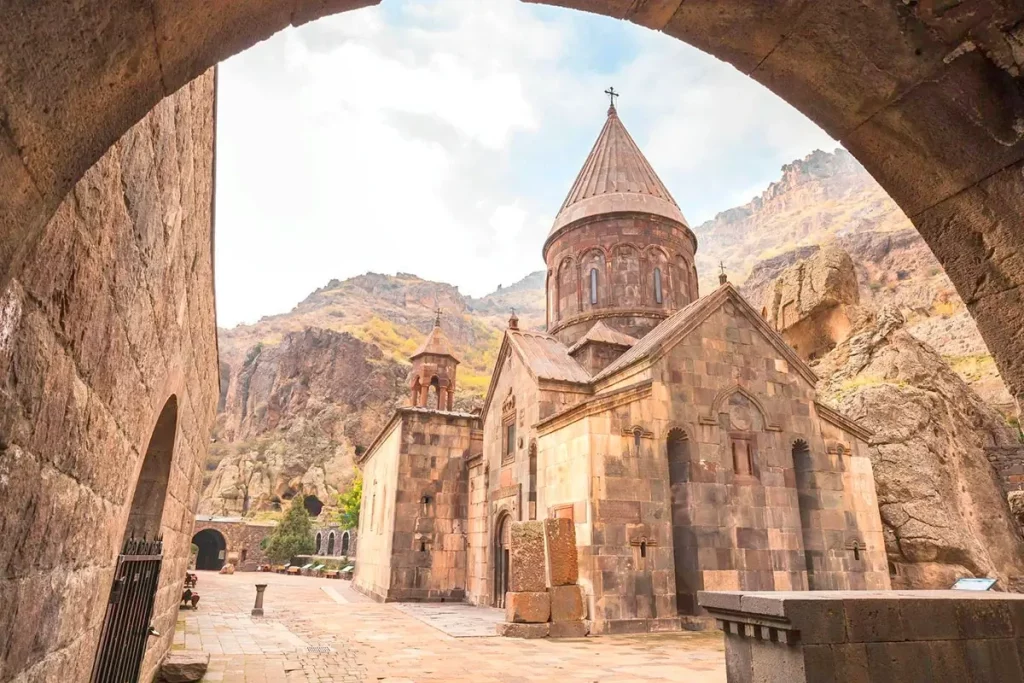
Geghard’s architectural fame rests on its combination of free-standing masonry and rock-hewn structures. It is the only consecrated monument in Armenia that is half built and half carved directly into a single monolithic cliff.
The main visible structures include:
- Katoghike Cathedral (1215) — the main church, built in classic Armenian cruciform plan with a high dome, decorated reliefs and finely fitted masonry. Built under the patronage of the Zakarian princes.
- Gavit (narthex, 1215–1225) — the entrance hall connecting the main church to the rock-cut sanctuaries. Its central oculus opens to the sky.
- Avazan (“basin”) rock-cut church — carved entirely into the cliff in the 1240s, with a sacred spring flowing inside.
- Astvatsatsin (Holy Mother of God) church and Proshyan family tomb — rock-cut chapel and burial vault decorated with one of the most famous reliefs in Armenian art: an eagle holding a lamb, the heraldic symbol of the Proshyan family.
- Upper Jhamatun (1288) — the second narthex, also rock-cut, used for memorial services.
- Dozens of khachkars — cross-stones carved into the cliff walls and scattered around the complex, some of the finest examples of medieval Armenian sculpture.
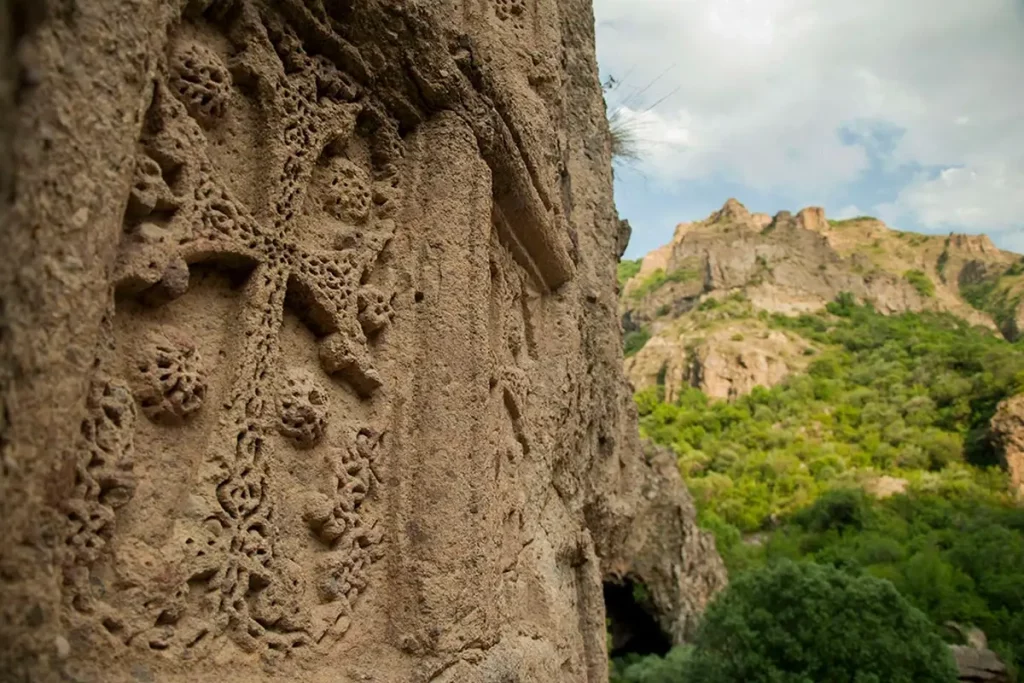
The acoustics inside the rock-cut churches are remarkable; the monastery is occasionally used as a concert venue for Armenian sacred music.
UNESCO World Heritage Site
In 2000, the Geghard monastery complex and the upper Azat Valley were inscribed on the UNESCO World Heritage List under criterion (ii), as “an exceptionally well-preserved and complete example of medieval Armenian monastic architecture and decorative art, with many innovative features that had a profound impact on the subsequent development of the region.”
The inscribed area covers both the monastery itself and the surrounding cliff landscape, which is considered inseparable from the monument. The site is owned by the Armenian Apostolic Holy Church and protected by Armenian national heritage law.
How to Get to Geghard from Yerevan
Geghard is located near the village of Goght, about 40 km east of Yerevan and 10 km beyond Garni Temple along the same road. There are three practical options.
By marshrutka (shared minibus). Marshrutkas from Gai Bus Station in Yerevan (Nor Nork district, 14/3 Gai Avenue) go to Goght village, but do not cover the last 4 km to the monastery. From Goght you would need to arrange a taxi for the final stretch (around 3,000–3,500 AMD). Fares from Yerevan to Goght are around 300 AMD. This option requires some planning, especially for the return.
By taxi. A one-way taxi from central Yerevan to Geghard costs roughly 6,000–8,000 AMD. Most travelers negotiate a round trip with waiting time, often combined with Garni, for around 15,000–22,000 AMD total. Apps like GG and Yandex Go work in Yerevan.
By private car with driver. The most flexible option, especially if you want to also visit Garni Temple and the Symphony of Stones. We provide private cars and drivers in Yerevan for day trips, with stops at your own pace.
Opening Hours, Entrance Fee and Practical Tips
- Opening hours: generally daily from around 09:00 to 18:00, often extended to 20:00 in summer. There is no formal access control, so hours are not strict, but earlier visits are recommended to avoid tour-group crowds and ensure you see the rock-cut interiors with natural light.
- Entrance fee: free. Geghard is an active religious site. Small donations toward upkeep are welcome but not required.
- Parking: small fee around 200 AMD.
- Toilets: clean facilities at the back of the monastery; a 200 AMD tip to the attendant is customary.
- Time needed: 1–1.5 hours for the monastery and the immediate surroundings.
- What to wear: modest dress — Geghard is an active church, so cover shoulders and knees. Women may want a light scarf for head covering inside the churches. Comfortable shoes for uneven stone surfaces.
- Food and drink: vendors at the entrance sell traditional gata (sweet bread), dried fruit, and fruit leather. Worth a stop.
- Sunday services: the monastery holds Sunday liturgy, which adds atmosphere but means more visitors. Weekdays are quieter.
Combining Geghard with Garni Temple
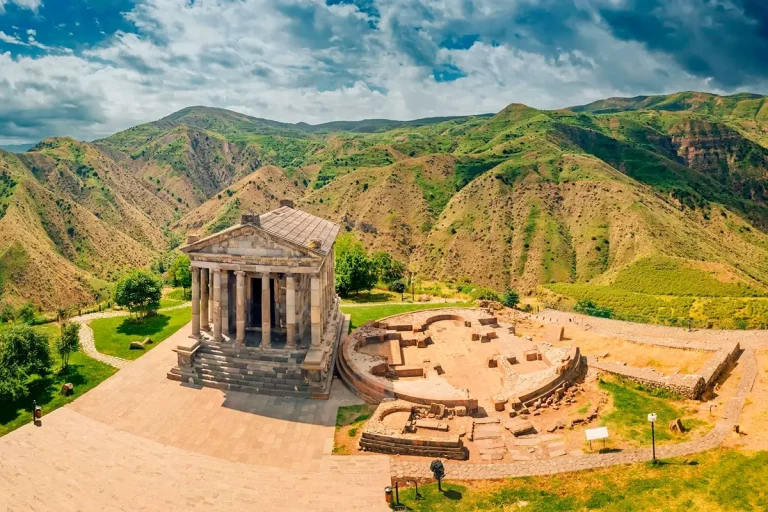
The classic day trip from Yerevan is the Garni and Geghard tour from Yerevan, usually including the Garni Temple, Geghard Monastery and the Symphony of Stones. Garni and Geghard are only 10 km apart on the same road, making them easy to visit together in 5–6 hours, including stops for sightseeing and photos.
The pairing of a 1st-century pagan temple with a 13th-century UNESCO-listed Christian monastery, both within an hour of the capital, makes this one of the most popular and rewarding routes in Armenia.