

Arzni
Arzni (Armenian: Արզնի) is Armenia’s closest balneological resort to Yerevan — a village at 1,250 m on a plateau above the Hrazdan River gorge, roughly 24 km and 30–40 minutes north of the capital in the Kotayk Province. For scale: Jermuk, Armenia’s headline spa town, sits 170 km away. Arzni is where Yerevanis go when they want mineral water, a cool gorge, and mountain air without a day on the road.
The resort’s identity rests on its carbonated mineral waters — a bicarbonate-chloride-sodium composition rich in boron and silicon, most often compared to the Karlovy Vary springs of the Czech Republic. Officially declared a resort in 1925, Arzni was the Soviet Union’s single specialist centre for coronary artery disease and post-infarction rehabilitation during much of the 20th century, and the “Arzni” bottled water — from the plant next to the springs — is still one of Armenia’s most recognised brands. Beyond the sanatoriums, the Hrazdan gorge below the village is one of the country’s best-known rock-climbing walls, and the shaded riverside picnic zones fill up on any warm weekend.
Geography and climate
Arzni sits on a plateau above the left bank of the Hrazdan River, in a narrow forested canyon that runs roughly north from Yerevan toward Hrazdan town. The gorge drops sharply on the eastern edge of the village — cliffs of columnar basalt rise more than 100 metres out of the river, and the natural caves in the lower rock served as prehistoric shelters and, later, wartime refuges for local villagers.
The elevation of 1,250 metres is enough to change the climate entirely from Yerevan’s basin. Summer daytime temperatures sit around +22 °C — often 10–15 degrees cooler than the capital during a July heatwave. Winter is soft, with averages around –5 °C and short cold snaps. Autumn is long and mild. The most distinctive climate metric is sunshine: local records show around 2,236 hours per year, which puts Arzni ahead of most Caucasian spa resorts on clear-sky days — one of the historical arguments for its therapeutic value. Atmospheric pressure is stable and modestly low, another factor Soviet-era balneological literature cited for cardiovascular patients.
Legend and etymology
Arzni carries one of Armenia’s most enduring origin legends. The story ties the village to Ara the Beautiful, the mythological Armenian king, and Semiramis (Shamiram), the Assyrian queen. Semiramis fell in love with Ara and demanded he leave Armenia to marry her; he refused, remaining faithful to his kingdom. She marched an army against him. On the slopes above what is now Arzni, Ara was killed in battle.
Grieving, Semiramis is said to have carried the wounded king to the mineral springs of Arzni, hoping the “immortal water” would bring him back to life. In the popular etymology, the name Arzni comes from “znnir Ara” — “bring Ara back to life.” A separate legend has Tigran the Great, the historical king of Armenia in the 1st century BC, coming to Arzni between wars to recover from injuries and fatigue.
Whatever the truth of the myth, the historical facts are these: archaeologists have found ancient coins from multiple states while cleaning the springs, evidence that the waters were used for medicinal purposes in antiquity, and along the Hrazdan riverbank below the village stretches an open-air Paleolithic encampment, roughly 2 km long and 500 metres wide — one of the most important prehistoric sites in Armenia. In older records the village appears as Artsni, Sajala, and Arzni-Asoriq.
Mineral waters and sanatoriums
Arzni’s therapeutic reputation rests on its carbonated, bicarbonate-chloride-sodium mineral waters, drawn from springs on the resort grounds. The water carries 1.25–2.0 g/l of dissolved carbon dioxide and a total mineralisation of 8–10 g/l, with additional boron and silicon. The composition profile places it in the same broad family as the Karlovy Vary waters of the Czech Republic, and Soviet-era literature routinely cited that comparison.
Medical indications documented at the sanatoriums:
- Cardiovascular disease: coronary artery disease, post-infarction and post-stroke rehabilitation, hypertension. During the Soviet era Arzni was designated the only specialist facility in the entire USSR for this profile.
- Chronic gastrointestinal conditions: gastritis, colitis, disorders of the biliary and hepatic systems.
- Musculoskeletal disorders: arthritis, chronic joint inflammation, degenerative joint disease.
- Metabolic disorders and diabetes.
- Neuroses, chronic fatigue, and overwork.
Treatments offered today include mineral-water baths, drinking cures, hydrotherapy, underwater massage, Sharko shower, inhalation therapy, oxygen therapy, acupuncture, and physiotherapy. Two sanatoriums operate year-round — the historic Arzni Sanatorium (founded 1925) with its own indoor thermal pool complex and the smaller resort hotels around the springs.
Next to the sanatoriums stands the Arzni mineral-water bottling plant, whose product is sold across Armenia. The plant’s springs and the medical springs are drawn from the same aquifer.
The resort was officially declared in 1925, but the healing use of the waters is much older: 6th-century Armenian churches stand on the plateau, and the Paleolithic evidence pushes settlement back tens of thousands of years.
History and the Assyrian community
Long before it became a Soviet spa town, Arzni was a stratified archaeological site. Burials in the northern part of the village show habitation from deep antiquity; the Paleolithic camp on the Hrazdan riverbank pushes the timeline back much further. The first medieval-era mention of the village dates to the 15th century, but the surviving 6th-century Armenian church on the plateau argues for continuous settlement well before that.
In the 19th century, Arzni was rebuilt by Assyrian refugees who had fled the region of Lake Urmia (northwest Iran). Their settlement gave Arzni a lasting Assyrian community — one of the few places in Armenia where the Assyrian language and traditions have survived into the present. The Assyrians built their own Assyrian church on the plateau, notably using stones from a destroyed ancient Armenian church on the same site.
Alongside the Assyrian church and the 6th-century Armenian church, the village preserves three later Armenian religious monuments: Surb Karapet Church (17th–18th century), Surb Petros and Poghos Church (Saints Peter and Paul, 18th–19th century), and Surb Mariam Astvatsatsin (Holy Mother of God, 19th century). Together they make an hour-long walking loop through the historic centre of the village.
The resort itself carries the architectural fingerprint of the Soviet 1950s–1970s. The main sanatorium blocks were built by respected Armenian architects in the modernist idiom of the period — striking, often overlooked, and slowly being recognised as a distinct heritage. A stroll through the sanatorium park reveals mosaics, sculptural panels, and open galleries characteristic of Soviet holiday architecture at its ambitious best.
What to do in Arzni
Riverside picnic zones. The Hrazdan gorge below the village is lined with shaded picnic areas — tables, grills, drinking water, riverside terraces. It is one of Yerevan’s favourite weekend escapes: pack the car, drive up in the morning, spend the day by the water, drive home by evening. In July and August, when Yerevan pushes past +38 °C, Arzni’s gorge sits comfortably in the low twenties.
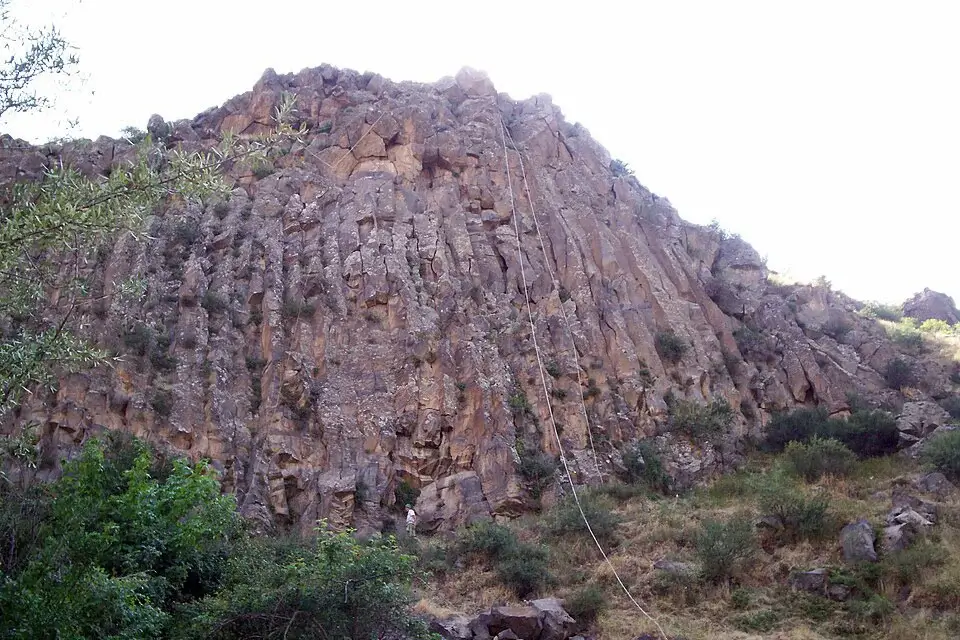
Rock climbing. The basalt cliffs of the Hrazdan gorge at Arzni host some of Armenia’s most popular sport-climbing routes — bolted, well-maintained, and regularly used for national competitions. Routes span beginner to advanced; local clubs run instruction days in season. Bring your own harness or arrange gear rental through a Yerevan climbing shop.
Sanatorium spa day. For guests who do not stay overnight, the main sanatoriums offer day passes to their pools and treatment facilities — a mineral bath, an underwater massage, a lunch, and back to Yerevan by evening. This is what most Yerevani weekenders come for.
Hiking and walking. Trails run along the plateau and down into the gorge — comfortable one-to-three-hour loops with views of the basalt cliffs and the river below. In spring the meadows above the village fill with wildflowers.
Village walking tour. The Assyrian church, the 6th-century Armenian church, Surb Karapet, Surb Petros and Poghos, and Surb Mariam Astvatsatsin — a 1–2 hour loop through the layered religious history of the village. Ask locally about opening times, as most rely on the parish priest.
Bird-watching. The Hrazdan gorge is a productive stretch for cliff-nesting raptors and forest species; spring and autumn migration seasons are the strongest.
What to see near Arzni
Arzni’s location makes it easy to combine with the other resorts and heritage sites of central Kotayk. Everything on this list is within 30 minutes’ drive.
Aghveran resort — 30 km northeast
Armenia’s second-closest mountain climatic resort, at 1,550 m in the Dalar valley. Thermal spa hotels, forested slopes, and hiking to the mountain lake at 2,450 m. Read the Aghveran resort guide — the two are often visited together.
Bjni Fortress — 20 km northeast
The 10th-century Bjni Fortress perched on a rocky promontory above the Hrazdan gorge — one of the most spectacular medieval strongholds in central Armenia. Built by the Pahlavuni princes, complete with Surb Astvatsatsin Church from 1031 and the seat of the medieval “Magistros Lyceum.” The village of Bjni is also the source of “Bjni” mineral water, Arzni’s stablemate on Armenian shop shelves.
Tsaghkadzor and Kecharis Monastery — 40 km northeast
Armenia’s principal ski resort at 1,850–2,819 m on Mount Teghenis, and the 11th–13th-century Kecharis Monastery in the same town — founded by Grigor Magistros Pahlavuni in 1033. Winter for skiing, summer for hiking and monasteries.
Garni and Geghard — 40 km southeast
Kotayk’s headline heritage pair: the 1st-century Hellenistic Garni Temple (Armenia’s only surviving pagan temple) and the UNESCO-listed rock-hewn Geghard Monastery, often combined with the Symphony of Stones basalt canyon.
Yerevan — 24 km south
The capital of Armenia is easily reachable for a day of city sightseeing after a morning at the sanatorium.
Best time to visit Arzni
June to September for the cool escape from Yerevan’s heat, active use of the gorge, climbing, hiking, and outdoor spa terraces. October and April–May for quiet, cheaper spa stays with mild weather. November through March for indoor treatments and the mildest winter climate on Armenia’s map — Arzni’s mercury rarely falls hard, and the sunny days keep coming.
The resort is genuinely year-round. If your primary reason for visiting is medical treatment, any month works. If you plan to spend time in the gorge or climbing, target the warm-season months.
How to get from Yerevan to Arzni
Arzni is the easiest resort in Armenia to reach from Yerevan — a single road due north along the Hrazdan valley, mostly downhill on the way back.
By private car or transfer: the most comfortable option. Fixed price, direct pickup from your Yerevan hotel or from Zvartnots Airport (roughly 35 km / 45 minutes to Arzni). The road runs along the gorge with curves — a driver takes the winding sections while you enjoy the scenery.
By car with driver in Yerevan: the most flexible option if you plan to combine Arzni with Bjni Fortress, Aghveran, or Tsaghkadzor. A common day loop: Yerevan → Arzni (mineral-water lunch and gorge walk) → Bjni Fortress → Aghveran (spa) → Yerevan. All three destinations sit within a compact 30-km triangle in central Kotayk.
By minibus rental: for groups of 6–19 people, the most cost-effective option.
Public transport: marshrutka minibuses run irregularly from Yerevan’s northern bus station to Arzni; for a day trip with children or luggage, a transfer or car with driver is much smoother.
Frequently Asked Questions
Arzni is one entry in Armenia’s broader network of spa, ski, and mountain retreats. Browse the full list at resorts in Armenia, which also covers Aghveran, Jermuk, Tsaghkadzor, Dilijan, Hankavan, Yenokavan, and the lakeside stays around Sevan. To combine Arzni with sightseeing across the country, see day tours from Yerevan or the full list of things to do in Armenia.