
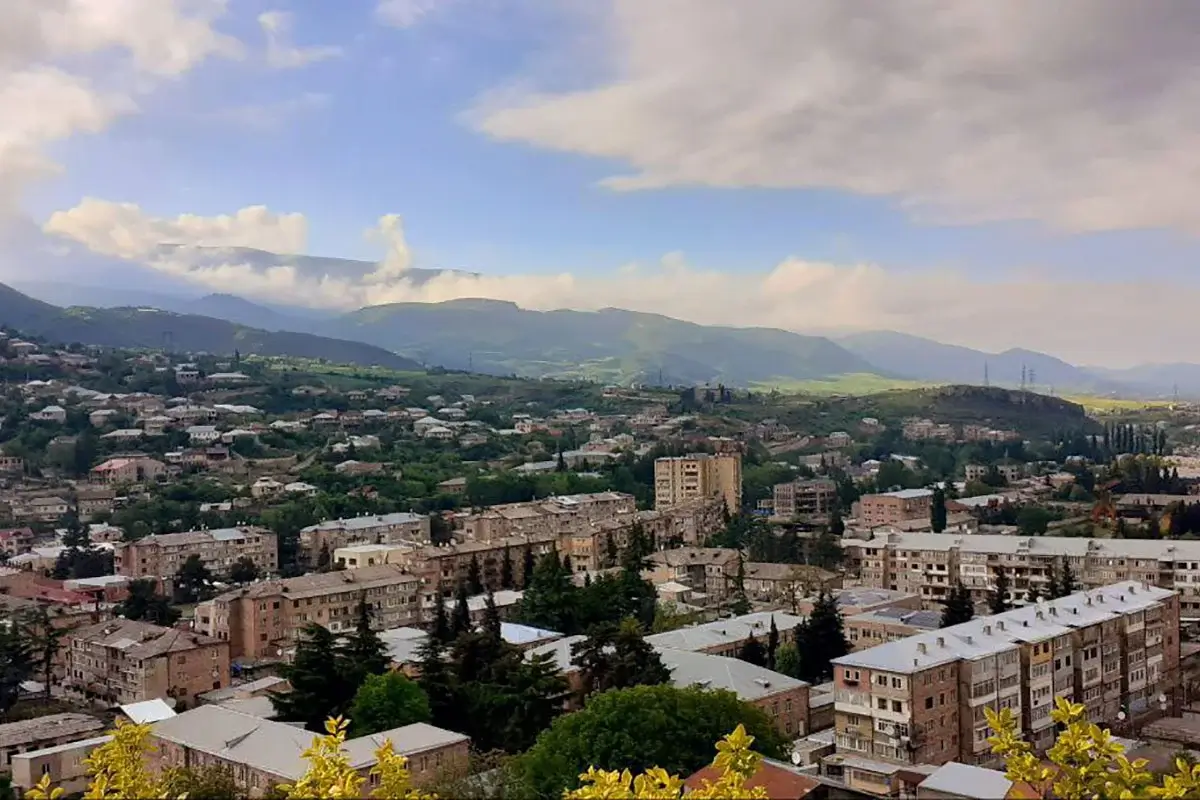
Ijevan
Ijevan (Armenian: Իջևան) is the administrative capital of Tavush Province in northeastern Armenia. It sits in the wide valley of the Agstev River, at the foot of the Ijevan Range, at 650–850 metres above sea level. About 21,000 people live here on 4.5 km². Until 1961 the town was called Karavansaray (“caravan inn”) — a name inherited from the medieval trading post that stood on the road linking Persia through Georgia to Russia. The modern name, Ijevan, means the same thing in Armenian. From Yerevan it is 142 km — a comfortable two-hour drive through Sevan and Dilijan.
Ijevan is Armenia’s warm north. Because it sits several hundred metres lower than nearby Dilijan, it has a sub-tropical microclimate — noticeably milder in winter, warmer in summer — which makes it one of the few places in Armenia where grapes and figs grow reliably outside the Ararat Plain. It is a wine town with a working factory since 1939, an arboretum of 750 species from every continent except Australia and Antarctica, an outdoor sculpture museum unique in Armenia, and — 14 kilometres north — the Paleolithic-era caves of Lastiver. Nothing else in Armenia combines wine, subtropical greenery and prehistoric caves in a single day.
Geography and climate
Ijevan sits in a broad river valley where the Agstev flows out of a narrow mountain gorge into open land. The Gugarats Range rises to the west, the outlying slopes of the Miapor Mountains to the east. The surrounding hills are low, softly outlined and covered in deciduous forest. Part of the town lies on those slopes; the rest fills the valley floor.

The climate is sub-tropical continental — warmer and more humid than in Dilijan, only 30 km away but 500 metres higher. July averages +23 °C, hot days reach +28 to +30 °C. Winters are mild: January averages −2 to −5 °C, and the temperature rarely drops below −15 °C. This mild climate is what allows local vineyards to thrive and lets the Ijevan Dendropark grow sub-tropical species that would not survive at Dilijan’s elevation.
The area is rich in mineral resources — marble, limestone, dolomite, clay and agate — which have historically supported small-scale construction and craft industries.
From caravan inn to Tavush capital
The Agstev valley has been inhabited since the Bronze Age — settlement sites from the 3rd and 2nd millennia BC have been excavated in the area. In the medieval period the region was defended by Kayan Fortress (from Armenian kayan, “encampment”), around which a settlement grew.
Ijevan sat on one of the great trade routes of the South Caucasus — from Persia and the Ottoman lands into Russia. In its middle, on the road itself, stood a caravanserai — a merchants’ inn — which gave the town its former name, Karavansaray.
The population suffered heavily during the 17th-century Persian–Ottoman wars. After the incorporation of Eastern Armenia into the Russian Empire in 1828, Karavansaray revived as a trading village. In 1939 the Soviet authorities founded the Ijevan Wine and Cognac Factory here, giving the town a permanent economic anchor. Karavansaray received the status of an urban-type settlement in 1951; in 1961 it received city status and its current name, Ijevan. In 1970 it was elevated to a city of republican subordination.
A curious modern chapter in the town’s history began during the Soviet period: the International Sculpture Symposium. Sculptors from Russia, Georgia, the Baltic states and other countries came to Ijevan for 45-day residencies and, at the end, donated their works to the city. Over the decades this created the Open-Air Sculpture Museum — the reason Ijevanis proudly call their town the city of 100 sculptures.
What to see in Ijevan and around
Ijevan Wine and Cognac Factory (1939)
The town’s economic anchor and one of its most rewarding tourist stops. Founded in 1939 by decree of the Armenian SSR government. For decades it supplied wine and cognac base to the famous Yerevan Ararat plant. Privatised in 1997, it now runs the full production cycle from vineyard to bottle. The factory produces red and white wines, cognac, and — the local specialities — unusual blackberry, quince and pomegranate wines, plus apricot and cornelian-cherry vodkas.
Daily tours with tasting are offered at the factory (9 Yerevanyan Street, 10:00–18:00). Visitors regularly note that the tasting here is more detailed and more atmospheric than at the Ararat plant in Yerevan — because this is a working production line, not a museum.
Ijevan Dendropark
A 14.5-hectare arboretum on the southern edge of the town, on the right bank of the Agstev. Founded in 1962 by the botanist Ludwig Sayadyan. It holds around 750 species of trees and shrubs from every continent except Australia and Antarctica — of which about 640 have adapted to the local climate. Conifers dominate the collection, with 133 species; broadleaf evergreens make up another 84 species. Notable groves include an extensive planting of Turkish (bear) hazel — one of the largest of its kind in the Caucasus. Entry is free, with signposts in Armenian, Russian and English. Seeds can be purchased at the entrance, and guided walks can be arranged. The park is now run by Mehak Sayadyan, son of the founder.
Makaravank Monastery (10th–13th century)
A medieval monastery 6 km west of the village of Achajur, about a 30-minute drive from Ijevan. The complex includes three churches, a chapel and the remains of monastic outbuildings. Its walls are built of dark pink andesite and red tuff — an unusual combination in Armenian church architecture. The main church (1205) is decorated with some of the finest carved ornament of any medieval Armenian monastery: eight-pointed stars, interlaced patterns, complex polyhedra. The 13th-century historian Kirakos Gandzaketsi describes a carpet donated to Makaravank by Princess Arzu-Khatun. Beside the monastery a spring flows through ancient clay pipes. It is still an active monastery. Full page: Makaravank Monastery.
Lastiver Caves
A complex of caves in a river gorge near the village of Yenokavan, roughly 14 km from Ijevan. The caves are over 10,000 years old. Inside, ancient wall drawings survive, along with stone cells and rock-cut beds. Local tradition says they were used for pagan rituals in antiquity and as a refuge during the Mongol invasions. The name comes from Armenian last (“raft”) — a wooden ladder-platform used to reach the entrance from the gorge floor. Wooden cabins at the site offer overnight stays, making Lastiver one of the best base points for eco-tourism in Tavush.
Yell Extreme Park
An adventure park in Yenokavan village, close to the Lastiver caves. Zip-line, via ferrata, climbing wall, off-road truck tours, paragliding and paintball. Open daily. Popular with families and groups — many combine Lastiver and Yell Extreme Park in a single day.
Historical and Ethnographic Museum
Founded in 1955. Four sections cover Urartian-era archaeology, artefacts from the 3rd and 2nd millennia BC, and the ethnography of Tavush. Highlights include old Ijevan “karpet” rugs and “khurjin” saddlebags — the traditional weavings that made Ijevan famous for its textile craft. The collection now holds more than 1,400 items.
Open-Air Sculpture Museum
Sculptures by masters from many countries, gifted to the town after the Soviet-era symposiums. They stand in the central park and along the main streets. Ijevan is the only town in Armenia with a permanent public sculpture collection of this scale.
Surb Hovhannes Church
A modern chapel built in 2008 in the town centre. Neat, with the distinctive conical Armenian roof.
Wine and weaving
Tavush Province is one of Armenia’s principal wine-producing regions. Ijevan’s mild climate allows extensive viticulture, and the winemaking tradition here — while young compared to Areni’s — goes back nearly a century. Beyond the main factory, private wineries operate in the surrounding villages, and small tastings can be arranged on request.
Weaving is Ijevan’s other historic craft. The town’s karpet rugs and khurjin saddlebags are known for their saturated colours and fine detail. Antique examples are on display at the Armenian State History Museum in Yerevan.
Who Ijevan suits
Wine and food travellers — the factory tour with tastings, the unusual fruit wines, and the sub-tropical fare of Tavush cuisine.
Adventure travellers — Lastiver, Yell Extreme Park (zip-line, via ferrata, off-road), and hiking and riding trails in the hills around town.
Nature lovers — the dendropark’s 750 species, the forested hills, the Agstev valley itself.
History travellers — Makaravank Monastery with its extraordinary carving, Kayan Fortress, the ethnographic museum, the Urartian finds.
Travellers looking for the quieter Armenia — Ijevan is less promoted than Dilijan, but arguably more authentic. A working provincial town going about its life, with a distinctive climate and character.
Best time to visit
Spring (April–May) — everything turns green, temperatures land in the +15 to +20 °C range. A good window for hiking and the dendropark.
Summer (June–August) — warm at +23 to +28 °C, but noticeably cooler than Yerevan. The best time for Lastiver and Yell Extreme Park.
Autumn (September–October) — the grape harvest. Gold-leaf forests on the surrounding hills and clear weather. The best time for the winery tour.
Winter (December–February) — quiet, minimal tourists, snow on the higher slopes. Temperature −2 to −5 °C. The roads stay open, but some outdoor sites become less accessible.
Practical notes
Ijevan has banks, shops, pharmacies, cafés and a handful of hotels — from budget guest houses to more comfortable options. Dedicated tourist infrastructure is limited, and that is part of the town’s appeal: it lives its own life, and visitors get a genuine look at everyday Tavush.
Mobile coverage is strong in town and patchy in the mountains. Reaching Makaravank and Lastiver requires a car — there is no public transport to either. The road to Makaravank has some steep sections; a regular car will manage, but an SUV is more comfortable.
Combine with nearby places
Dilijan — 30 km west. The mountain resort with its national park, Lake Parz, and the monasteries of Haghartsin and Goshavank.
Lake Sevan — on the way from Yerevan. The largest lake in the Caucasus and the medieval Sevanavank Monastery.
Noyemberyan — a border town north of Ijevan, the nearest point to the Georgian frontier.
A comfortable one- or two-day route from Yerevan: Yerevan → Lake Sevan → Dilijan → Ijevan → Makaravank → Lastiver. Easiest with a car with driver from Yerevan or as a private day tour.
How to get there
Ijevan is 142 km from Yerevan, about 2 to 2.5 hours by car. The road runs along Lake Sevan, through Dilijan, and then east along the Agstev valley. It is asphalted and in good condition throughout.
Marshrutkas run from Yerevan’s Northern Bus Station. Cost around 2,000 AMD, journey 2.5–3 hours, departures every 1–2 hours.
For an unhurried trip that takes in Sevan and Dilijan on the way, hire a car with driver from Yerevan or arrange a transfer. This is the classic Tavush loop.
Frequently Asked Questions
See more on Armenia’s cities or plan the trip with a car with driver from Yerevan.