Makaravank Monastery
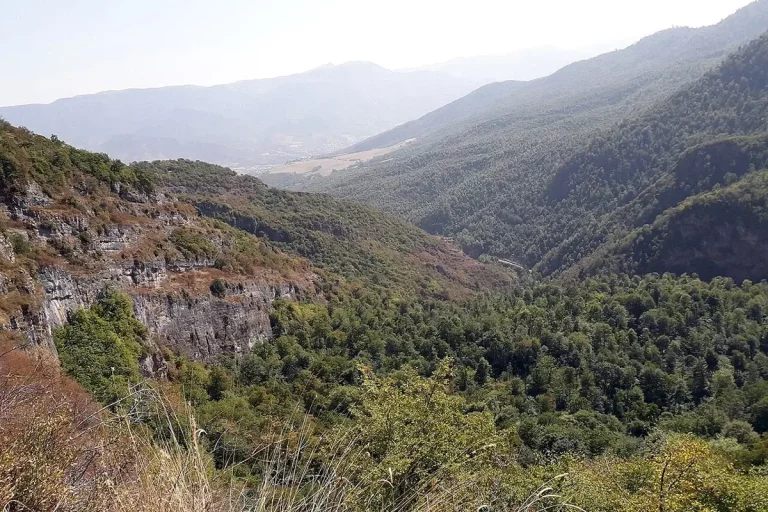
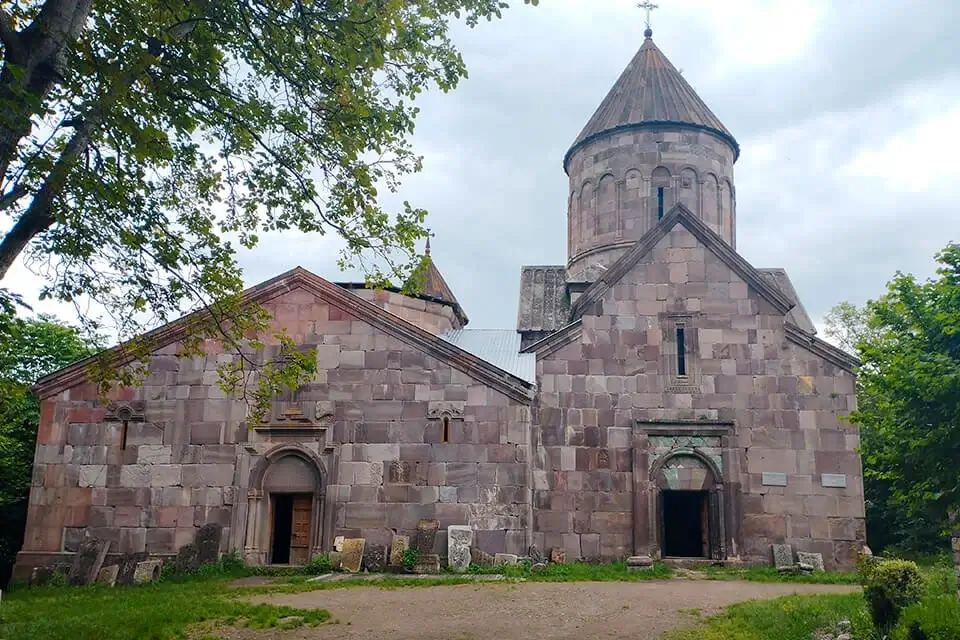
Makaravank Monastery (Armenian: Մակարավանք) is a 10th–13th-century Armenian monastic complex on the forested slope of Mount Paytatap, in Tavush Province, about 3 km west of the village of Achajur and 165 km north of Yerevan. Built of dark-pink andesite, red tuff and occasional greenish stone, it is one of the most richly decorated monasteries in medieval Armenia — its scholars routinely place it in the same artistic league as Aghtamar, Noravank and Gandzasar.
Its fame rests on a single wall. The altar dais of the main church is covered in eight-pointed stars and octagons filled with carving unlike anything else in Armenian architecture: bouquets of stylised flowers, fishes, birds, crowned sphinxes, sirens, a boatman looking forward, and — in one octagon at the upper-left edge — a small human figure inscribed with the Armenian word Eritasard, meaning “young man”: traditionally read as the carver’s signed self-portrait.
Quick Facts
- Built / Founded: 10th–13th c. (main church 1205)
- Location: Achajur (3 km east of monastery), Tavush Province
- Also known as: Makaravank Monastery, Makaravank, Agravavank, Monastery of the Crow, Մակարավանք, Ագռավավանք
- From Yerevan: ~165 km (2.5 hours by car)
- Entrance fee: Free
- Time needed: 45–60 minutes
- Status: Preserved historic monastery
- GPS coordinates:
40.9739032, 45.1270109
A short history: from Mahanaberd to the Vachutian princes
Makaravank stands a few kilometres above the village of Achajur — known in the Middle Ages as Mahanaberd. A natural spring at the foot of the monastery wall almost certainly explains why the spot was consecrated to begin with: across the medieval Caucasus, monasteries grew around water sources.
The oldest church in the complex is a small 10th–11th-century cross-winged domed church built of large blocks of rough-hewn red volcanic tuff, traditionally dedicated to St. Gregory the Illuminator. It is one of those modest, archaic structures that anchor an Armenian monastic complex around it; later centuries grew over it without removing it
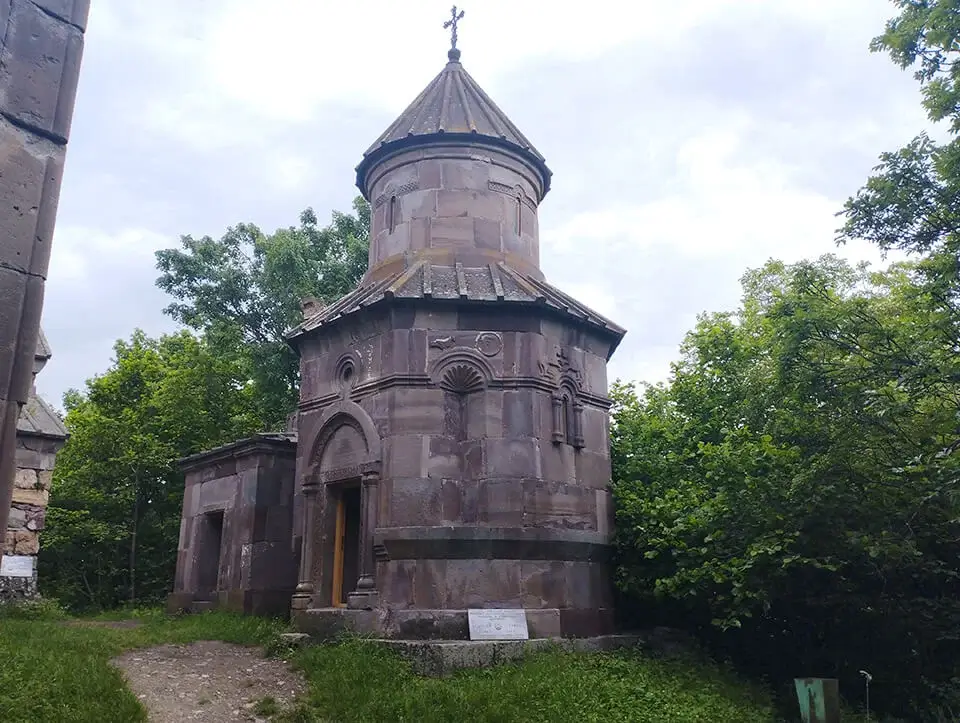
In 1198 the religious leader Hovhannes built the small Surb Astvatsatsin Church (“Holy Mother of God”) from white stone on the eastern side of the complex — a building cruciform inside, octagonal outside, an unusual plan for Armenian churches, with windows ornamented with birds, lions, and an eagle struggling with a dragon.
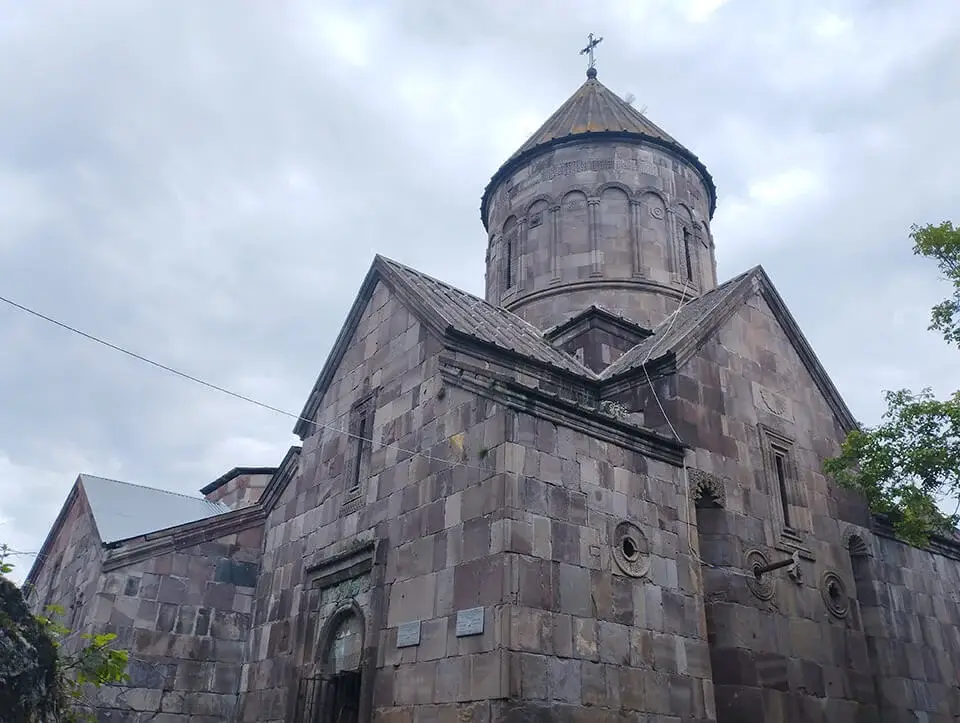
The main church of the monastery was built in 1205 by Vardan, son of Prince Bazaz, of finely tooled pink andesite. The attribution is known from a khachkar broken into four pieces and rediscovered by the archaeologist G. Sargsyan in 1953; its inscription names both the builder and the year. A few years later, before 1207, a four-column gavit of red andesite was added at the west end, sponsored by Prince Vache I Vachutian — the same magnate whose patronage shaped the great gavit at Sanahin Monastery (1211), the church of Surb Sion at Saghmosavank (1215), and the cathedral at Hovhannavank (1216–1221). The Vachutian arms — a pair of eagles — are carved among the reliefs.
The single historical record of medieval Makaravank comes from the 13th-century historian Kirakos Gandzaketsi, who notes that the wife and daughter of Prince Vakhtang Arzu-Khatun sewed an altar curtain for the monastery. From the 14th century onwards the textual record falls silent — probably the moment when monastic life began to wind down.
The complex was once surrounded by a high curtain wall with a columned gate, residential structures, and even small pavilions over mineral springs. Today the buildings stand in a quiet clearing in the Tavush forest; the wall traces are visible but mostly ruined.
The altar-wall reliefs: medieval Armenia’s finest carving
The architectural reason most visitors come to Makaravank lies inside the main church of 1205, on the semicircular altar dais wall.
The dais is articulated by thirteen shallow concave niches separated by paired pilasters and crowned with two stacked rows of profiled eight-pointed stars alternating with octagons — and every star and every octagon is carved with something different. Bouquets of stylised flowers, fishes of every imaginable kind, birds, sphinxes wearing crowns, sirens, a boatman gazing straight ahead, the Old Testament scene of Jonah inside the whale, and — in an octagon up the left edge — a small human figure with the Armenian word Eritasard (“young man”) carved next to him. Scholars from the early 20th century onwards have read it as the carver’s signed self-portrait: a 13th-century Armenian artist quietly inserting his face among the saints and animals on his own wall.
The whole composition is held inside a single deep profiled frame that directs the eye inwards. In its variety, density and inventiveness this single wall is generally considered to have no equal in medieval Armenian sculpture.
External reliefs and architecture
The outside of the 1205 church is hardly less expressive than the altar dais inside it.
- Over the central window of the south facade sits a stone sun dial; immediately below, on a small console, a relief of a dove.
- Beneath the south window, an eagle holding a calf in its claws — a popular medieval Armenian image of dominion.
- Round windows on different sides vary in shape and ornament — each effectively a separate small work.
The portal of the gavit carries two of the monastery’s most often photographed reliefs:
- On the right, a crowned winged sphinx.
- On the left, a lion attacking an ox.
The stepped framing of the gavit portal — which encloses the window above the doorway in a single architectural composition — uses the same compositional device as the gavit at Geghard Monastery, suggesting either a shared workshop or close stylistic influence at the start of the 13th century.
Inside, the main church is spacious and well-lit, with massive pentagonal piers connected by tall arches. The dome (now roofless) rested on a round drum decorated with a delicate twenty-arch blind arcade on paired half-columns.
The four churches
The Makaravank complex actually consists of four churches and several secondary buildings, all clustered within the old curtain wall:
- The oldest church (10th–11th c.) — red tuff, cross-winged plan with corner annexes, modest but with finely carved window frames.
- Surb Astvatsatsin (1198) — white-stone Mother-of-God church, octagonal outside, by the abbot Hovhannes.
- The main church (1205) — pink andesite, by Vardan, son of Prince Bazaz, with the altar-wall reliefs described above.
- A small chapel — ashlar masonry with a vaulted ceiling and a carved door frame.
The four-column gavit built before 1207 covered both the oldest church and the main church, with a small vaulted bakery for communion bread opening off its north side.
The legends of Makaravank
Two folk stories explain the monastery’s two names.
Makar and his son. A master mason called Makar built the monastery together with his only son. The son cut and decorated the stones; the father laid them. As the walls climbed Makar grew so absorbed in the work that he stopped coming down at night and slept on top of the rising masonry. One morning he noticed that the stones had begun to arrive less finely cut. The villagers told him the son was unwell, but Makar guessed the truth — that his son was already dead. He threw himself from the dome. The villagers buried him at the foot of the wall, and the monastery took his name: Makaravank (“Vank” = “monastery”).
The crow. A second tale gives the monastery’s alternative name, Agravavank (“Monastery of the Crow”). One day the builders were cooking arisha (a wheat porridge) in a large pot. A crow circled the pot insistently. When the cooks lifted the lid the crow flew straight down into the boiling porridge — and only when they poured the food away did they find a snake at the bottom of the pot. The bird had sacrificed itself to warn them; the monastery was renamed in its honour.
How to get to Makaravank Monastery from Yerevan
Makaravank lies in northern Tavush, on the forested slopes above the Aghstev valley. From Yerevan it is about 165 km via Dilijan and Ijevan — roughly 2.5 hours by car. The final 3 km from Achajur is a forest road that climbs through dense woodland; passenger cars handle it easily in dry weather, but it can be slippery after rain.
There is no public transport to the monastery itself. From Ijevan (23 km) it is taxi only. From Dilijan (~50 km) the most common arrangement is a private car and driver from Yerevan covering a full Tavush day route — Makaravank typically pairs with Goshavank, Haghartsin and Dilijan town, sometimes adding Lake Parz.
Practical tips on site
- The altar dais reliefs are the reason to come — go straight into the main church and find the wall behind the altar before anything else. The Eritasard figure is in the upper-left corner; the Jonah-in-the-whale scene and the crowned sphinxes reward a slow look.
- Outside, walk around the south facade for the sun dial, the dove and the eagle-with-calf reliefs.
- The gavit portal carries the winged sphinx (right) and the lion attacking an ox (left).
- The monastery sits in dense forest — even in midsummer it is shaded and cool. A pleasant picnic area with a natural spring sits just outside the wall.
- There are no shops or cafés at the monastery; bring food and water from Ijevan or Dilijan.
- Best time to visit: May to October, when the forest track is dry and the woodland is at its most photogenic.
- Plan 30–45 minutes for the monastery, or about an hour with the spring and a short walk through the woods.
What to see nearby
- Ijevan (~23 km) — the regional capital, with a wine plant and one of the oldest carpet factories in Armenia.
- Goshavank Monastery (~35 km) — founded by the scholar Mkhitar Gosh in 1188, famous for its 1291 Aseghnagorts khachkar — one of the most intricate cross-stones ever carved.
- Haghartsin Monastery (~45 km) — a 10th–13th-century monastic complex set deep in the forest near Dilijan, with an exceptionally large medieval refectory.
- Dilijan (~50 km) — the mountain spa town often called “Armenian Switzerland”, in the middle of Dilijan National Park.
- Lake Parz (~40 km) — a small forest lake popular for walks and a zipline.
Frequently asked questions
Makaravank is one of those Armenian monasteries that rewards a careful eye more than a wide-angle camera: not a dramatic cliff-edge silhouette, but a single forested clearing in Tavush where a 10th-century cross-winged church, a 12th-century white-stone Mother-of-God chapel, and a 13th-century cathedral with carving unmatched anywhere else in medieval Armenia all stand within thirty paces of each other. With Goshavank and Haghartsin twenty-five and forty-five kilometres on, the easiest way to take the cluster in is with a private car and driver from Yerevan over a single day in the Tavush forest.