Armenian Alphabet
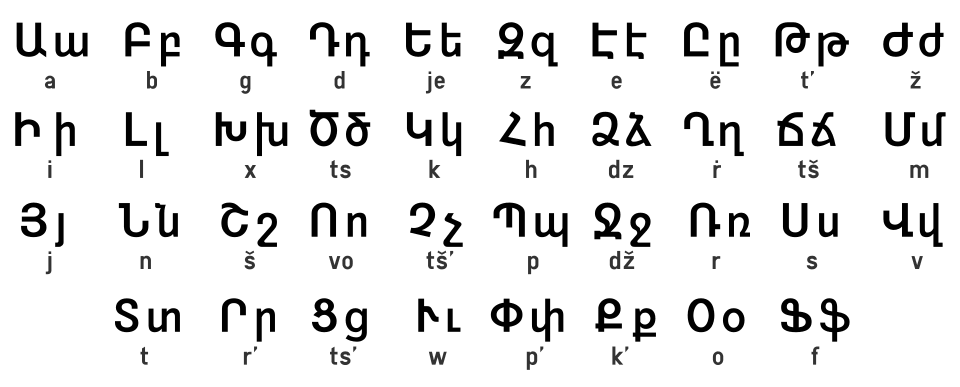
The modern Armenian alphabet consists of 39 letters. The chart below presents their uppercase and lowercase forms, common Latin transliteration, approximate English pronunciation, IPA notation and traditional numerical values.
The Armenian script was created by the scholar and clergyman Mesrop Mashtots in the early fifth century. His original alphabet contained 36 letters; three more were incorporated later. More than 1,600 years after its creation, the script remains in everyday use in Armenia and Armenian communities around the world.
Pronunciation note: this guide primarily follows modern Eastern Armenian as spoken in the Republic of Armenia. Several consonants are pronounced differently in Western Armenian.
Armenian Alphabet Chart with English Pronunciation
The letters are listed in Armenian alphabetical order. English equivalents are only approximate because some Armenian sounds do not have exact counterparts in English.
| № | Uppercase | Lowercase | Transliteration | English pronunciation | IPA | Value |
|---|---|---|---|---|---|---|
| 1 | Ա | ա | a | “a” in father | [ɑ] | 1 |
| 2 | Բ | բ | b | “b” in boy | [b] | 2 |
| 3 | Գ | գ | g | “g” in go | [ɡ] | 3 |
| 4 | Դ | դ | d | “d” in dog | [d] | 4 |
| 5 | Ե | ե | ye / e | “ye” initially; “e” elsewhere | [jɛ] / [ɛ] | 5 |
| 6 | Զ | զ | z | “z” in zoo | [z] | 6 |
| 7 | Է | է | e | “e” in bed | [ɛ] | 7 |
| 8 | Ը | ը | ə | “a” in about | [ə] | 8 |
| 9 | Թ | թ | t’ | aspirated “t” | [tʰ] | 9 |
| 10 | Ժ | ժ | zh | “s” in measure | [ʒ] | 10 |
| 11 | Ի | ի | i | “ee” in see | [i] | 20 |
| 12 | Լ | լ | l | “l” in light | [l] | 30 |
| 13 | Խ | խ | kh | “ch” in Bach or loch | [χ] | 40 |
| 14 | Ծ | ծ | ts | unaspirated “ts” | [ts] | 50 |
| 15 | Կ | կ | k | unaspirated “k” | [k] | 60 |
| 16 | Հ | հ | h | “h” in house | [h] | 70 |
| 17 | Ձ | ձ | dz | “ds” in beds | [dz] | 80 |
| 18 | Ղ | ղ | gh | guttural “r/gh” | [ʁ] | 90 |
| 19 | Ճ | ճ | ch | unaspirated “ch” | [t͡ʃ] | 100 |
| 20 | Մ | մ | m | “m” in man | [m] | 200 |
| 21 | Յ | յ | y | “y” in yes | [j] | 300 |
| 22 | Ն | ն | n | “n” in name | [n] | 400 |
| 23 | Շ | շ | sh | “sh” in ship | [ʃ] | 500 |
| 24 | Ո | ո | vo / o | “vo” initially; “o” elsewhere | [vɔ] / [ɔ] | 600 |
| 25 | Չ | չ | ch’ | aspirated “ch” | [t͡ʃʰ] | 700 |
| 26 | Պ | պ | p | unaspirated “p” | [p] | 800 |
| 27 | Ջ | ջ | j | “j” in jam | [d͡ʒ] | 900 |
| 28 | Ռ | ռ | ṙ | strongly rolled “r” | [r] | 1000 |
| 29 | Ս | ս | s | “s” in sun | [s] | 2000 |
| 30 | Վ | վ | v | “v” in voice | [v] | 3000 |
| 31 | Տ | տ | t | unaspirated “t” | [t] | 4000 |
| 32 | Ր | ր | r | lightly tapped “r” | [ɾ] | 5000 |
| 33 | Ց | ց | ts’ | aspirated “ts” | [tsʰ] | 6000 |
| 34 | Ու | ու | u | “oo” in food | [u] | — |
| 35 | Փ | փ | p’ | aspirated “p” | [pʰ] | 8000 |
| 36 | Ք | ք | k’ | aspirated “k” | [kʰ] | 9000 |
| 37 | Եվ | և | yev / ev | “yev” initially; “ev” elsewhere | [jɛv] / [ev] | — |
| 38 | Օ | օ | o | “o” in more | [o] | — |
| 39 | Ֆ | ֆ | f | “f” in fish | [f] | — |
Note: in reformed Armenian orthography, Ու/ու represents the sound “oo” and is included in the alphabetic sequence, although it consists of two characters. In traditional orthography, the separate letter Ւ/ւ has the numerical value 7000.
The letter և has no distinct uppercase form. In uppercase text it is written as ԵՎ in reformed orthography.
An apostrophe in the transliterations t’, p’, k’, ts’ and ch’ indicates aspiration — a short burst of air after the consonant. It does not indicate stress.
How to Pronounce Armenian Letters
Most Armenian letters retain the same pronunciation in different positions. The letters Ե, Ո and և require special attention, as do the aspirated consonants.
Ե: “ye” or “e”
At the beginning of a word, Ե is normally pronounced “ye”: Երևան — Yerevan. In other positions, it represents a sound close to the “e” in “bed”: տեր — ter.
Ո: “vo” or “o”
At the beginning of a word, Ո is normally pronounced “vo”: Ոսկի — voski, meaning “gold.” Elsewhere, it is pronounced “o”: գործ — gorts, meaning “work.” A well-known exception is ով, meaning “who,” in which the initial Ո is pronounced “o.”
և: “yev” or “ev”
At the beginning of a word, և is pronounced “yev”; within a word, it is normally pronounced “ev.” For example, և means “and,” while Սևան is transliterated as Sevan.
Aspirated Consonants
Eastern Armenian distinguishes between voiced, voiceless unaspirated and voiceless aspirated consonants. The principal aspirated letters are թ [tʰ], փ [pʰ], ք [kʰ], ց [tsʰ] and չ [tʃʰ]. They are pronounced with a noticeable burst of air.
Armenian Punctuation
The Armenian full stop looks like a colon: ։. The question mark ՞ is placed above the stressed vowel of the relevant word rather than separately at the end of the sentence.
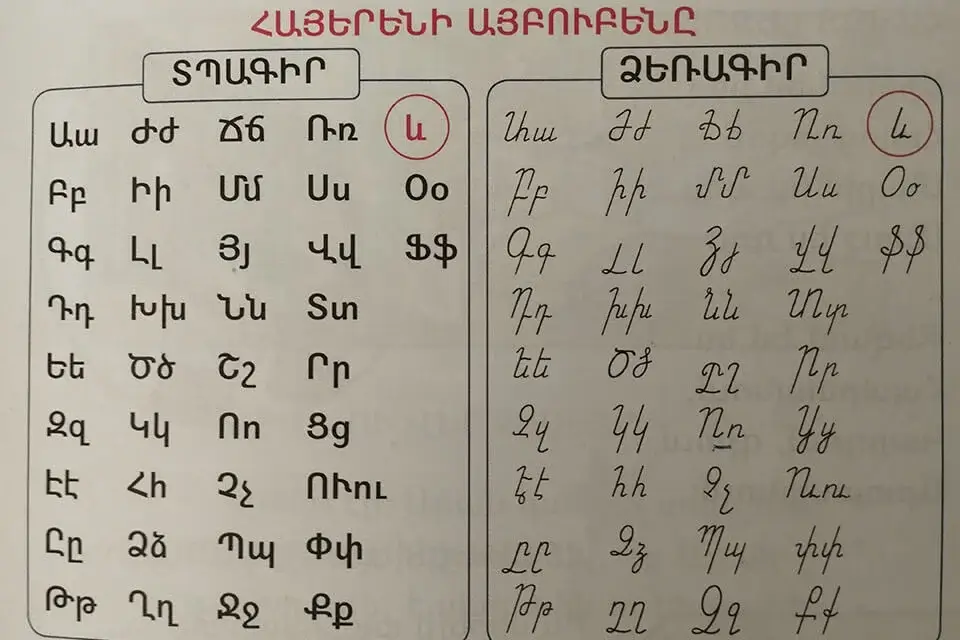
Printed and Handwritten Armenian Letters
Handwritten Armenian letters can differ considerably from their printed forms, especially in lowercase. For example, handwritten ա may look quite different from the character commonly seen in print. Learners should therefore study printed and handwritten forms separately.
Four major historical styles of Armenian writing are generally distinguished:
- Erkatagir — the earliest monumental script, used in manuscripts and stone inscriptions.
- Bolorgir — a more rounded medieval script that became widely used in manuscripts.
- Shkhagir — a cursive style developed for faster everyday writing.
- Notrgir — a compact notarial cursive script.
Modern Armenian handwriting was influenced by these historical traditions but does not correspond exactly to any one of them.
How Many Letters Are in the Armenian Alphabet?
The modern reformed Armenian alphabet used in Armenia contains 39 letters. Mesrop Mashtots created the original 36-letter alphabet in the early fifth century. The letters Օ and Ֆ were added in the Middle Ages. During the 20th-century spelling reforms, Ու and և came to be treated as separate alphabetic letters, while Ւ ceased to function as an independent letter in the reformed alphabet.
Traditional Armenian orthography, still used by many diaspora communities, treats some of these characters differently. The underlying script and most letter forms nevertheless remain shared by both systems.
Who Created the Armenian Alphabet?
The Armenian alphabet was created by the scholar, translator and clergyman Mesrop Mashtots in the early fifth century, traditionally dated to AD 405. His work was supported by Catholicos Sahak Partev and King Vramshapuh.
The new script made it possible to translate religious and scholarly works into Armenian, expand education and establish a written Armenian literary tradition.
A Brief History of Armenian Writing
The original alphabet devised by Mesrop Mashtots contained 36 letters. Օ and Ֆ were incorporated during the Middle Ages to represent sounds found in foreign words. The composition of the alphabet changed again during the spelling reforms introduced in Soviet Armenia.
Reformed orthography is used primarily in the Republic of Armenia, while traditional orthography remains widespread among Armenian communities outside the former Soviet Union. Both systems are based on the script created by Mashtots.
Armenian writing played a central role in preserving the language, literature and historical record. A major collection of Armenian manuscripts is held at the Matenadaran in Yerevan.
The Armenian Alphabet Monument
A monument consisting of 39 large stone letters stands near the village of Artashavan on the slopes of Mount Aragats. It was unveiled in 2005 to mark the 1,600th anniversary of the Armenian script.
Information about its location, directions from Yerevan and practical details for visitors is available in our guide to the Armenian Alphabet Monument.