
Armenian Alphabet
The modern Armenian alphabet consists of 39 letters. The chart below presents their uppercase and lowercase forms, common…
Armenian culture is one of the world’s oldest living cultures. Its roots reach back to the ancient civilisation of Urartu, while the adoption of Christianity as the state religion in 301 and the creation of the Armenian alphabet in 405 helped shape a distinctive civilisation at the crossroads of Europe and Asia. For first-time visitors, the most important thing to understand is that this culture does not belong only in museums—it remains part of everyday life.
This section brings together guides to the essential elements of Armenian culture: its language and writing system, history, national symbols, religion, cuisine, customs and people. Whether you are planning a trip or simply want to understand Armenia more deeply, this is a useful place to start. To experience the country’s cultural and historical heritage in person, explore our private day tours from Yerevan or travel around Armenia at your own pace with a car and driver.

The modern Armenian alphabet consists of 39 letters. The chart below presents their uppercase and lowercase forms, common…

A concise guide to the history of Armenia, covering its ancient kingdoms, Christian heritage, medieval period, the 20th century and independence.

Armenian traditions combine ancient customs, Christian heritage, strong family ties and famous hospitality. Learn about weddings, holidays, folk dances, everyday etiquette and the customs travelers are most likely to encounter in Armenia.

Christianity has shaped Armenian history and culture for centuries. Learn about the Armenian Apostolic Church, its traditions, major holidays, sacred sites, and what visitors should know before entering a church or monastery.

The Armenian people have preserved a distinct language, Christian heritage and cultural identity through centuries of political change and migration. This overview explores their history, family traditions, cuisine, art, architecture, music and worldwide diaspora.

Armenian cuisine brings together lavash baked in a tonir, charcoal-grilled khorovats, tolma, hearty soups, local cheeses, traditional sweets, wine and brandy. This guide covers the dishes and drinks every visitor should try in Armenia.

The Armenian flag is a horizontal tricolor of red, blue and orange. Discover the official meaning of its colors, its history, proportions, display rules and design codes.
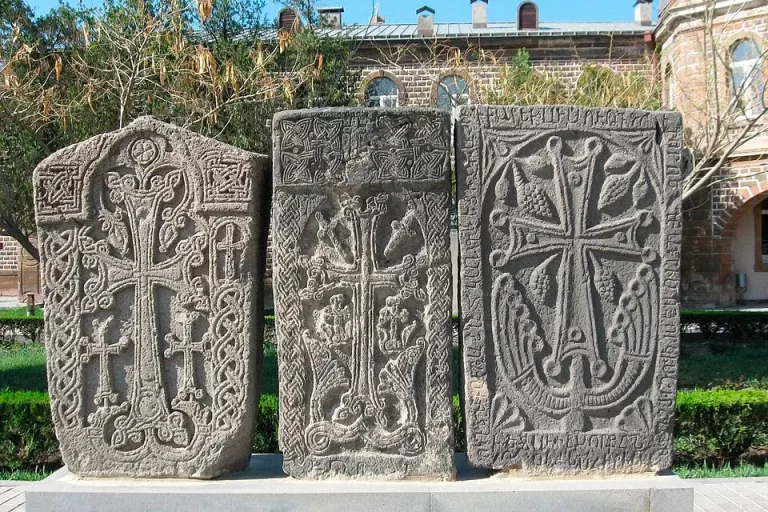
Khachkars are uniquely Armenian carved cross-stones. Learn how to read their symbolism, trace their history and find outstanding examples at Noratus, Goshavank, Geghard and other monasteries across Armenia.
Armenian culture is best understood not from a page but on the ground — in a village church, at a khachkar carved eight centuries ago, over a table that never seems to empty. The sites that carry this heritage are scattered across the country, and reaching them comfortably makes all the difference. A car with driver in Yerevan lets you move at your own pace between monasteries, temples and old towns, with a driver who knows the roads and the region.
To have the story behind each site told as you go — the history, the symbols, the traditions — our guided day tours from Yerevan take you to landmarks such as the pagan temple of Garni and the monasteries of Geghard, Sevanavank and Haghpat.
Travelling as a family or a group? A minibus with driver keeps everyone together across the longer cultural routes.