
Armenian Alphabet Monument
Not every country has a monument to its own alphabet — Armenia does. On the slopes of Mount Aragats above the village of Artashavan, scattered across a hillside meadow, stand 39 giant carved letters of the Armenian alphabet in pink, grey, and orange tuff. Beside them stands a statue of Mesrop Mashtots, the linguist-saint who created the alphabet in 405 CE. The open-air complex, commonly called the Park of Letters, was opened in 2005 to mark the alphabet’s 1,600th anniversary, designed by Jim Torosyan — one of the major Armenian architects of the 20th century, the same hand behind the Yerevan Cascade.
The location is not accidental: 20 km south of the monument, in the village of Oshakan, lies the grave of Mesrop Mashtots himself. A visit here is, in effect, the start of a short cultural pilgrimage that ends at his tomb. The site is 40 km from Yerevan (40–50 minutes by car), entry is free, and the grounds are open around the clock.
Quick Facts
- Built / Founded: 2005
- Architects: Jim Torosyan
- Location: Artashavan village, Aragatsotn Province
- Also known as: Park of Letters, Armenian Alphabet Alley, Հայոց այբուբենի հուշարձան
- From Yerevan: About 40 km / 40–50 minutes
- Entrance fee: Free
- Time needed: 20–40 minutes
- Best time to visit: May to October
- GPS coordinates:
40.407962, 44.380579
Mesrop Mashtots and the Birth of the Alphabet
The Armenian alphabet was created by the linguist, theologian, and missionary Mesrop Mashtots (c. 361/362 – 17 February 440 CE). Armenia had adopted Christianity in 301 CE — the first state in the world to do so — and within a century the country faced an acute practical problem: the scriptures and the liturgy were in Greek and Syriac, neither of which most Armenians spoke. Mashtots saw the issue clearly. Without a script of its own, the church’s reach would stay shallow and the nation would remain culturally vulnerable to assimilation by the neighbouring Persian and Byzantine empires.
Commissioned by King Vramshapuh and Catholicos Sahak Partev, Mashtots travelled on a research expedition to Mesopotamia, working in the great libraries of Amida, Edessa, and Samosata. He studied Greek, Syriac, and several other writing systems before, around 405 CE, producing a 36-letter alphabet that captured the phonetics of spoken Armenian with remarkable precision. The 19th-century German linguist Heinrich Hübschmann and the French Indo-Europeanist Antoine Meillet later independently described it as one of the most accurate phonetic alphabets ever devised.
The structure itself carries theological meaning. The first letter, Ա (Ayb), begins the word Astvats — “God.” The last of the original 36, Ք (Keh), begins Kristos — “Christ.” The religious framing was deliberately built into the architecture of the alphabet. In the Middle Ages three more letters were added — Օ, Ֆ, and the digraph ՈՒ — bringing the total to today’s 39 symbols.
The first sentence ever written in Armenian was the opening of the Book of Proverbs: “To know wisdom and instruction; to perceive the words of understanding.” Mashtots died on 17 February 440 CE and was buried at Oshakan, 20 km from the monument that now honours him
What You’ll See: 39 Letters in Tuff
The Park of Letters is an open-air sculpture park on a green hillside. The site is unfenced and accessible at any hour.
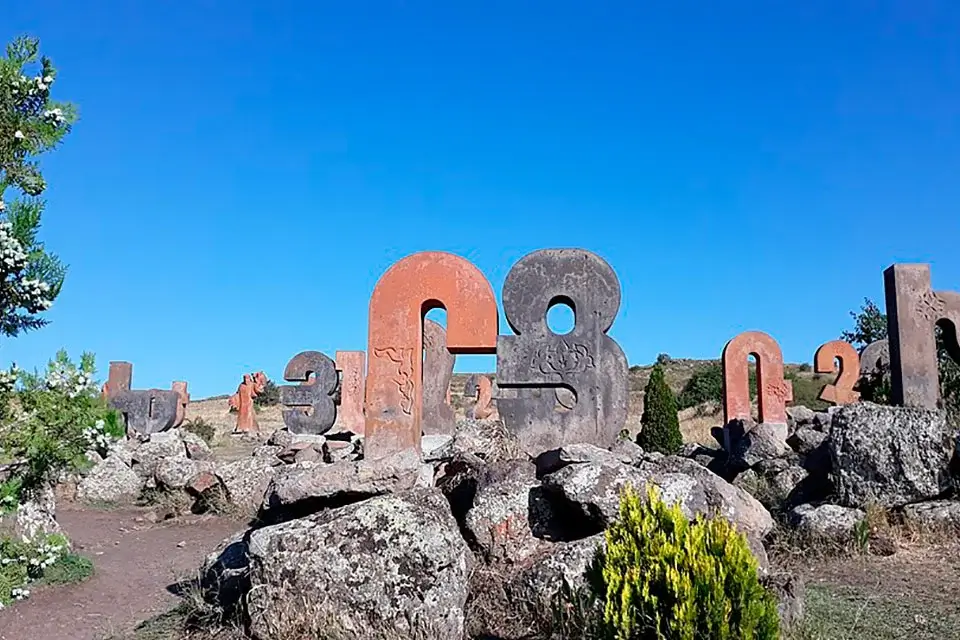
The 39 stone letters stand separately across the meadow, each roughly 1.5–2 metres tall, cut from pink, grey, and orange Armenian tuff. The carvers — stoneworkers drawn from across the country — gave each letter its own ornamental detail, drawing on the long tradition of Armenian calligraphy. You can walk freely between them, find the letter of your own name, and pose for photos. (The Armenian script resembles neither Cyrillic nor Latin; even visitors who have seen photographs are usually surprised by how alien it looks in person.)
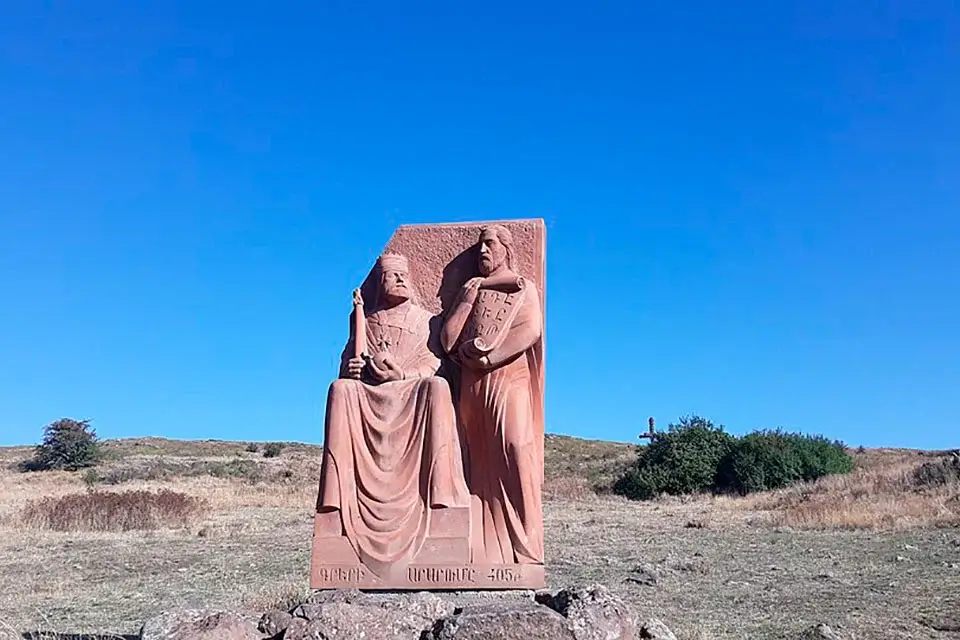
The statue of Mesrop Mashtots is the focal sculpture: the alphabet’s creator depicted with a pupil bent over a stone book at his feet. Around the complex, additional sculptures honour Armenian poets and thinkers, including the national poet Hovhannes Tumanyan.
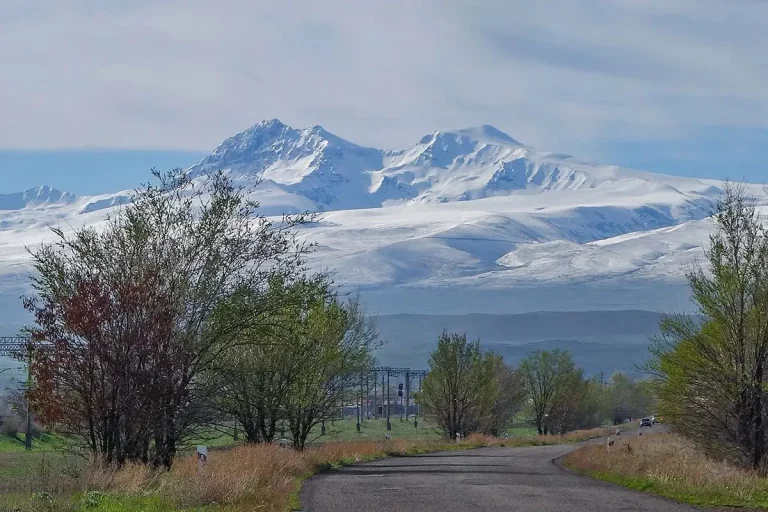
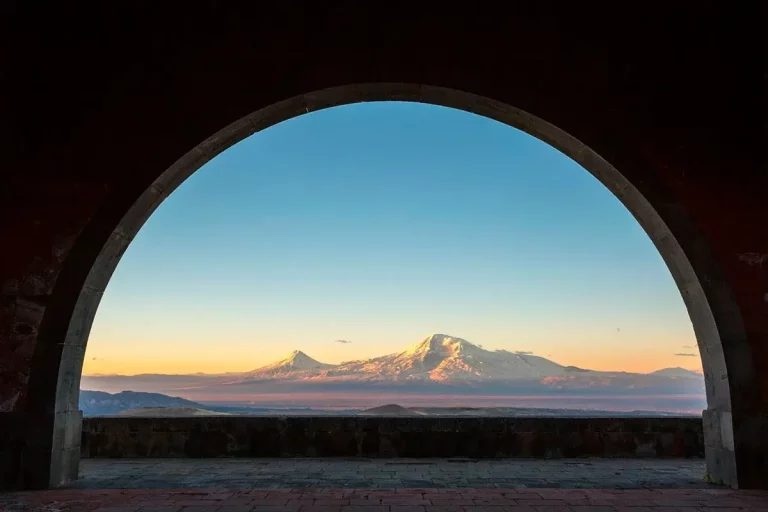
The panorama is part of the experience. From the site you look out over the Ararat Plain, with Mount Ararat (5,165 m) visible on clear days to the south-west, and the slopes of Mount Aragats (4,095 m) — the highest peak in modern Armenia — rising behind you.
Symbolism: Letters as Numbers
What’s almost never explained on travel-blog write-ups of the monument is that the original 36 letters were arranged into a deliberate mathematical structure: four rows of nine letters, where each row represented a numerical order of magnitude — ones (1–9), tens (10–90), hundreds (100–900), and thousands (1,000–9,000). The Armenian alphabet doubled as a number system, and was used as such for centuries; numerical inscriptions on medieval Armenian manuscripts and architecture follow the same convention.
The three letters added in the Middle Ages did not receive numerical values — they were appended to the end of the alphabetical sequence and stayed outside the counting grid. The asymmetry is itself revealing: it shows how meticulously the original 36-letter system was engineered, and why Armenians have long regarded their alphabet as an intellectual achievement rather than just a writing system.
The Architect: Jim Torosyan
The complex was designed by Jim Petrosovich Torosyan (1926–2014), a major figure of 20th-century Armenian architecture. Honoured as People’s Architect of the USSR, a full member of the Russian Academy of Arts, and Chief Architect of Yerevan (1972–1982), his portfolio includes the Yerevan Cascade (the monumental staircase in central Yerevan), the Republic Square metro station, the Hovhannes Toumanyan monument in Gyumri, and the Yerevan City Hall building.
Torosyan had returned to the theme of the alphabet before. In 1962 he had designed the Mashtots Memorial at Oshakan — two ten-metre granite stelae shaped like an open book, with Armenian letters carved across the pages. For the Park of Letters he chose a different approach — lean and monumental: the only formal element is the letter itself, its shape, its proportions, and its meaning.
The Park of Letters was among the last major works of his long career. Torosyan died in January 2014 and is buried in the Komitas Pantheon in Yerevan.
How to Get There and When to Visit
By car or with a driver: 40 km from Yerevan, 40–50 minutes via Ashtarak. The road is paved the whole way. The monument is marked on Google Maps and maps.me; parking is free and on-site. Coordinates: 40.407962, 44.380579.
The most practical option for international visitors is a private car with driver in Yerevan, which lets you string the Park of Letters together with Amberd Fortress, Lake Kari, Saghmosavank, and Oshakan in a single Aragatsotn day without changing transport.
On a day tour: the monument is a regular stop on guided Aragatsotn day trips out of Yerevan. The standard combination is Park of Letters → Amberd → Lake Kari → Saghmosavank. See available day tours from Yerevan.
By taxi: 7,000–12,000 AMD one way from Yerevan. Worth arranging with the driver to wait at the site, since there’s no return traffic to flag down.
On public transport: there’s no direct route. Marshrutkas from Kilikia Bus Station go to Ashtarak, from where a local taxi covers the remaining 15 km.
Best time of year:
- Spring (May–June) — the hillside is in flower, the air is fresh at altitude, temperatures are mild.
- Summer (July–August) — noticeably cooler on the slopes than in Yerevan, but the midday sun is fierce. Hat and water essential.
- Autumn (September–October) — warm tones in the landscape, soft light, few other visitors. The best season for photography.
- Winter — the site stays open, but the access road can be icy and the wind on the slope is sharp. Warm clothes and proper footwear.
The best light for photographs is early morning or the hour before sunset.
Practical Tips
- Time on site: 20–40 minutes for the monument itself. Combined with Amberd, Lake Kari, Saghmosavank, and Oshakan, it’s a comfortable full day from Yerevan.
- Footwear: closed, comfortable. The site is on a slope, with grass and uneven ground.
- Sun and wind: strong at altitude — bring a hat, sunscreen, and a light jacket regardless of the season.
- No infrastructure on site: no café, no shop, no toilets. The closest facilities are in Ashtarak, 15 km back down the road. Bring water and a snack.
- Mobile signal works but can be patchy — download offline maps in advance.
- Dogs: a small pack of stray dogs sometimes roams the meadow. They’re generally indifferent to visitors, but families with small children should keep an eye out.
What’s Nearby
The Park of Letters sits in the middle of one of Armenia’s richest day-trip clusters. Most visitors combine several of these in one outing:
- Amberd Fortress — a 7th–13th-century fortified complex on the southern slope of Mount Aragats at 2,300 m, about 30 km away. Massive basalt walls above the confluence of two rivers.
- Lake Kari — a high-altitude lake at 3,200 m near the base of Aragats’s southern peak; the standard launch point for summer ascents and a striking destination on its own.
- Saghmosavank Monastery — the 13th-century “Monastery of Psalms” on the rim of the Kasakh Gorge; one of the great medieval Armenian sites, about 25 km from the Park of Letters.
- Hovhannavank Monastery — Saghmosavank’s sister complex on the same canyon a few kilometres further south.
- Oshakan village — Mesrop Mashtots’ burial site, with the 19th-century Church of St Mesrop built over the saint’s grave (the original church here dated to the 5th century). About 20 km south of the Park of Letters — the symbolic closing point of the day.
- Byurakan Astrophysical Observatory — the historic Soviet-era observatory of Viktor Ambartsumian on the slopes of Aragats, about 15 km away.
Most of these fit comfortably into a single day with a private driver — see the Architectural Landmarks of Armenia category for the wider context, or a car with driver in Yerevan for the practical arrangement.