
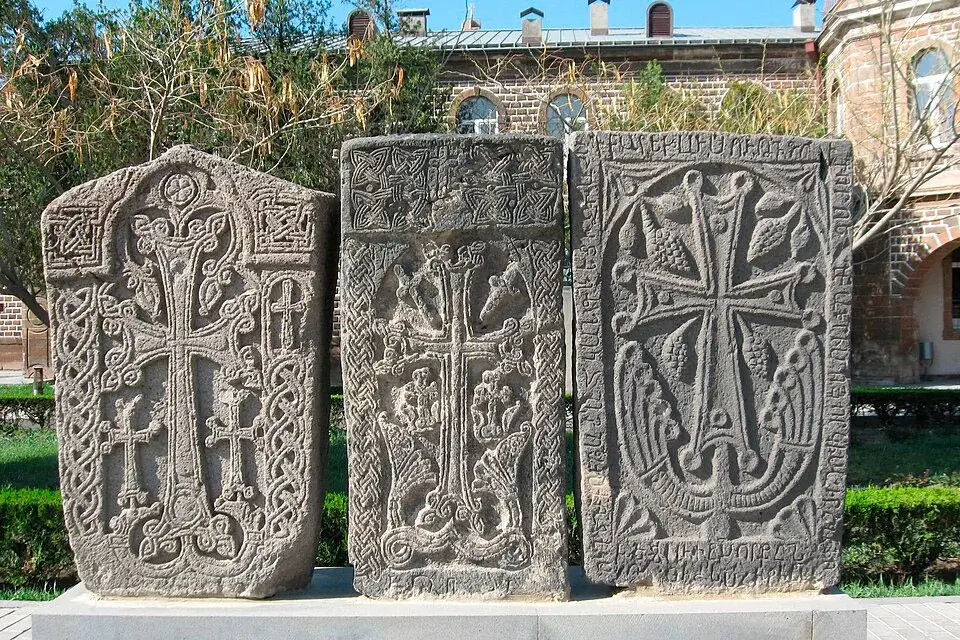
Armenian khachkars
Khachkars (խաչքար, literally “cross-stones”) are uniquely Armenian stone stelae carved with a central cross and intricate ornamentation. They are among the most recognisable symbols of Armenian culture: no two khachkars are identical, and the craftsmanship and symbolism behind them are included on UNESCO’s Representative List of the Intangible Cultural Heritage of Humanity. Across Armenia, they range from modest roadside stones to extraordinary masterpieces of medieval carving.
What Is a Khachkar?
A khachkar is an upright stone slab, usually carved from volcanic tuff or basalt, with a cross on its main face. The Armenian word combines khach (խաչ), meaning “cross”, and kar (քար), meaning “stone”.
A khachkar is not simply a gravestone or memorial marker. It developed into a distinct form of Armenian sacred art with its own structure, symbolism and carving techniques. Although monumental stone crosses exist in other Christian cultures, the khachkar tradition is specifically Armenian.
A typical khachkar stands between one and three metres high. Its front surface may be covered with such fine carving that the stone resembles lace. Each composition is individual: craftsmen varied the cross, rosettes, borders, inscriptions and plant motifs rather than repeating the same complete design.
What Does a Khachkar Symbolise?
The central cross represents salvation and the victory of life over death. On a khachkar, the cross is rarely shown in isolation: it often appears to grow from curling leaves, vines and branches. This transforms it into the Tree of Life—a living, flowering cross.
A carved rosette or circular motif usually appears beneath the cross. It is commonly interpreted as a solar symbol or wheel of eternity, known in Armenian as the arevakhach. The cross rising above this motif represents light, renewal and the continuity of life.
The surrounding plant ornament is more than decoration. Interwoven vines and uninterrupted patterns suggest infinity, while the complete composition evokes the Garden of Eden and the paradise toward which the soul aspires.
A khachkar therefore brings together three central ideas in a single stone: salvation through the cross, eternal life through the solar rosette and paradise through the flourishing plant ornament.
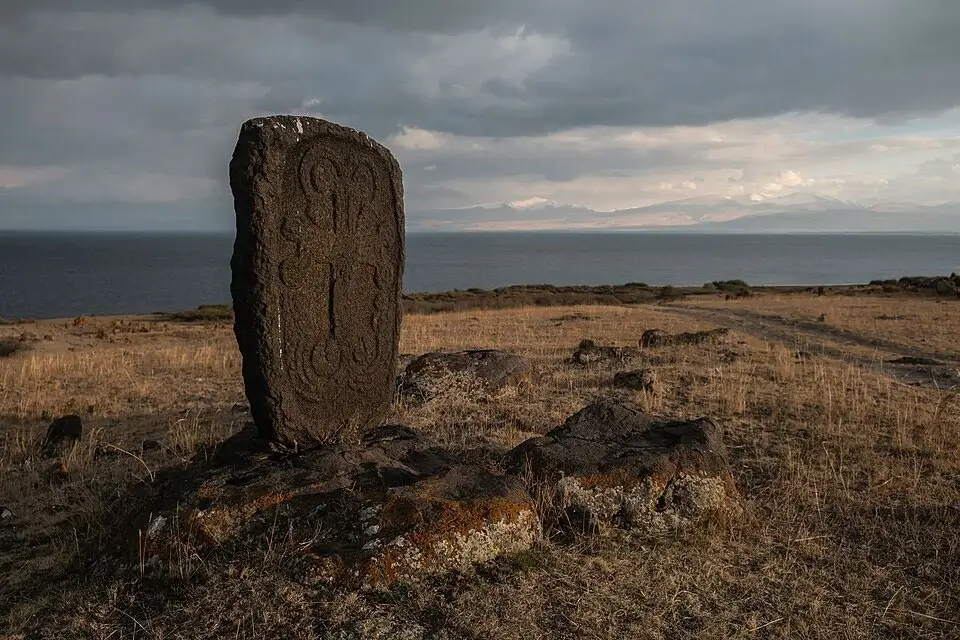
How to Read a Khachkar: The Main Carved Elements
When you look closely at a well-preserved khachkar, you can usually identify a consistent visual structure:
- Central cross: the principal element, often carved with widening or decorated ends.
- Rosette or solar disc: positioned beneath the cross and associated with eternity and the continuity of life.
- Plant motifs: vines, leaves and branches surrounding the cross and representing the Tree of Life.
- Decorative border: an interwoven frame around the composition, often formed from an apparently unbroken line symbolising infinity.
- Upper cornice: sometimes decorated with biblical scenes, saints or the person who commissioned the stone.
- Inscription: usually placed near the base or on the reverse, recording the patron, date, purpose of the khachkar or name of its craftsman.
The finest khachkars of the twelfth and thirteenth centuries are astonishingly detailed. Works associated with masters such as Momik, as well as the 1273 Amenaprkich or “All-Saviour” khachkar at Haghpat, can resemble jewellery carved in stone.
History of Khachkars: From the Ninth Century to Today
Khachkars in their recognisable form appeared during the ninth century, developing from earlier stone stelae and wooden crosses. One of the earliest securely dated examples was erected at Garni in 879 and is associated with Queen Katranide, the wife of King Ashot I Bagratuni.
The art of khachkar carving reached its height between the twelfth and fourteenth centuries. Craftsmen such as Timot, Mkhitar, Momik, Poghos and Vahram created increasingly complex compositions, and some recorded their names in inscriptions carved into the stone.
The tradition survived periods of invasion and foreign rule, continuing through the fifteenth, sixteenth and seventeenth centuries. One of the greatest later collections stood at the Armenian cemetery of Julfa in Nakhchivan, which historical accounts describe as having once contained thousands of khachkars. The cemetery was demolished and levelled between the late 1990s and the mid-2000s, a major loss of medieval cultural heritage documented through photographs, video and satellite imagery.
Khachkar carving remains a living tradition. Modern craftsmen create cross-stones to commemorate people, historic events, the Armenian Genocide, the 1988 earthquake and community anniversaries. Armenian communities have erected them throughout the diaspora, from Europe and Russia to North America.
Khachkars belong to the same cultural world as the Armenian alphabet and the architecture of Armenia’s medieval monasteries. All three were shaped by generations of craftsmen working within a distinctive artistic and religious tradition.
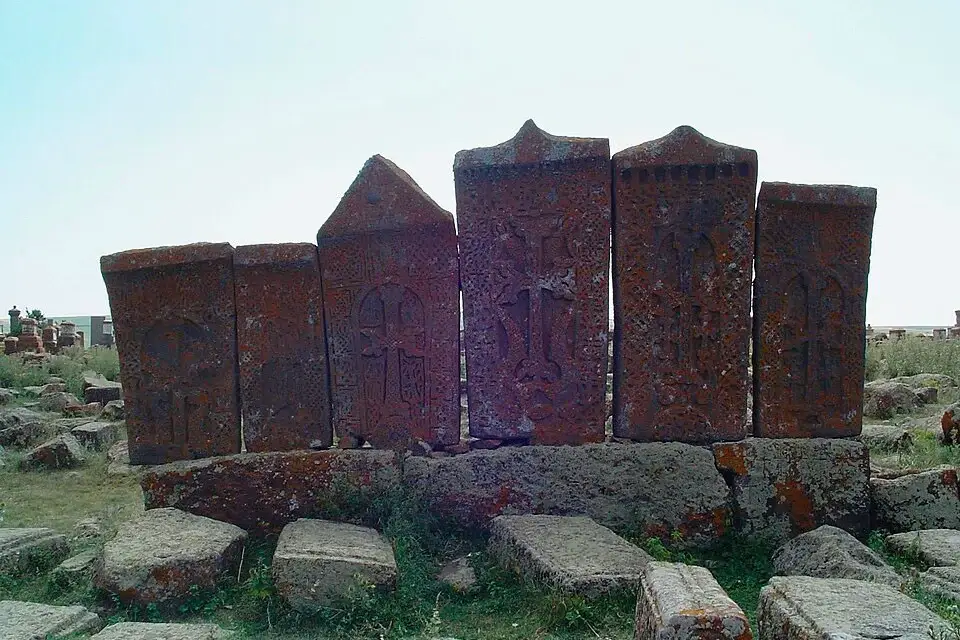
How Many Khachkars Are There in Armenia?
Researchers commonly estimate that more than 40,000 khachkars survive in Armenia and in regions historically inhabited by Armenian communities. They range from simple roadside stones to exceptionally detailed works created by celebrated medieval craftsmen.
An exact figure is impossible to establish. Khachkars continue to be discovered during archaeological work, many remain in remote mountain locations and others have been damaged or lost. Their enormous number and variety have made the cross-stone one of the most recognisable symbols of the Armenian cultural landscape.
Why Did Armenians Erect Khachkars?
Khachkars were created for several religious, commemorative and practical purposes:
- Memorial khachkars: erected in memory of a deceased person, sometimes as a gravestone or cenotaph.
- Votive khachkars: commissioned in gratitude to God for healing, a safe journey, the birth of a child or another important blessing.
- Commemorative khachkars: created to mark a military victory, the construction of a church or bridge, the founding of a settlement or another significant event.
- Protective khachkars: placed near springs, mountain passes and the boundaries of villages or monastic lands as spiritual protection for people and places.
- Architectural khachkars: carved into or set within the walls of churches and monasteries during construction or restoration.
The tradition formed part of a wider system of Armenian religious customs. Khachkars marked important moments in the lives of individuals and communities, and they continue to be commissioned for memorial and commemorative purposes today.
Khachkars and UNESCO
In 2010, “Armenian cross-stones art: symbolism and craftsmanship of khachkars” was inscribed on UNESCO’s Representative List of the Intangible Cultural Heritage of Humanity. The inscription covers the knowledge of stone carving, the symbolism of the designs and the traditions associated with creating and consecrating khachkars.
This recognition protects and celebrates the khachkar not simply as an individual historic monument, but as a living tradition. The skills, meanings and rituals connected with cross-stones continue to be passed from experienced craftsmen to new generations.
Where to See the Finest Khachkars in Armenia
Khachkars can be found throughout Armenia, but several locations stand out for the number, age or exceptional quality of their cross-stones.
Noratus Cemetery contains the world’s largest surviving field of khachkars. Located near Gavar on the shore of Lake Sevan, it has approximately 800 cross-stones dating from the tenth to the seventeenth centuries. The vast open-air cemetery is an essential stop during a longer trip around Lake Sevan.
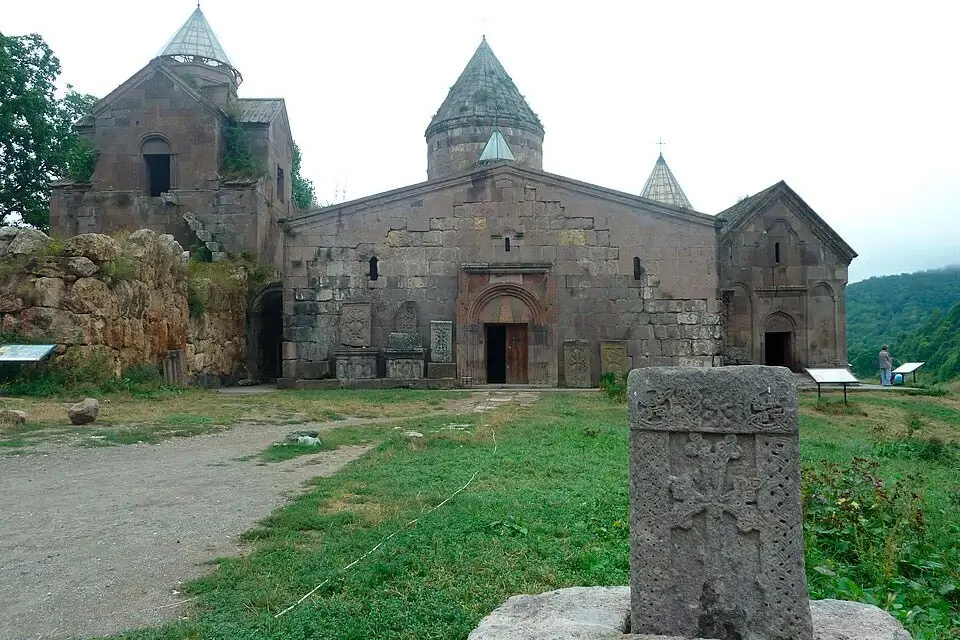
Goshavank Monastery is home to one of Armenia’s most celebrated cross-stones: the finely carved khachkar created by the master Poghos in 1291. Its extraordinarily delicate ornament is considered one of the finest achievements of medieval Armenian stone carving.
Geghard Monastery has khachkars carved directly into its rock walls as well as free-standing examples. The monastery is normally visited together with Garni Temple on one of the most popular routes from Yerevan.
Etchmiadzin has an open-air collection of historic khachkars near the cathedral complex. It is a convenient place to compare cross-stones from different periods and regions.
Sevanavank Monastery, standing above Lake Sevan, preserves several medieval khachkars, including examples dating from the thirteenth century.
Tatev, Haghpat, Sanahin and Noravank are also surrounded by khachkars from different periods. At these monasteries, the cross-stones form part of a wider architectural landscape of churches, chapels, tombs and carved stone decoration.
To see several outstanding khachkars without rushing, explore our private day tours from Yerevan or hire a car with a driver for a route tailored to the monasteries and historic sites you want to visit.
Khachkar Souvenirs and Gifts
Miniature khachkars are popular souvenirs from Armenia. Modern replicas are carved from volcanic tuff, basalt or obsidian and sold by craftspeople at Yerevan Vernissage Market, in souvenir shops near major monasteries and at the airport.
Sizes range from small tabletop pieces measuring 10–15 centimetres to large decorative stelae made for gardens and courtyards. A hand-carved khachkar made from natural stone is more than a simple ornament—it is a small work of art that can be kept for many years.
A modern khachkar replica is one of the most meaningful gifts you can bring home from Armenia. Buy newly made pieces from established craftspeople or reputable shops, and do not purchase old stones, archaeological fragments or supposed antiques without clear documentation.
Armenian Cultural Heritage
See Armenia’s Khachkars in Person
Visit Noratus, Goshavank, Geghard, Etchmiadzin and Armenia’s medieval monasteries on a private route from Yerevan. We will help plan the itinerary, arrange a comfortable vehicle and add a professional guide when requested.
Private itinerary · Comfortable vehicle · English-speaking guide available on request


