Azat Reservoir
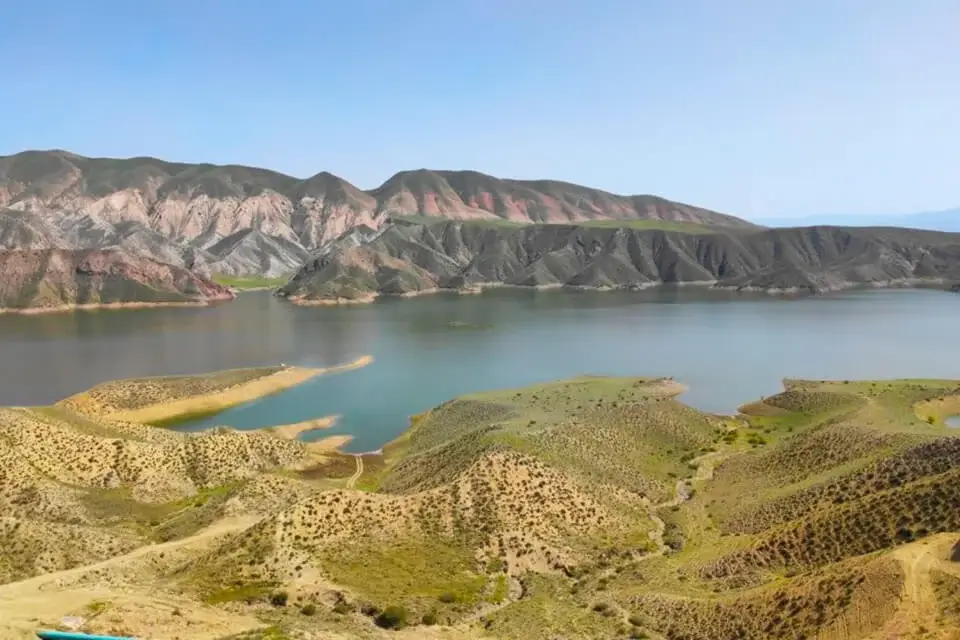
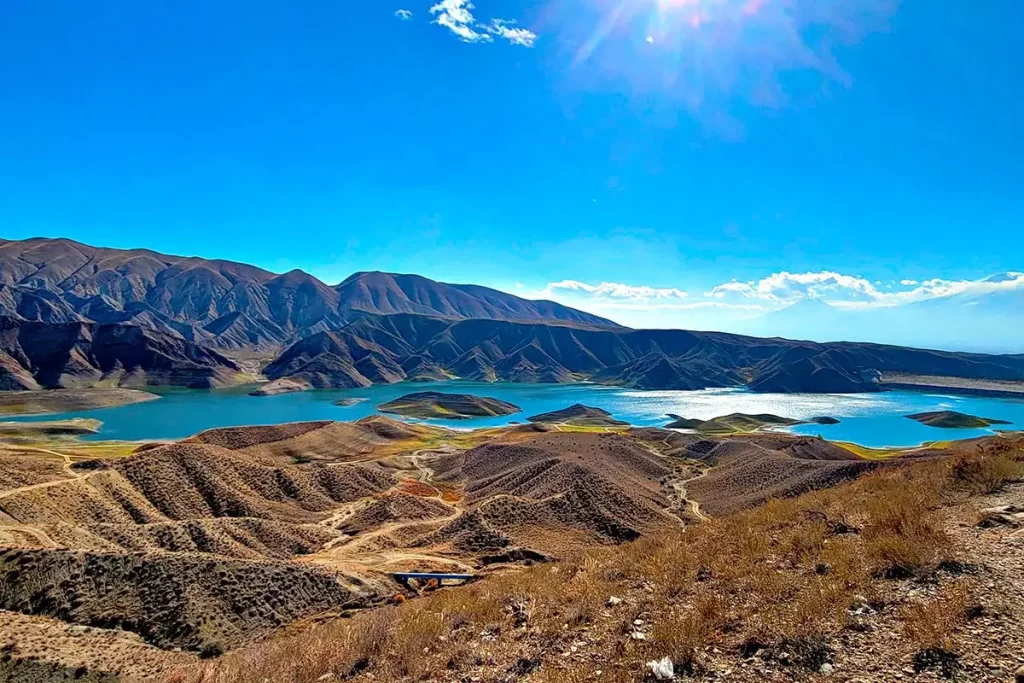
Azat Reservoir is a man-made lake on the Azat River in Ararat Province, around 35 km southeast of Yerevan, built in 1976 to irrigate the Ararat Valley. On a map it’s a Soviet-era irrigation pond; on the ground it looks like a genuine mountain lake — bright turquoise water held between the same black basalt walls that, a few kilometres upstream, form the famous Symphony of Stones. It’s the closest scenic lake to the capital, the most overlooked stop on the Garni–Geghard road, and one of the most photogenic spots in the Yerevan day-trip zone.
Quick Facts
- Built / Founded: 1976 (commissioned)
- Location: Near Lanjazat village, foot of Mount Yeranos, Ararat Province
- Also known as: Azat Reservoir, Azati jrambar, Ազատի ջրամբար
- From Yerevan: 35 km / 40–60 min
- Elevation: 1050 m
- Depth: up to ~72 m
- Entrance fee: Free
- Time needed: 20–40 minutes on site; pairs with Garni–Geghard day trip
- Best time to visit: April–May (peak colour); September–October
- Status: Working reservoir; fourth-largest in Armenia
- GPS coordinates:
40.072, 44.618
Where Azat Reservoir Sits
The reservoir lies near the village of Lanjazat in Ararat Province, at the foot of Mount Yeranos — the rust-red, treeless ridge that frames the south shore. Coordinates: 40.072, 44.618. From Yerevan it’s about 35 km on paved road, normally 40 to 60 minutes depending on traffic.
It’s worth understanding the geography here. The Azat River begins on the slopes of Mount Spitakasar in the Geghama range, flows down through the Garni Gorge — past the Symphony of Stones — and continues into a narrower canyon, where the reservoir was created by closing the gorge with a 70-metre earth-and-rock dam. The same lava flow that produced the columnar basalt at the Symphony of Stones makes up the canyon walls around the reservoir, so what you see here is the same Pleistocene-era geology — just downstream, holding turquoise water instead of an open river.
The reservoir is the fourth-largest in Armenia by area (about 2.85 km²) and holds roughly 70 million cubic metres of water. Its depth — around 72 metres at the deepest point — is what keeps it ice-free in winter and gives the water that mountain-lake colour.
Why It’s Worth Stopping
The view. The single reason most travellers come is the contrast: vivid turquoise water set against black basalt cliffs, with the Geghama Mountains in the background. There’s nothing else like it within an hour of Yerevan.
The geology. Standing on the dam, you’re looking at the same basalt columns that make the Symphony of Stones famous — only here they hold a lake instead of forming an open canyon wall. It’s a natural extension of the Garni Gorge story.
The pairing. Azat Reservoir sits exactly on the road between the three big monuments of the Garni Valley: Garni Temple, the Symphony of Stones, and Geghard Monastery. Stopping at the reservoir adds about half an hour to that day and turns three monuments into a complete circuit.
The quiet. Despite being 40 minutes from the capital, the reservoir gets a small fraction of the visitors that Garni and Geghard do. Most days you’ll share the dam with two or three cars.
How the Light Works — Best Photo Times
The defining photograph here is the turquoise water against the dark basalt. That contrast is at its best in late spring and early autumn, when meltwater has filled the reservoir to its high mark and the colour reaches its most saturated. The colour itself comes from fine basalt sediment that the river carries down from the Geghama Mountains — not from minerals or algae.
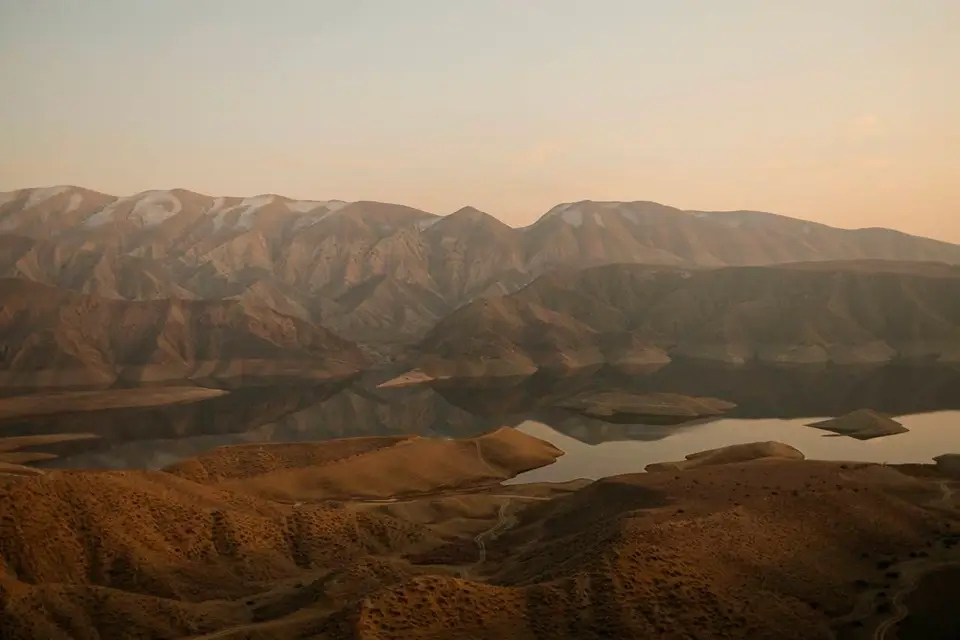
The light matters as much as the season. Mid-morning and the hour before sunset give the softest angle and the strongest shadow play across the basalt columns. Midday is the worst time — the sun comes straight down, contrast goes harsh, the water flattens out, and there is no shade anywhere along the shore.
The three useful vantage points:
- The dam itself — the standard panoramic view, water disappearing into the canyon, mountains in the distance. Best with a 35–50 mm lens.
- The shore path — a low-angle viewpoint that gives mirror reflections, especially on a windless evening.
- The ridge above the dam — a steep 50–80 m climb behind the dam gives a top-down composition that works for drones and wide lenses.
How to Get to Azat Reservoir
By car or transfer — the simplest option. From Yerevan take the H3 highway towards Garni, and just before the village take the right turn signed for Lanjazat / Azat Reservoir. From there a paved mountain road runs another 3 km to the dam. A standard saloon car handles the whole route in dry weather; after heavy rain the last section is slow. Parking at the dam is free.
If you don’t have your own car, the cleanest setup is a car with driver from Yerevan — the driver will fold the reservoir into the standard Garni–Geghard day automatically. For groups and families a minivan with driver handles the same route comfortably. Most travellers see the reservoir as part of a day tour from Yerevan combining Garni, Geghard, the Symphony of Stones, and the reservoir.
On foot from Garni — for active travellers there’s a marked hiking route, the “Temple of the Sun” trail, that descends from Garni Temple into the Azat Gorge, passes the Symphony of Stones and an 11th-century stone bridge, and continues downstream to the reservoir. It’s of medium difficulty and takes about 3.5 hours one way. Coming back the same route adds another 3.5 hours, so most hikers arrange a pick-up at the dam.
Public transport runs only as far as Garni village. From Garni, the reservoir is a 3–4 km walk along the road or a short taxi ride.
When to Visit
Spring (April–May) — the best window. The reservoir is at its highest, water at peak turquoise, poppies on the slopes, daytime around +15…+22 °C.
Summer (June–August) — clear but punishing in the middle of the day, with afternoon temperatures of +30…+38 °C and no shade anywhere on the shore. Go before 10 a.m. or after 5 p.m., or skip July altogether.
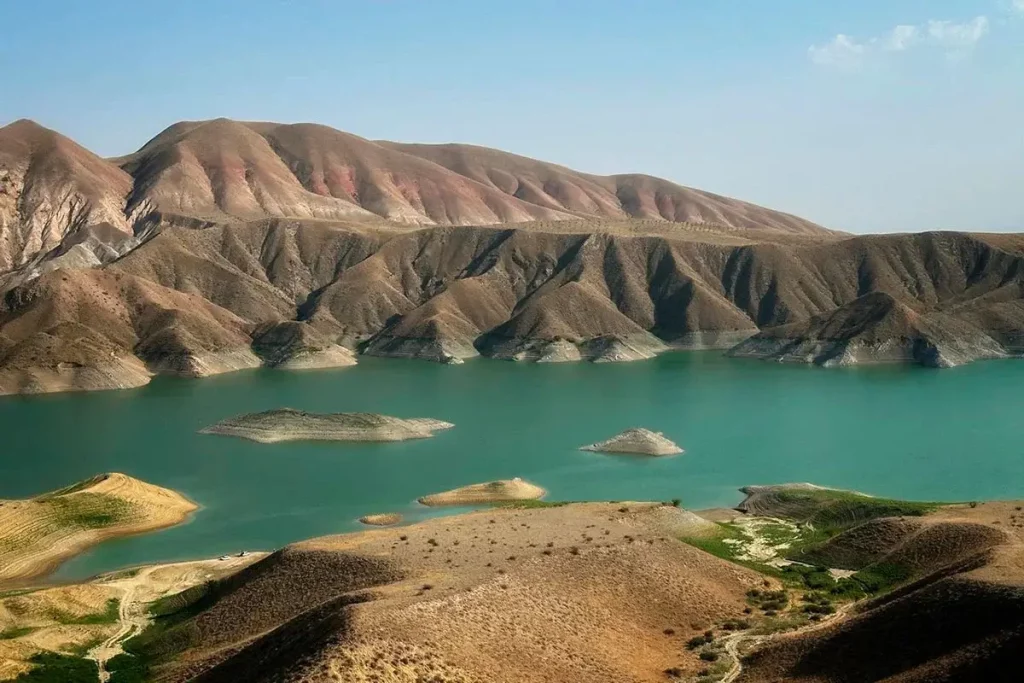
Autumn (September–October) — the second-best season after spring. Warm slopes in ochre and rust, the colour of the water still strong, and almost no other visitors.
Winter (December–March) — the reservoir is too deep to freeze, but the colour shifts from turquoise to a deep, almost steel blue. Snow on the dark basalt slopes makes for a graphic, minimal scene that you can usually have to yourself. The road is cleared.
At 1,050 m the reservoir is not high, but the canyon channels a strong evening wind. A windbreaker is sensible in any season; in summer, sunscreen and at least 1.5 litres of water per person are essential — there is no shade on the shore and no shop on the way back to Garni.
What You Can Do at the Reservoir
It’s primarily a viewpoint, but the water itself supports a few low-key activities:
- Photography — the main draw. Sunrise and sunset are the rewarding hours.
- Walking — a 1–2 km loop along the shore from the dam, easy in dry weather. Not really a trail, more of a worn path.
- Stand-up paddleboarding — SUP boards are a recent addition; some Yerevan rental shops will deliver to the dam by arrangement. Calm mornings only.
- Fishing — carp and a few other species live in the reservoir; informal fishing happens here, but check current local rules before bringing tackle, as parts of the water-protection zone are restricted.
What you can’t do: swim. The reservoir is part of the Ararat Valley irrigation system and swimming is not permitted. The water is around +18 °C even in midsummer, the banks are steep, and the dam area has whirlpools.
Practical Notes
- No infrastructure on site — no café, no toilet, no shop, no bins. The nearest of all four is in Garni village (5 minutes by car).
- Entry is free; parking at the dam is free.
- Plan 20–40 minutes for a photo stop, or up to 2 hours if you walk the shore.
- Bring everything: water, snacks, sunscreen, hat, windbreaker, and a bag for your trash.
- Kids are fine on the walking path; keep them away from the dam edge — there are unguarded drops.