
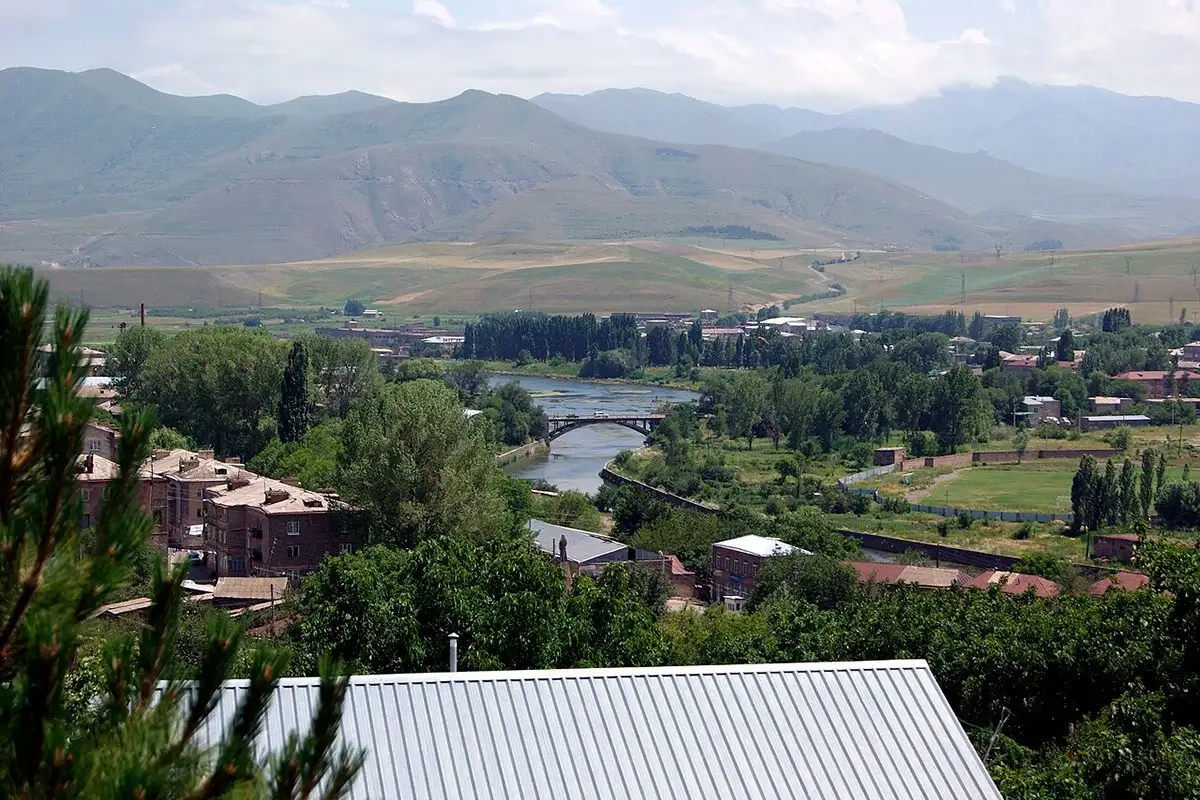
Sisian
Sisian (Armenian: Սիսիան) is a small town in Syunik Province in southeastern Armenia. It sits on the Sisian Plain at 1,587 metres above sea level, on both banks of the Vorotan River — a tributary of the Araxes basin. Around 13,000 people live here. The settlement is very old, but it only received city status in 1974; before then it was a village called Karakilisa. Until the 10th century Sisian was one of the cultural and spiritual centres of the Syunik region. From Yerevan it is 217 km south — roughly a three-and-a-half-hour drive.
Sisian is Armenia’s gateway to the deep past. Five kilometres north stands Karahunj, a field of 222 upright stones sometimes called “the Armenian Stonehenge.” At the edge of town, the Shaki Waterfall drops 18 metres into a gorge whose caves sheltered people in the Paleolithic era. And on Mount Ughtasar — a volcanic massif above 3,000 metres — sits a stretch of stone carrying more than 10,000 petroglyphs, some of them close to 5,000 years old. Few places in the Caucasus concentrate this much prehistory in a single day’s driving.
What to See in Sisian and Around
Sisian and its surroundings combine prehistoric monuments, waterfalls, high-altitude petroglyphs and medieval landmarks. The main attractions below have their own detailed guides with practical information for planning a visit.
 Shaki Waterfall
 Sisavan Church
 Ughtasar Petroglyphs
 Vorotnaberd Fortress
 Vorotnavank Monastery
 Zorats Karer
Geography and climate
Sisian lies on the open Sisian Plain in the middle course of the Vorotan River, in the middle of a bowl formed by the Zangezur Mountains and a volcanic massif crowned by Mount Trasar (3,594 m). The town sits six kilometres south of the main Yerevan–Meghri highway; the turnoff is signposted from the main road.
The climate is continental, noticeably drier and colder than in nearby Goris. The annual average is +6.6 °C. Summers are warm, winters can be severe — the record low is −37 °C. Rainfall is light at around 365 mm a year, with most of it falling in spring. In July and August, Sisian is a natural escape from the Yerevan heat: cooler by day and cool enough at night to sleep with the window open.
A short history
The Sisian area has been inhabited for tens of thousands of years. Paleolithic tools have been found in the caves and rock shelters around the Shaki Waterfall. The megalithic complex of Karahunj is dated to the 3rd–5th millennium BC, which places its oldest structures well before the first Egyptian pyramids.
Until the 10th century AD Sisian was one of the leading centres of Syunik’s cultural and religious life. The town was sacked in 1103, and later suffered under Mongol invasions in the 13th century. From the 16th through the 18th centuries the region fell under Persian influence. The modern town in its current form took shape in the 1920s and 1930s under Soviet rule; the old village of Karakilisa was renamed Sisian in 1935 and received city status in 1974.
Two figures from Sisian are still remembered in Armenia’s cultural memory. Israel Ori (1658–1711) was a diplomat and one of the founding figures of the Armenian national liberation movement, who spent decades trying to persuade European courts to support an Armenian uprising against Persian rule. Nicholas Adontz (1871–1942) was a Byzantine historian whose work on medieval Armenia is still foundational.
Sisian’s Main Attractions
Mount Ughtasar and its petroglyphs
Some twenty kilometres from Sisian rises Mount Ughtasar, a volcanic massif with a summit plateau at around 3,300 metres. Scattered across the plateau, on flat basalt slabs left by ancient eruptions, are more than 10,000 petroglyphs: hunting scenes, chariots, wild animals, geometric patterns and figures dancing in rings. The oldest carvings are around 5,000 years old; later additions run into the Bronze Age.
Ughtasar is one of the largest concentrations of prehistoric rock art anywhere in the Caucasus — but reaching it is not easy. The last stretch of the road is passable only in a 4×4, and the final approach is on foot. The season is short: June through September. Going with a guide is strongly recommended.
Sisavan Church (7th century)
A small stone church of the Armenian cross-in-square type, distinguished by a twelve-sided dome, stands inside Sisian itself. It is traditionally dated to the 7th century, though some sources push it back into the 6th. Fragments of medieval frescoes survive inside. It is one of the oldest still-functioning churches of Syunik.
In the town
The Sisian Archaeological and Ethnographic Museum holds finds from Karahunj and Ughtasar together with an ethnographic collection of medieval Syunik. On the main square stands a striking Soviet-era monument to Armenian revolutionaries — a woman in traditional dress holding out a wreath — a rare surviving example of the Soviet monumental style in this part of the country.
A comfortable two-day route from Yerevan: Yerevan → Noravank → Sisian (Karahunj and Shaki Waterfall) → Goris (overnight) → Tatev → Khndzoresk → Yerevan. The distances make it worth doing with a car with driver from Yerevan or as part of a private day tour.
Who Sisian suits
- Travellers interested in archaeology and prehistory — Karahunj, the Ughtasar petroglyphs and the Paleolithic caves of the Shaki gorge give Sisian the highest concentration of pre-Christian sites anywhere in Armenia within a small radius.
- Nature travellers — the Vorotan gorge, the Shaki Waterfall and the alpine slopes of Ughtasar reward a slow day.
- Anyone driving south to Goris and Tatev — Sisian sits directly on the route. A two-hour stop here — Karahunj plus the waterfall — fits naturally into a full Syunik day.
- Travellers wanting quiet — Sisian is small, uncrowded and unpolished. Very few international tour buses stop here.
Best time to visit
- Spring (April–May) — the best time for the Shaki Waterfall, when spring melt gives it full volume. Ughtasar is still snowed in.
- Summer (June–August) — the peak season. All roads are open, including the difficult track to Ughtasar. Daytime temperatures are comfortable at +18 to +25 °C, and evenings feel a world away from Yerevan.
- Autumn (September–October) — clear air, sharp light and low tourist numbers. Ughtasar stays open until the first snow.
- Winter — can be harsh, down to −20 °C, occasionally the record −37 °C — but Karahunj and the waterfall stay open. Ughtasar is closed.
How to get there
Sisian is 217 km from Yerevan — a drive of about 3 to 3.5 hours on the M-2 highway via Areni and the Vorotan Pass. The town sits six kilometres south of the highway, and the turnoff is clearly signposted.
Public transport is thin. Marshrutkas heading to Goris or Kapan pass Sisian, but they drop you at the highway junction, not inside the town — and none of the outlying sites (Karahunj, Ughtasar, the Shaki Waterfall) can be reached without your own vehicle. The realistic options are a rental car, an organised tour, or a private driver from Yerevan who can fit Sisian into a two-day southern route.
Frequently Asked Questions
See more on Armenia’s cities or plan the trip with a car with driver from Yerevan.