
Amberd Fortress
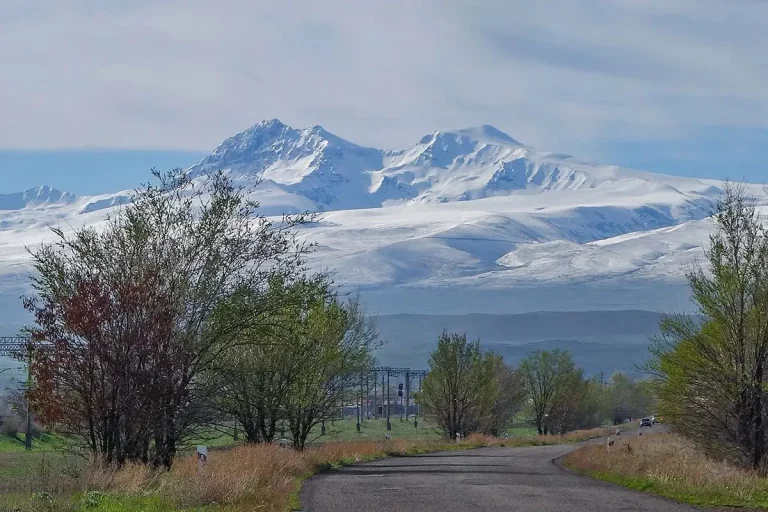
Amberd Fortress (Armenian: Ամբերդ — “fortress in the clouds”) is a medieval Armenian castle-town on the southern slopes of Mount Aragats, on a triangular spur at 2,300 m, where the rivers Amberd and Arkashen meet. The site has been fortified since prehistory; the visible complex was built between the 7th and 13th centuries by three of medieval Armenia’s most powerful princely houses — the Kamsarakans, then the Pahlavunis, then the Vachutians. At its core stand a three-storey basalt castle of about 1,500 m², the Vahramashen Church of 1026, a rare set of medieval baths with a Roman-style hypocaust, and a covered passage 300 m long that descends to the river for water during siege. In 2024, Europa Nostra included Amberd in its list of the 7 most endangered cultural heritage sites in Europe. The fortress lies about 60 km from Yerevan and combines naturally with Saghmosavank, Hovhannavank, and Lake Kari for a full day on Aragats.
Quick Facts
- Built / Founded: 7th c. (Kamsarakans); 11th c. (Pahlavunis); Vahramashen Church 1026
- Architects: Vahram Pahlavuni (church 1026)
- Location: Byurakan, Aragatsotn Province
- Also known as: Amberd, Amberd Fortress, Amberd Castle, Fortress in the Clouds, Vahramashen Church, Ամբերդ, Ամբերդ ամրոց
- From Yerevan: ~60 km from Yerevan (~1.5 hours)
- Elevation: 2300
- Entrance fee: 1,500 AMD
- Time needed: 1–1.5 hours
- Best time to visit: May–October
- Status: National cultural heritage monument; Europa Nostra "7 Most Endangered" (2024)
- GPS coordinates:
40.3885461, 44.2264791
From the Kamsarakans to the Vachutians
The Amberd spur was inhabited as early as the Stone Age, and traces of a Bronze Age and Urartian fortress survive among the foundations. The first historical castle was built in the 7th century by the Kamsarakan princes, a noble house tied to the Arsacid royal dynasty and traditionally linked to St Gregory the Illuminator.
Four centuries later the site passed to the House of Pahlavuni — the most powerful noble family of the Armenian Bagratid kingdom of Ani. Prince Vahram Pahlavuni, supreme military commander of the kingdom, rebuilt the castle in the early 11th century, added three new bastions along the ridge above the Arkashen canyon, organized the water supply, and in 1026 crowned the work with a new church. Vahram defended Ani against the Byzantines and was killed in battle against the Seljuks at the age of eighty. The career — and the patronage — of the Pahlavunis is recorded in the manuscripts of Vahram’s nephew, Grigor Magistros Pahlavuni, who founded Kecharis Monastery in 1033 and led the academy at Sanahin.
After the fall of Ani in 1064 and the Seljuk invasions of the 1070s, Amberd became a Seljuk garrison. In 1197 the joint Armenian-Georgian army under General Zakare Zakaryan liberated the fortress; over the next decades the Zakarians refortified the walls and rebuilt the outer structures.
In 1215 Amberd was purchased by Vache I Vachutian, the leading vassal of the Zakarians in Aragatsotn. This was the same year Vache built his Surb Sion at Saghmosavank in the Kasagh canyon below; the two projects — fortress on Aragats and monastery on the river — were halves of a single seigniorial program. Amberd became the administrative capital of the Vachutian principality and the central node of the Aragatsotn province.
In 1236 the Mongols stormed the fortress; the central castle was destroyed. The site recovered partially under the late Vachutians in the 14th century — at one point “the province of Amberd” was used as a synonym for the Ararat plain — but by the close of the medieval period it was finally abandoned and never reoccupied. Excavations beginning in 1929 have uncovered bronze lamps and incense burners, Chinese porcelain, painted Egyptian glass, faience tableware, coins, and weapons — clear evidence that Amberd, despite its altitude, sat on a working east-west trade circuit.
The Castle — Three Floors of Basalt
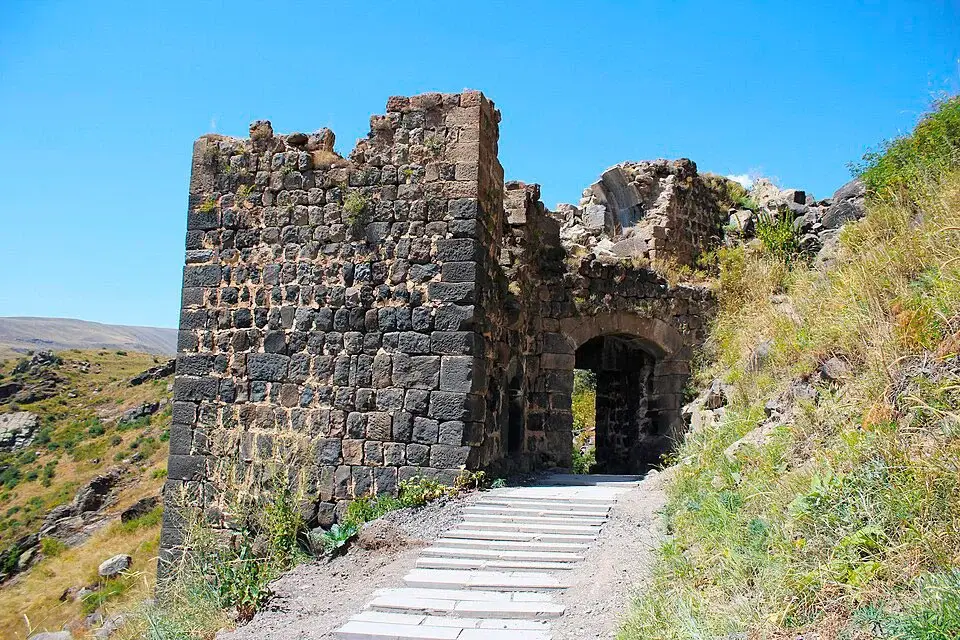
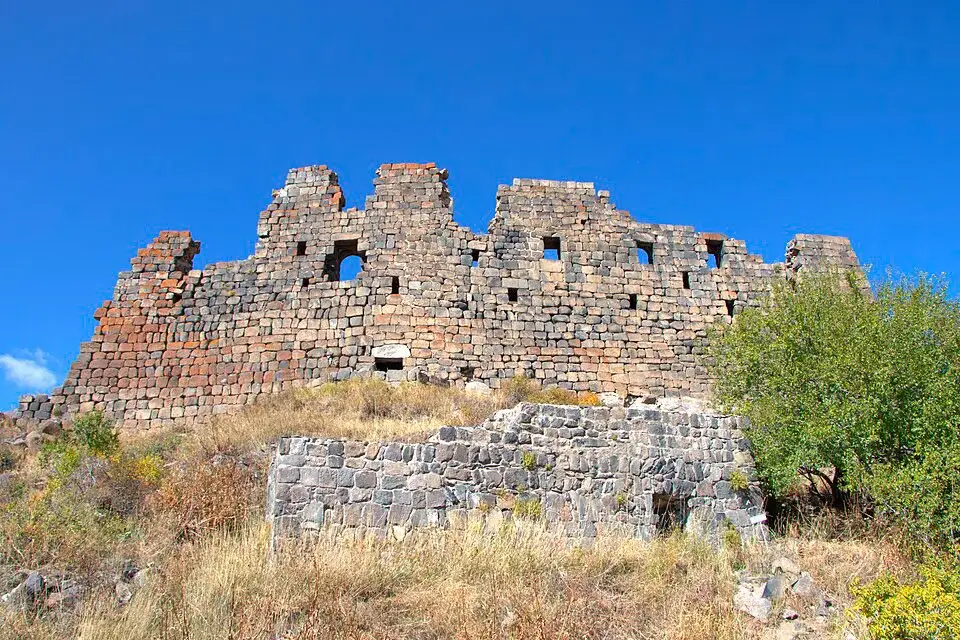
The castle stands on the highest point of the spur. It is a three-storey rectangular keep of about 1,500 m², built from roughly hewn basalt blocks set in lime mortar. A longitudinal interior wall divides each floor into two halves: a long corridor along one wall, with access to the bastions, and five rooms in a row along the other — entered in sequence, one through the next. Wooden plank floors on log beams divided the storeys. The third floor housed the reception rooms and private chambers of the prince.
The curtain walls — 15–16 m high and 2–3 m thick — close the spur on the only accessible side, reinforced by semi-circular three-tier bastions built with a slight inward curve so defenders could keep eye contact with anyone climbing the slope below. The remaining sides need no walls: the Amberd and Arkashen gorges drop almost vertically. Two gates — the Arkashen and the Amberdadzor — open through the curtain.
Vahramashen Church (Surb Astvatsatsin), 1026
The church stands at the very tip of the spur, where the gorges meet. Its formal dedication is to Surb Astvatsatsin (Holy Mother of God); locals call it Vahramashen, “built by Vahram,” after the founding inscription on the lintel of the north portal that names Prince Vahram Pahlavuni and dates the completion to 1026.
It is a cruciform domed church with four two-storey corner chambers. The plan is a rectangle on the outside, a circle on the inside, with a twelve-faceted drum crowned by an early form of conical umbrella dome — by some Armenian architectural historians regarded as the first example of this dome type in Armenian architecture (echoed later at Geghard, Hovhannavank, Saghmosavank, and Harichavank). The exterior is famously austere — clean basalt facets, paired pilasters at the edges of the drum, almost no decorative carving. The proportions inside have no measurable difference between the parallel walls, including on the diagonal — a notable feat of medieval Armenian geometry. Vahramashen was repaired in 1936 and again in 1970.
The Baths — A Hypocaust on Mount Aragats
A short walk south of the castle stand the ruins of one of medieval Armenia’s most interesting baths. Built under the Pahlavunis in the 10th–11th centuries, the bathhouse consists of two domed rooms — a changing room and a washing room — plus a boiler. The floor was raised on stone supports; hot air from the furnaces circulated underneath, heating the bathing chamber by the Roman hypocaust method — the same technology found at Garni, Ani, and Lori Berd.
The plumbing is the unusual detail: cold water arrived through clay pipes from sources higher on the slope; hot water arrived through iron pipes from a furnace 4–5 m away — an early use of differential piping for differential thermal loads.
During excavations under the floor of the bath, archaeologists discovered the burial of a court jester — most likely the man who entertained the Pahlavuni prince during his time in the bath.
Water and the Secret Passage
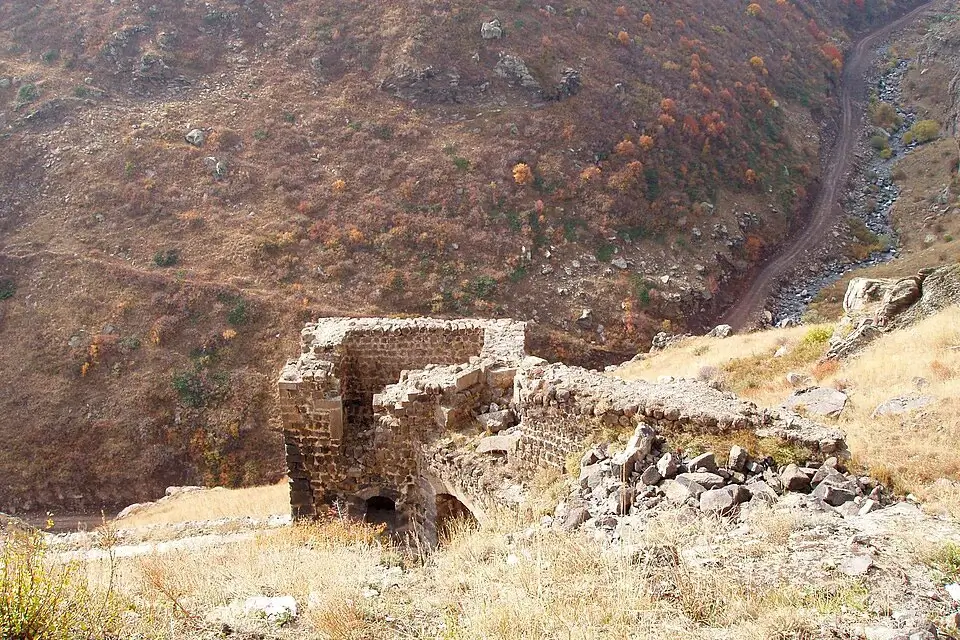
A working water system at 2,300 m was as crucial to Amberd as the walls. Above the fortress, on the higher slopes of Aragats, terra-cotta pipes ran for four to five kilometres from springs and snow-melt reservoirs into the citadel; inside the walls, stone cisterns stored what arrived. The line above ground was the obvious weakness — easy for besiegers to cut. The solution was a covered, stepped passage through a cleft in the rock down to the Arkashen River.
The longest of these passages reached 300 m in length and stood up to 2 m high. Each was built by trenching the slope, raising stone walls, capping the trench with slabs, and disguising the cap with field stone — easier than tunnelling through Aragats’s basalt, and as effective.
How to Get to Amberd from Yerevan
The fortress lies about 60 km from Yerevan, around 6.4 km north-west of Byurakan village, on the southern flank of Mount Aragats. The drive takes about 1.5 hours; the last ten kilometres are a paved mountain switchback through high pasture.
- By car: Yerevan → Ashtarak highway → Byurakan → Amberd (about 1.5 hours). Parking is available at the trailhead near the spur.
- Public transport: there is no public bus to the fortress. A taxi from Byurakan is possible, but expensive without a return arrangement.
- With a driver: a car with driver in Yerevan is the natural way to combine Amberd with Saghmosavank, Hovhannavank, the Byurakan Observatory, and (in summer) Lake Kari on the upper slope of Aragats — a full Aragatsotn day from Yerevan.
Visiting Amberd — What to Know
The fortress sits in the open, on a windswept spur, at a high elevation.
- Best season: May to October. The mountain road is regularly blocked by snow in winter and is not always cleared until late spring.
- Bring warm layers — even in July the wind on the spur is cold. A jacket and proper shoes are essential.
- No shops or cafés at the site. Bring water, snacks, and sun protection.
- No safety rails at the gorge edges — be careful with children.
- Ticket: entry to the complex is around 1,500 AMD (prices change occasionally).
- Inside the castle, the lower-storey rooms are accessible; floors above are partly ruined.
- Vahramashen Church is fully accessible — note the pure proportions inside and the north-portal inscription.
- The hypocaust baths sit a short walk south of the castle; the system of supports under the bathing-room floor is the standout feature.
- The classic photographs of Amberd are taken from the path along the Arkashen ridge, with the church silhouetted against the gorge below.
A recommended day route from Yerevan: Saghmosavank → Hovhannavank → Amberd → Byurakan Observatory (or, in summer, continue up to Lake Kari at 3,200 m for an alpine extension).
What to See Nearby
- Lake Kari — about 15 km further up Aragats at 3,200 m; the trailhead for the south summit of Mount Aragats. Accessible only in summer.
- Byurakan Astrophysical Observatory — about 15 km away; founded by Viktor Ambartsumian in 1946, one of the world’s leading optical observatories.
- Saghmosavank Monastery — about 20 km away; the Surb Sion built by Vache Vachutian in 1215, the same year he bought Amberd. The two sites are halves of one patronage program.
- Hovhannavank Monastery — about 25 km away; the same Vache Vachutian’s cathedral of 1216–1221 on the same Kasagh canyon.
- Harichavank Monastery — about 50 km away; the architectural prototype of the Hovhannavank dome and a major Vachutian donor site.
- Marmashen Monastery — about 100 km away; built by the same Vahram Pahlavuni in 988 — the Pahlavuni patron of Amberd’s 1026 church.
- Kecharis Monastery — about 60 km away in Tsaghkadzor; founded in 1033 by Grigor Magistros Pahlavuni, Vahram’s nephew.
Frequently Asked Questions
Amberd is the place where one princely family laid stones, the next added a church, the third stormed the walls, and a covered passage carved into the rock still descends 300 metres to a mountain river. The cloud the fortress is named for closes over the spur most mornings before lifting, briefly, on to a view of the Ararat plain — and then closing again. To stand at the north portal of Vahramashen at 2,300 m is to stand at the joint between two of medieval Armenia’s most important dynastic stories.
To combine Amberd with Saghmosavank, Hovhannavank, the Byurakan Observatory, and (in summer) Lake Kari in a single day from Yerevan, consider a private car with driver in Yerevan tailored to the Aragatsotn cluster.