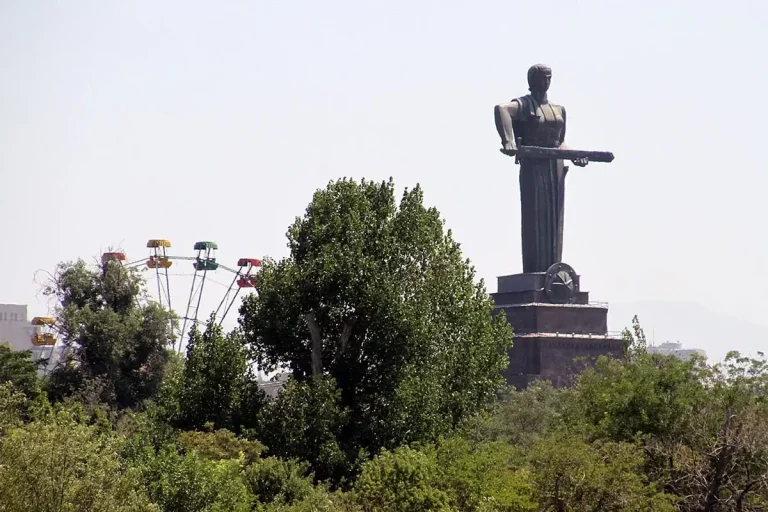

Erebuni Fortress
Erebuni Fortress (Armenian: Էրեբունի ամրոց) is the Urartian citadel-city founded by King Argishti I in 782 BC on the Arin Berd hill in what is now the south-eastern part of Yerevan. It is the birthplace of Armenia’s capital: the name Yerevan derives directly from Erebuni, and the date carved into the founding inscription — 782 BC, twenty-nine years before the traditional founding of Rome — is the official birthday of the city. Twenty-three cuneiform tablets, fragments of religious and secular frescoes, two temples, and a palace of more than 100 rooms have been excavated on the hill since 1950; the finds are displayed in the Erebuni Museum at the foot of the slope, opened in 1968 for the 2,750th anniversary of the city. In 2012, Forbes included Erebuni in its list of the world’s nine most ancient fortresses. Both museum and citadel are inside Yerevan and reachable in about 15 minutes from the centre.
Quick Facts
- Location: Yerevan, Yerevan
- Also known as: Erebuni Fortress, Erebuni Citadel, Arin Berd, Arin-Berd, Urartian Fortress of Erebuni, Էրեբունի ամրոց, Արին Բերդ
- From Yerevan: Inside Yerevan (15 minutes from city centre)
- Elevation: about 1,017 m
- Entrance fee: 1,500 AMD (museum + citadel)
- Time needed: 1.5–2 hours
- Best time to visit: April–June, September–October
- Status: Historical-archaeological museum-reserve
- GPS coordinates:
40.1406957, 44.5380056
782 BC — How Yerevan Began
In the early 8th century BC, the Kingdom of Urartu (also called Biainili, the Kingdom of Van) was the dominant state of Western Asia. Its king, Argishti I (r. ca. 785–753 BC), pushed his frontier into the fertile Ararat Valley to secure agricultural land against the resistance of the local population, recorded in Urartian annals as the “country of Aza.” Around 782 BC he ordered a new fortified city — Erebuni — built on the triangular crown of Arin Berd hill as the empire’s northern stronghold.
The exact date of the founding survives because Argishti’s own cuneiform inscription does. Discovered in 1950 on the hill by an archaeological team led by Konstantine Hovhannisyan (with Boris Piotrovsky as on-site adviser), it reads:
“By the greatness of the God Khaldi, Argishti, son of Menua, built this mighty stronghold and proclaimed it Erebuni for the glory of Biainili and to instill fear among the king’s enemies.”
Two further identical inscriptions have since been found inside the citadel, and a third record at Van — the Khorkhor chronicle — independently confirms the 782 BC date. According to the historian Margarit Israelyan, the labour came from prisoners taken in Argishti’s earlier campaigns north of Lake Sevan, including 6,600 soldiers captured around Melitene and the upper Euphrates — which is why the population of Erebuni was multi-ethnic from the day it opened.
Six years later, in 776 BC, Argishti founded a second city — Argishtikhinili, near modern Armavir — as the economic counterpart of his military citadel.
The name Erebuni comes from the Urartian verb erebu-ni — “to seize,” “to capture,” “to conquer.” Through the centuries the sound shifted by predictable steps — Erebuni → Erebvani → Erevani → Erevan → Yerevan — and the name of an Urartian fort became the name of a modern capital.
29 Years Older Than Rome
The line tour guides repeat is true. The founding inscription of Erebuni dates the city to 782 BC. The traditional founding of Rome by Romulus is dated to 753 BC. Yerevan is therefore twenty-nine years older than Rome, and one of the oldest continuously inhabited cities in the world. It celebrated its 2,750th anniversary with the opening of the Erebuni Museum in 1968 and its 2,800th in 2018; in 2026 the city is 2,808 years old.
After Urartu — A City That Refused to Be Abandoned
Successive Urartian kings — Sarduri II and Rusa I — used Erebuni as a residence on their northern campaigns and continued to expand it. In the 7th century BC, Rusa II built a much larger economic centre nearby at Teishebaini (Karmir Blur), and many objects from Erebuni were moved there; the older citadel kept its strategic role.
When Urartu fell in the late 7th century BC, Erebuni did not. Under the Achaemenid Persian empire (6th–4th centuries BC) the citadel was rebuilt as a provincial capital: the Temple of Khaldi was converted into a columned hall (apadana) of Persian type, and the Susi shrine was reshaped into a fire temple. The city continued through the early Armenian and Hellenistic periods. Despite repeated invasions, Erebuni was never completely abandoned — by gradual expansion and continuous habitation, it grew, over almost three millennia, into the city of Yerevan itself.
Architecture of the Citadel
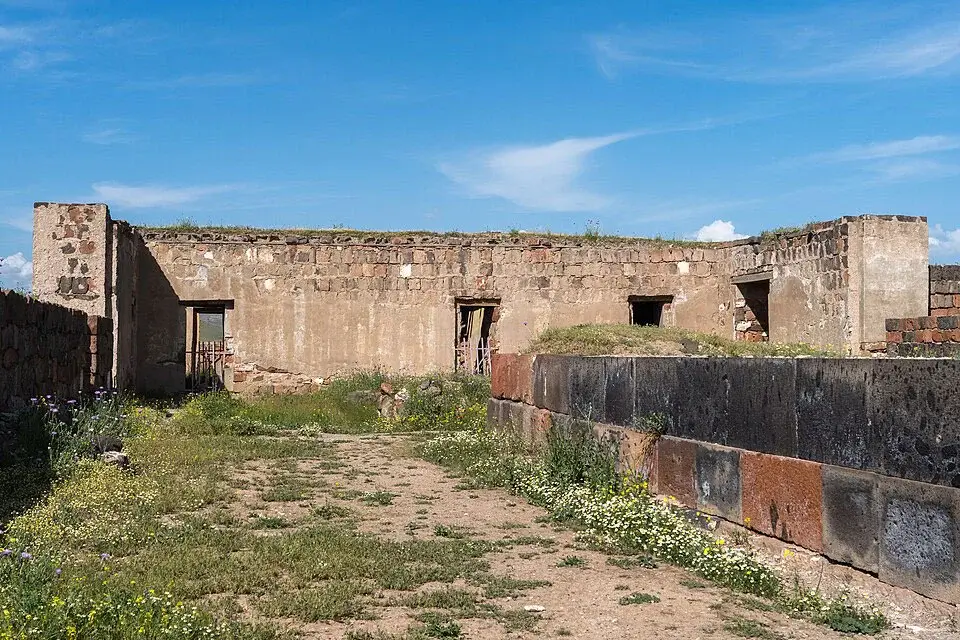
The citadel sat on the triangular summit of Arin Berd, a 65-metre hill levelled by Urartian engineers. The total area was roughly 8 hectares; the only practical approach was the gentler south-eastern slope, where the single fortified gate opened onto the central ceremonial yard.
Key elements:
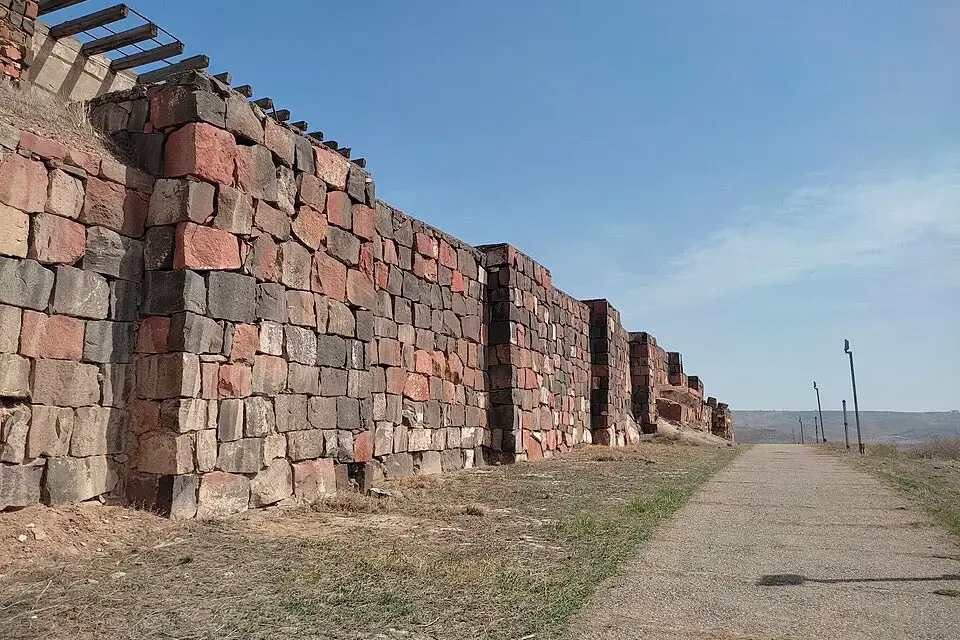
- Three rings of ramparts — once 10–12 m high, surviving today to about 5–6 m. The walls combined a basalt-block plinth, mud-brick uppers, wooden tie beams, and adobe — a sophisticated composite for the 8th century BC. Buttresses reinforced the curtain every eight metres.
- Palace of Argishti — over a hundred rooms arranged on stepped platforms. The inner walls were finished in murals on religious and secular themes: processions of gods, sacred trees, hunting scenes, and agricultural labour. The Urartian pigment formula gave the wall paintings a brightness and durability that has not been fully matched in later reconstructions. Surviving fragments are kept at Erebuni and at the Pushkin Museum in Moscow.
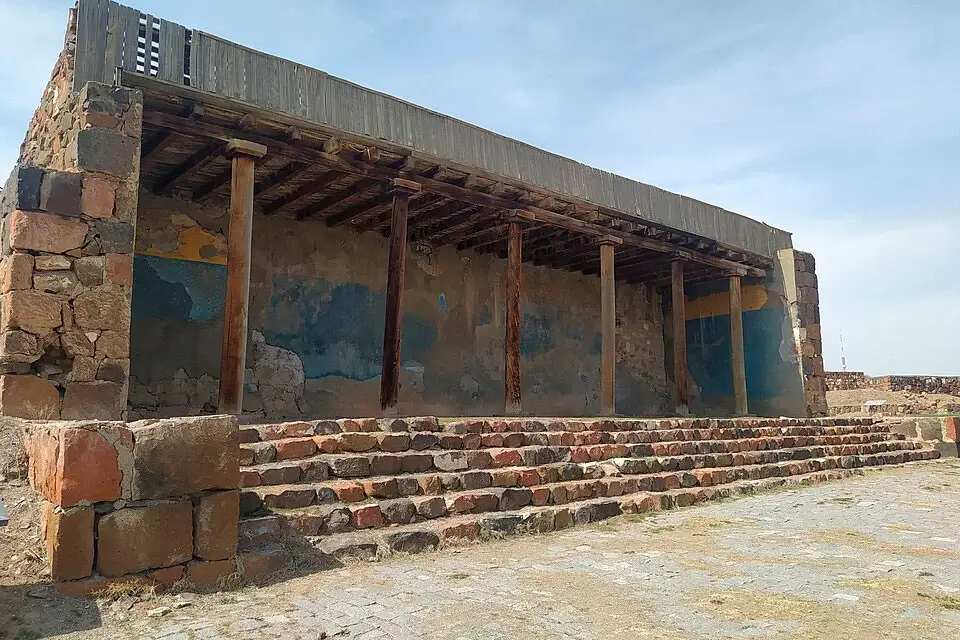
- Temple of Khaldi — the largest known sanctuary of the chief Urartian god, with a four-part plan (great hall, side chambers, a square tower with stairs, and a U-shaped peristyle courtyard). The floor was paved with small wooden plates resembling parquet; interior walls were painted sky-blue.
- Temple of Susi — a much smaller shrine of the local god Ivarsh, possibly for the indigenous population of the country of Aza. No windows; light fell through an opening in the ceiling, with cuneiform inscriptions on the door jambs.
- Six-column portico at the citadel entrance, with frescoes on the wall and a stairway flanked by bronze figures of winged bulls with human heads — a striking parallel with Assyrian guardian sculpture.
- Royal assembly hall — a colonnaded chamber for ceremonies and audiences with the king’s guard.
- Underground stone water pipes — each segment carved to lock with the next, delivering water to the citadel from springs in the surrounding plain.
The Erebuni Museum
The Erebuni Historical and Archaeological Museum-Reserve was opened on 19 October 1968 for the 2,750th anniversary of Yerevan. The building, by architects Shmavon Azatyan and Baghdasar Arzumanyan, deliberately echoes the closed-wall plan of Urartian palaces; the bas-reliefs on the façade — including a large portrait of Argishti I above the main entrance — are by the sculptor Ara Harutyunyan, the same artist who carved the Mother Armenia monument in Victory Park.
The reserve has three branches — Arin Berd (Erebuni proper), Karmir Blur (Teishebaini), and the much older Shengavit early-agricultural settlement — and the permanent exhibition is built from the finds of all three. The collection holds more than 12,000 archaeological objects across the pre-Urartian, Urartian, Achaemenid, Hellenistic, and early Armenian periods.
The highlights to look for inside:
- The founding cuneiform of Argishti I and the 23 cuneiform tablets of Argishti I, Sarduri II, and Rusa III.
- Frescoes with processions of gods, hunting and sacrifice scenes.
- Bronze lamps and incense burners; red-burnished pottery; large clay storage jars (karases) inscribed in cuneiform with their wine or grain capacity.
- Painted Egyptian glass, Milesian coins, and silver rhytons (drinking horns) — testimony to Erebuni’s reach into the wider ancient world.
- A small painted wooden warrior figurine with a cuneiform inscription on its bronze base.
The recommended sequence is museum first, citadel second — without the context, the hilltop reads as a low stone outline; with it, it reads as a 2,800-year-old palace.
How to Get to Erebuni Fortress
The fortress and museum are inside Yerevan, at 38 Erebuni Street in the Erebuni district, on the south-eastern edge of the city.
- Bus — city bus #58 from the centre runs directly to the museum.
- Taxi — about 15 minutes from Republic Square.
- On foot — possible from the centre as a 1.5-hour walk, mostly downhill on the return.
- With a driver — a car with driver in Yerevan is the simplest way to combine Erebuni with a half-day Urartu-era loop: Erebuni Fortress → Karmir Blur (Teishebaini) → Garni Temple and the Symphony of Stones.
Hours, Tickets, and Practical Tips
The Erebuni Museum is open Tuesday to Sunday, 10:30–16:30, and closed on Monday.
- Tickets: a combined museum + citadel ticket is typically around 1,000–1,500 AMD (about USD 2.5–4); prices change occasionally, and the open hilltop ruins are accessible outside ticketed hours. Guided tours in Armenian, Russian, or English can be booked in advance.
- Climb the hill after the museum — it is a short ascent from the building, with the citadel ruins at the top and panoramic views over Yerevan and (in clear weather) Mount Ararat.
- The hill has no shade — in summer bring water, a hat, and sun protection.
- Photography is allowed in the citadel; some museum rooms may restrict flash photography during conservation work on the murals.
The best months are April–June and September–October — Yerevan’s high summer can push the open hilltop into the high 30s °C.
What to See Nearby
- Karmir Blur (Teishebaini) — the second Urartian site in Yerevan, about 6 km west of Erebuni. Built by Rusa II in the 7th century BC as an economic and storage centre and a branch of the same museum-reserve.
- Matenadaran (Institute of Ancient Manuscripts) — about 15 minutes by taxi. One of the world’s great collections of medieval manuscripts; an essential companion to the Urartu-era depth of Erebuni.
- Cascade Complex — open-air contemporary sculpture and panoramic views of Mount Ararat.
- Republic Square — the heart of modern Yerevan; the singing fountains run on summer evenings.
- Garni Temple — about 30 km east; Armenia’s only surviving Greco-Roman temple (1st century AD), built over the foundations of an earlier Urartu-era stronghold.
- Symphony of Stones — the basalt-column canyon adjacent to Garni, easily combined with Erebuni on the same day.
- Charents Arch — the classic Mount Ararat viewpoint on the road to Garni.
Frequently Asked Questions
Erebuni Fortress is the place where a single line of cuneiform — carved into a basalt block in 782 BC and uncovered by an archaeologist in 1950 — gave a modern city its birth certificate. The hilltop palace and the painted walls have been worn down to outlines, but the inscription is still there, and a 2,808-year-old name is still in daily use. To stand on Arin Berd is to stand on the oldest layer of Yerevan.
To combine Erebuni with a half-day Urartu-era loop (Karmir Blur, Garni Temple, the Symphony of Stones) or a full day exploring Armenia from Yerevan, consider a private car with driver in Yerevan.