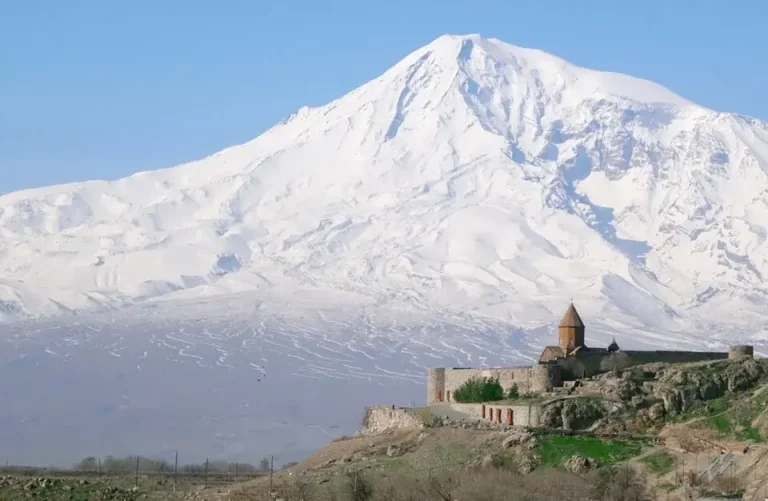

Hovhannavank Monastery
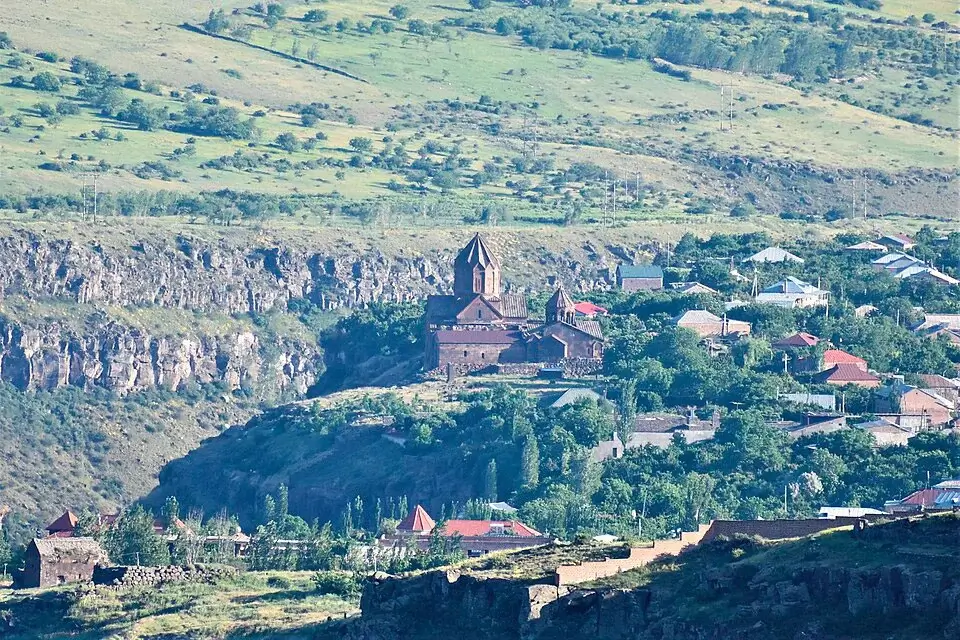
Hovhannavank Monastery (Armenian: Հովհաննավանք — “Monastery of St. John”) is a medieval Armenian monastic complex perched on the western edge of the Kasagh river canyon, in the village of Ohanavan, Aragatsotn Province, 30 km north-west of Yerevan. Its eastern wall rises directly out of the cliff face; seen from the opposite side of the gorge, the church looks like a stone continuation of the canyon itself.
The monastery brings two very different periods of Armenian Christianity into a single courtyard: a 4th-century basilica founded by St. Gregory the Illuminator — one of the oldest churches in Armenia — and a 13th-century cathedral built by the Vachutian princes, whose western portal carries one of the few large figural reliefs in medieval Armenian sculpture: the New Testament Parable of the Wise and Foolish Virgins. Five kilometres further upstream, on the same canyon, stands its sister monastery Saghmosavank — built by the same patron just a year earlier.
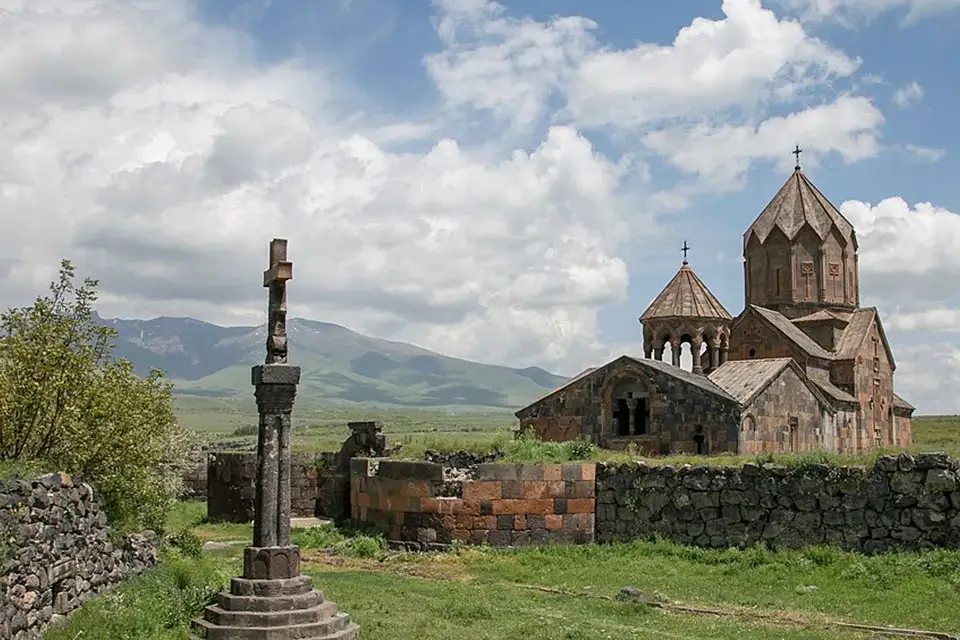
Quick Facts
- Built / Founded: 4th c. (basilica); 1216–1221 (cathedral)
- Location: Ohanavan, Aragatsotn Province
- Also known as: Hovhannavank Monastery, Hovhanavank, Ohanavank, Հովհաննավանք
- From Yerevan: ~30 km (35–40 minutes by car)
- Entrance fee: Free
- Time needed: 30–45 minutes
- Status: Active monastery
- GPS coordinates:
40.3394444, 44.388611
A short history: from a pagan temple to the Vachutian princes
According to Armenian church tradition, the spot on which Hovhannavank stands once held a pagan temple of Astghik — the Armenian goddess of love, beauty and water. In the early 4th century, St. Gregory the Illuminator — the same figure who founded Etchmiadzin Cathedral and converted Armenia to Christianity — built a basilica on the site and placed in it the relics of John the Baptist (in Armenian Hovhannes Mkrtich). The monastery took its name from him; for centuries the relics were believed to perform miracles, and the basilica became a major pilgrimage destination.
By the 5th century Hovhannavank was already an important monastic centre. The Armenian historian Ghazar Parpetsi served here as abbot and is said to have written his History of the Armenians — one of the foundational texts of Armenian historiography — within the basilica’s walls. In 573 the original wooden roof of the basilica was replaced with a stone vault as part of a wider renovation campaign.
At the end of the 12th century, Queen Nana raised a fortified wall around the complex, in places nearly four metres thick, reinforced with towers — fragments of which still stand. A few years later, in 1200, a long lapidary inscription was cut into the north wall by the Zakare and Ivane Zakarian brothers, marking the liberation of “the land of Ararat from the heavy yoke” and dedicating the monastery to St. John the Forerunner — one of the most significant medieval Armenian inscriptions to have survived.
The defining building campaign came in the 13th century under the Vachutian princely house — the same family whose patronage shaped Saghmosavank, the great gavit at Sanahin Monastery, and several smaller foundations around Mount Aragats. After centuries of slow decline a violent earthquake in 1918 destroyed the cathedral’s dome and southern wall; both were faithfully reconstructed in the 1980s and 1990s, working from old photographs and the 17th-century descriptions of the historian Zakaria Kanakertsi.
The Cathedral of Surb Karapet and the Wise and Foolish Virgins
The principal church, Surb Karapet (“Holy Forerunner”) was built between 1216 and 1221 at the commission of Prince Vache I Vachutian Amberdtsi, only a year after the same prince had built the church of Surb Sion at Saghmosavank. Both belong to the “Gandzasar style” of 13th-century Armenian cathedrals — cross-domed plans with two-storey chapels in all four corners, an umbrella-shaped dome and richly carved portals, alongside the cathedrals of Gandzasar itself and Harichavank.
The crown jewel of Hovhannavank is its western portal. The entrance is set within a series of nested half-columns carved with fine vegetal ornament and eight-pointed stars, and on the tympanum above it sits a high-relief sculpture of the Parable of the Wise and Foolish Virgins from the Gospel of Matthew — a Christ figure in the centre, flanked by five wise virgins holding lit lamps and five foolish virgins with their lamps gone out. Large figural Biblical scenes are rare in medieval Armenian sculpture, which usually favours geometric and vegetal ornament; this tympanum is one of the most original pieces of 13th-century Armenian carving.
The 1918 earthquake collapsed the dome and the south wall in less than a minute, but the portal itself survived. The dome and the southern wall were rebuilt in the 1990s.
The 4th-century basilica
The basilica of St. Karapet adjoins the cathedral on the north side. It is a single-nave church built of black and grey tuff, with the unusual feature — rare for Armenian churches — of an interior iconostasis. The oldest fabric goes back to the basilica founded by St. Gregory the Illuminator in the early 4th century; the building was substantially renovated in 573, and again between 1652 and 1734, when the Vachutian family emblem (a dove in eagle’s claws) was carved into the walls. North of the basilica lie the foundations of an even older structure of the very early 4th century — possibly the church St. Gregory built on the ruins of the Astghik temple itself.
The gavit and the rotunda belfry
In 1250 Vache’s son, Prince Kurt I Vachutian, and his wife Khorishah added a monumental gavit (narthex) to the west facade of the cathedral. An inscription on the wall records their gift in their own words:
“In the year 699 [i.e. 1250], I, Kurt, son of Vache, and my spouse Khorishah… established this great house of glory…”
The gavit is a four-pillar hall that almost completely covers the cathedral’s west facade. Around 1274 a twelve-column rotunda 6.5 metres in diameter was built over the gavit’s central skylight, doubling as a belfry — the largest rotunda belfry of its kind in Armenia. From inside the gavit, the rotunda opens upwards to the sky like a small drum.
A medieval scriptorium — and a thousand inscriptions
Between the 12th and 17th centuries Hovhannavank was one of the leading educational and theological centres of eastern Armenia. The monastery’s school taught theology, philosophy, music, calligraphy and the science of calendars; the scriptorium produced manuscripts that travelled across the Armenian world. Roughly twenty surviving manuscripts copied at Hovhannavank are held today in the Matenadaran in Yerevan.
In the 17th century the historian Zakaria Kanakertsi (1627–1699) spent his entire life here and left a detailed account of the monastery and its surroundings — the foundation document for almost everything we know about the medieval complex. The walls of Hovhannavank carry more than a hundred lapidary inscriptions from the 13th to 18th centuries — one of the richest epigraphic ensembles in Armenia.
The legend of the secret tunnel
To the right of the altar in the cathedral there was once a hidden tunnel that ran down to a cave in the Kasagh canyon. A medieval legend explains its purpose: during one invasion the villagers took refuge inside the monastery, and when the attackers broke through the walls they found only the abbot, who told them that the people had “gained the wings of doves and flown away.” In truth, all of them had escaped through the tunnel into the gorge. A separate tradition links the same tunnel to a raid by Tamerlane in the late 14th century, when the abbot is said to have thrown himself into the river rather than surrender.
How to get to Hovhannavank Monastery from Yerevan
The monastery lies about 30 km north-west of Yerevan, in the village of Ohanavan — roughly 35 minutes by car via the M3 highway through Ashtarak. From Ashtarak (6 km away) you turn north on the secondary road that follows the western rim of the Kasagh canyon.
By public transport, marshrutkas run regularly from Yerevan to Ashtarak; from Ashtarak a short taxi covers the last 6 km to Ohanavan. Because Hovhannavank pairs naturally with Saghmosavank (5 km north), Amberd Fortress, and Lake Kari on the slopes of Mount Aragats, most visitors hire a car with driver in Yerevan and turn the Kasagh canyon into a single half-day or full-day trip.
Practical tips on site
- Look at the west portal first — the Wise and Foolish Virgins relief and the eight-pointed-star ornament are the monastery’s main artistic treasure, and easy to walk straight past on the way into the cathedral.
- Step inside the gavit and look up: the 1274 rotunda on its twelve columns is the largest of its kind in Armenia.
- Visit the basilica for the rare interior iconostasis — almost no other Armenian church preserves one.
- The cliff edge has no railings. The drop is sheer; keep children close and watch the wind.
- Plan 30–45 minutes for the monastery, or up to an hour with a walk along the canyon rim and a look at the khachkars.
- The best photographs are from the opposite side of the canyon — there is a small viewpoint reachable on foot from Ohanavan village.
What to see nearby
- Saghmosavank Monastery (~5 km) — the “Monastery of Psalms” on the same canyon rim, built by the same Prince Vache Vachutian in 1215, with a remarkable medieval library hall.
- Ashtarak (~6 km) — old town with the 7th-century Karmravor church (one of the smallest medieval Armenian churches still standing), Tsiranavor and Spitakavor churches, and a medieval bridge over the Kasagh.
- Amberd Fortress (~25 km) — a 10th–13th-century fortress on the south slope of Mount Aragats at 2,300 m.
- Byurakan Observatory (~15 km) — one of the leading astrophysical observatories of the 20th century, founded by Viktor Hambardzumyan in 1946.
- The Kasagh cave monastery (between Hovhannavank and Saghmosavank) — a small 12th-century cave-cell complex carved into the canyon walls, reachable only on foot.
- Mount Ara — the mountain rising directly behind Hovhannavank in many photographs.
Frequently asked questions
Hovhannavank is the kind of Armenian monastery where everything important is layered into a single small courtyard: the spot where Armenian tradition places a pre-Christian temple of Astghik; the 4th-century basilica founded by the saint who converted the country; the historian’s cell where the History of the Armenians was written; the 13th-century portal with its rare figural relief; and the rotunda belfry that has no equal in Armenia. With Saghmosavank five kilometres up the same canyon and Amberd Fortress on the slopes of Mount Aragats behind it, the easiest way to take in the cluster is with a private car and driver from Yerevan.