
Marmashen Monastery
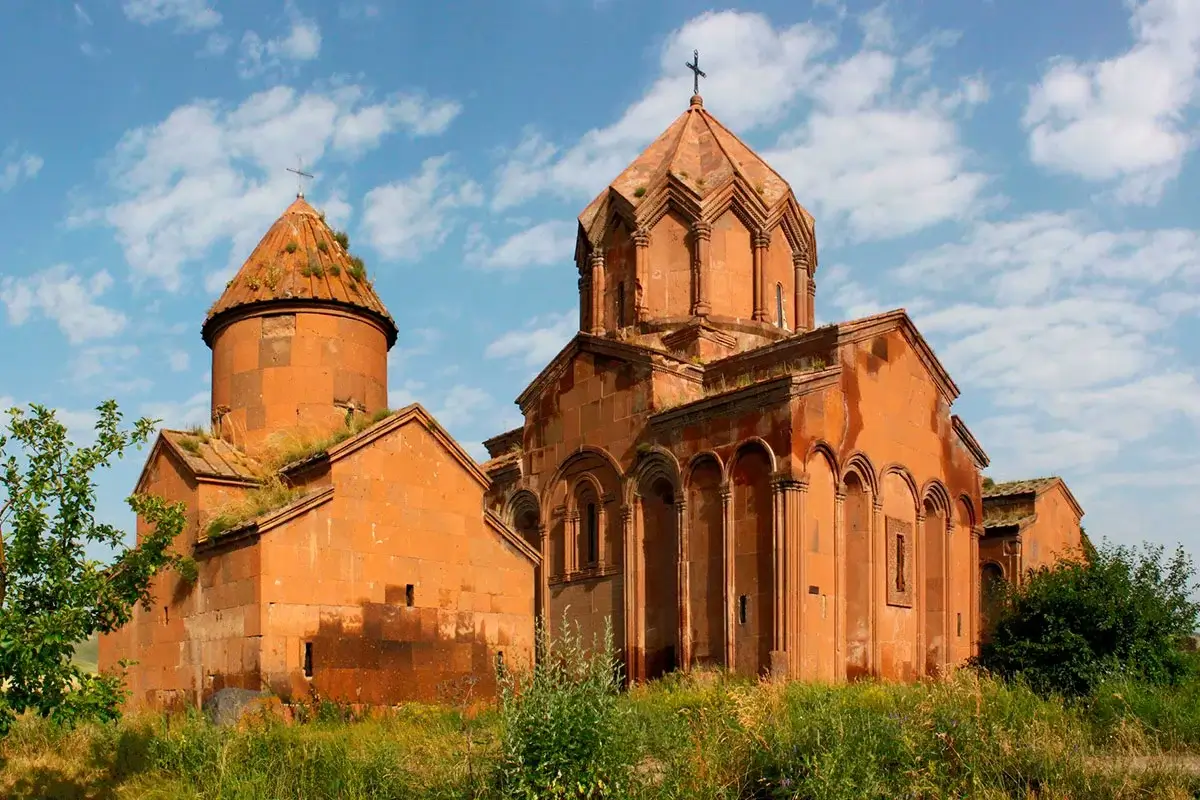
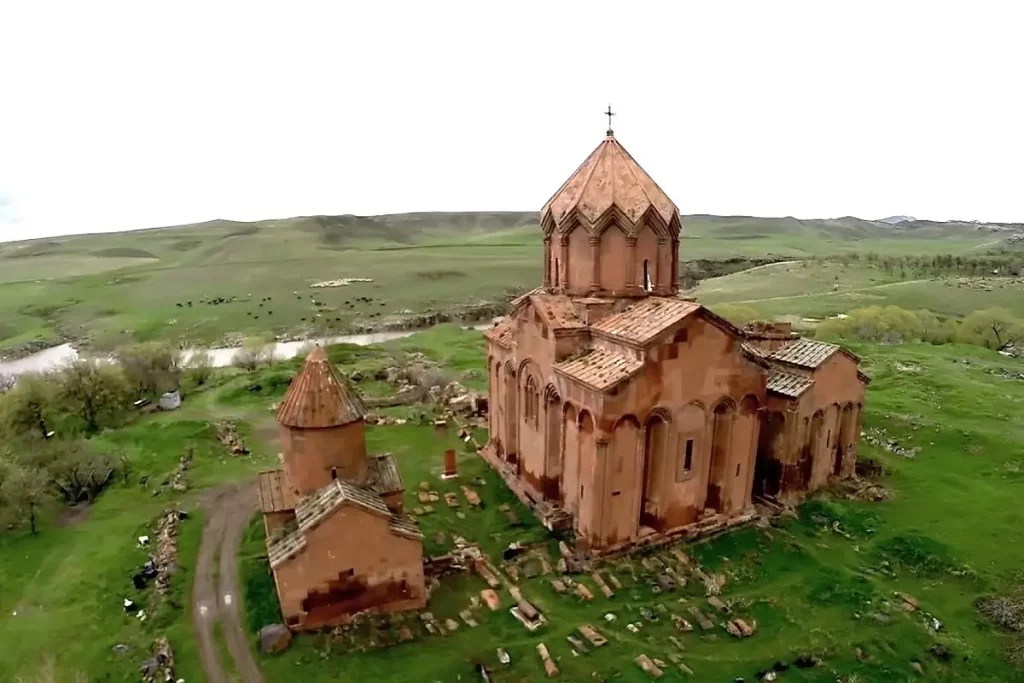
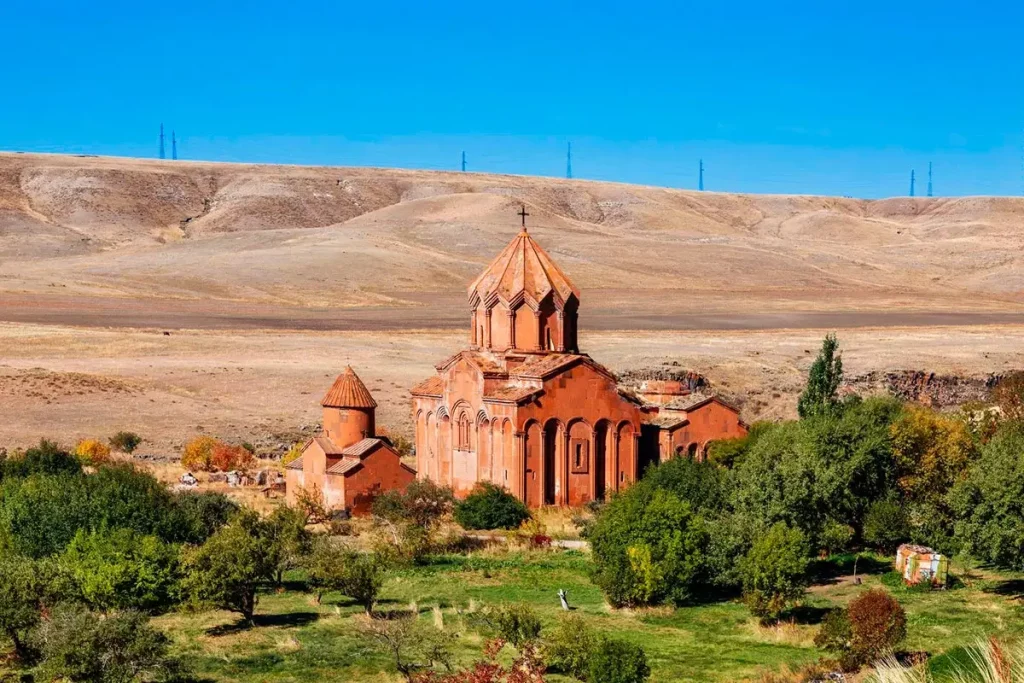
Marmashen Monastery (Armenian: Մարմաշեն) is a 10th–13th-century Armenian monastic complex on the left bank of the Akhurian river in Shirak Province, 10 km north-west of Gyumri. Its main church — Katoghike Surb Astvatsatsin, built of deep-red tuff between 988 and 1029 under the patronage of Prince Vahram Pahlavuni — is one of the finest surviving examples of the Ani school of medieval Armenian architecture. Unlike most Armenian monasteries, which were built in hard-to-reach mountain locations for defence, Marmashen sits on an open shelf above a bend of the river — closer in spirit to a noble summer residence than a fortress, conceived in the same century when the great cathedral was rising at Ani only 35 km to the south.
Vahram Pahlavuni (c. 967–1045) was sparapet — supreme commander — of the army of the Bagratid Kingdom of Armenia. He led the defence of Ani against the Byzantines at the Battle of Ani in 1042, mobilised the forces that crowned Gagik II as the last Bagratid king of Armenia in 1043, and died in battle near Dvin in 1045. Marmashen was his ancestral foundation, and his tomb still lies beneath the floor of the monastery’s western gavit. Today the complex stands as a museum-monument, preserved but not fully active as a parish — though services have been held intermittently since the building was re-consecrated by Catholicos Karekin II in 2003.
Quick Facts
- Built / Founded: 988–1029 (main church); 10th–13th c. (full complex)
- Location: Vahramaberd village, Shirak Province
- Also known as: Marmashen, Marmashen Monastery, Marmashenavank, Marmashen Vank, Մարմաշեն, Մարմաշենի վանք
- From Yerevan: 125 km / 2–2.5 hours
- Entrance fee: Free
- Time needed: 40–60 minutes
- Best time to visit: May to October
- Status: preserved historic site / museum-monument
- GPS coordinates:
40.8428541, 43.7558559
A short history: the Pahlavuni dynasty’s foundation on the Akhurian
The Pahlavuni princes — who claimed descent from the Arsacid lineage of St. Gregory the Illuminator himself — were the second great noble house of medieval Armenia: while the Bagratunis sat on the throne in Ani, the Pahlavunis held the hereditary office of sparapet and the lands of Shirak. The founder of Marmashen, Vahram Pahlavuni, was the head of the family at the turn of the 11th century. The same patron also built the small Vahramashen church inside Amberd Fortress in 1026 — together with Marmashen, one of two architectural monuments that bear his personal imprint.
According to the carved inscription on the south wall of the main church — preserved intact to this day — construction of the Katoghike Church of the Holy Mother of God began in 988 and was completed in 1029. Other buildings rose around it through the early 11th century, and a gavit-mausoleum was added on the western side after Vahram’s death in 1045 to serve as the burial place of the patron and his family. The Pahlavuni endowment to the monastery, recorded in the inscriptions, opened with Bagaran, the former Bagratid capital of the 9th century, marking Marmashen as a symbolic extension of the dynasty’s territorial and ancestral memory north of Ani.
A second, later inscription on the south wall — studied in detail by the academic Crossing Frontiers project at the Courtauld Institute — records a donation to the monastery’s Church of St. Peter by Queen Mariam, the Iberian-Bagratid first wife of King Giorgi I of Abkhazia, Kartli and Kakheti (1014–1027), in memory of her grandmother. Mariam later served as regent for the young Bagrat IV of Georgia and granted protection to the citizens of Ani after the death of Yovhannes-Smbat in 1040 — placing Marmashen at the centre of a Georgian-Armenian Bagratid network on the eve of the Byzantine annexation of Ani.
Through the 11th century the Seljuk Turkic invasions reached Shirak. The main church was converted into a fortress and the surrounding monastic property turned into a village. In 1225, Vahram’s grandsons — Archbishop Grigor and his brother Lord Gharib (Garib) — recovered the family estates with the help of the Zakarian princes of Eastern Armenia and rebuilt the monastery. The detailed history of the rebuild was inscribed on the cathedral’s north wall, and most of what we know about medieval Marmashen comes from that single inscription. The Mongol invasions of the 13th century destroyed much of the renewed complex.
Marmashen stood largely abandoned until the early 19th century, when the Akhurian river became the new border between the Russian Empire and Ottoman Turkey after the Russo-Turkish wars of the 1820s. Armenian families from Kars resettled the area and revived the surrounding villages. In 1870 the local benefactor Mkrtich Jalalyan restored the main church and opened a school beside it. Services continued through 1923.
The 1883 earthquake destroyed the north church; the 1988 Spitak earthquake damaged the main cathedral. After 1988, an international restoration project led by the Italian Embassy and the Armenian benefactor Gayane Kaznati rebuilt the complex; the cathedral was re-consecrated by Catholicos Karekin II in the summer of 2003.
Architecture: the Ani school in three churches
Marmashen is small for an Armenian monastery — three standing churches and one excavated foundation — but it is dense with architectural quality. The complex divides into a Big group at the foot of the river plateau and a Small group on a hill to the north.
Katoghike Surb Astvatsatsin (988–1029). The main church is a domed-hall structure of red tuff, with a cruciform exterior and an umbrella-shaped cupola on a faceted drum. The walls are made of unusually large stones — some up to two metres high — and decorated with continuous blind arcading on paired half-columns, narrow arched windows, and triangular niches on three of the four exterior walls. The single entrance is on the west. Architecturally, the church is in direct dialogue with the great cathedral of Ani: the same vertical proportions, the same logic of surface decoration, the same “Ani school” workshop tradition that defined the Bagratid era. Some sources attribute the design to the architect Trdat — the master architect credited with the Ani Cathedral and with rebuilding the dome of Hagia Sophia in Constantinople after the 989 earthquake — but the attribution is traditional rather than documented.
The Northern Church (11th century). A smaller cross-domed church with four corner annexes, built directly north of the Katoghike. It is sometimes identified as the Church of St. Stepanos, and was severely damaged in the 1883 earthquake; its present form is largely the 20th-century reconstruction.
The Circular Four-Apse Church. Discovered only in 1954–1956 during Soviet-era excavations beneath the foundations of a village barn. Only the lower two courses of masonry survive, but the round exterior plan with four interior apses is highly unusual for medieval Armenian architecture and may indicate an earlier date than the Katoghike — making it a possible candidate for the monastery’s oldest church.
The Gavit-Mausoleum. A 13th-century four-pillar narthex attached to the west of the Katoghike, now reduced to its column bases. The graves of Vahram Pahlavuni and his immediate family lie beneath the gavit’s floor; the carved tombstone of Vahram himself is a 19th-century replacement.
The Small Church. On a low hill to the north of the main group, surrounded by a small medieval cemetery whose excavated graves include the tomb of Princess Sophia, Vahram’s wife. Tradition holds that the hill was a pre-Christian sanctuary long before the Pahlavunis chose the site.
The Pahlavuni inscriptions
The walls of the Katoghike carry two of the longest and most informative medieval Armenian inscriptions still in situ:
- The south wall inscription (988–1029) is Vahram Pahlavuni’s own dedicatory text, listing the dates of construction, the bequests of land and property to the monastery (opening with Bagaran), and effectively summarising the political and religious self-presentation of the Pahlavuni clan.
- The north wall inscription (1225) is the rebuild record left by Archbishop Grigor and Lord Gharib, naming sponsors, listing furniture, sacred vessels, vestments, fields and vineyards donated, and giving us almost all the medieval history of the complex.
Both inscriptions are remarkable for the calligraphic care of their carving — long parallel rules, evenly spaced letterforms — and are themselves important documents for the history of medieval Armenian epigraphy.
A pre-Christian and Urartian layer
Marmashen does not sit alone on the Akhurian. The plateau around it has been inhabited for at least four millennia.
- Local tradition — supported by archaeological survey — places one of the important pre-Christian sanctuaries of the region on the hill where the Small Church now stands.
- Caves in the gorge a few hundred metres from the monastery were inhabited during the Stone Age.
- One kilometre east, in Vahramaberd village, a stone-cut cuneiform inscription of the Urartian king Argishti I (8th century BC) records his conquest of this part of Shirak — a direct link to the Bronze-Age kingdom whose memory still shapes the toponymy of the region.
- Around the monastery the traces of ten fortresses have been identified within a five-kilometre radius — evidence of the unusual density of settlement in the third millennium BC.
- Across the river, near the Marmashen bridge (a medieval bridge probably of the 10th–11th century), lie Bronze Age graves at an abandoned settlement.
The cumulative effect is one of the most layered single landscapes in Armenia.
How to get to Marmashen Monastery from Yerevan
From Yerevan, Marmashen is ~125 km on the M1 highway towards Gyumri — typically 1 hour 45 minutes by car. The most direct approach is to skirt north around Gyumri before turning west toward Vahramaberd; the last 10 km are on a paved local road that is fine for any passenger car. Brown signage for “Marmashen” appears a few kilometres before the site.
By public transport, marshrutkas from Yerevan’s Kilikia bus station run to Gyumri for 1,500–2,000 AMD. The Yerevan–Gyumri express train is the most comfortable option (≈2 hours) and runs from Yerevan’s main railway station. From Gyumri the final 10 km is by taxi — typically 1,200–2,000 AMD one way via the GG Taxi app, with most drivers happy to wait an hour while you visit.
Marmashen pairs naturally with Gyumri for a single day from the capital. A flexible alternative is to hire a car with driver in Yerevan and combine Marmashen with Harichavank Monastery, Yereruyk Basilica, and Gyumri itself on one long Shirak loop.
Practical tips on site
- Plan 45–60 minutes for the complex; add 30 minutes if you walk down to the river or look for the medieval bridge.
- The site is in an open river valley and almost always windy; bring a light jacket even in midsummer.
- No cafés or shops are on site — bring water and food from Gyumri.
- The best photographs are from the north hill by the Small Church, looking down on the three churches together, and from the riverside at sunset, when the red tuff turns its deepest colour.
- Note the calligraphy of the south-wall inscription of the Katoghike — even non-readers of Armenian can appreciate the carved geometry.
- Across the river, fragments of the medieval bridge are still visible — a short scramble down the slope brings you near.
What to see nearby
- Gyumri (~10 km) — Armenia’s second city, with the 19th-century Kumayri quarter of black-tuff houses, Vardanants Square, the Black Fortress, and the city’s distinctive cultural scene.
- Vahramaberd Fortress (~1 km) — fragments of the 13th-century defensive wall built by the Pahlavuni descendants, which gave the modern village its name (“Fortress of Vahram”).
- Argishti I cuneiform inscription (~1 km, in Vahramaberd village) — an 8th-century BC Urartian rock inscription that takes the human history of the site back to the Iron Age.
- Harichavank Monastery (~35 km via Artik) — the great Zakarian cathedral of 1201 and the 7th-century Mastara-style church.
- Yereruyk Basilica (~50 km south on the same Akhurian river) — 4th–6th-century paleo-Christian ruins on UNESCO’s Tentative List.
- Lake Arpi National Park (~70 km north) — pelican-nesting wetland on the Javakheti plateau.
- Amberd Fortress (~90 km on the return route to Yerevan) — the same Vahram Pahlavuni’s other architectural monument, with his 1026 Vahramashen church.
Frequently asked questions
Marmashen is the kind of medieval site where the history sits in plain view: a deep-red tuff cathedral with a thousand-year-old inscription cut into its south wall; the tomb of the patron who led the last Armenian defence of Ani buried beneath the gavit; a circular church discovered under a barn in the 1950s; an Urartian cuneiform a kilometre away; Bronze Age graves across the river. With Gyumri ten kilometres on and the rest of the Shirak monasteries on the same day, the easiest way to take it in is with a private car and driver from Yerevan.


