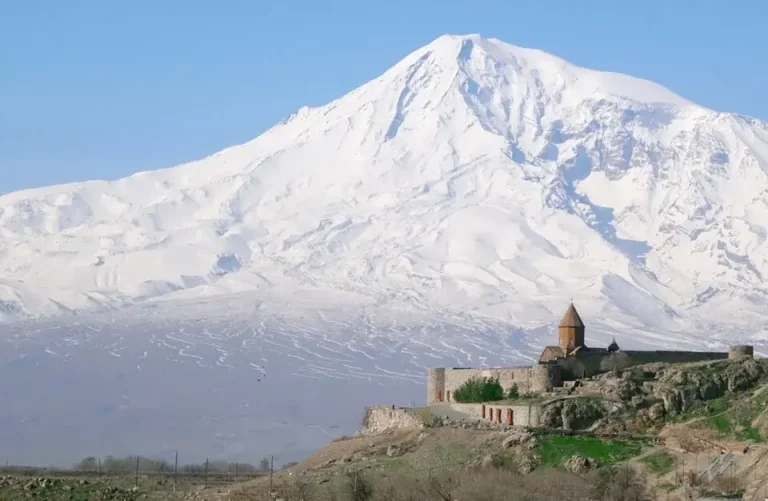

Akhtala Monastery
Akhtala Monastery (Armenian: Ախթալայի վանք), also known as Pghindzavank (“Coppermine Monastery”), is a 10th-to-13th-century fortified monastery in the town of Akhtala in northern Armenia’s Lori Province, 185 km north of Yerevan and only 25 km from the Georgian border. The complex combines a powerful medieval fortress and a single domed basilica church whose interior is covered, wall to wall, with one of the most important surviving cycles of 13th-century Byzantine fresco painting outside the Byzantine empire itself. Visitors who come for the better-known UNESCO monasteries of Haghpat and Sanahin nearby often describe Akhtala as the artistic highlight of the day.
Quick Facts
- Built / Founded: 10th century; frescoes 1205–1216
- Location: Akhtala, Lori Province
- Also known as: Pghindzavank, Pghndzavank, Akhtala Fortress Monastery, Ախթալայի վանք, Պղնձավանք
- From Yerevan: About 185 km
- Entrance fee: Free
- Time needed: 45–90 minutes
- Best time to visit: April–October
- Status: Cultural heritage site / active pilgrimage site
- GPS coordinates:
41.150494, 44.763959
About the monastery
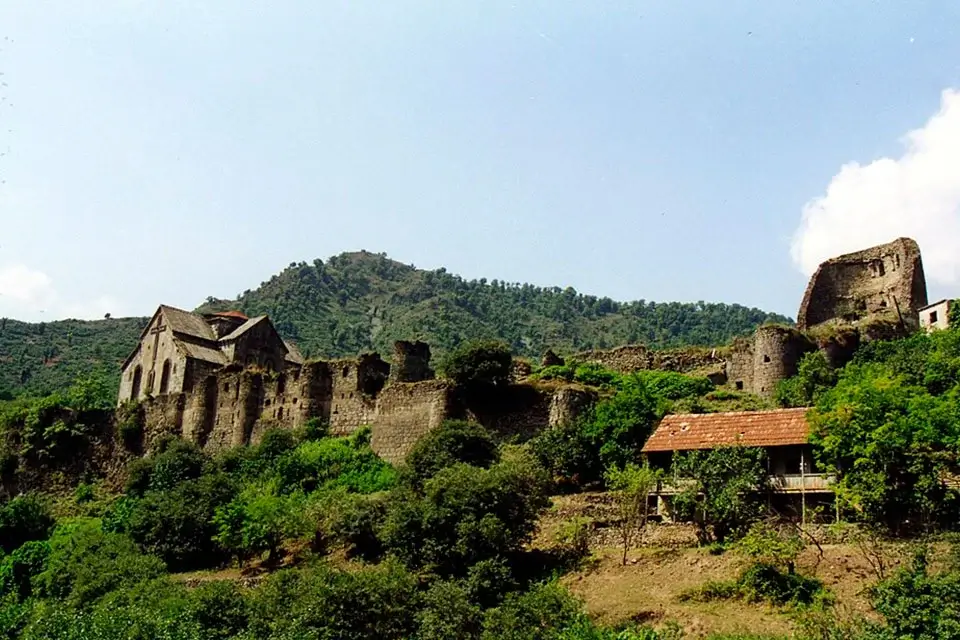
Akhtala stands on a small plateau ringed on three sides by deep rocky canyons above the Shamlugh river, in the broader gorge of the Debed. The fortress is reached from a single direction — north — through a monumental gateway and a three-storey pyramidal tower; the canyons themselves do the rest of the defensive work. The walls and towers are built of bluish basalt set in lime mortar, and most of the curtain wall and the entrance complex are still standing more than a thousand years after they were raised.
The monastery’s main building is the Church of Surb Astvatsatsin (Holy Mother of God), a three-nave domed basilica at the centre of the fortress. Around the church stand the ruins of a smaller single-nave chapel, monastic cells, a refectory, a bath house and the foundations of older buildings — and below the wall, a still-accessible underground tunnel runs out from the foundations. Akhtala was administered by the Armenian Apostolic Church for most of its history, became the largest Chalcedonian (Georgian-rite) monastery in northern Armenia under the Zakaryans in the early 13th century, and today functions as an active religious site with pilgrimage days on 20–21 September each year that draw Armenians, Greeks and Georgians together.
The frescoes (1205–1216)
The artistic glory of Akhtala is the cycle of frescoes commissioned by Ivane Zakaryan (also known as Ivane Mkhargrdzeli) between 1205 and 1216, after his conversion to Chalcedonian Christianity at the Georgian royal court. The paintings cover virtually every interior wall, partition and supporting pier of the Church of Surb Astvatsatsin — a saturation of wall painting that is unique among medieval Armenian churches, where fresco cycles of this scale are extremely rare.
The cycle is executed in what art historians call the Armenian-Chalcedonian style: dominated by deep blues and luminous golds, with Byzantine colouring and Armenian thematic logic. Researchers have identified the hands of eight different masters working across the cycle, each with a recognisable individual style. Parallels have been drawn between the paintings and the 11th-century Armenian miniatures of the Mugni Gospels.
The scenes draw from both the Old and New Testaments and include large-scale depictions of the Virgin enthroned with Christ in the dome, the Holy Communion, John the Baptist, scenes of the Last Judgement, and a series of standing and half-length saints along the piers — including, prominently, Saint Gregory the Illuminator, the patron saint of the Armenian Church. The inscriptions accompanying the paintings are written in three languages — Armenian, Greek and Georgian — a direct reflection of the multilingual culture of Akhtala at its 13th-century height.
According to a well-known local story, the frescoes were at one point judged so visually overwhelming that they distracted parishioners during the liturgy, and the parish priest ordered the walls covered with a layer of whitewash. The lime was later removed and most of the cycle has now been cleaned and stabilised — restoration work was carried out in particular between 1979 and 1989 — but in some places the damage of centuries of incense smoke, lime, raids and weather remains visible.
A thousand years of history
The plateau on which Akhtala stands has been inhabited since the Bronze Age. Between 1887 and 1889 the French archaeologist Jacques de Morgan excavated 576 stone burial chambers here, with grave goods of clay, bronze and iron dating from the 8th century BC, and the fortress was almost certainly built on top of these older foundations. In the 5th century AD the settlement is recorded under the name Agarak; in the medieval period it was known as Pghindzahank — the Copper Mine — after the rich copper deposits that defined the local economy for the next thousand years.
The Kyurikid fortress
The medieval fortress was built in the late 10th century by the Kyurikids, a branch of the Bagratuni dynasty founded by Gurgen, son of King Ashot III the Merciful. Gurgen’s brothers — Smbat II and Gagik I — were the kings under whom the Bagratuni Kingdom of Armenia reached its 10th-century peak. In 982, Ashot III established the Kingdom of Lori (Tashir-Dzoraget) in the historical region of Gugark and placed Gurgen on its throne. Akhtala became one of the most important defensive points of north-western Armenia, paired with the fortresses of Lori, Kayan, Kaytzon and Gag in protecting the kingdom.
In 1188, on the testimony of an inscription on a khachkar (cross-stone) recovered from a nearby site, the Princess Mariam, daughter of Kyurike II, built the Church of Surb Astvatsatsin inside the existing fortress. The inscription reads, in translation: “I, the daughter of Kyurikeh, Mariam, erected Surp Astvatsatsin at Pghndzahank — those who honour us, remember us in their prayers.” The same princess had built the narthex of nearby Haghpat Monastery three years earlier, in 1185.
The Zakaryans and the Chalcedonian conversion
By the late 12th century, after the Seljuk wars, the fortress had passed into the hands of Ivane Zakaryan, brother of the great general Zakare Zakaryan who, together with the Georgian army, had liberated most of Armenia from Seljuk rule. Ivane had adopted Chalcedonian (Georgian-rite) Christianity at the Georgian royal court — a strategic move that strengthened his standing in Tbilisi and his authority over the Armenian Chalcedonian communities of the north — and he converted Akhtala into the largest Chalcedonian monastery in northern Armenia. Several neighbouring monasteries, including Kobayr, were also converted to the Georgian rite during this period.
Ivane and his son Avag are buried in the narthex of the Surb Astvatsatsin church.
Later centuries and the modern site
The church’s original dome — built of stone with a tall spire — did not survive into the modern era. Local tradition variously attributes its destruction to Tamerlane’s 14th-century campaign through the Caucasus or to the 18th-century Avar raids; historians today tend to favour the latter dating, though the medieval damage may have been gradual. The complex itself was gradually abandoned during the same period, but a sustained pattern of restoration began in the 19th century and continued through the major Soviet-era project of 1979–1989 that stabilised both the church and the fortress walls.
From the late 18th century onward, a community of ethnic Greeks settled in Akhtala to work the gold, silver and copper mines, and from that period the monastery has had a continuous secondary character as a Greek pilgrimage site as well as an Armenian one. The annual pilgrimage of 20–21 September still draws Armenians, Greeks and Georgians together at the same altar.
The fortress and church architecture
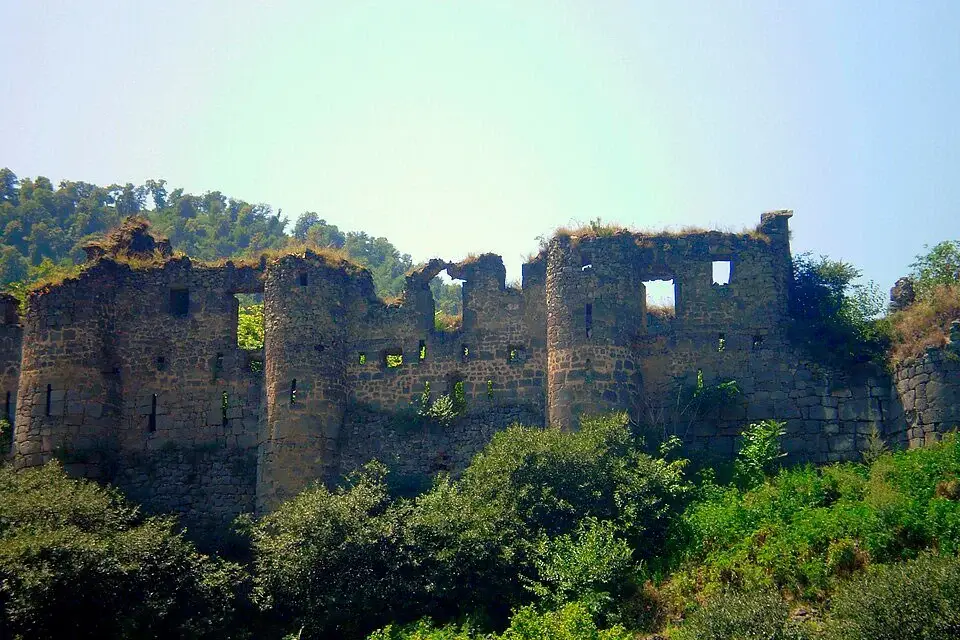
The fortress. The exterior wall runs along the lip of the canyons and ties into the rock face where the cliffs are highest. The single entrance, on the north side, is set behind a tall arched pyramidal tower flanked by smaller bell-shaped towers — the most architecturally distinctive part of the surviving exterior. Inside the wall, the layout is a small monastic settlement: the central church, a smaller single-nave church to the north-west, ruins of monks’ cells, a refectory, a bath house, and the entrance to an underground tunnel that runs out from beneath the northern wall.
The Church of Surb Astvatsatsin. A three-nave domed basilica with the bearings (load-bearing piers) joining the side chapels of the apse. The general plan is recognisably Armenian; the decorative vocabulary — vaulted vestibules, relief crosses on the façades, the carved framing of the windows, scalloped arcading — is recognisably Georgian. The church is a textbook example of cross-cultural medieval architecture in the borderland between two Christian traditions. The stone drum and spire that originally crowned the building are gone; the surviving roof is a later restoration.
To the left of the central entrance is the mausoleum of the Kyurikids. The narthex contains the burials of Ivane Zakaryan and his son Avag.
Legends and cultural footnotes
Akhtala is unusually rich in folklore and modern cultural connections.
- The Cross of the Baptism. Local tradition held that the monastery once kept a cross said to have been used by John the Baptist to baptise Jesus Christ. The relic, according to the story, was later given to Ivane Zakaryan and sold by him to Noravank Monastery in Syunik for a large sum.
- Akhtala copper and the Statue of Liberty. Local lore holds that the copper from Akhtala’s mines was used by the French to cast the Statue of Liberty in New York. There is no documentary evidence for this — the chronology does not actually align, as the statue was completed in 1886 while the Compagnie Française des Mines d’Akhtala only began industrial-scale operations in 1887 — but the story does reflect the genuine importance of the mines and their French ownership through the early 20th century.
- The Lenktemur cliff. One of the cliffs surrounding the monastery is known as Lenktemur, after Tamerlane, who, according to local tradition, buried one of his wives beneath it during his Caucasus campaign.
- The bearded Persians. One of the church’s frescoes shows a group of bearded Persian figures. Folklore holds that this composition kept invading armies from attacking the church, on the principle that no Persian commander would wish to deface a portrait of his own people.
- Parajanov’s The Color of Pomegranates. Several scenes of Sergei Parajanov’s 1969 experimental film The Color of Pomegranates — one of the canonical works of Soviet-Armenian cinema — were shot at Akhtala. For visitors with an interest in 20th-century cinema, the monastery is a small pilgrimage site of its own.
There are also two competing local legends about earlier founders of the church: one tradition holds that the church was built in the 7th century by the Byzantine emperor Heraclius, who was of Armenian extraction; another, that it was built in the 5th century by the Georgian king Vakhtang I Gorgasali. Modern scholarship finds no documentary support for either, but the stories themselves reflect the layered Armenian–Byzantine–Georgian identity of the site.
When to visit and what to know
- Opening hours. The monastery is open to visitors daily, approximately 9:00 to 17:00. Entry is free.
- How long to allow. 45 to 60 minutes is enough to see the church and the main fortress. Add a further 30–40 minutes to walk the length of the curtain wall and look down into the canyons.
- The key. The church door is sometimes kept locked — the key is held by a local caretaker in the village. If the door is closed when you arrive, ask in the houses immediately below the entrance and someone will usually appear with the key within a few minutes. Do not leave without seeing the interior.
- A torch is useful. The church interior is dim, and the frescoes show much more detail with a small handheld light. A phone torch is enough.
- Footwear. The fortress site is uneven, with loose stone and changes in elevation. Wear shoes you can walk on rough ground in.
- No photography restrictions inside. Visitors generally photograph the frescoes without flash, which preserves the pigments.
- Pilgrimage days. If you want to see the monastery as a living religious site, the annual feast of 20–21 September is the day Armenians, Greeks and Georgians come together at the church.
How to get to Akhtala from Yerevan
The monastery is in the deep north of Armenia, about 185 km from Yerevan along the M-6 highway through Vanadzor and Alaverdi. By private car the drive takes 2.5 to 3 hours one way.
Akhtala sits very close to the Bagratashen border crossing into Georgia, which makes it a natural stop for travellers crossing between the two countries — Tbilisi is only 87 km on the Georgian side of the border, about 2 to 2.5 hours by road.
The simplest plan from Yerevan is to combine all three Lori monasteries — Haghpat, Sanahin and Akhtala — in a single long day from the capital. Total driving is around 400 km. For a more relaxed itinerary, overnight in Alaverdi or Vanadzor and split the visits across two days.
The most comfortable way to organise this trip is with a private car with driver for the day — the driver waits at each monastery while you visit, the route is shaped to your pace, and the trip can be extended into Georgia if you want to continue north. The same logic works as part of a private day tour from Yerevan with a Lori-region itinerary.
The Yerevan–Tbilisi train also calls at Akhtala station, which is a few kilometres below the monastery; this is a slower option (overnight, with a morning arrival) but a memorable one for travellers without time pressure.
What to see nearby
Akhtala sits at the eastern edge of one of Armenia’s densest cultural clusters. Within 30 km:
- Haghpat Monastery (~15 km) — UNESCO World Heritage site. The great 10th-to-13th-century monastic ensemble with its gavits (narthexes) and khachkars. The narthex was built in 1185 by Princess Mariam — the same princess who, three years later, built the church at Akhtala.
- Sanahin Monastery (~20 km) — UNESCO World Heritage site. Twin to Haghpat, known for its medieval academy and library and for the Sanahin Bridge, one of the most elegant medieval bridges in the Caucasus.
- Kobayr Monastery (~25 km) — a half-ruined 12th-century monastery in the gorge of the Debed, with surviving fragments of frescoes. Like Akhtala, Kobayr was converted to the Georgian rite under the Zakaryans, and the two sites are art-historical companions.
- The Debed River canyon — the dramatic gorge that runs between Vanadzor and the Georgian border. The road itself is one of the most scenic in northern Armenia.
- Alaverdi (~20 km) — the small town at the bottom of the Debed canyon, with a Soviet-era cable car (currently disused) and several modest local restaurants serving Lori-region cooking.
- The Bagratashen border crossing (~25 km) — the closest land crossing into Georgia, useful if you are continuing north to Tbilisi.
A natural one-day plan from Yerevan: Haghpat → Sanahin → Akhtala → lunch in Alaverdi, returning to Yerevan in the evening. About 400 km of driving and 10 to 12 hours door to door.
Frequently asked questions
Akhtala is the kind of monument that visitors discover and then quietly recommend to other visitors — a fortress with a medieval church inside it, that medieval church covered with one of the great fresco cycles of the Caucasus. Plan it with Haghpat and Sanahin for the obvious one-day Lori plan; plan it on its own if you want to take time over the painting.