Saghmosavank Monastery
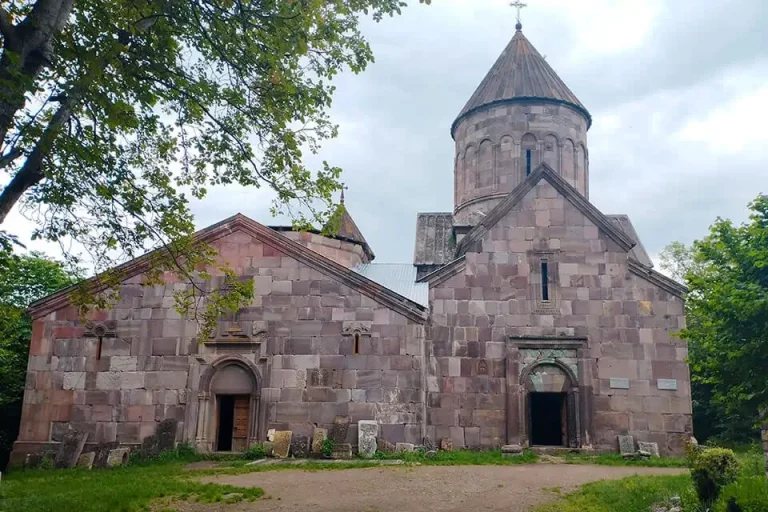
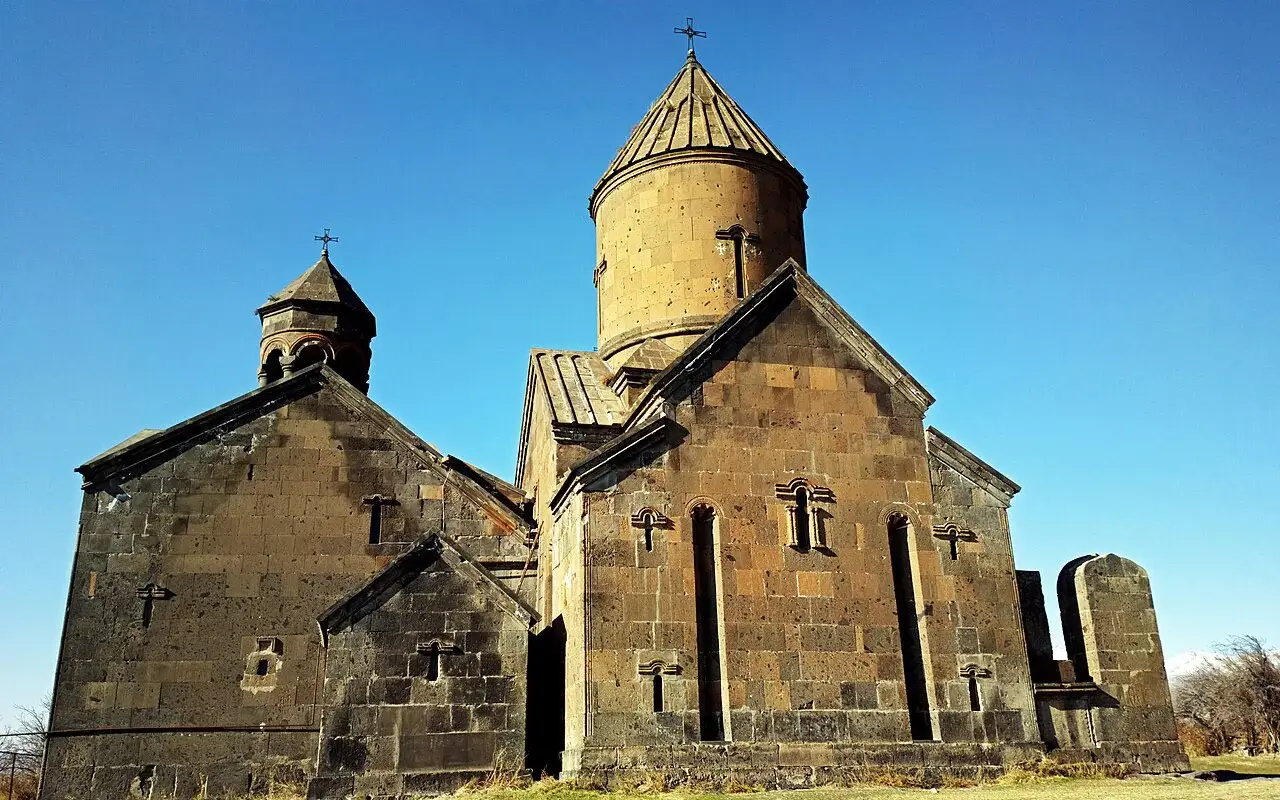
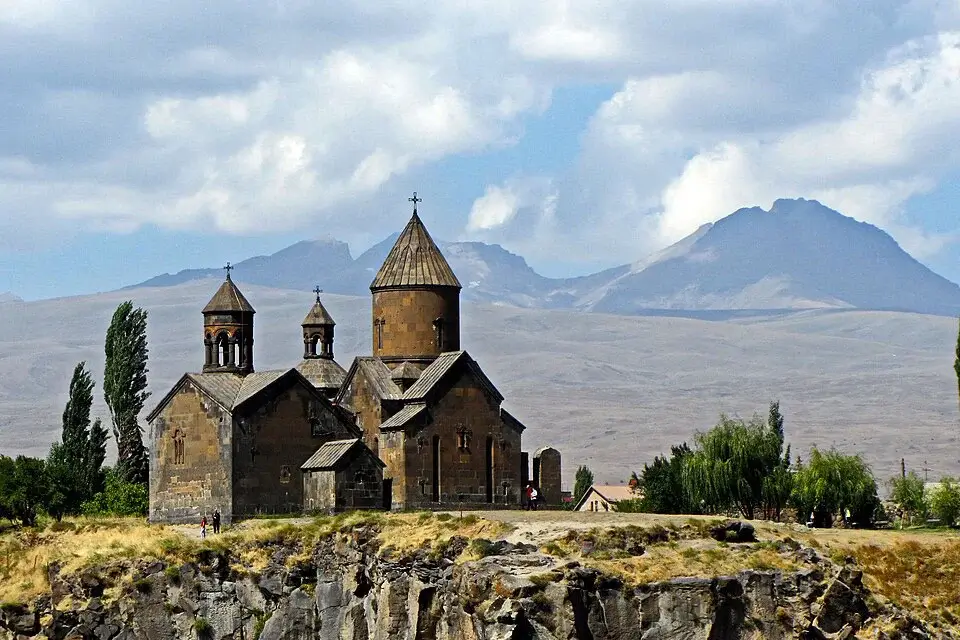
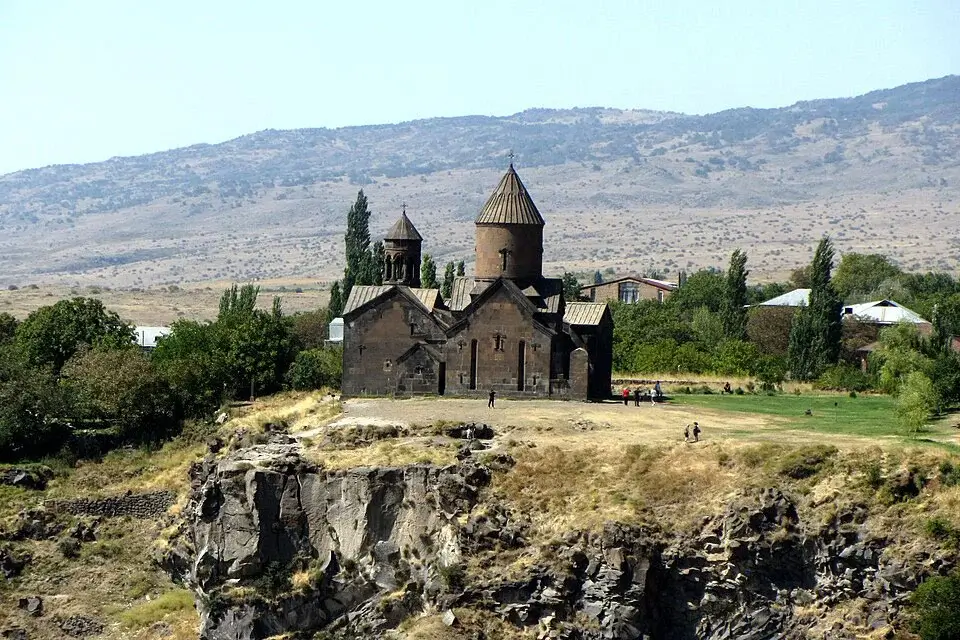
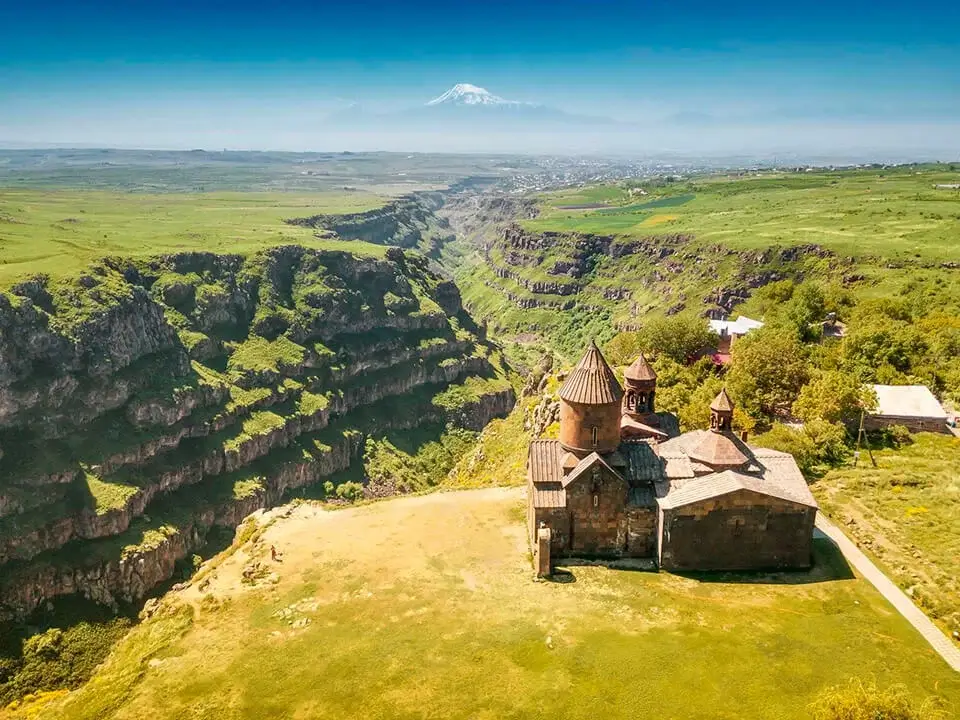
Saghmosavank Monastery (Armenian: Սաղմոսավանք — “Monastery of Psalms”) is a 13th-century Armenian monastic complex perched on the eastern edge of the 200-metre-deep Kasagh river canyon, in the village of Saghmosavan in Aragatsotn Province, 40 km north-west of Yerevan. Built of grey-brown volcanic tuff with orange tints, it sits literally on the cliff edge: from across the gorge the eastern walls of the churches read as a vertical extension of the rock itself. On clear days the view from the courtyard takes in Mount Ararat to the south and Mount Aragats to the north-west, with the canyon dropping away at the visitor’s feet.
The 13th-century historian Kirakos Gandzakketsi listed Saghmosavank among the eight most important monasteries in Armenia. Its main church and its library were built by the same Vachutian prince who shaped the neighbouring Hovhannavank five kilometres downstream, and the two monasteries are universally treated as a pair — almost always visited together, almost always compared. What Hovhannavank gives the visitor in 13th-century figural sculpture, Saghmosavank gives in a remarkable purpose-built medieval library, in the gorge view, and in its name: the place where, according to tradition, St. Gregory the Illuminator first taught monks to sing psalms.
Quick Facts
- Built / Founded: 4th c. (tradition); main buildings 13th c. (Surb Sion 1215)
- Location: Saghmosavan village, Aragatsotn Province
- Also known as: Saghmosavank Monastery, Saghmosavank, Monastery of Psalms, Սաղմոսավանք
- From Yerevan: ~40 km (40–50 minutes by car)
- Entrance fee: Free
- Time needed: 30–45 minutes
- Status: Active monastery
- GPS coordinates:
40.3805351, 44.3967175
A short history: from St. Gregory to a medieval university
According to tradition, the first church on this site was built in the 4th century by St. Gregory the Illuminator — the same saint who founded Etchmiadzin Cathedral and converted Armenia to Christianity. Legend says that he climbed the slopes of Mount Aragats, saw the spot from above, and decided to build here; he then gathered monks and taught them to sing psalms continuously, so that the sound rolled along the canyon. From the Armenian word saghmos — “psalm” — the monastery took its name.
The first reliable mention of Saghmosavank in historical sources comes from the 12th century, when the vardapet (monastic teacher) Hovhannes Munj founded a school here. Through the Seljuk invasions (1064–1211) the monks of Saghmosavank descended into caves in the Kasagh gorge to continue copying manuscripts and to support the underground resistance — a manuscript list discovered in one of those caves as late as May 1912 confirms how much scribal activity continued through that period.
Saghmosavank’s golden age began in the early 13th century under the Vachutian princely house. In 1215 Prince Vache I Vachutian and his wife Mamakhatun built the main church of the complex — Surb Sion (Holy Zion). The same prince started work on the cathedral of Hovhannavank one year later, and his patronage stretched south to the great gavit at Sanahin Monastery (1211) and east to the gavit at Makaravank (before 1207). Vache also donated one village and 115 manuscripts to Saghmosavank — the seed of the great library that would soon need its own building.
That building came in 1255, when Vache’s son Kurt I Vachutian and his wife Princess Khorishah Mamikonyan built a purpose-designed library-church, Surb Astvatsatsin, in memory of their late daughter Mamakhatun. By that point the library is recorded as holding around 120 manuscripts, including biblical interpretations, theological literature, and the works of medieval Armenian historians.
The intellectual flowering peaked in 1267, when the great Armenian scholar and historian Vardan Areveltsi moved his higher monastic school from Khor Virap Monastery up to Saghmosavank. With its dedicated scriptorium and library it became one of the principal centres of learning in medieval Armenia. The school stayed open until the end of the 17th century.
Two later restorations brought the complex back into shape: a substantial campaign in the mid-17th century under Catholicos Hovhannes of Moks, and another in 1890 ordered by Catholicos Mkrtich Khrimian (Khrimian Hayrik). Through the Soviet period Saghmosavank avoided the warehousing that destroyed many Armenian churches — it was protected as an architectural monument and quietly preserved. The most recent major restoration was completed in 1998–2000, for the 1,700th anniversary of Armenia adopting Christianity.
Surb Sion Church (1215) and the moving dome
The main church of Saghmosavank is built directly on the canyon’s edge. Surb Sion is a cross-winged domed structure with two-storey annexes in all four corners — the same architectural type Vache Vachutian used at Hovhannavank a year later, and known in Armenian art history as the “Gandzasar type.” The high cylindrical drum with four narrow windows carries a conical roof, and short pipe-shaped stone elements characteristic of the region’s domical roofing complete the silhouette.
Local tradition says that the architect of Surb Sion designed the dome to move up to 10 centimetres in any direction, so that earthquakes would dissipate rather than collapse it — an engineering touch that has helped the church survive for more than 800 years on the lip of an active seismic landscape.
The jamatoun (gavit) was added immediately after the church, between 1215 and 1220, against the western wall. A spacious assembly hall that doubled as the formal entrance to the church, it follows the standard four-pillar plan but, in keeping with the rest of the complex, is restrained on the outside.
The Gratun — a rare medieval library building
What sets Saghmosavank apart from its twin is its purpose-built library. Most medieval Armenian monasteries kept their manuscripts in side rooms, vestries, or specially deepened niches. Only a handful — most famously Sanahin, Haghpat, and Saghmosavank — built dedicated library buildings within their walls.
Saghmosavank’s library, the small Surb Astvatsatsin Church (Gratun), was built in 1255 by Prince Kurt I Vachutian and Princess Khorishah Mamikonyan, in memory of their daughter Mamakhatun. From the outside it is severe and almost ascetic, the same height as the main church but with almost no decoration — a deliberate contrast with the inside.
The interior is the opposite. The vaulted ceiling rises to an eight-faceted rotunda that lets light into the room from above, and the walls and arches are carved in geometric and vegetal patterns assembled from stones in red, black, white and yellow — a quiet polychromy unusual for an Armenian church interior. Around the upper part of the walls run deep niches designed to hold manuscripts and precious church utensils — including hiding places to which books could be retreated during invasions. The entire room reads as both a library and a small chapel: a building made for books.
The full complex: chapel, gavit, and the red khachkars
Beyond the main church and the library, Saghmosavank includes a single-nave chapel to the south, the jamatoun, the foundations of a curtain wall (mostly ruined), and a scattering of medieval khachkars — Armenian carved cross-stones — some standing on stepped pedestals. Many of the Saghmosavank khachkars were originally painted with Armenian red cochineal, a pigment ground from insects, symbolising the blood of Christ on the cross. Traces of the red are still visible in protected niches on a few of the stones.
The legend of Tamerlane and the doves
One of the best-known local stories ties Saghmosavank to the late-14th-century invasion of Tamerlane, who burned villages, killed civilians, and looted manuscripts across Armenia. According to the legend, while still in Armenia Tamerlane fell seriously ill and offered to grant a wish to whoever could cure him. A priest from Saghmosavank stepped forward and asked that Tamerlane release as many prisoners as could fit inside the church. Tamerlane agreed, expecting a few hundred — but the prisoners, said to number 70,000, walked one by one into the small church and somehow all of them fit inside. When Tamerlane reached the entrance, the priest is said to have turned them into doves, which flew out through the windows. Tamerlane fled Armenia, and the country had peace.
It is the kind of medieval miracle story that makes sense the moment you stand inside the small main church and look up at the high windows of the drum.
How to get to Saghmosavank Monastery from Yerevan
The monastery lies about 35–40 km north-west of Yerevan, in the village of Saghmosavan — roughly 40 minutes by car via the M3 highway through Ashtarak. From Ashtarak (10 km away) the route follows the eastern rim of the Kasagh canyon north.
By public transport, marshrutkas run regularly from Yerevan to Ashtarak; from Ashtarak a short taxi covers the last 10 km. Most travellers, however, combine Saghmosavank with Hovhannavank, the Armenian Alphabet Monument and (with more time) Amberd Fortress on the slopes of Mount Aragats — for that, the simplest option is to hire a car with driver in Yerevan and treat the Kasagh canyon as a single half-day or full-day route.
Practical tips on site
- Step inside the Gratun (library) — its strict outside hides one of the most expressive small interiors in medieval Armenia, with a polychrome stone rotunda above your head.
- The cliff edge has no railings — the drop is sheer 200 metres. Keep children close.
- The canyon rim is always windy; even in midsummer a light jacket pays off.
- The best photographs are from the opposite side of the canyon, where the silhouette of the churches lines up with Mount Aragats behind them; a short walk down a path on the west rim reaches the viewpoint.
- Plan 30–45 minutes for the monastery itself, or up to an hour with a canyon-rim walk.
- There are no shops or cafés at the monastery — bring water from Ashtarak or Yerevan.
What to see nearby
- Hovhannavank Monastery (~5 km south) — Saghmosavank’s twin on the same canyon rim, with the rare 13th-century relief of the Parable of the Wise and Foolish Virgins and Armenia’s largest rotunda belfry.
- Armenian Alphabet Monument (~1 km north) — 39 stone letters of the Armenian alphabet, carved in tuff and installed in 2005–2006 for the 1,600th anniversary of the alphabet’s invention by Mesrop Mashtots. A small, photogenic open-air site.
- Ashtarak (~10 km) — old town with three medieval churches (Karmravor, Tsiranavor, Spitakavor) and a medieval bridge over the Kasagh.
- Amberd Fortress (~30 km) — a 10th–13th-century fortress on the south slope of Mount Aragats at 2,300 m.
- Byurakan Observatory (~20 km) — one of the leading astrophysical observatories of the 20th century, founded by Viktor Hambardzumyan in 1946.
- Mount Aragats — Armenia’s highest mountain, visible from the courtyard of the monastery.
Frequently asked questions
Saghmosavank is the kind of medieval site that rewards a careful walk through three small rooms more than a single sweeping photo: the main church on the cliff edge with its earthquake-flexing dome, the gavit beside it, and — easiest to miss — the small library where a 13th-century princess buried her daughter inside a building made for books. With Hovhannavank five kilometres south, the Armenian Alphabet Monument a kilometre north, and Mount Aragats rising in the background, it sits at the centre of the most accessible monastic landscape near Yerevan — most easily explored with a private car and driver from Yerevan.