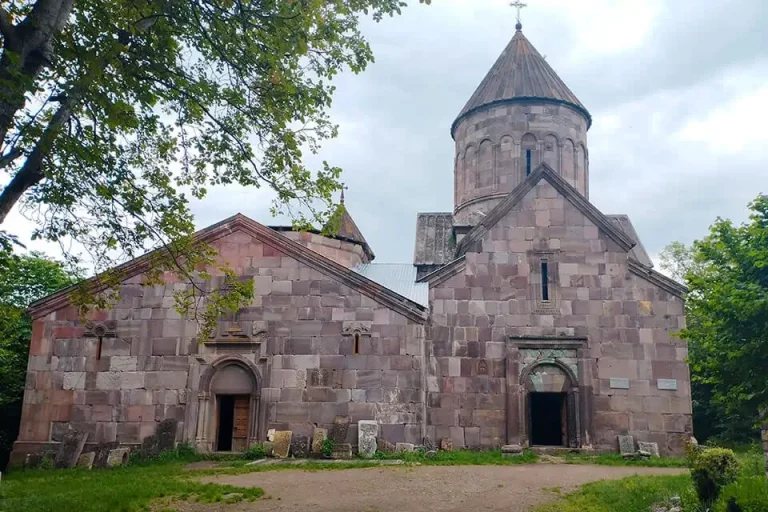

Haghpat Monastery
Haghpat Monastery (Armenian: Հաղպատավանք, Haghpatavank) is a 10th–13th-century monastic complex set on the slope of a hill above the Debed canyon, in the Lori Province of northern Armenia. In 1996 it became the first Armenian site inscribed on the UNESCO World Heritage List — described by UNESCO as a “masterpiece of religious architecture and a major centre of learning in the Middle Ages.” Four years later the listing was extended to include its UNESCO twin, Sanahin Monastery, three kilometres west across the same canyon.
Both monasteries were founded by Queen Khosrovanush, wife of the Bagratid king Ashot III the Merciful, in the late 970s. For three centuries Haghpat was one of the great scientific and literary centres of medieval Armenia: a library so renowned that the manuscripts of the modern Yerevan Matenadaran are partly its inheritance; a school where medicine, astronomy, music, and theology were taught; and a workshop where some of the finest illuminated manuscripts in Armenian art were copied.
Quick Facts
- Built / Founded: 976 AD
- Location: Haghpat village, Lori Province
- Also known as: Haghpat Monastery, Haghpatavank, Haghpat Monastic Complex, Հաղպատավանք, Հաղպատ
- From Yerevan: ~180 km (2.5–3 hours by car)
- Entrance fee: Free
- Time needed: 45–60 minutes
- Status: Active monastery / UNESCO World Heritage site
- GPS coordinates:
41.0938533, 44.711976
A short history: from Queen Khosrovanush to the Mongols
Haghpat was founded around 976 AD by Queen Khosrovanush, wife of King Ashot III the Merciful and one of the most influential royal patrons of medieval Armenian architecture. She had begun the neighbouring Sanahin monastery a few years earlier; Haghpat was its sister foundation, conceived in honour of her two sons — the future king Smbat II of Ani and Gurgen (Kyurike), the founder of the Kyurikian (Tashir-Dzoraget) royal house.
The construction of the central cathedral, Surb Nshan (“Holy Sign of the Cross”), began in 976 under the direction of the founding abbot Simeon and his assistant Tiranun, and was completed in 991 during the reign of Smbat II. The traditional attribution gives the architect as Trdat — the same master architect later credited with the rebuilding of the dome of Hagia Sophia in Constantinople after the 989 earthquake. A high-relief sculpture on the church’s east facade shows the two royal princes standing opposite each other, holding a model of the church between them.
Through the 11th–13th centuries, under the patronage of the Kyurikian, Zakaryan, and Khaghbakyan (Proshyan) families, Haghpat grew into one of medieval Armenia’s most important monasteries. The library and scriptorium produced hundreds of manuscripts; the school is said to have included the Armenian scholar Hovhannes Imastaser (“the Philosopher”), a major medieval theologian and poet. At its peak the monastery housed more than 500 monks.
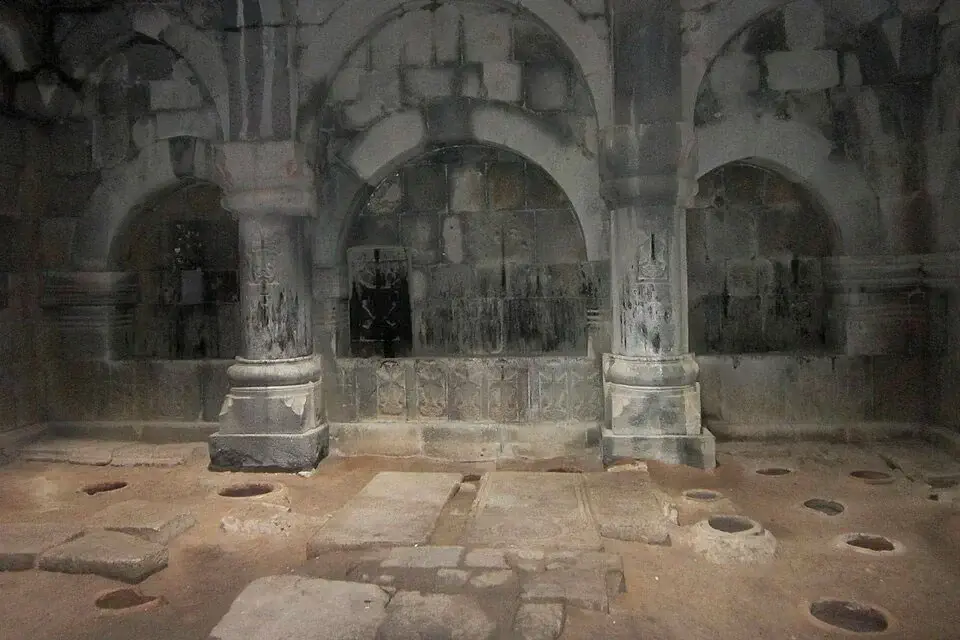
The complex suffered several blows. Around 1105 parts of it were burned by Seljuk raiders. In 1130 an earthquake damaged the cathedral and main buildings; full restoration took nearly fifty years. When Mongol armies began their westward push in the 13th century, the monks hid the most precious manuscripts in seven caves in the surrounding hills. Only three of those caches were ever recovered, and even after the danger passed the library hall was never fully restored as a book repository — instead, it was repurposed as a food store, with sunken ceramic jars set into its stone floor. Some of those jars are still visible today.
Even so, Haghpat remained a significant religious centre. In 1260 the Armenian prince Prosh Khaghbakian, fighting alongside his Zakaryan suzerains in the Mongol-led Siege of Mayyafariqin, returned with Christian relics taken from the captured city — including, by tradition, the right hand of the Apostle Bartholomew, which was brought to Haghpat.
The buildings of Haghpat
The complex sits partway up the hillside, not on the summit — a deliberate monastic choice, traditionally interpreted as a symbol of humility. The buildings cluster around the cathedral in an asymmetrical but balanced ensemble, surrounded by a low towered rampart.
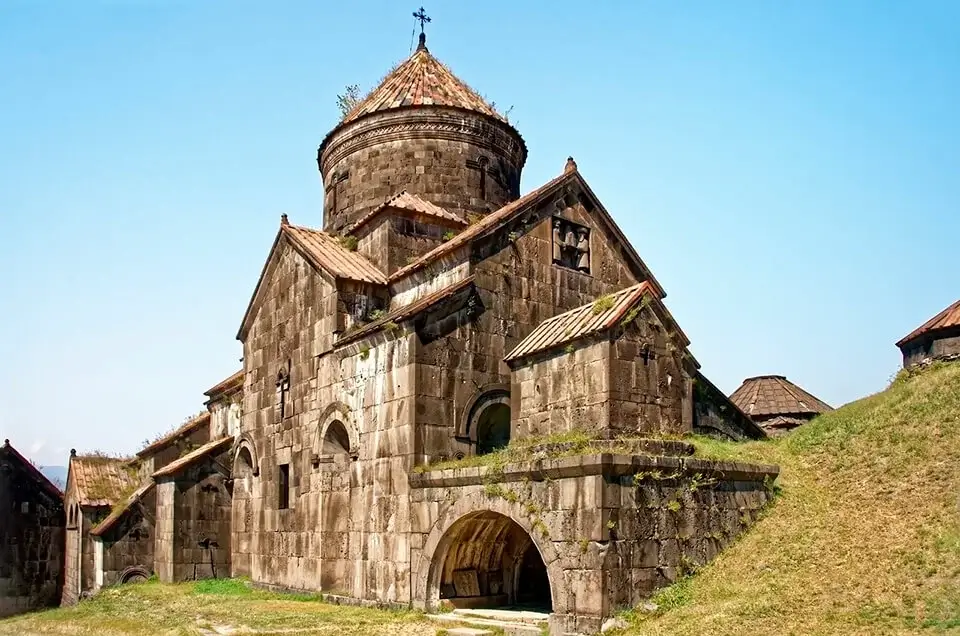
- Surb Nshan Cathedral (976–991) — the oldest and largest building. A rectangular domed church with an internal cruciform plan; the central dome rests on four massive pillars in the side walls, and the exterior is articulated by the triangular recesses typical of the period. The interior preserves significant fragments of medieval frescoes, including an enthroned Christ. The east facade carries the donor sculpture of princes Smbat and Gurgen.
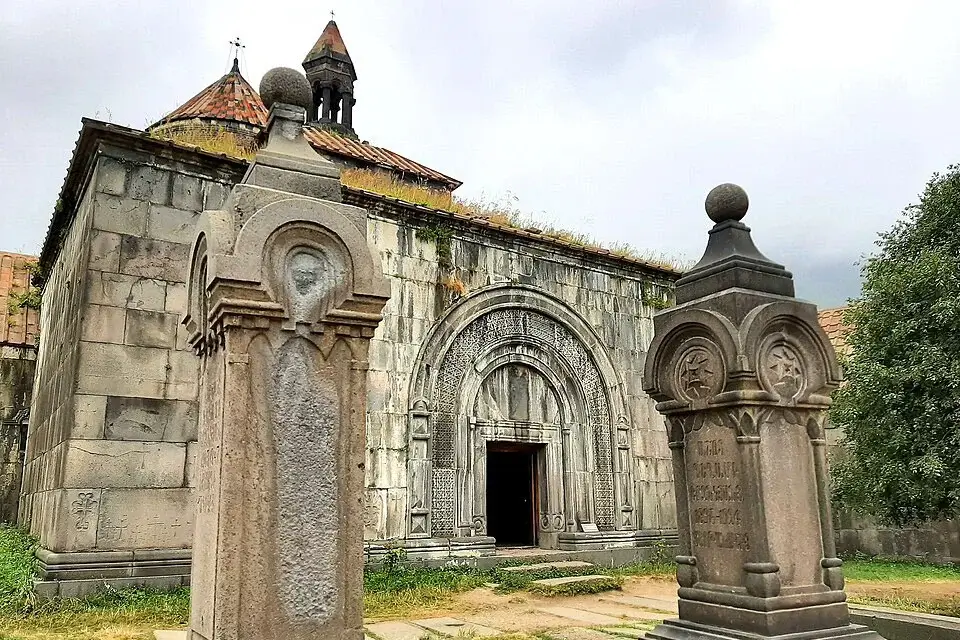
- The gavit of Surb Nshan (1185) — built by Princess Mariam, daughter of Kyurike, with an inscription that begins “I, Mariam, daughter of King Kyurike, have built with great hope this house of prayer over our tombs.” Its floor is paved with the tombstones of the Kyurikian royal house — walking across them is considered an act of respect in Armenian tradition. The roof rests on intersecting ribbed arches with an open central oculus.
- St. Grigor Church (1005) — a small domed church south of the cathedral, later expanded with two side chapels: one in the early 13th century, the other, Hamazasp’s Gavit (1257), commissioned by the abbot Hamazasp and the largest single structure in the complex.
- The library and scriptorium (mid-11th c., rebuilt 1258–1262) — square hall with niches for manuscripts in the walls. The original wooden roof was replaced by the abbot Hovhannes with a stone vault of intersecting arches; the sunken ceramic jars in the floor remain from its later role as a food store after the Mongol invasion.
- The refectory (13th c.) — built into the defensive wall outside the inner enclosure, with an octagonal roof for light and smoke. Large enough to seat around 270 monks at once.
- Kayan Fortress (Kayanberd) (1233) — a separate hilltop stronghold built specifically to watch over the approaches to Haghpat after the Mongol threat appeared.
- The three-storey bell tower (1245) — free-standing, with light arched openings on each level. Together with the Sanahin belfry, it was one of the first multi-storey bell towers in Armenian architecture.
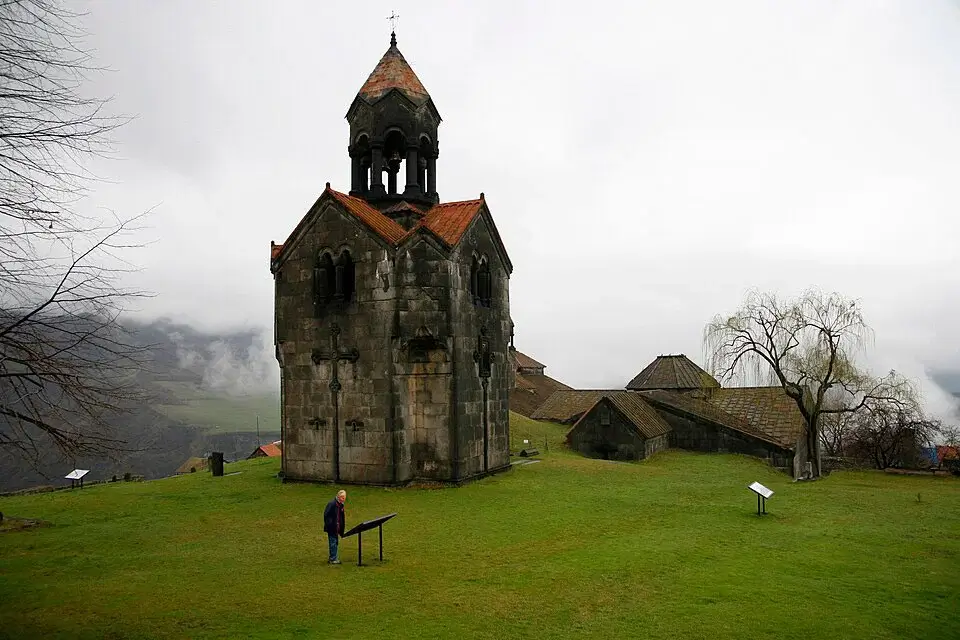
The buildings are constructed of locally quarried basalt and adapted closely to the slope; the result is an organic, irregular ensemble that reads as a single architectural body rather than as a collection of separate buildings.
The Amenaprkich khachkar (1273)
Dozens of medieval khachkars stand in the monastery grounds, ranging in date from the 11th to the 13th centuries — but the one piece every visitor stops in front of is the Amenaprkich (“All-Saviour”) khachkar of 1273, set just outside the northern entrance of Surb Nshan.
Unlike most Armenian khachkars, which are almost purely ornamental, the Amenaprkich is figural: at its centre is a full Crucifixion scene — Christ on the cross, flanked by the Virgin Mary and the Apostle John, with Joseph of Arimathea and Nicodemus below, the twelve apostles in small frames along the sides, and personifications of the sun and moon above. Scholars believe it was installed in 1273 by the abbot Hovhannes (Yovhannes), whose personal prayer is among its many inscriptions; the sculpting is traditionally attributed to a master named Vahram. The stone is unusually soft, which allowed extreme fineness of carving, and the finished khachkar was originally painted a bright red with cochineal dye — a pigment ground from insects. It is widely regarded as one of the finest khachkars in Armenia.
The legend of the name
A medieval folk story explains how the two monasteries came by their names. According to the legend, a prince of Sanahin invited a celebrated master craftsman to build a monastery in the canyon. The master arrived with his son, but during the work the two quarrelled, and the son walked away and accepted a commission from another prince to build a second monastery nearby. When the father saw his son’s finished work, he is said to have exclaimed, “Agh pat!” — Armenian for “good wall!” — and the new monastery took that name: Haghpat.
The same encounter, in Sanahin’s version, supplied that monastery with its name: pointing back at his own work, the father told his son, “Sa nraniz hin e” — “this one is older than that one.”
How to get to Haghpat Monastery from Yerevan
Haghpat lies in northern Lori, near the Georgian border. From Yerevan it is about 180 km on the M6 highway via Vanadzor and Alaverdi — typically 2.5 hours by car. The monastery sits on a plateau above the city of Alaverdi, about 10 km by road from the centre.
By public transport: minibuses run from Kilikia Bus Station in Yerevan to Alaverdi (~3 h), with a short taxi up to Haghpat village. The Yerevan–Tbilisi train also stops at Alaverdi station, and Haghpat is a 15–20 minute taxi ride from there — which makes the monastery a natural stop for anyone crossing between Armenia and Georgia. The Bagratashen border crossing is only ~30 km north.
Because Haghpat and Sanahin are only seven kilometres apart by road (and three across the canyon), they are almost always visited as a pair, often together with Sanahin Monastery and Akhtala Monastery-Fortress (with its frescoes) for a full Lori day. The whole circuit from Yerevan is roughly 400 km and 10–11 hours door-to-door; the most flexible way to do it is with a private car and driver in Yerevan.
Practical tips on site
- The cathedral is open daily; entrance to the complex is free.
- Plan 45–60 minutes for the cathedral and library, or up to 1.5 hours if you walk around the rampart, find the khachkars and the Kayan fortress viewpoint, and stop to look at the canyon from the platform behind the bell tower.
- Walking on the gavit’s tombstones is normal and respectful — Princess Mariam built the floor that way. Do not step around them.
- The Amenaprkich khachkar stands just outside the northern entrance of Surb Nshan — easy to miss if you walk into the cathedral first.
- Step inside the library and look for the sunken ceramic jars in the floor: physical traces of the Mongol-era manuscript hiding.
- Sunset is widely considered the best photo light at Haghpat — the basalt walls turn a deep gold-pink against the canyon below. Plan a Sanahin-then-Haghpat order so that the last stop coincides with the evening light.
What to see nearby
- Sanahin Monastery (~7 km by road, 3 km across the canyon) — the UNESCO twin, with the academy of Grigor Magistros, the matenadaran with the stone-tent ceiling, and the 12th-century lion-bridge.
- Akhtala Monastery-Fortress (~15 km) — known for the only large-scale Armenian–Chalcedonian fresco cycle in Armenia, painted in 1205–1216.
- Kobayr Monastery (~25 km) — a half-ruined 12th-century monastery clinging to a cliff above the Debed gorge, with fragments of medieval frescoes.
- Alaverdi (~10 km) — the regional capital in the canyon below, with a Soviet-era ropeway and small canyon-side restaurants.
- The Debed canyon itself — a deep, forested gorge that links all the Lori monasteries in a single natural setting.
Frequently asked questions
Haghpat is the kind of monastery where the walls themselves are inscriptions: a thousand-year-old cathedral built by a queen for her sons; a princess’s gavit paved with the tombstones of a royal house; a 13th-century khachkar whose figures break with almost every other Armenian khachkar; a library where the floor jars still mark the panic of the Mongol invasions. With Sanahin across the canyon and Akhtala twenty kilometres on, it is the centrepiece of one of the finest day routes in northern Armenia — most easily done with a private car and driver from Yerevan.