
Hayravank Monastery
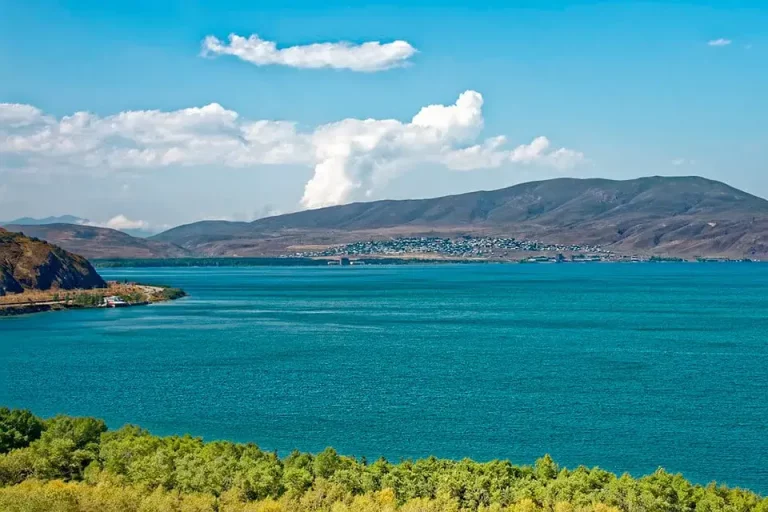
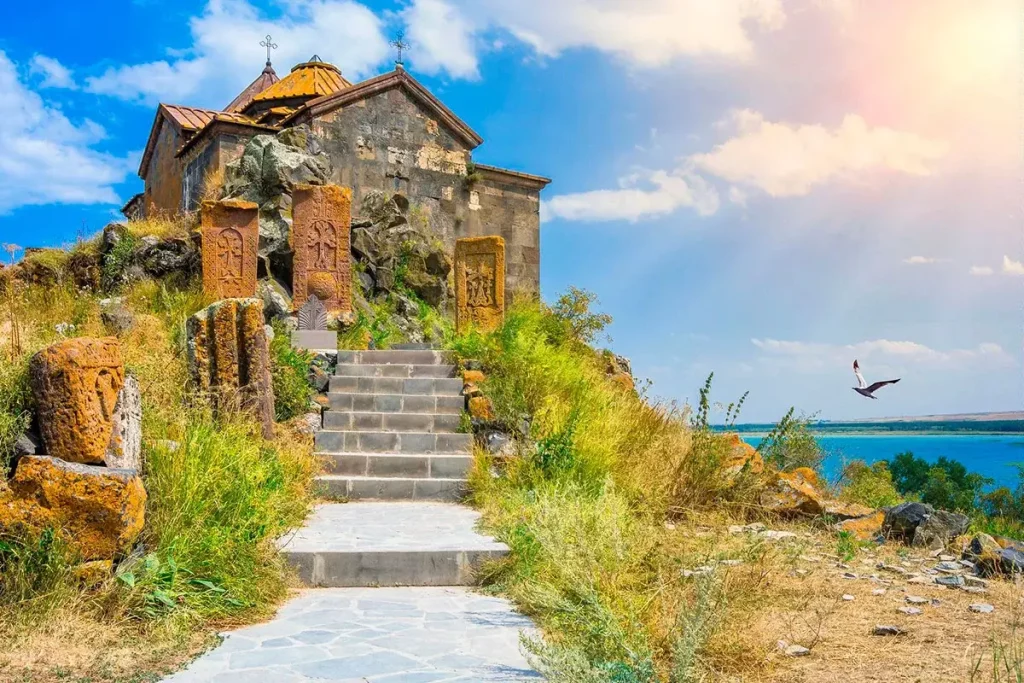
Hayravank Monastery (Armenian: Հայրավանք — “Father’s Monastery”) is a 9th–12th-century complex perched on a rocky cliff above the western shore of Lake Sevan, about 80 km from Yerevan. The site holds the Church of St. Stepanos (late 9th century), a small 10th-century chapel, and a 12th-century gavit, together with a small cemetery of medieval khachkars. The 18th-century Catholicos Ghazar I Jahketsi recorded the legend that gave the monastery its second name — Mardaghavnyats, “the monastery of the people-doves” — and the place still draws visitors as much for its story as for its panoramic view over the lake.
Quick Facts
- Built / Founded: 9th–12th centuries
- Location: Hayravank village, Gegharkunik Province
- Also known as: Hayravank Monastery, Հայրավանք, Ayrivank, Mardaghavnyats, Father Hovhan's Monastery
- From Yerevan: 80 km from Yerevan
- Entrance fee: Free
- Time needed: 30–45 minutes
- Best time to visit: Late afternoon May–October; Vardavar (mid-July) for ceremonies
- Status: Museum monument (Armenian Apostolic site)
- GPS coordinates:
40.4327, 45.10806
Where it is
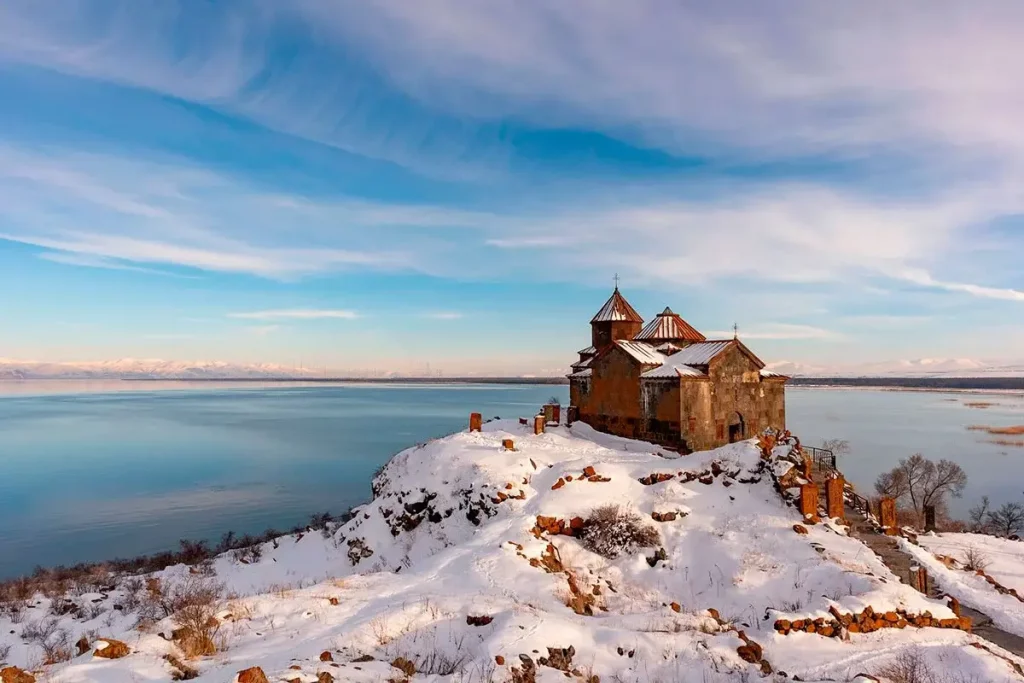
The monastery stands on a rocky promontory directly above Lake Sevan, on the edge of Hayravank village in Gegharkunik Province. From Yerevan it is about 80 km along the M-4 highway via the town of Sevan, then south along the western lake shore. The cliff position gives one of the best southern panoramas of the lake — the church and the water are visible together in a single frame, which is rare on Sevan. GPS: 40.4327, 45.10806.
How to get to Hayravank from Yerevan
The drive from Yerevan is roughly 80 km — about 1 hour 15 minutes by car. Follow the M-4 toward Sevan and Dilijan, then turn off the M-10 at the town of Sevan and continue south along the western shore to Hayravank village. The road is paved the whole way; in winter, watch for ice after snowfalls. There is no entrance fee and no fixed opening hours — the grounds are open in daylight.
Public transport is harder. Marshrutkas from Yerevan’s Northern Bus Station run toward Gavar or Martuni; ask the driver to drop you at the turn-off for Hayravank village, then walk roughly 1 km. The return schedule is not always convenient for a same-day trip. The most flexible option is to hire a car with driver in Yerevan and combine Hayravank with Sevanavank and the Noratus cemetery in one day.
History and architecture
The monastery was founded in the 9th century, when monastic communities were spreading rapidly along the shores of Lake Sevan. The Church of St. Stepanos (St. Stephen the Protomartyr) is the oldest building, built in the second half of the 9th century. A small chapel was added next to it in the 10th century, and a gavit (vestibule) was attached to the western facade in the late 12th century. Because the church sits at the very edge of the cliff, the gavit had to be shifted off-axis from the main building, and two of its columns were replaced by half-columns set into the wall — a small but elegant solution to a structural problem.
St. Stepanos is a quatrefoil cruciform central-plan church: four semi-circular apses intersect to form squinches that carry an octagonal drum and a conical dome. The lower walls are built of rough-hewn dark basalt; the arches and the drum are made of finely cut, light-coloured tuff — the contrast between dark and light stone is a signature of Armenian medieval architecture. The conical dome above the drum is decorated with “harlequin-patterned” stonemasonry, alternating reddish and greyish tuff blocks. This is one of the earliest surviving examples of polychrome decorative masonry in Armenia — a technique that would become widespread in the centuries that followed. An oculus at the top of the dome lets a narrow shaft of light fall through the interior, and the squinches inside carry early stalactite-style detailing.
According to the inscriptions on the building, the church was first restored in 1211 by the brothers and monks Hovhasap and Nerses, who also built a two-columned hall with an yerdik (skylight). Five medieval inscriptions are known on the walls, of which the 1211 inscription is the earliest. The monastery was active until the 19th century, after which it fell into disuse; in the 1980s it was restored and the collapsed dome rebuilt.
The cliff itself was inhabited long before Christianity. Excavations on and around the site have produced metal and stone weapons, tools, clay idols, fireplaces, and tombs from the Bronze and Iron Ages, including a polished black Early Bronze Age vessel. A short distance to the northwest stand the remains of fortification walls and settlement foundations spanning from the Bronze Age through the medieval period — the so-called Spitak Berd (“White Fortress”), which according to local tradition was linked to the monastery by an underground passage.
The small walled courtyard preserves khachkars from the 15th–16th centuries, including a particularly fine cross-stone attributed to the master Akop, with a carved Christ at the centre and the four evangelists at the corners.
The legend of the priest and the doves
The most famous story attached to Hayravank was recorded by Ghazar I Jahketsi, Catholicos of All Armenians in the early 18th century. According to the legend, in 1381, during the invasions of Timur (Tamerlane), the abbot Hovhan lived at Hayravank. Unwilling to witness the destruction of his people, he threw himself from the cliff into Lake Sevan — but instead of drowning, he walked across the surface of the water. Timur, struck by the miracle, summoned the monk and promised to grant him one wish. Hovhan asked that as many villagers be spared as could fit inside his tiny church.
Timur agreed — the building was very small. But the villagers came in one after another, and the monastery held them all. When Timur finally burst inside in anger, the church was empty: a dove flew from the priest’s hand out through the window. According to the chronicle, everyone who entered had been turned into a dove and flown to their homes, where they became people again. From that day the monastery was known as Mardaghavnyats — from the Armenian mard (“man”) and aghavni (“dove”). Some sources add that the priest worked the transformation with a relic of the True Cross, later moved for safekeeping to nearby Sevanavank.
When to visit and what to expect
Hayravank is open all year. The summer high season runs June through September; the most beautiful light falls in the late afternoon, when the western cliff catches the sun and the lake turns deep blue behind the church. Winter visits are dramatic but cold and windy — Sevan sits at 1,900 m. The traditional Armenian holiday of Vardavar in mid-July is the busiest day at Hayravank, with pilgrims arriving for blessings; expect crowds and ceremonies that day.
Practical notes: no entrance fee, no fixed hours, parking on the road below the cliff, a small souvenir stall in season. The walk up from the parking area takes a couple of minutes on narrow stone steps — solid shoes help, especially when icy.
What else to see nearby
- Sevanavank Monastery (~30 km north) — a 9th-century twin to Hayravank, on the Sevan Peninsula. The two are usually visited together.
- Noratus Cemetery (~15 km south) — the largest medieval khachkar field in Armenia, with hundreds of cross-stones from the 9th–17th centuries.
- Spitak Berd (“White Fortress”) — 1 km from the monastery, reachable on foot. Bronze Age to medieval fortification ruins on the same ridge.
- Lake Sevan — beaches, viewpoints, and Sevan trout restaurants along the shore.
The natural day-trip from Yerevan: Sevanavank → Hayravank → Noratus, and back along the M-4.
FAQ
Hayravank is the kind of small monastery where the setting carries as much weight as the architecture — a 9th-century cliff-top church above the blue of Sevan, with a Bronze Age fortress on the same ridge and a 14th-century legend told in dove-feathers. For more sites across the country, see our guide to things to do in Armenia.