Symphony of Stones
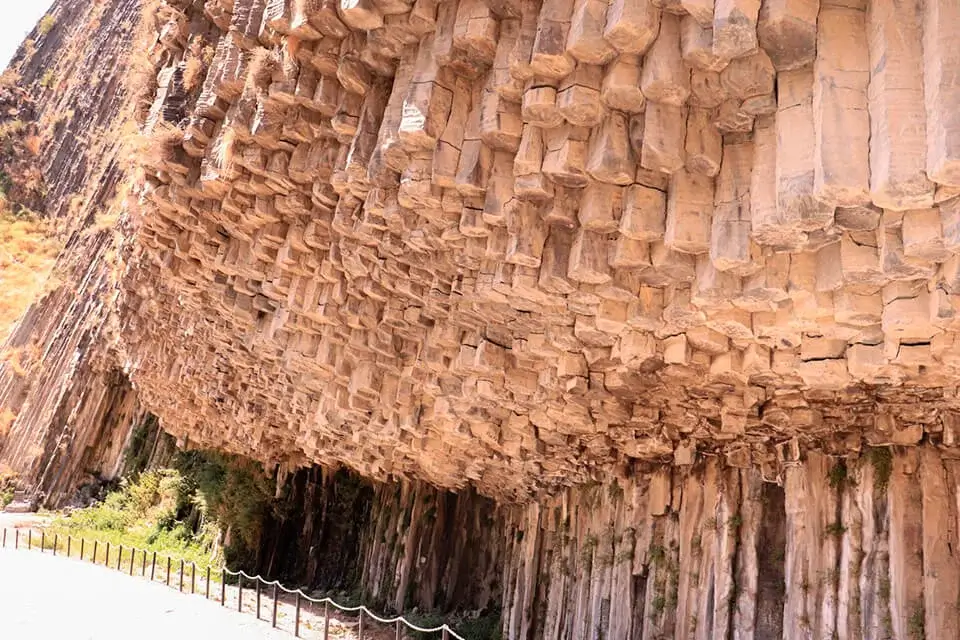
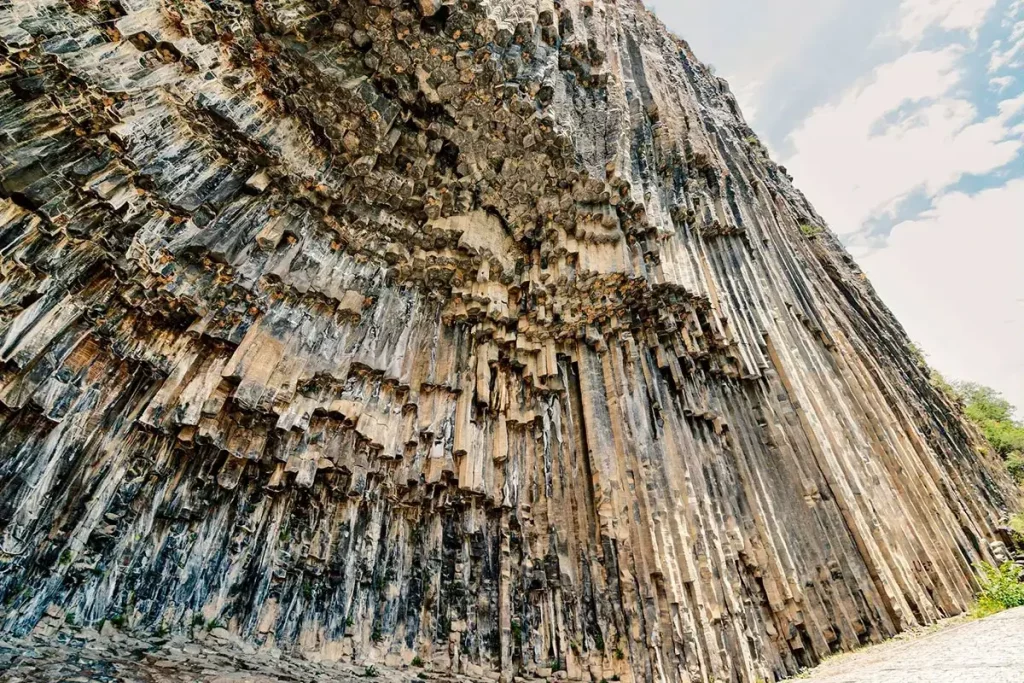
The Symphony of Stones, also known as the Basalt Organ, is a striking natural monument in Armenia’s Garni Gorge — a wall of tightly packed hexagonal and pentagonal basalt columns hanging from the canyon cliffs, in places reaching almost 50 metres in height. Formed by volcanic lava that cooled and crystallised inside the gorge over geological time, the columns are so symmetrical they look man-made, resembling the pipes of a giant organ. The site lies just below Garni Temple, about 30 km east of Yerevan, and is almost always visited as part of the classic Garni–Geghard day trip.
Quick Facts
- Location: Garni Gorge, Kotayk Province
- Also known as: Basalt Organ, Symphony of the Stones, Qareri Simfonia
- From Yerevan: About 30 km / 50 minutes
- Entrance fee: 300 AMD
- Time needed: 30–45 minutes
- Best time to visit: Spring and autumn; mid-morning or late afternoon for the best light
- Status: Natural monument; part of UNESCO Upper Azat Valley landscape
- GPS coordinates:
40.1158403, 44.7388445
What is the Symphony of Stones?
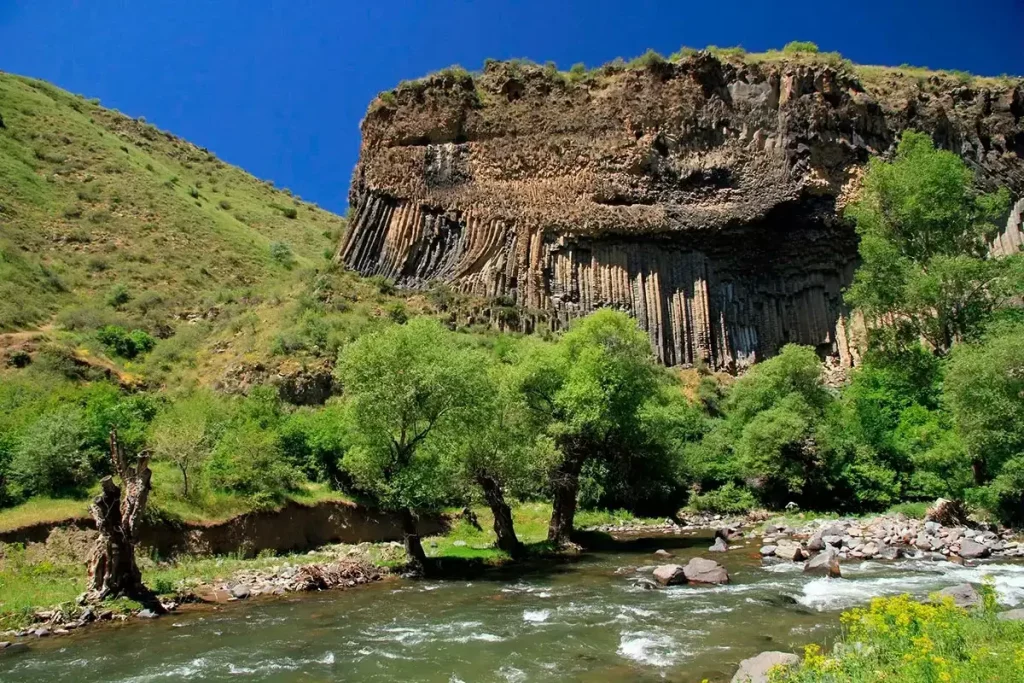
The Symphony of Stones is the most photographed stretch of the Garni Gorge, where the Azat River has cut through ancient basalt lava flows and exposed thousands of columnar formations along the canyon walls. The columns are vertical, with regular five- and six-sided cross-sections, and the cliff face looks as if it were carved by a master sculptor.
The popular Armenian name “Symphony of Stones” (Քարերի սիմֆոնիա, Qareri Simfonia) refers to the resemblance to organ pipes, paired with the soundtrack of the Azat River flowing through the gorge. The site is also officially called the Basalt Organ.
In 2013, Armenia’s tourism poster featuring the Symphony of Stones won first place in the “Europe” category at the UNWTO “Vettor Giusti” tourism poster competition — a small but telling sign of how iconic the site has become.
How the Basalt Columns Formed
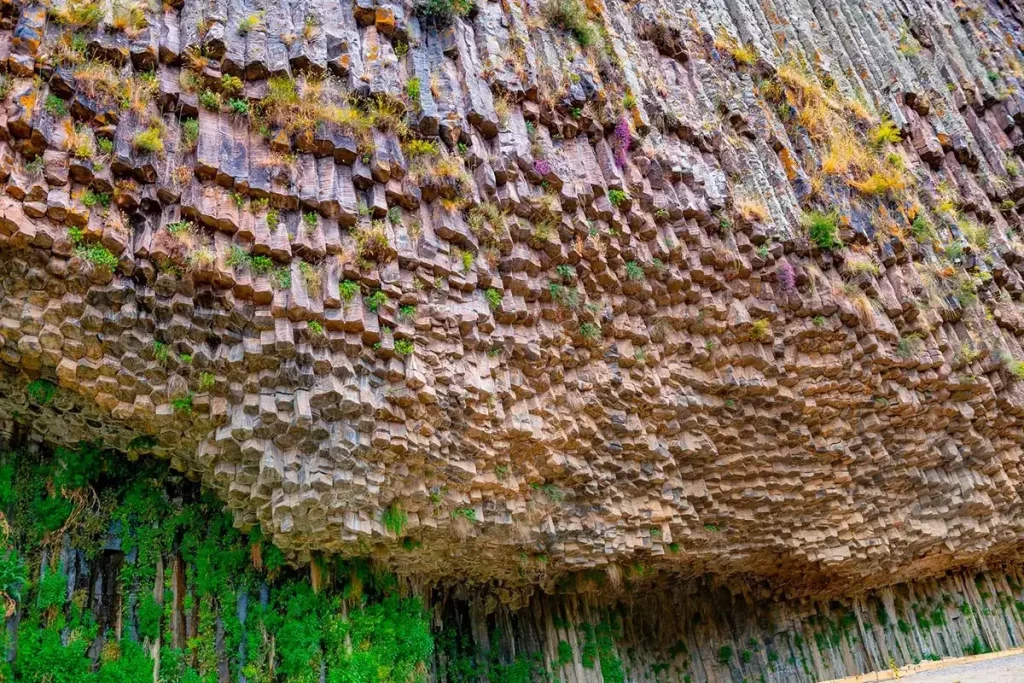
The columns are the result of columnar jointing, a geological process that happens when thick basaltic lava cools and contracts slowly. As the lava solidifies, vertical stress fractures propagate downward through the cooling rock, breaking it into long, regular polygonal columns — almost always five- or six-sided. The same process can be seen at the Giant’s Causeway in Northern Ireland, Devils Postpile in California, and Reynisfjara beach in Iceland.
In the case of the Garni Gorge, the source of the lava was the Geghama Mountains, a Quaternary volcanic range east of the gorge. Estimates of when the flows occurred vary in popular sources, but the consensus geological story is the same: lava filled the valley, cooled under its own weight, and over many thousands of years the Azat River eroded the softer surrounding rock, leaving the harder basalt columns standing exposed.
In some places, river floods have eroded the lower portions of the columns, leaving the upper sections protruding outward — natural balconies hanging high above the canyon floor.
Garni Gorge and the Azat River
The Symphony of Stones is one section of a longer canyon. Garni Gorge stretches for several kilometres along the Azat River, with basalt cliffs on both banks. The gorge is part of the broader cultural landscape inscribed by UNESCO together with Geghard Monastery in 2000 as “Monastery of Geghard and the Upper Azat Valley.”
Along the way you can also see the Azat Bridge, a single-arched medieval bridge built from black tuff between the 11th and 12th centuries. Restoration was completed in 2013. The bridge is small and easy to miss, but worth a few minutes if you’re driving through.
On the opposite side of the gorge, beyond the basalt cliffs, lies the Khosrov Forest State Reserve — one of the oldest protected areas in the world, with origins traditionally traced to the 4th century AD. Today it protects rare plants, animals and semi-arid mountain landscapes near the Azat River valley.
How to Get to the Symphony of Stones from Yerevan
The Symphony of Stones is about 30 km east of Yerevan and 2 km below Garni Temple, accessed by a narrow road that descends into the gorge from Garni village.
By private car with driver. The easiest and most common option. The descent road is steep and narrow with sharp turns, but a regular passenger car can make it in dry weather. In winter or after heavy rain the road can be slippery and most drivers prefer 4WD. We provide private cars and drivers in Yerevan for the Garni–Symphony–Geghard route, with stops at your own pace.
By taxi. A round-trip taxi from Yerevan that covers Garni, the Symphony of Stones and Geghard typically costs 15,000–22,000 AMD. From Garni village alone, a local driver will take you down and back for around 3,000–5,000 AMD.
By foot from Garni Temple. Adventurous travellers sometimes hike down into the gorge from the temple — about a 35-minute descent. The trail is straightforward but the return climb is steep, and there is little shade. Bring water and sturdy shoes.
By marshrutka. There is no direct public transport to the Symphony of Stones. Marshrutka 266 or 284 from Gai Bus Station in Yerevan reaches Garni village, but the final 2 km descent into the gorge has to be done by car, taxi or on foot.
Practical Tips for Visiting
- Entrance fee: there is a small fee of around 300 AMD at the entrance to the site, used for upkeep of the access path.
- Time needed: 30–45 minutes for the columns themselves and the riverbank walk. Add 30 minutes if you want to walk further along the gorge.
- Best time of day: mid-morning or late afternoon, when sunlight angles across the columns and brings out the shadow detail. Midday light flattens the cliff face.
- Best season: spring (April–May) and autumn (September–October) — comfortable temperatures, clear light, and the river runs full. Summer is hot and exposed; winter can be icy.
- What to wear: sturdy shoes — the path is uneven gravel and loose stone. A hat and sunscreen in summer; layers in spring/autumn.
- Water and food: bring your own. Vendors are only at Garni village above, not at the site itself.
- Safety: warning signs mark areas where loose basalt fragments can fall. Stay on the marked path; do not climb the columns.
- Photography: the best shots are wide-angle looking up the cliff face. The Azat River and gravel bars in the foreground add scale.
Combining with Garni Temple and Geghard Monastery
The Symphony of Stones works best as part of the classic Garni, Symphony of Stones and Geghard day trip from Yerevan. The route usually includes Garni Temple, the basalt columns in Garni Gorge, and Geghard Monastery. The whole trip covers roughly 80 km round-trip and takes 5–6 hours including stops.
A typical itinerary: leave Yerevan in the morning, visit Garni Temple first (1 hour), descend into the gorge for the Symphony of Stones (30–45 min), drive back up and continue to Geghard Monastery (1–1.5 hours), then return to Yerevan. The order can be reversed — some travellers prefer to do Geghard first to avoid crowds, then come back through Garni and end at the Symphony in late-afternoon light.
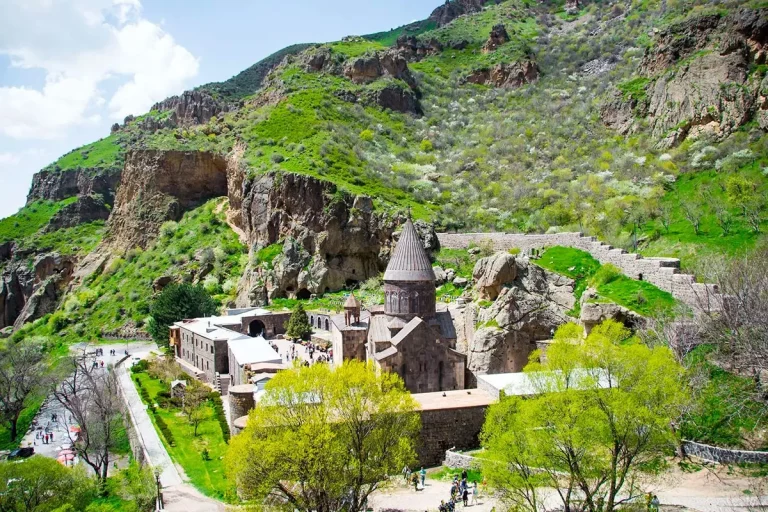
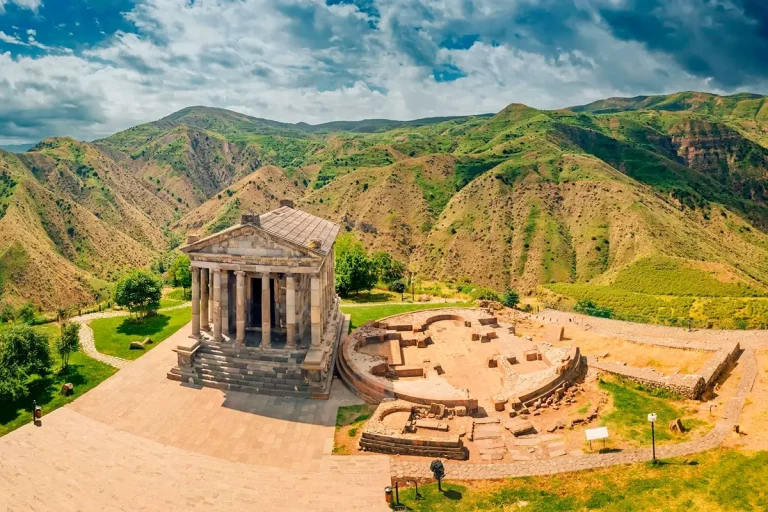
This combination is one of the most rewarding day trips in Armenia: a pagan temple, a natural geological wonder, and a UNESCO-listed Christian monastery, all within an hour of the capital.
FAQ
See more places in our full guide to things to do in Armenia — including Garni Temple, Geghard Monastery, Lake Sevan, Khor Virap and other top day trips from Yerevan.