
Khosrov Forest State Reserve
Khosrov Forest State Reserve is Armenia’s oldest protected area and one of the few places on Earth with a documented 1,700-year history of continuous conservation. It is not a single forest but a network of four districts covering 23,213.5 hectares across the south-western foothills of the Geghama Range in Ararat Province.
People come here not for a leisurely park stroll but for what Armenia’s standard tourist routes simply do not show: relict juniper groves preserving Tertiary-period flora, the sheer-walled Azat River gorge with its hidden waterfalls, and one of the only places in the country where camera traps still record the Caucasian leopard.
Quick Facts
- Built / Founded: 334–338 CE; state reserve since 1958
- Location: Garni district entrance / SNCO HQ in Vedi, Ararat Province
- Also known as: Khosrov Reserve, Khosrov Forest, Khosrovi antar, Խոսրովի անտառ պետական արգելոց
- From Yerevan: 45–55 km from Yerevan to the Garni entrance / 1–1.5 hours
- Entrance fee: 2,000 AMD (RA citizens) / 4,000 AMD (foreigners); permit via EasyPay
- Time needed: Short stop 1–2 hours; waterfalls route 6–8 hours
- Best time to visit: April–June and September–October
- Status: State Reserve SNCO; European Diploma 2013; IUCN Category Ia
- GPS coordinates:
40.0833, 44.8500
A Forest Planted by an Armenian King in the 4th Century
The reserve takes its name from King Khosrov III Kotak of the Arshakuni dynasty (the epithet “Kotak” means “the small”). According to the fifth-century historian Pavstos Buzand, in 334–338 CE Khosrov ordered the planting of two artificial forests along the Azat River: “Tachar Mayri” (“Temple of the Mother”), running from the fortress of Garni to the ancient capital of Dvin, and “Khosrovakert,” stretching south from Dvin to the Araxes River. The purpose was practical — to improve the climate around the royal capital and create hunting grounds for the court. This made Khosrov one of the first known monarchs in history to formally establish a protected nature reserve.
“Khosrovakert” disappeared over the centuries, but “Tachar Mayri” survives — today’s protected territory is the descendant of that fourth-century planting. The land was designated a state reserve on 20 September 1958 by decision of the Soviet Armenian government. In 2002 the reserve was reorganised as a State Non-Commercial Organisation (SNCO) under the Ministry of Environment. International recognition came on 26 August 2013, when Khosrov Forest received the European Diploma of Protected Areas from the Council of Europe — the first such honour in the South Caucasus.
Four Districts, 23,213 Hectares: How the Reserve Is Organised
The reserve consists of four non-contiguous districts scattered along the south-western Geghama Range:
| District | Area | What’s there |
|---|---|---|
| Garni | 4,253 ha | Azat River gorge, waterfalls, the closest entrance to Yerevan |
| Kakavaberd | 4,745 ha | Medieval Kakavaberd Fortress (“Magpie Fortress,” 5th–9th c.) |
| Khosrov | 6,860.8 ha | Core district, ancient juniper groves, “Trchnaberd” oak forest |
| Khachadzor | 7,354.7 ha | The most remote and least accessible district |
Elevation ranges from 700 m in the river valleys to 2,800 m on the upper meadows. The administrative headquarters sit in the town of Vedi, and the SNCO also manages the small Khor Virap State Sanctuary (50.28 ha) under the same umbrella.
Tertiary Relicts and the Caucasian Leopard: Why Khosrov Is Unique
Khosrov’s central scientific value is its Tertiary-period relict ecosystems — biological communities millions of years old that survived the Ice Ages and now exist nowhere else in the Caucasus ecoregion. Two species dominate: multi-fruited juniper (Juniperus polycarpos) and Caucasian oak (Quercus macranthera). The reserve’s southern slopes carry the most extensive juniper sparse forests in Armenia, while the densest oak stands grow in the Khosrov district at 1,600–2,300 m, in an area locally known as “Trchnaberd” (“bird fortress”).
The biodiversity figures are extraordinary for a country the size of Belgium:
- 1,849 species of vascular plants — more than 50% of Armenia’s flora and about a third of the entire Caucasus flora, all on just 1% of the country’s area; 80+ species are in the Armenian Red Data Book and 24 are endemic
- 283 species of vertebrates, with 58 in the Armenian Red Data Book and 51 in the IUCN Red List
- 192 species of birds — roughly 56% of Armenia’s avifauna; 37 species are internationally protected; Khosrov is the only known nesting site of the black vulture in Armenia
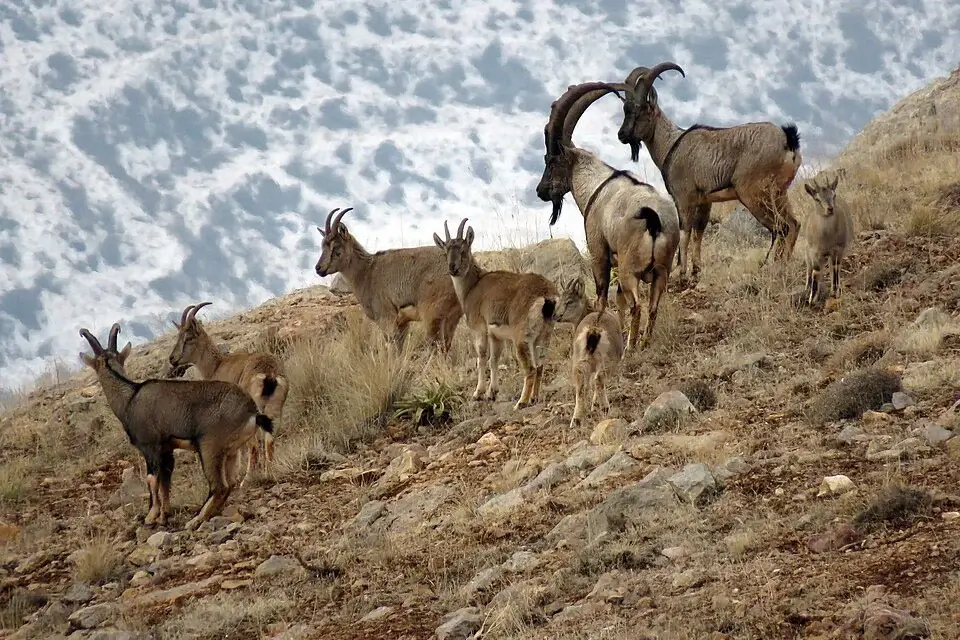
The reserve’s most famous resident is the Caucasian leopard (now classified as the Persian leopard, Panthera pardus tulliana). After years when the species was considered locally extinct, camera traps in 2019 photographed an adult male — nicknamed “Nesho” — and Armenia officially declared that year the Year of the Caucasian Leopard. Recent estimates put the total population in Armenia at only around 10 individuals. In any district where leopard activity is recorded, tourist access is closed immediately. Other large mammals include Eurasian lynx, Syrian brown bear, grey wolf, wild boar, bezoar goat (the reserve’s emblem), Armenian mouflon, golden eagle, and Egyptian vulture.
Main Sights Inside the Reserve
The Azat River gorge. A deep canyon walled by hexagonal basalt columns. Together with Geghard Monastery, the gorge was inscribed on the UNESCO World Heritage List in 2000. Its most accessible section is the famous Symphony of Stones basalt formation — geographically part of the Garni district but reachable as a short walk from the main road.
Vahagn and Astghik waterfalls. Named after two ancient Armenian deities — Vahagn (god of fire, thunder and war) and Astghik (goddess of love, beauty and fertility). According to legend, Astghik bathed beneath her waterfall each evening; when a dragon abducted her, Vahagn slew it and brought beauty back to the world. The two cascades stand a few hundred metres apart deep in the Garni district. Vahagn is a narrow, powerful ~10 m drop; Astghik is calmer, with a natural pool below. These are the two best-known of the four falls collectively called the Aghjots Falls.
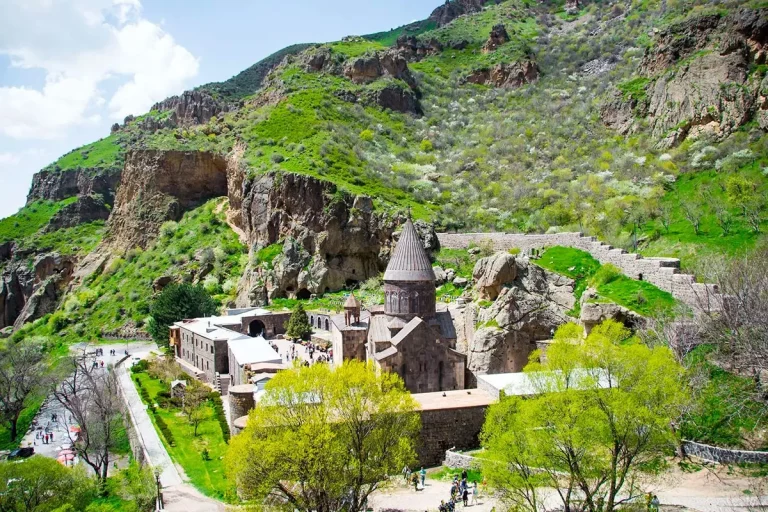
Kakavaberd Fortress (5th–9th c., also called Geghi Fortress). A medieval citadel perched on a sheer cliff above the Azat River, in the Kakavaberd district.
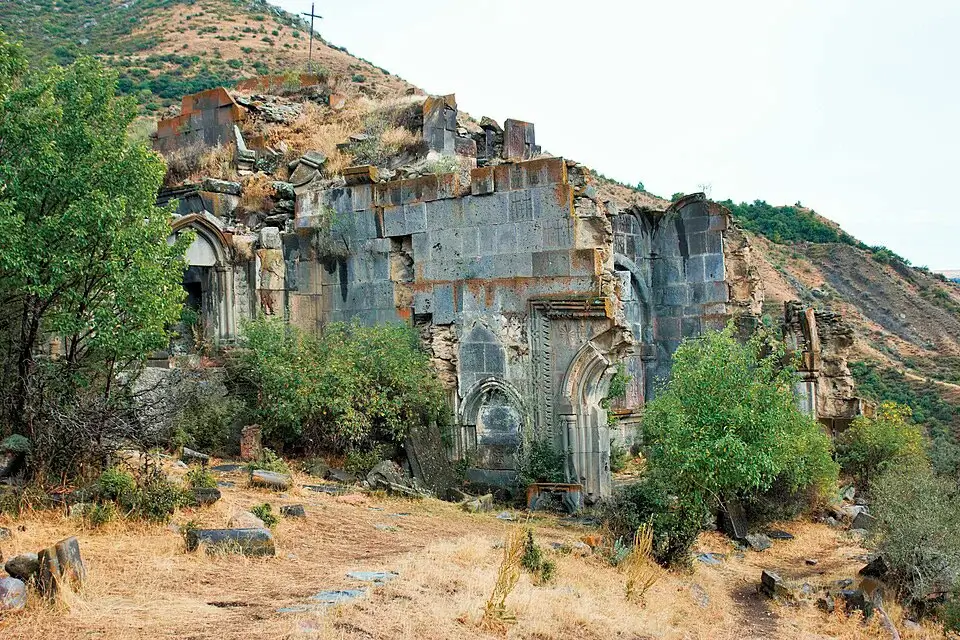
Aghjots Vank Monastery (13th c., also called Surb Stepanos). A monastery complex high above the waterfalls, reachable only on foot or by 4×4 along rough mountain tracks. The main church — Surb Stepanos — is one of the few preserved structures.
How to Visit Khosrov Reserve: Permits, EasyPay, Approved Trails
This is the part that catches most travellers off-guard. You cannot simply walk into Khosrov Reserve. Since 2021 the Ministry of Environment has enforced a strict permit system:
- Pre-register for one of the approved hiking routes
- Pay through an EasyPay terminal: “State Payments” → Ministry of Environment logo → “Khosrov Forest State Reserve” window
- Enter personal details (social card number, surname, given name)
- Keep your receipt — it is checked at the entrance
Fees (as published by the Ministry):
- 2,000 AMD per RA citizen
- 4,000 AMD per foreign visitor
- 10,000 AMD per guide (where required)
Administration contacts: +374 234 2 20 30, [email protected]
In any zone where the Caucasian leopard has recently been recorded, access is closed even to permit holders. The Visitor Center in the Garni district (open since 9 September 2008) is the place to confirm which trails are currently open.
Visiting independently is, in practice, very difficult. The approved trails are graded medium-to-hard; the classic “waterfall trek” starting at Garni village (Garni → Vahagn → Astghik → Azat gorge → return) covers around 17 km with ~500 m of elevation gain. Trail markings are sparse, mobile coverage is poor, and OpenStreetMap data is unreliable inside the reserve. For most visitors, joining a local guided hike or arranging a private car with driver in Yerevan and a local trail guide for a dedicated day is the realistic option.
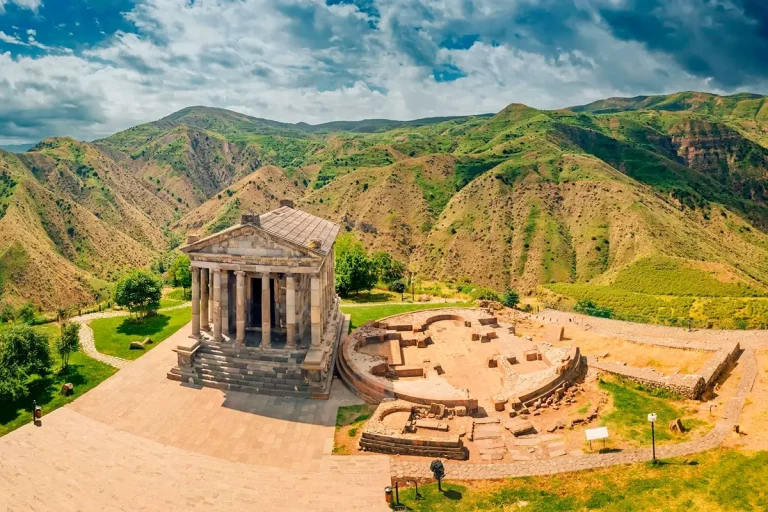
Many visitors first encounter Khosrov as part of the standard Garni–Geghard day tour, which skirts the reserve’s eastern boundary and ends at the Symphony of Stones — a short, easy way to step into the territory without committing to the full waterfall hike.
When to Visit
- Spring (April–May): alpine meadows in full bloom, rivers at peak flow, waterfalls at their most powerful. Best light for photography, but trails are slippery after rain.
- Early summer (June): the sweet spot — green landscapes, all routes open, and 5–8 °C cooler than Yerevan thanks to the 1,200–2,000 m elevation of the visitor zones.
- Late summer (July–early September): hot and dry; the Wikiloc community specifically warns against mid-June to mid-October because of heat and snake activity on lower-altitude trails.
- Autumn (October): less green but vivid juniper and oak colours, far fewer visitors.
- Winter (November–March): most trails closed because of snow and avalanche risk; only the lower Garni district remains partially accessible.