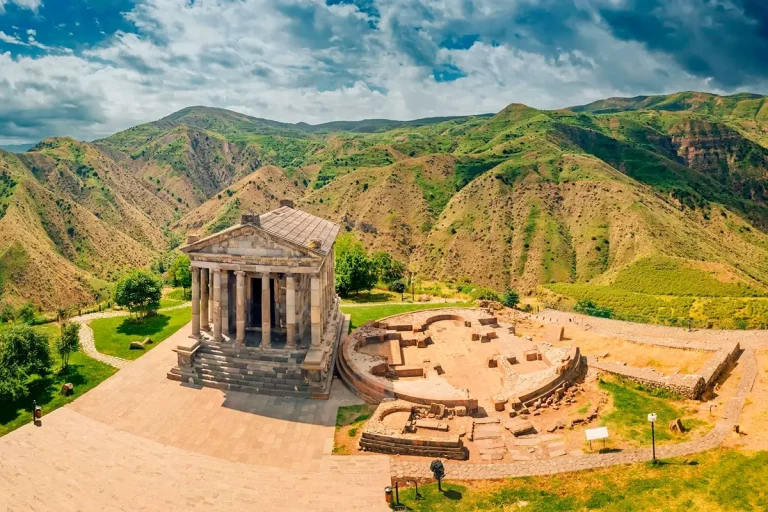

Zvartnots Cathedral
Zvartnots Cathedral (Armenian: Զվարթնոց — “the Celestial Angels”) is the ruined remains of a 7th-century circular cathedral on the Ararat Plain, 17 km west of Yerevan and just a few minutes from Zvartnots International Airport. Built between 643 and 652 under Catholicos Nerses III the Builder, it stood about 45 metres high and was the largest aisled tetraconch in early medieval Armenia — a centrally planned, three-tier cylinder crowned by a dome. The cathedral collapsed in the 10th century, was excavated only at the start of the 20th, and has been a UNESCO World Heritage Site since 2000.
Quick Facts
- Built / Founded: 643–652 AD
- Location: Vagharshapat (Etchmiadzin) area, Armavir Province
- Also known as: Zvartnots Cathedral, Զվարթնոց, Cathedral of the Vigilant Angels, Temple of the Celestial Angels
- From Yerevan: 17 km from Yerevan
- Entrance fee: 1,500 AMD (adult); 500 AMD students/seniors; free under 7
- Time needed: 40–60 minutes
- Best time to visit: April–June, September–October; mornings for Ararat backdrop
- Status: UNESCO World Heritage Site (2000); museum and archaeological park
- GPS coordinates:
40.1603, 44.3366
Why Zvartnots is worth a visit
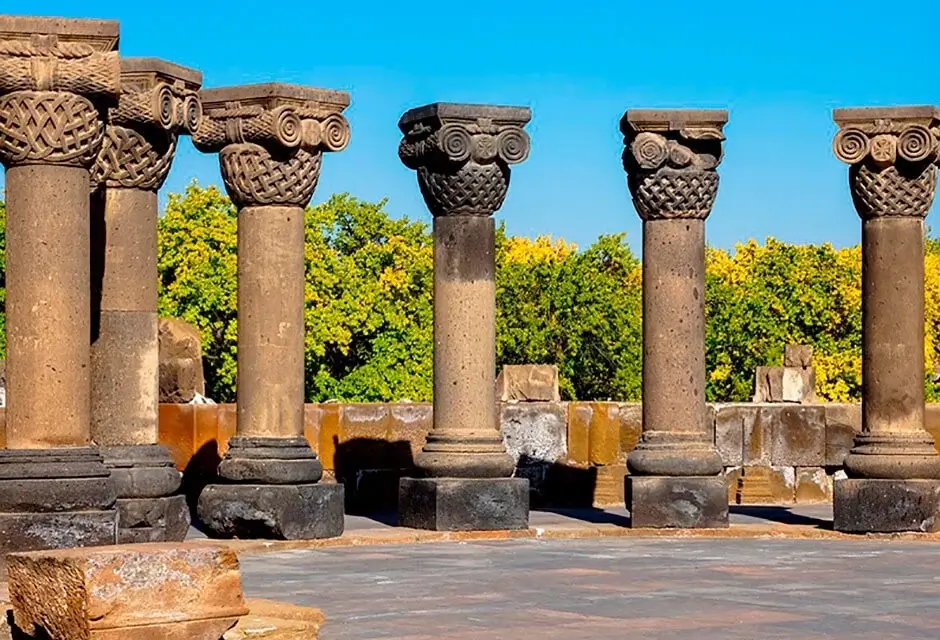
Zvartnots is not just a field of stones — it is the site of a 7th-century architectural revolution. Neither Byzantium nor Sasanian Persia had anything like it: a circular three-tier cathedral with a dome reaching 45 metres, ionic capitals in basket form, monumental eagle capitals on the piers, and friezes of pomegranates and grapevines carved in high relief. Catholicos Nerses III, fluent in Greek and a former officer in the Byzantine army, deliberately blended Armenian, Syrian, and Byzantine traditions in a way that has no real parallel anywhere else.
According to the medieval Armenian historian Movses Kaghankatvatsi, the cathedral was consecrated in 652 in the presence of Byzantine Emperor Constans II, who was so struck by it that he asked the architect to come to Constantinople and build a copy. The master died on the journey, and the plan was never carried out. Nerses III believed Zvartnots would stand for 1,000 years, until the Second Coming; it lasted around 320, collapsed in the 10th century, and lay buried under the Ararat Plain for almost a millennium before excavation in 1901–1907.
History: from Nerses III to UNESCO
Construction began in 643 under Catholicos Nerses III the Builder (r. 641–661), who moved the patriarchal seat from Dvin to Zvartnots after Arab armies occupied the former capital. The site was not chosen at random — by tradition, it marked the meeting between King Tiridates III and Gregory the Illuminator that led Armenia to adopt Christianity as a state religion in the early 4th century. The cathedral was dedicated to Gregory and to the zvartnots — the “vigilant” or “celestial” angels who, in the saint’s vision, were said to have descended over the site.
The cathedral was consecrated in 652. After Nerses III’s death, construction continued under Anastas Akoratsi (653–659) and possibly later. By the end of the 10th century the structure had collapsed. The most widely accepted explanation is an earthquake, though some historians suggest that Arab raids weakened the load-bearing stones first. After the collapse Zvartnots was abandoned, gradually buried, and forgotten.
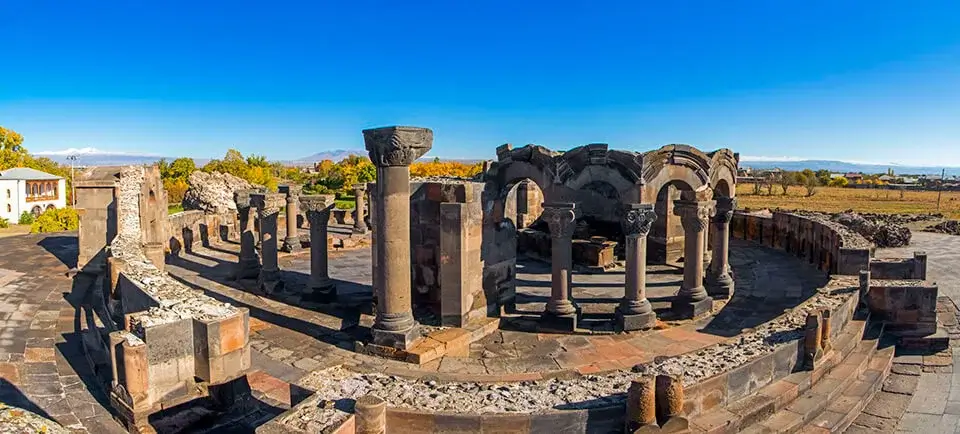
The ruins were excavated between 1901 and 1907, led by Archpriest Khachik Dadyan. Partial reconstruction of the lowest tier — the arches and several columns visible today — was carried out from the 1940s onward, based on the research of the Armenian architectural historian Toros Toramanian. In 2000, Zvartnots was inscribed on the UNESCO World Heritage List together with the cathedral and churches of Etchmiadzin.
Architecture: what makes Zvartnots unique
Zvartnots was a centrally planned aisled tetraconch — a cruciform interior with four apses, inscribed in a circular (not square) exterior. Seen from a distance, the building read as three concentric cylinders stepping inward: the lowest tier had 32 sides, the middle 16, and the upper 8, the whole crowned by a dome. With its 2-metre platform the total height reached about 49 metres. The interior diameter was roughly 36 metres, the walls about a metre thick, with five entrances and a circular ambulatory running around the central tetraconch.
Four massive piers, set 10.5 metres apart, carried the upper levels through a system of eight arches. The capitals on these piers were unlike anything else in Armenia — basket-form columns combining ionic volutes with carved eagles “supporting” the heavens. One of the capitals bore Nerses III’s personal monogram in Greek, not Armenian — a striking marker of the Catholicos’s pro-Byzantine sympathies. The lower walls were decorated with blind arcades and high-relief carvings of grapevines, pomegranates, and palmette ornament. Surviving spandrel figures show workers holding construction tools — a rare medieval portrait of the builders themselves.
The composition was so influential that around 1001–1005 the architect Trdat (the same Trdat who reconstructed the dome of Hagia Sophia in Constantinople after the earthquake of 989) built a close copy in the Armenian capital of Ani — the Church of Gagikashen. The Holy Trinity Church in Yerevan, completed in 2003 by architect Baghdasar Arzoumanian, is also explicitly modelled after Zvartnots.
What to see on the site
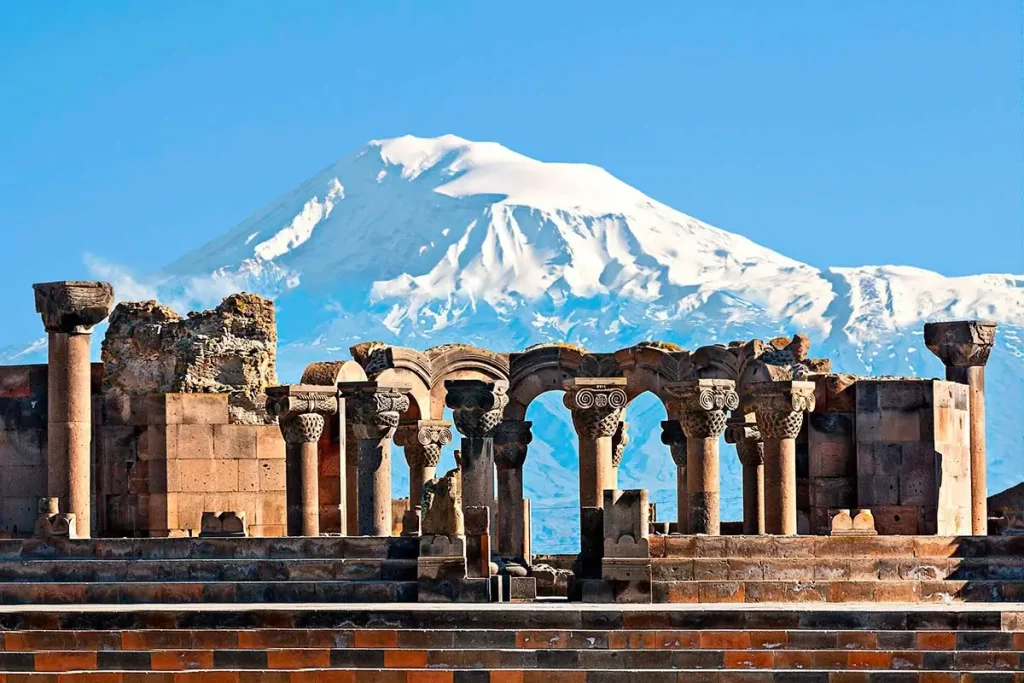
The cathedral ruins are partially restored up to the level of the first-tier arches. Columns, eagle capitals, carved fragments, and the foundations of the tetraconch are all visible; walking the full circle of the ambulatory gives the clearest sense of the original scale, and the angles toward Mount Ararat are striking.
The Patriarchal Palace sits to the southeast. It had two rectangular wings: the western wing held a colonnaded hall used for receptions and a summer banquet hall; the eastern wing contained the living quarters, a chapel, and a bathhouse with a hypocaust under-floor heating system. Sections of the original clay-pipe water supply survive on site.
The on-site museum has two galleries. The first presents a scale model and renderings of the cathedral as it would have looked when complete. The second displays original fragments — a sundial, mosaic tiles, the only surviving relief panel with a named figure, and the famous eagle capitals at eye level. Admission to the museum is included in the site ticket.
The Urartian cuneiform inscription by King Rusa II is set near the southern entrance. Carved in the 7th century BC, it predates the cathedral by 1,300 years and shows that the site was already significant long before Christianity arrived in Armenia.
How to get to Zvartnots from Yerevan
Zvartnots sits 17 km west of Yerevan, on the highway to Vagharshapat (Etchmiadzin). The standard options:
- Taxi (Bolt, GG, Yandex Go) — 15–25 minutes, around 2,000–3,000 AMD. The fastest and most flexible.
- Marshrutka №203 from Kilikia bus station — runs to Vagharshapat (Etchmiadzin); ask the driver to drop you at “Zvartnots.” 30–40 minutes, around 200–300 AMD.
- Tour or private car with driver — the most comfortable option, especially if you combine Zvartnots with Etchmiadzin Cathedral and St. Hripsime and St. Gayane churches in a single half-day.
The roadside landmark is a stone eagle column by the sculptor Yervand Kochar on the right-hand side of the highway as you leave Yerevan; the turning to the site is immediately after. Parking at the gate is free.
Hours, admission, and practical tips
Hours: daily 10:00–18:00 (sometimes shorter in winter — worth checking before a December–February visit).
Admission: 1,500 AMD for adults (≈ $4 USD), 500 AMD for students and seniors, free for children under 7. The museum is included.
How long to allow: 40–60 minutes covers the ruins and the museum at an unhurried pace. If you are combining with Etchmiadzin and the Hripsime/Gayane churches, this is a comfortable half-day from Yerevan.
Best light: morning, when the columns face the rising sun and Mount Ararat is most likely to be cloud-free; or late afternoon for a warmer tone on the basalt. There is almost no shade on the open plain — bring a hat and water in summer.
What else to see nearby
- Etchmiadzin Cathedral (~4 km) — the spiritual centre of the Armenian Apostolic Church and considered the oldest state-built cathedral in the world (4th century). UNESCO World Heritage.
- St. Hripsime Church (618) — one of the masterpieces of early Armenian Christian architecture, also on the UNESCO list.
- St. Gayane Church (630) — another UNESCO-listed early Armenian church, just outside Etchmiadzin.
- Etchmiadzin Treasury Museum — holds the Holy Lance (one of the relics traditionally identified as the spear that pierced Christ) and a fragment of wood traditionally identified as from Noah’s Ark.
The classic half-day route from Yerevan is Zvartnots → Etchmiadzin Cathedral → St. Hripsime → St. Gayane, ending with lunch in Vagharshapat.
FAQ
Zvartnots is the kind of ruin where the missing parts read as clearly as the surviving ones. The carved capitals, the perfect circle of the foundations, and the museum model together make it possible to stand inside a building that has been gone for a thousand years. For more sites across the country, see our guide to things to do in Armenia.