
Sevanavank Monastery
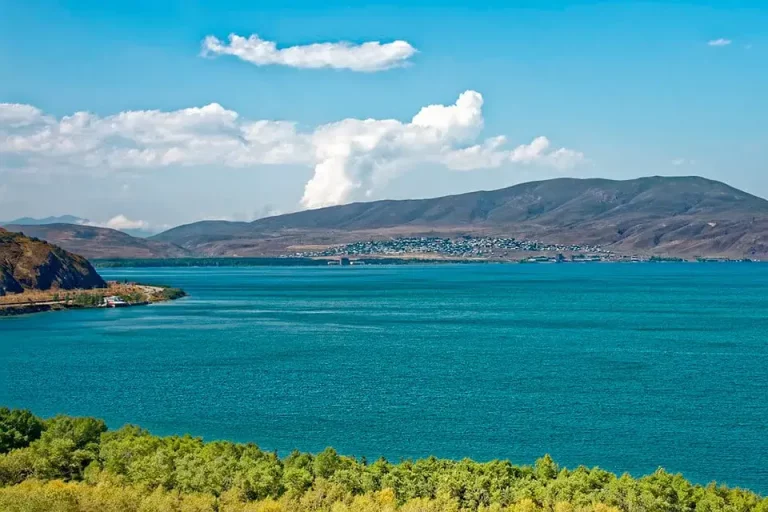
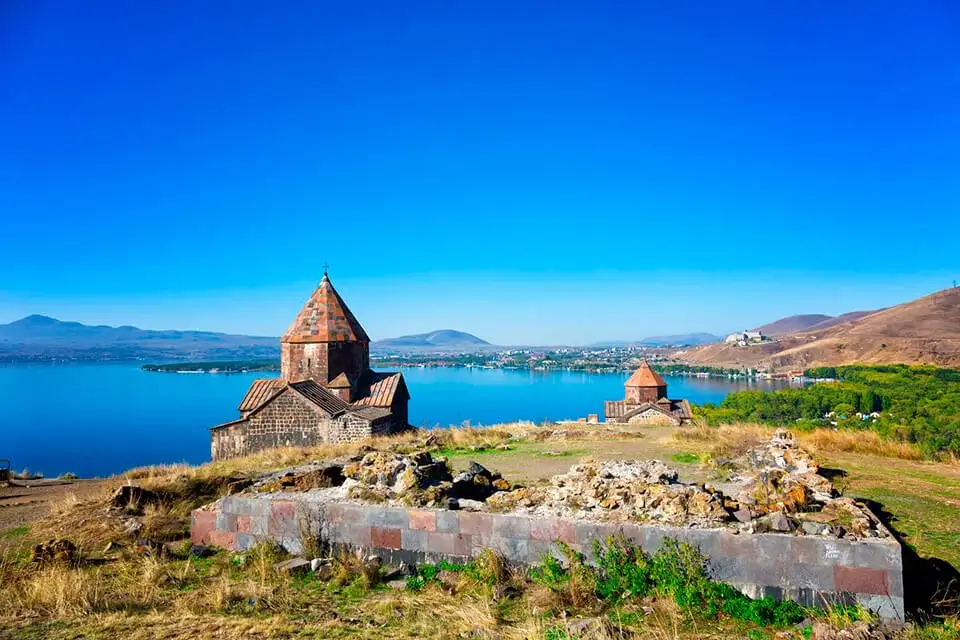
Sevanavank Monastery (Armenian: Սևանավանք — “the Black Monastery”) is one of the most recognisable images of Armenia. Set on a rocky peninsula at the northwestern end of Lake Sevan — an island until the 20th century — it rises above the turquoise water of the largest high-altitude lake in the Caucasus. The climb up the stone staircase to two 9th-century churches of black tuff, and the panorama of mountains and water that opens at the top, is one of the experiences that defines a trip to Armenia.
Quick Facts
- Built / Founded: 874 AD
- Location: Sevan peninsula (town of Sevan), Gegharkunik Province
- Also known as: Sevanavank Monastery, Սևանավանք, Sevan Monastery, Black Monastery, Mariamashen
- From Yerevan: 65 km from Yerevan
- Entrance fee: Free
- Time needed: 30–60 minutes (1–1.5 hours with peninsula walk)
- Best time to visit: June–September; sunrise and the hour before sunset for photography
- Status: Active monastery (Armenian Apostolic Church); Vazgenian Theological Academy on the peninsula
- GPS coordinates:
40.5650, 45.0109
History of Sevanavank: from island to peninsula
The site predates the monastery by millennia. Archaeological finds show the territory was inhabited as far back as the Neolithic and Bronze Age, and the island position made it a natural fortress. In 305 — only a few years after Armenia adopted Christianity — Gregory the Illuminator is said to have built the small Church of Surb Harutyun (the Holy Resurrection) on the island, on the site of an earlier pagan sanctuary. It is counted among the very first Christian buildings in the country.
Monks settled on the island in the late 8th century, building a chapel and cells. In 874 AD, Princess Mariam — daughter of Ashot I Bagratuni (the future king and founder of the Bagratuni dynasty) and widow of the Syunik prince Vasak — financed the construction of the two churches that survive today: Surb Arakelots and Surb Astvatsatsin. According to tradition, Sevanavank was one of thirty churches Mariam vowed to build in memory of her husband. The 874 dedication inscription is still legible on the eastern wall of Surb Arakelots, and the monastery is also known by the name Mariamashen — “built by Mariam.”
A second tradition links the founding to the monk Mashtots Yeghvardetsi (later Catholicos), who is said to have seen the Twelve Apostles in a vision and to have asked Mariam to build a church to them on Lake Sevan.
Sevanavank was famous in Armenian church history for its severity. The community was used in part as a place of penance for monks from Etchmiadzin who had sinned: the French Caucasian traveller Jean-Marie Chopin, who visited in 1830, recorded a regimen that forbade meat, wine, and contact with young people or women. The code of conduct was based on the nine rules of Basil of Caesarea and the seven rules of Sargis Saghmosavanetsi.
The Battle of Sevan (921)
Sevanavank stood at a turning point in Armenia’s struggle to throw off Arab rule. In 921, King Ashot II “the Iron” (Ashot Yerkat) took refuge on the island with a small force of soldiers and monks against an Arab army led by the general Bashir. The water around the island was its decisive military advantage.
According to the legend, a fisherman who knew the lake well advised the king to attack at sunrise, with the sun behind his fleet — the glare blinded the Arab boats and the Armenians, monks among them, won the battle. The fortress walls built to defend the island can still be traced on the western side of the peninsula. The Russian-language version of the story tells of a dense morning fog and Armenian boats with burning torches drawing the enemy ships deeper into the lake before attacking when the fog cleared; both versions appear in the chronicles.
Architecture: the austere beauty of black tuff
The surviving complex consists of two churches, the ruins of a third, fragments of a gavit, and dozens of khachkars.
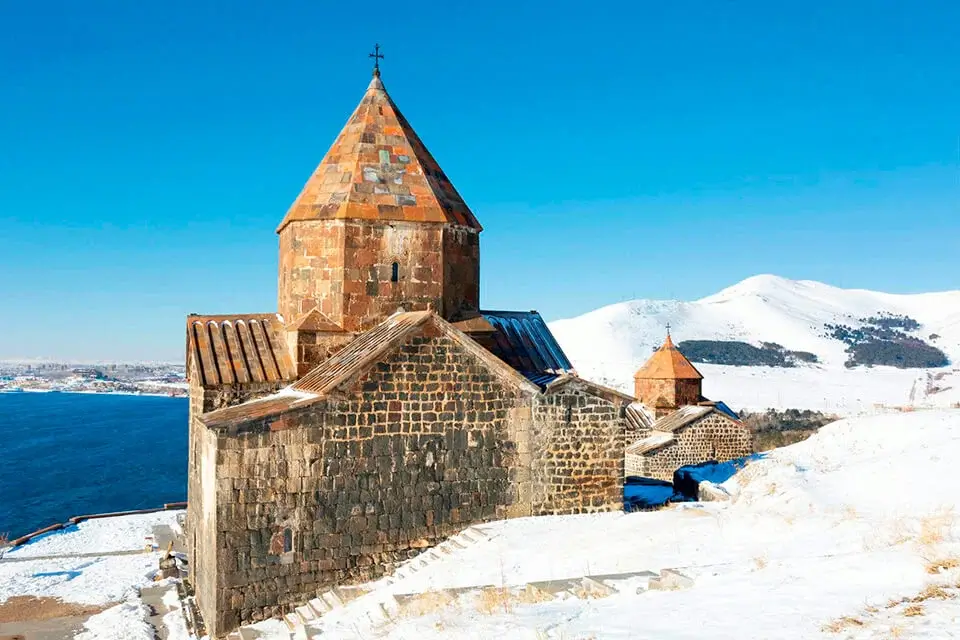
Surb Arakelots (Church of the Holy Apostles) is the first building reached at the top of the stairs. It is a cruciform church with an octagonal drum carrying the dome, built of dark volcanic tuff. Set into one of its walls is one of the most remarkable khachkars in Armenia: a 13th-century all-saviour cross-stone depicting Christ with Mongol facial features — a stylistic choice of the period, when Armenian masters deliberately gave sacred figures Mongol traits so that the Mongol invaders would not destroy the churches that held them. Carpet patterns and biblical scenes frame the central figure.
Surb Astvatsatsin (Church of the Holy Mother of God) sits slightly higher and is similar in plan to its neighbour. The church was dismantled in 1931 in the Soviet period, with the stones used to build a holiday house on the (then) island; it was later rebuilt, and in 1956–1957 both churches went through a full restoration.
Between the two churches and around the peninsula stand dozens of khachkars finely carved over the 9th–17th centuries. The Sevanavank cross-stones are unusual in their material: not the warm red tuff seen in most of Armenia, but a local stone with a soft greenish tone. Fragments of the carved wooden columns of the destroyed gavit are now displayed at the History Museum of Armenia in Yerevan and at the Hermitage in St. Petersburg.
Lake Sevan: the “Armenian Sea”
Lake Sevan is the largest body of water in Armenia and one of the largest high-altitude freshwater lakes in the world. It sits at roughly 1,900 m, covers about 1,200 km², and until the mid-20th century the monastery stood on an island three kilometres offshore. During the Stalin era the lake was deliberately drained by some 20 metres for irrigation and hydroelectric power; the island became a peninsula, and a guesthouse, the Armenian president’s summer residence, and the new buildings of the Vazgenian seminary all took root on the formerly inaccessible land. A long-running restoration programme is now slowly raising the water level again.
Sevan is also famous for ishkhan — the endemic Sevan trout — which is on the menu of every fish restaurant along the shore. For the lake itself, see our Lake Sevan guide.
How to get to Sevanavank from Yerevan
Sevanavank is on the peninsula next to the town of Sevan, about 65 km northeast of Yerevan — roughly an hour by car on the M-4 highway. The road is paved and easy in any season; in winter, watch for ice on the climb up to the peninsula. There is no entrance fee.
Marshrutkas from Yerevan’s Northern Bus Station leave for the town of Sevan every 30–40 minutes; from there a short taxi ride covers the last 3 km to the peninsula. There is also a Yerevan–Sevan electric train. A one-way taxi from Yerevan costs around 8,000–10,000 AMD.
The most flexible option is to hire a car with driver in Yerevan and combine Sevanavank with Hayravank, Noratus, and Dilijan in a single day.
Hours, admission, and what’s on site
- Hours: the monastery grounds are open daily; no fixed schedule. The two churches are usually open during daylight.
- Admission: free.
- Time on site: the climb up the stone staircase takes 5–10 minutes; a focused visit to the two churches is 30–60 minutes. With walks around the peninsula and photography, allow up to 1.5 hours.
- At the base of the peninsula: parking, souvenir stalls, cafés, and public toilets. Several restaurants serving Sevan trout sit on the shore below.
Practical tips for visiting
At ~1,900 m, Sevanavank is always cooler and windier than Yerevan — bring a windbreaker even in summer. The climb up to the churches is on a steep stone staircase; sturdy shoes help, especially in winter when steps can be icy. Early morning and the hour before sunset are the best light for photographs, when the lake takes on a gold-and-rose tone. To avoid the larger tour groups in summer, arrive before 10:00.
Next to the monastery stands the Vazgenian Theological Academy, founded in 1990 and named after Catholicos Vazgen I — the only working seminary in this part of Armenia. It is not open to casual visitors, but you’ll see its modern buildings on the northern side of the peninsula.
What else to see nearby
- Hayravank Monastery (~30 km south) — a 9th-century church on a cliff above the western shore. Much smaller, much quieter than Sevanavank.
- Noratus Cemetery (~30 km) — the largest medieval khachkar field in Armenia, with hundreds of cross-stones from the 9th–17th centuries.
- Dilijan (~40 km) — the “Armenian Switzerland”: a forest-resort town with the restored Sharambeyan craft quarter and the UWC Dilijan campus.
- Tsaghkadzor (~50 km) — ski resort with a cable car and the medieval Kecharis Monastery.
- Ishkhan (Sevan trout) and crayfish — at the shore restaurants below the peninsula.
A typical day from Yerevan: Sevanavank → Hayravank → Noratus → Yerevan, or Sevanavank → Dilijan → Haghartsin → Goshavank for the Tavush extension.
FAQ
Sevanavank is the kind of place where Armenian history, faith, and landscape collapse into a single image — two black-tuff churches at the top of a stone staircase, the blue of the lake on every side, the Sevan range on the far horizon. For more sites across the country, see our guide to things to do in Armenia.