
Lake Arpi
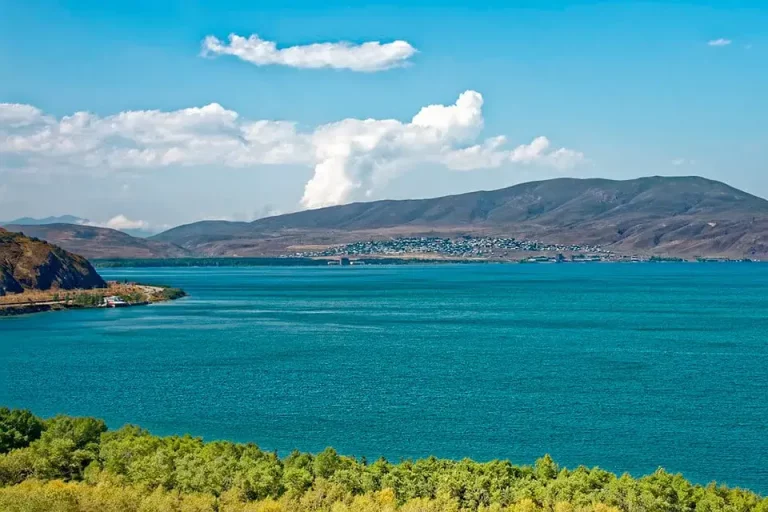
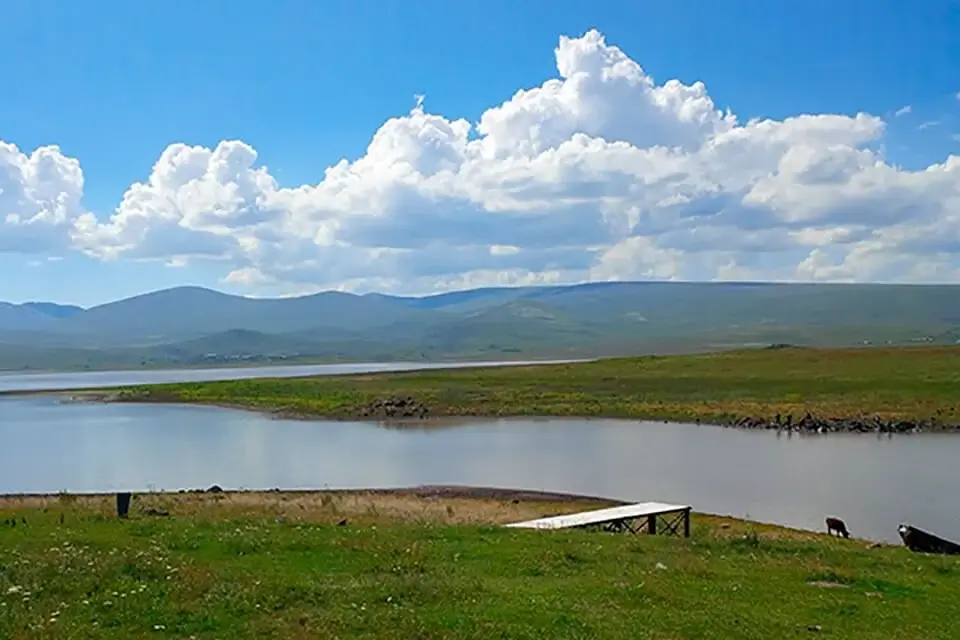
Lake Arpi is the second-largest lake in Armenia after Sevan, set at 2,025 metres on the Ashotsk Plateau in the country’s far northwest. No trees, no buildings, no shoreline cafés — just alpine grassland, constant wind, and a vast sheet of water stretching to the horizon. The entire surrounding territory forms Lake Arpi National Park, a Ramsar wetland that hosts the world’s largest colony of Armenian gulls and Armenia’s only breeding population of Dalmatian pelicans. For most travellers it’s too remote to bother with; for birdwatchers, photographers and lovers of empty landscapes, it’s one of the country’s quiet trophies.
Quick Facts
- Location: Ashotsk Plateau, near Amasia community, Shirak Province
- Also known as: Arpi Lake, Lake Arpi, Arpa Göl, Արփի լիճ
- From Yerevan: 200–210 km / 3.5–4.5 hours
- Elevation: 2,025 m
- Depth: avg 4.2 m, max 8 m
- Entrance fee: Free
- Time needed: 3–6 hours on site (birding); 2-day Gyumri loop recommended
- Best time to visit: May–July (nesting); September (migration)
- Status: Lake Arpi National Park; Ramsar Wetland (1993)
- GPS coordinates:
41.0500, 43.6167
Where Is Lake Arpi?
The lake sits in the northwestern corner of Armenia, in Shirak Province, on the high Ashotsk Plateau near the borders with Turkey and Georgia. The nearest city is Gyumri, 60–70 km to the south. The nearest village is the rural community of Amasia. On maps the lake appears as Arpi Lake or the Armenian Արփի լիճ; you’ll occasionally see the old Turkish name Arpa Göl in older atlases.
Lake Arpi is shallow — average depth around 4 metres, maximum about 8 — with gentle grassy banks and broad reedy shallows. Those shallows are exactly what make it a birdwatching site: shelter, food and nesting space for waterfowl. The lake is also the source of the Akhurian River, which flows on to form part of the Armenia–Turkey border.
A Lake, a National Park, and a Ramsar Wetland
Lake Arpi is partly natural and partly engineered. The basin itself is natural, but in 1951 a Soviet-era dam raised the water level by several metres for irrigation downstream. Today it functions as both a high-altitude lake and a regulated reservoir.
On 7 June 1993 Lake Arpi was designated a Ramsar Wetland of International Importance (Ramsar site no. 621), together with Lake Sevan — one of the first two wetlands Armenia placed under the convention. In 2009 the wider area, roughly 250 km², became Lake Arpi National Park, one of only four national parks in the country. The park forms a single ecosystem with Javakheti Protected Areas across the border in Georgia, making it part of one of the Caucasus’s most significant transboundary wetland complexes.
Why Visit Lake Arpi
If Lake Sevan is Armenia’s busy summer lake — beaches, restaurants, crowds — Arpi is its opposite. You can spend a full day here and not meet another tourist. Most people come for one of three things.
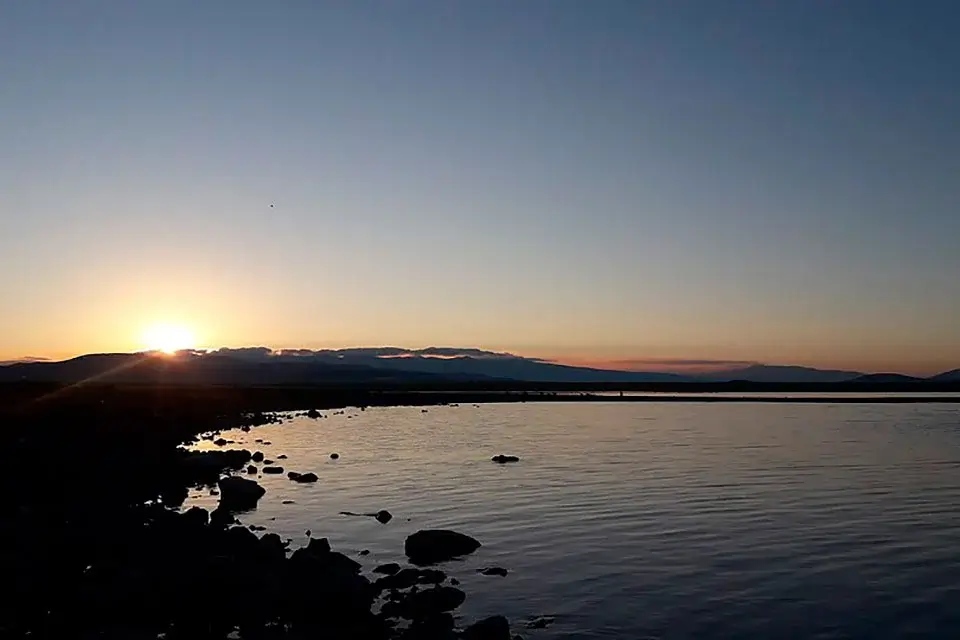
For birdwatchers, Arpi is the country’s single most important site. For photographers, it’s the unbroken 360° horizon and the way sunset light pools on the water across an entirely empty plateau — and one of Armenia’s darkest skies for astrophotography. For travellers who simply want to see a side of Armenia outside the standard itinerary, it’s as remote and unspoilt as the country gets.
Birdwatching at Lake Arpi
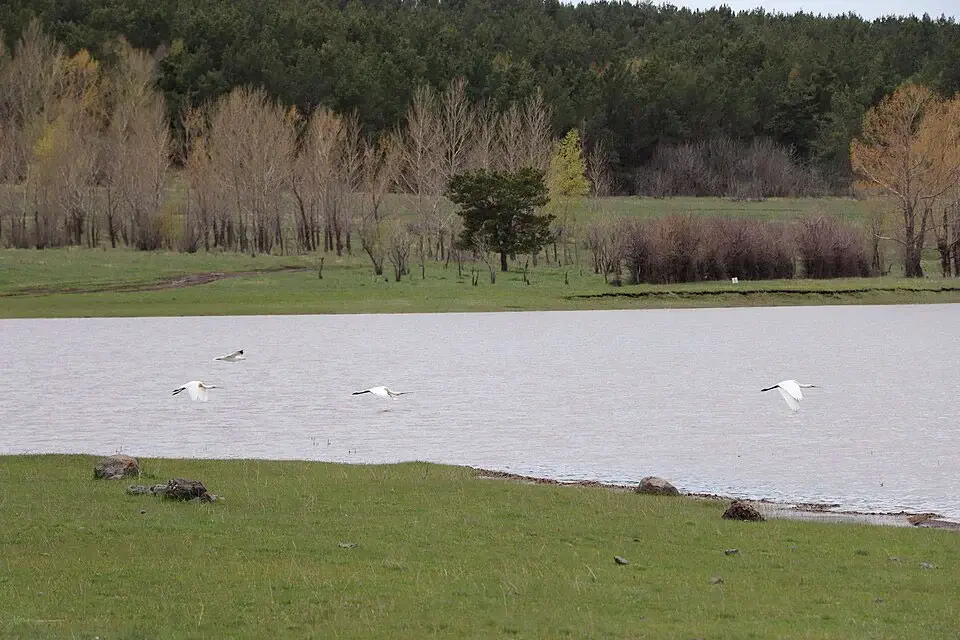
More than 190 bird species have been recorded in the national park; about 120 breed regularly, around 100 pass through on migration, and roughly 70 overwinter despite the brutal cold. The two headline residents are world-class.
The Armenian gull (Larus armeniacus) is endemic to the Armenian Highland, and Arpi’s nesting colony — around 10,000 breeding pairs on small islets — is considered the largest in the world. The Dalmatian pelican, globally threatened, has its only breeding site in Armenia here, alongside great white pelicans that stop on migration.
Beyond the headline pair, expect common cranes, black storks, great white egrets, Eurasian spoonbills, ruddy shelducks, greylag geese, mallards and several teal species, plus waders — stilts, redshanks, snipe. Raptors over the meadows include long-legged buzzard, marsh and Montagu’s harrier, and lesser spotted eagle. Forty-four species in the park are on the IUCN Red List or Armenia’s Red Data Book.
Peak season for nesting is May–July; spring (April–May) and autumn (September) bring large migrating flocks. The best hours are early morning, ideally before 8 a.m., and the last hour before sunset. Most birding is done from the northern and eastern shallows. Bring binoculars (8×42 or 10×42 is the standard), keep distance from nesting colonies and stay on existing tracks — this is protected land.
How to Get to Lake Arpi
From Yerevan the lake is about 200–210 km, or 3.5–4.5 hours of driving without long stops. The route follows the M1 highway through Aparan and Aragatsotn to Gyumri, then the H32 northwest through Amasia, where you turn off toward Berdashen and the lake. The main road is fully paved. The last 10–15 km from Amasia to the shore is gravel — passable in a sedan in dry weather with care, but after rain you’ll want decent clearance or a 4×4.
For most travellers it’s worth pairing Arpi with Gyumri on a two-day route — overnight in Gyumri, full birding day at Arpi, return to Yerevan — rather than trying to do it as a single long day trip. The easiest way to handle the logistics is a car with driver from Yerevan, whose driver will know the current state of the gravel road. For groups and families a minivan with driver is roomier.
From Gyumri it’s 60–70 km and roughly 1–1.5 hours via the H32 through Amasia. Arpi works well as a day trip from Gyumri.
By public transport there’s no realistic option. Marshrutkas reach Amasia from Gyumri, but the final 10–15 km to the shoreline has no service. Plan on private transport.
When to Visit
May–June is the best window for birding — birds are nesting, meadows are green and wildflowers are out. Daytime highs of +15…+20 °C, but the wind is constant and nights drop to +3…+5 °C.
July–August brings warm days up to +22…+25 °C, dry trails, and long golden sunsets. Water reaches +12…+16 °C, but swimming isn’t the point here — the lake is shallow, the bottom is silty and the shore is marshy.
September offers autumn migration, sharp clear air and almost no other visitors. Pack for cold nights (down to freezing).
Winter turns the plateau into a stark, minimal landscape and the lake freezes partly over. Roads can be impassable after snowfall. Only go with proper conditions and a confident driver.
A note on wind: the Ashotsk Plateau is windy all year, even on cloudless summer days. A windbreaker or fleece is non-negotiable in any season.
What to Bring
There is no infrastructure at the lake itself. The nearest toilets, café and shop are in Amasia or Gyumri.
Clothing: windbreaker, fleece, hat or buff — at every season. Sunglasses and high-SPF sunscreen — UV at 2,000 m is strong, and water reflection amplifies it.
Footwear: trail shoes or light hiking boots. The shore is grassy but locally wet and slippery.
Food and water: at least 1.5 litres of water per person and a real lunch. A thermos of tea is genuinely useful on a windy day.
Optics and tech: binoculars are the single most important item; a phone or camera with zoom for general use; serious bird photographers will want a 200–400 mm lens, a tripod and a polariser for the lake itself. Mobile signal is unreliable — download an offline map (maps.me or OsmAnd) and bring a power bank.
What to See Nearby
Gyumri, Armenia’s second city, is 60 km away and the natural base for a trip. The 19th-century stone old town, the artisan workshops and a small but excellent café scene are worth at least a half-day, ideally an overnight stay.
Marmashen Monastery (10th–13th c.), just 10 km from Gyumri, is built in red tuff and sits in a quiet river valley — a common add-on to a Gyumri–Arpi route.
Dashtadem Fortress, a medieval castle with round towers on a hilltop between Gyumri and Yerevan, is less visited but visually striking and breaks up the long drive south.
A two-day Yerevan → Gyumri → Arpi loop is much easier to plan as a private day tour with overnight in Gyumri than to improvise on the road.
Who Will Enjoy the Trip
Lake Arpi isn’t for everyone. It’s distant, windy, treeless, and stripped of infrastructure. But if you’re a birder, a landscape or night-sky photographer, or simply the kind of traveller who wants Armenia outside the standard itinerary, it pays back the effort more than almost any other site in the country. It also rewards couples and small groups who value silence and accept simple conditions.