
Dilijan
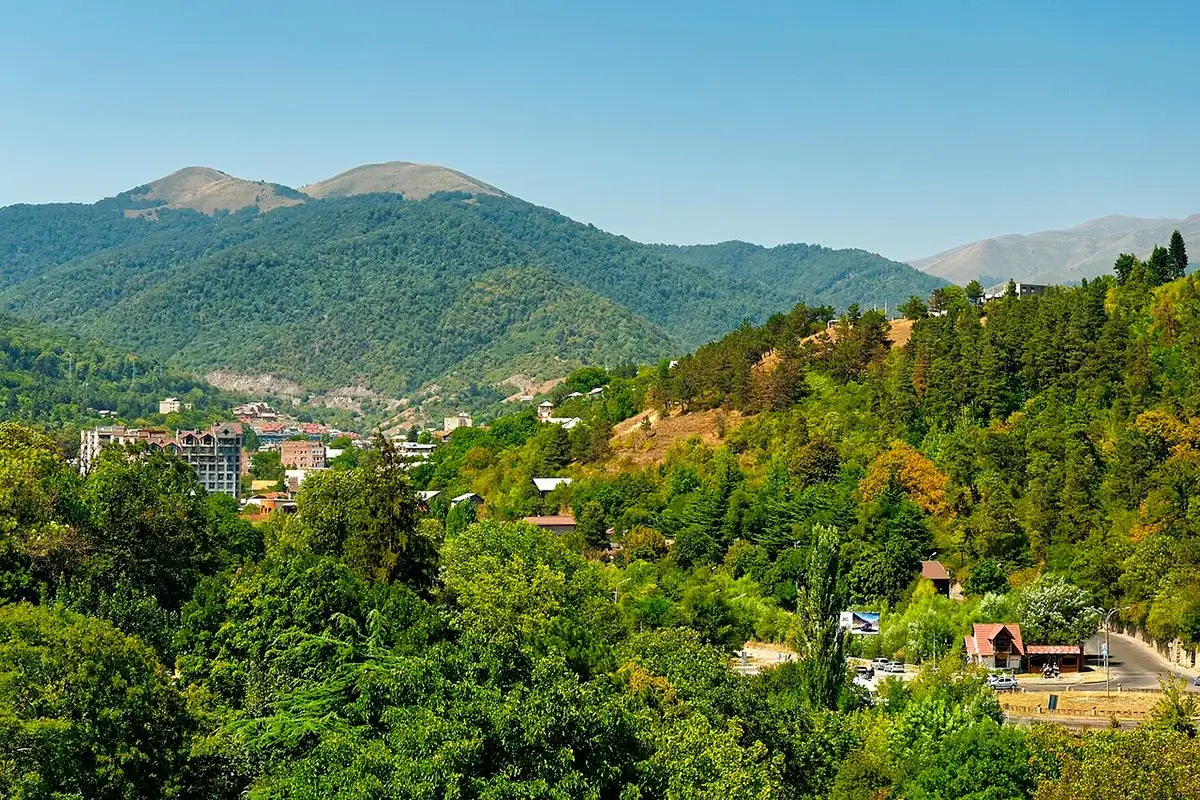
Dilijan is a mountain resort town in Armenia’s Tavush Province, tucked into the forested valley of the Aghstev River at an elevation of 1,255–1,510 m. Locals — and just about every guidebook — call it the country’s “Little Switzerland” for its dense beech and pine forests, mild climate, and mineral springs. The town sits inside Dilijan National Park, one of the richest forest reserves in the South Caucasus, and works equally well as a day trip from Yerevan or as an overnight base for hiking and monastery visits.
From Yerevan the town is about 100 km and 1.5–2 hours by car, with Lake Sevan roughly halfway along the route. The drive itself is a preview of the destination — after the Sevan Pass tunnel, the road drops into a densely wooded serpentine that opens onto the valley below.
What to See in Dilijan and Around
Dilijan and its surroundings combine forest lakes, medieval monasteries, hiking trails and historic landmarks. The main attractions below have their own detailed guides with practical information for planning a visit.
 Dilijan National Park
 Goshavank Monastery
 Haghartsin Monastery
 Jukhtakvank Monastery
 Lake Gosh
 Matosavank Monastery
 Mount Dimats
 Parz Lake
 Shaghot Waterfall
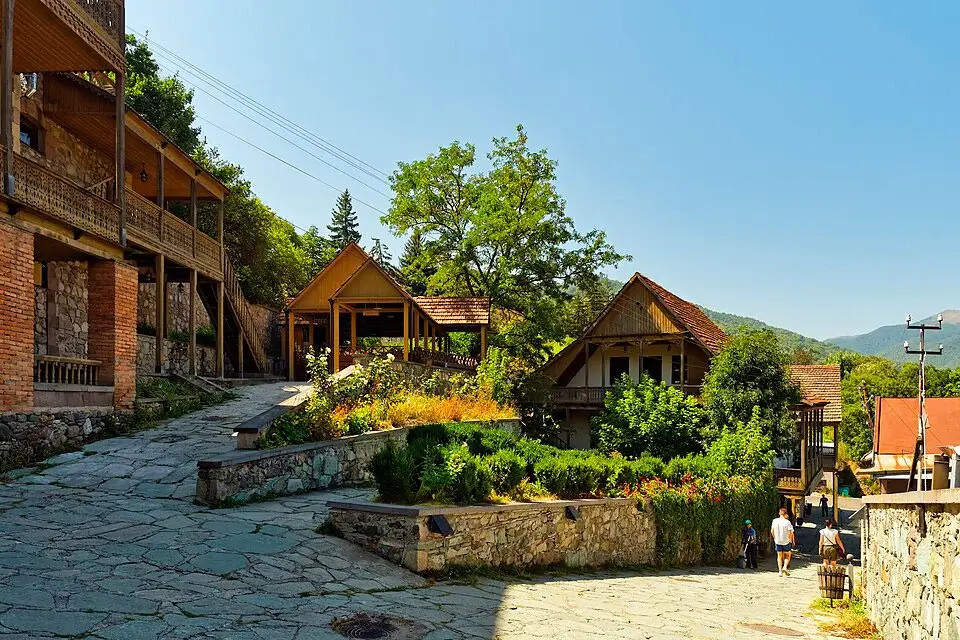
 Sharambeyan Street in Dilijan
Other Places in Town
- Central City Park. A green area in central Dilijan with walking paths, a small artificial lake and places to relax.
- Dilijan Museum and Art Gallery. The museum introduces the history and culture of Dilijan and Tavush, while the gallery includes works by Armenian and European artists.
- Mimino Monument. A sculpture of the main characters from the famous Soviet film Mimino and one of the most recognizable landmarks in central Dilijan.
- VereV Rope Park. An outdoor adventure park in the central park area, with routes of different difficulty levels and a climbing wall.
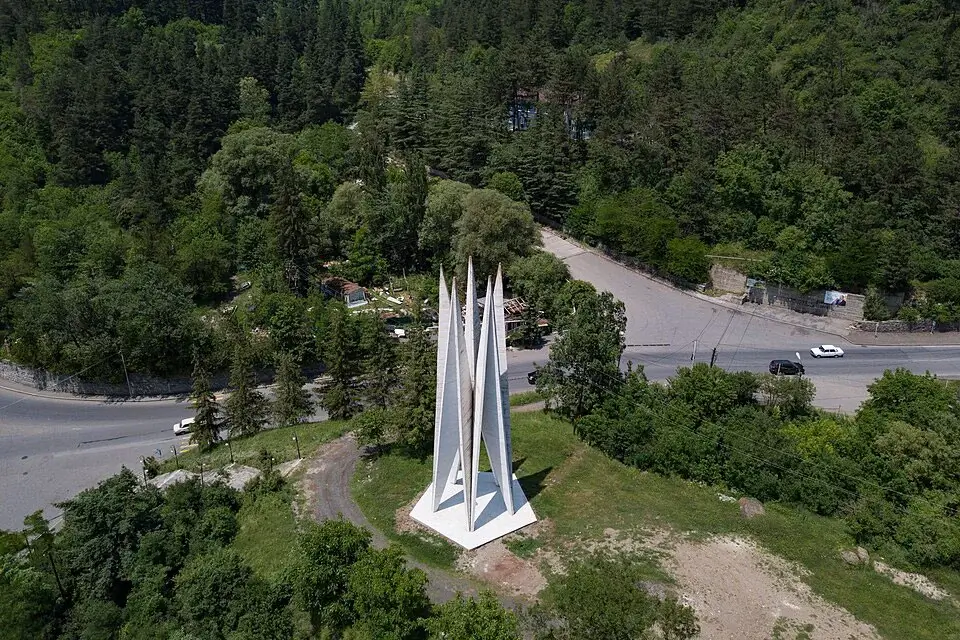
- Monument to the 50th Anniversary of Soviet Armenia. A striking example of Soviet modernist architecture designed by Armenian architect Artur Tarkhanyan.
Geography and climate
Dilijan sits in a narrow, wooded valley squeezed between the Pambak Range to the west and the Areguni (Miapor) Range to the south. The Aghstev River rises on the Pambak slopes and flows east toward the Kura. The town is essentially a natural bowl, shielded from harsh winds by the surrounding mountains — the reason its climate is unusually mild for Armenia.
Summers are moderately warm (average July temperature +18…+19 °C), while Yerevan bakes at +35 and above. Winters are mild and sunny, with January averaging around –2 °C. Humidity is moderate (about 70%), and precipitation reaches roughly 640 mm/year. That combination — warmth, low humidity, and pine-scented air — turned Dilijan into a spa town in the early 20th century. The first tuberculosis sanatorium in Armenia opened here in 1921, and by the Soviet era Dilijan was one of the country’s premier climatic health resorts.
The drive from Yerevan runs past Lake Sevan and through the Sevan Pass tunnel (about 2.3 km long). After the tunnel, the famous Dilijan serpentine road begins — a sight in itself, with each hairpin opening a new view of forested gorges.
History
The area around Dilijan has been inhabited since the Bronze Age. In antiquity it belonged to the Varazhnunik district of the Ayrarat province of Greater Armenia, and its old name Hovk referred to a summer hunting residence of the Arshakuni (Arsacid) kings. Small settlements developed in the valley through the medieval period, but the town itself only took shape in the 19th century, when Russian Imperial administration reorganized the region and Dilijan grew as a merchant stop on the Yerevan–Tbilisi route.
The town’s real turning point was the early 20th century, when its climate was clinically documented and the first sanatorium opened in 1921. By the 1950s and 60s Dilijan had become one of the Soviet Union’s better-known mountain resorts, drawing artists, writers, and composers. Aram Khachaturian composed part of his ballet Spartacus here; Dmitri Shostakovich, Benjamin Britten, and Mstislav Rostropovich were regular visitors. Dilijan received city status in 1958.
The most recent chapter — and the most visible on the ground — is the founding of UWC Dilijan International College in 2014, which brought a striking piece of contemporary architecture, a permanent international community, and a wave of new cafés and guesthouses to the town.
Dilijan National Park
Dilijan is surrounded by the forests of Dilijan National Park, which is one of the main reasons to spend more than a few hours in the area. The park combines beech and oak forests, mountain lakes, medieval monasteries and a network of hiking trails.
Several marked routes range from short forest walks to full-day hikes. Dilijan is the main base for exploring the park, while Lake Parz, Haghartsin, Goshavank and Mount Dimats can be visited as separate trips from the town.
Mineral springs and Dilijan water
Dilijan’s mineral springs rise from around 50 m underground. The water is carbonated bicarbonate–chloride–sodium, comparable in composition to French Vichy and Georgian Borjomi. A bottling plant operates on the springs, producing the Dilijan mineral water brand. The combination of these springs, mild climate, and pine-rich air was historically used to treat respiratory, digestive, and cardiovascular conditions — and it’s still the medical foundation for the town’s sanatoriums.
Who Dilijan is for
- Nature and hiking travelers — a national park at your doorstep, marked trails, forest lakes, and quiet gorges. Trails range from easy one-hour loops to serious full-day treks.
- Families — a mild climate without Yerevan’s summer heat, a deer breeding center, a rope park, and easy walks around Parz Lake.
- History travelers — medieval monasteries Haghartsin, Goshavank, Matosavank, and Jukhtakvank all within a 20 km radius.
- Anyone seeking quiet — the town is small, the pace slow, especially outside July–August.
- Photographers — golden autumn in the beech woods, misty mornings over the gorges, mirror-still forest lakes.
Best time to visit
- Spring (April–May) — everything is green, waterfalls run at full volume, comfortable +12…+18 °C. Some rain in April.
- Summer (June–August) — the main hiking season. Days +18…+25 °C, evenings cool. When Yerevan hits +40, Dilijan is still comfortable without air conditioning. Peak tourism in July–August.
- Autumn (September–October) — the most photogenic season. Beech and oak forests turn gold and burgundy. Clear air, few visitors.
- Winter (December–February) — snow-covered forests, quiet streets, minimal tourism. Temperatures usually around –2…0 °C. Roads are cleared and the town is accessible year-round.
What to combine with Dilijan
- Lake Sevan — Armenia’s largest lake, right on the road from Yerevan. Sevanavank Monastery on the peninsula is a natural stop. Sevan + Dilijan + one of the monasteries is the most popular combined day route in northern Armenia.
- Ijevan — the administrative center of Tavush Province, 30 km east. Known for winemaking and carpet weaving.
- Vanadzor and Lori Province — the northern industrial city and gateway to Haghpat, Sanahin, and Odzun monasteries. Reachable in around 1.5 hours from Dilijan.
Lake Sevan, Dilijan and the nearby monasteries can be combined into one full-day trip from Yerevan: Dilijan Tour from Yerevan.
How to get to Dilijan
From Yerevan it’s roughly 100 km, or 1.5–2 hours by car. The road is paved and in good condition. The route runs past Lake Sevan, then through the Dilijan Tunnel (about 2.3 km), followed by the serpentine descent into the valley.
Marshrutka minivans leave from Yerevan’s Northern Bus Station several times a day, roughly every 1–2 hours. Fare is around 1,500 AMD, journey time 2–2.5 hours.
The most flexible option is a private car with driver in Yerevan or a direct Yerevan–Dilijan transfer. We usually build a combined route for our guests: a Lake Sevan stop on the way in, and Haghartsin or Goshavank on the way back — the lake, the forests, and the monasteries in a single day.