
Tsaghkevank Monastery
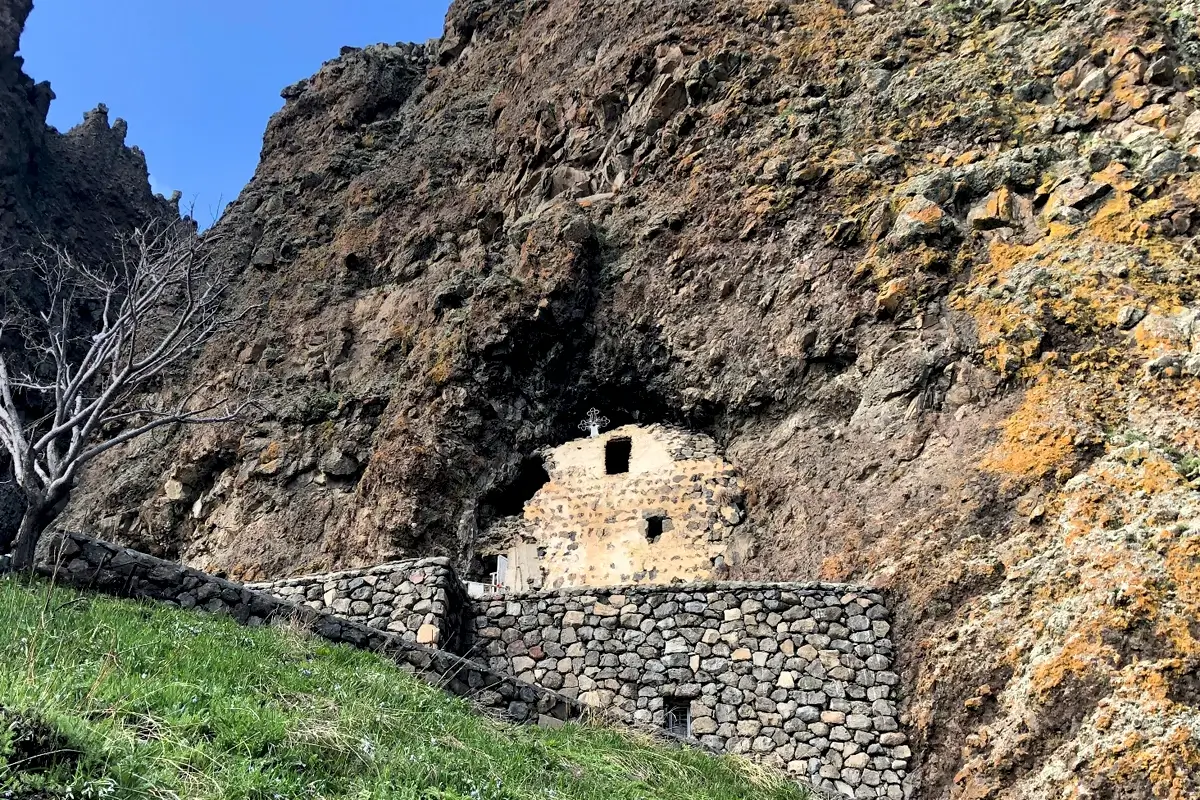
Tsaghkevank (Armenian: Ծաղկեվանք — “Flower Monastery”), also known as Kuys Varvara (“Virgin Barbara”) or the Monastery of St. Barbara, is a small cave shrine carved into the southern cliffs of Mount Ara in Aragatsotn Province, 35 km north of Yerevan. Unlike most Armenian monasteries, Tsaghkevank was not built but hollowed directly out of the volcanic rock: a single mossy cave chamber with an altar, a stone basin, and water dripping slowly through the limestone from the cave’s roof. The site has been a pilgrimage destination for centuries, drawing visitors who come for two folk legends, a zinc-rich healing spring, and a quiet uphill walk that ends with one of the cleanest Ararat-valley views in this part of Aragatsotn.
It is not an active monastic complex with regular services — for most of the year the shrine is empty and silent. The big day is the feast of St. Barbara, when families from the surrounding villages walk up to the cave together. The rest of the time you may well have the place to yourself.
Quick Facts
- Built / Founded: 4th–5th c. (tradition)
- Location: Karbi (trailhead); shrine on Mount Ara, Aragatsotn Province
- Also known as: Tsaghkevank, Tsaghkevank Monastery, St. Barbara Cave Shrine, Tsaghkevank St. Barbara, Ծաղկեվանք, Սուրբ Վարվառա
- From Yerevan: 35 km / about 1 hour by car + 10 min walk
- Entrance fee: Free
- Time needed: 2–3 hours
- Best time to visit: April–June and September–October
- Status: pilgrimage site
- GPS coordinates:
40.3977438, 44.4424502
The setting: Mount Ara
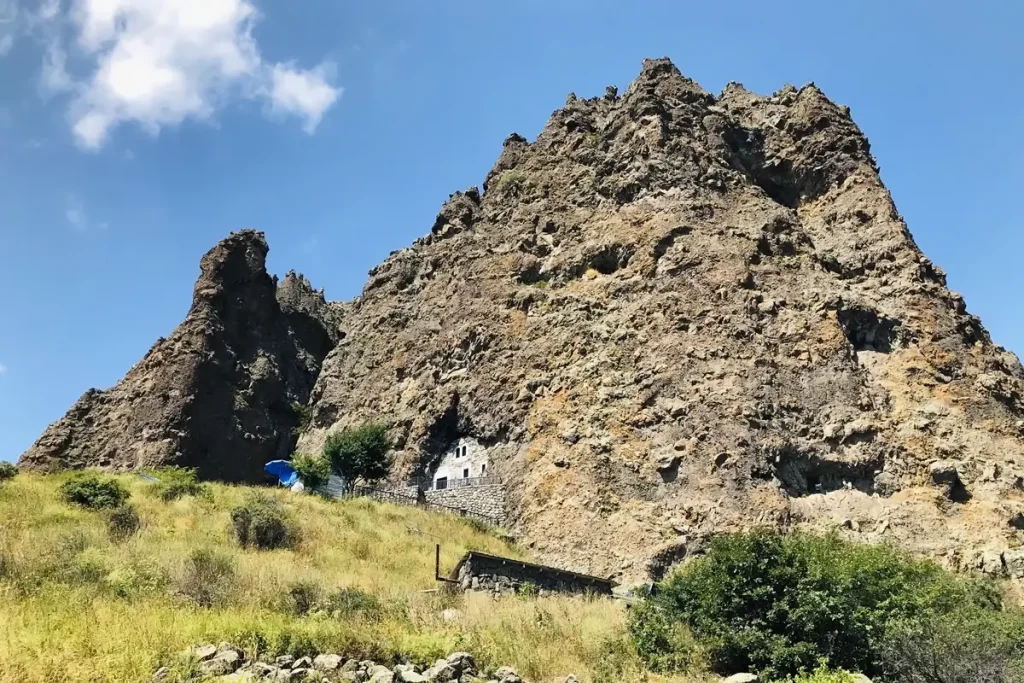
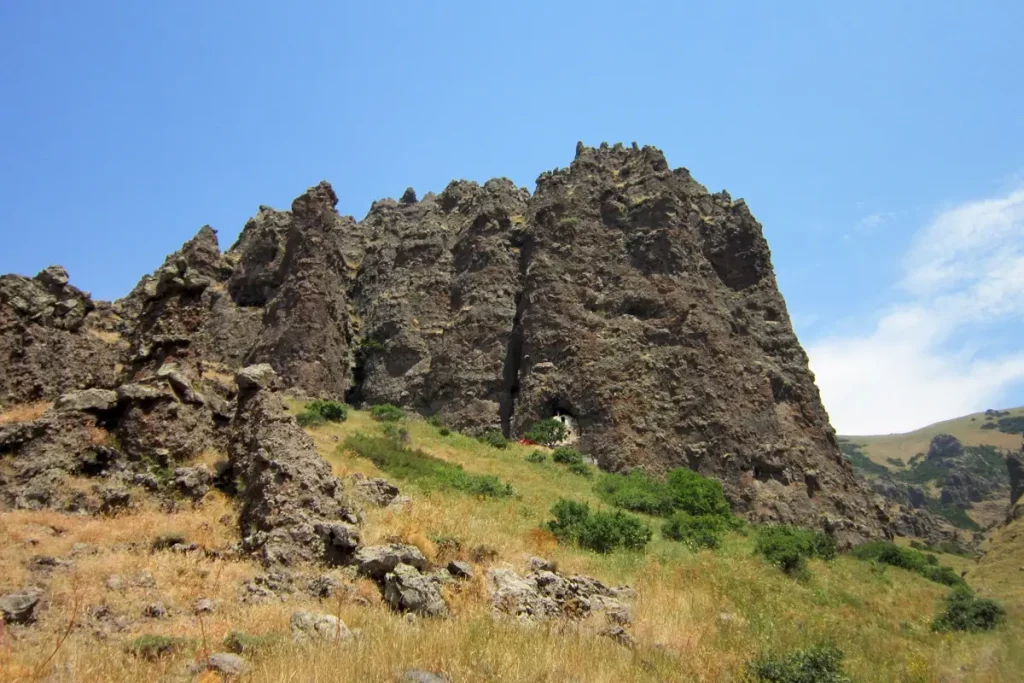
Tsaghkevank sits on the southern slope of Mount Ara (Armenian Arayi Ler) — a heavily eroded extinct volcano of 2,614 metres rising between the Hrazdan and Kasagh rivers. The mountain takes its name from King Ara the Beautiful (Ara Geghetsik), the legendary early Armenian ruler who, according to the 5th-century historian Movses Khorenatsi, fell in battle on these slopes against Queen Semiramis (Shamiram) of Assyria — one of the founding myths of Armenian historical writing.
The shrine itself sits inside a southern bedrock cliff. From the small terrace at the cave entrance the view opens across the Ararat valley to the south; on clear days, the silhouette of Mount Ararat is visible above the horizon. There is no formal facade — the cave entrance is set directly into the rock, with a small built portal carrying a wooden door. Inside, the chamber is low and damp, with moss along the walls, an altar, candle stands, and a stone basin into which the cave water drips from above.
Two legends: St. Barbara and the Maiden Tsaghik
Two folk traditions explain Tsaghkevank’s name and its veneration.
St. Barbara. According to the first, the early Christian martyr Saint Barbara (Armenian Kuys Varvara) fled her pagan father, who had condemned her to death for her faith, and hid in this very cave. A local shepherd spotted her with his dog; Barbara begged him for silence and warned that if he betrayed her, he would turn to stone. When her father reached the mountain, the shepherd nonetheless pointed the way — and was instantly turned to stone, together with his flock. Before her martyrdom, Barbara asked God that her name be invoked for the healing of children suffering from smallpox and rubella, and the prayer was granted. Mothers with sick children still bring them to the shrine on her feast day.
The Maiden Tsaghik. The second legend explains the Armenian name Tsaghkevank. A beautiful young woman called Tsaghik (“Flower” in Armenian) caught the eye of a local Armenian prince, who tried to take her by force. She fled to the same cave on Mount Ara and asked a shepherd to keep her hidden. The prince, riding through, met the same shepherd, who — frightened — told him where she was. Tsaghik, seeing the prince approach, climbed onto the cliff above the cave and threw herself off the edge. The shepherd was turned to stone with his flock, and the shrine on the mountain took her name: Tsaghkevank — the Monastery of the Flower. The water that drips from the cave’s roof is, in this version, the tears of Tsaghik.
The two stories sit happily together in local tradition: the cave is read at once as St. Barbara’s hiding place and as the place of the flower-maiden’s leap. Tradition places the founding of a “holy place” on this site in the 4th or 5th century; the first surviving written mention is far later, by the 18th-century Catholicos Simeon Yerevantsi (1710–1780).
The healing spring
The cave’s defining feature is the spring that drips through its roof. Local tradition has always held the water sacred and curative; in folk practice it is used especially for the eyes, for joint stiffness, and for muscle spasms.
The folk reading turns out to have a real mineralogical basis. Modern chemical analysis of the water shows an unusually high zinc content — and zinc is a documented dietary micronutrient for eye health, joint tissue and muscle function. Pilgrims arrive with plastic bottles and fill them at the basin, and the cave’s small ferns and mosses live off the same slow drip.
The water flow is highest in spring and summer; in winter and dry late summer it can slow to a few drops a minute, but never stops entirely.
How to get to Tsaghkevank from Yerevan
The cave shrine is about 35 km north-west of Yerevan — roughly 1 hour by car.
Take the M3 highway to Ashtarak, then turn off toward Mughni village, cross the Kasagh canyon, and at the T-junction turn left toward Karbi. From Karbi, a packed-dirt road climbs the lower slope of Mount Ara; the start of the walking trail is marked by a roadside cabin (often parked beside a small truck), which is also the place to leave the car.
From there it is about 3 km on foot up a stony unpaved track, taking 40–60 minutes depending on pace. The grade is gentle but the surface is loose, and after rain the stones can be slippery — sturdy shoes with grip are essential. There is essentially no signage: download an offline map (Maps.me or OsmAnd) before you set out, or — far easier — go with a driver who knows the trail. Mobile reception is unreliable above Karbi; Armenia’s emergency number is 112.
Children can do the walk, but bring water and snacks: there are no shops, cafés or toilets between Karbi and the cave.
Without a car, the trip is awkward — marshrutkas reach Ashtarak or Karbi but leave the final 5–7 km uncovered. The simplest option is to hire a car with driver in Yerevan for half a day, or to add Tsaghkevank to a fuller Aragatsotn route together with Hovhannavank and Saghmosavank.
Practical tips on site
- Plan about 2 hours round-trip from the parking area: 40–60 minutes up, 30 minutes inside the cave and on the terrace, 40 minutes back down.
- The cave is cool and damp year-round — a light jacket helps even in midsummer.
- Bring an empty bottle if you want to fill it at the spring.
- The St. Barbara feast (in December by the Armenian church calendar) is the busiest day of the year; expect a procession of pilgrims and parked cars at the trailhead.
- A small secondary cave with a cross and a few icons of the saint sits a few minutes further up the gully — easy to overlook.
- Wildlife: local guides report bears, wolves and foxes on the upper slopes of Mount Ara, and the occasional snake. The path itself is safe in daylight, but the slopes off the trail are not.
What to see nearby
- Hovhannavank Monastery (~12 km) — 13th-century cliff-edge monastery over the Kasagh canyon, with the rare Wise and Foolish Virgins relief on its western portal.
- Saghmosavank Monastery (~15 km) — Hovhannavank’s twin upstream on the same canyon, with the 1255 medieval library.
- Mughni — St. George Church (~10 km) — 17th-century church with distinctive striped tuff masonry, on the way back to Yerevan.
- Ashtarak (~8 km) — old town with the 7th-century Karmravor church and a medieval bridge over the Kasagh.
- Mount Ara summit — a 4–6 hour climb from Tsaghkevank up the south face takes you to 2,614 m, with views of Aragats, Ararat and the Ararat valley. The hike is steep and partly waymarked.
Frequently asked questions
Tsaghkevank is the kind of Armenian site that does not appear in the guidebook top-ten lists: a single cave on a mountain slope, two folk legends instead of a single dated history, and a healing spring that has a real mineralogical answer to its old reputation. With Hovhannavank and Saghmosavank fifteen kilometres on, it can sit comfortably inside a half-day from Yerevan — most easily reached with a private car and driver from Yerevan.


