
Sanahin Monastery
Sanahin Monastery (Armenian: Սանահին վանք) is a 10th–13th-century monastic complex built on a high plateau above the Debed canyon in the Lori Province of northern Armenia, 175 km from Yerevan. Its name in Armenian means literally “this one is older than that one” — a claim of seniority over the neighbouring monastery of Haghpat, which stands directly across the canyon, three kilometres away.
While Haghpat became the great spiritual centre of medieval Lori, Sanahin earned a different reputation: as a university. Its school taught philosophy, medicine, astronomy, music and calligraphy; its scriptorium was one of the leading centres of Armenian manuscript illumination; and its small academy in the corridor between the two churches is traditionally associated with Grigor Magistros Pahlavuni — the same Armenian polymath who founded Kecharis Monastery further south. In 1996 Haghpat was inscribed on the UNESCO World Heritage List; Sanahin and its medieval lion-bridge were added by extension in 2000.
Quick Facts
- Built / Founded: 10th c. (Surb Astvatsatsin, 928–944)
- Location: Sanahin district, Alaverdi, Lori Province
- Also known as: Sanahin Monastery, Sanahin Monastic Complex, Sanahinavank, Սանահին, Սանահինի վանք
- From Yerevan: ~175 km (2.5–3 hours by car)
- Entrance fee: Free
- Time needed: 45–60 minutes
- Status: Active monastery / UNESCO World Heritage site
- GPS coordinates:
41.0872827, 44.6660897
A short history: from a refugee church to a royal capital
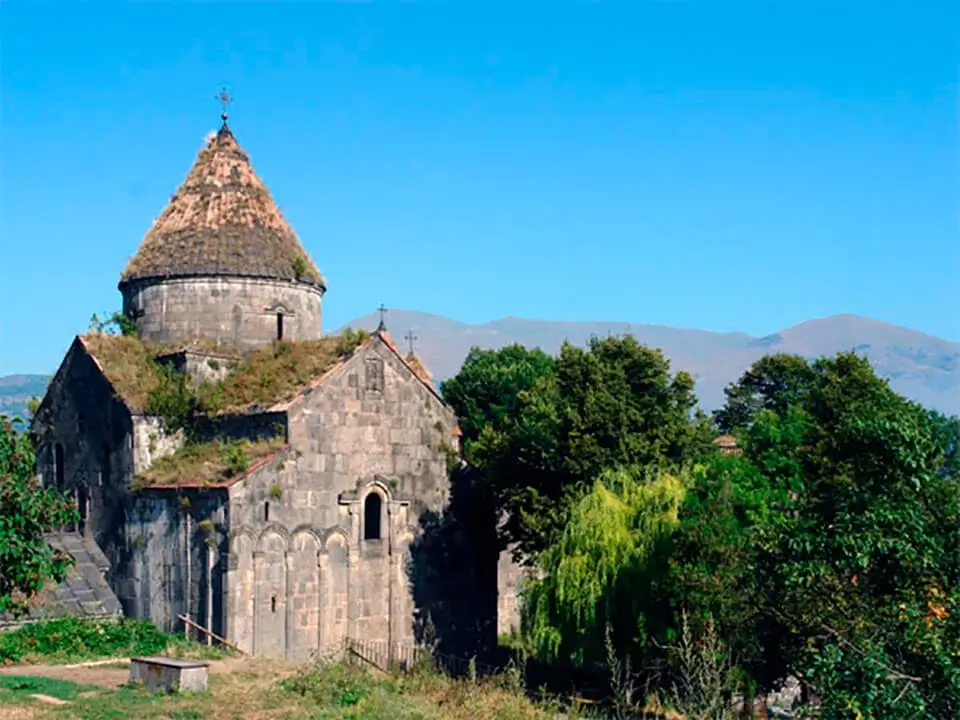
The oldest building at Sanahin is the small Surb Astvatsatsin (Holy Mother of God) Church, built between 928 and 944 by Armenian clerics expelled from Byzantium during a period of theological repression. Its central-domed, cross-shaped plan with a tall round drum is closer to contemporary Georgian church architecture than to the Armenian classical type, and it shows the cultural exchange flowing through the Debed valley in the 10th century.
The complex was given its definitive shape between 957 and 966, when Queen Khosrovanush — wife of the Bagratid king Ashot III the Merciful — funded the construction of the main cathedral, Surb Amenaprkich (the Holy Savior, also called Katoghike). It is one of the finest examples of 10th-century Armenian architecture: four two-storey sacristies surround the central dome, and the entire interior is built on a balance of square base and circular vault. A sculpted relief at the top of the east facade shows the queen’s sons, Smbat (later King Smbat II of Ani) and Kyurike (later founder of the Kyurikian Kingdom), holding a model of the church between them — one of the first examples of donor portraiture in Armenian monumental sculpture.
In 979 a decree of King Smbat II made Sanahin the seat of the bishop of the newly created Kyurikian Kingdom (the Tashir-Dzoraget realm), which it remained for nearly a century. Over the next 200 years the monastery grew into a small monastic town: more than twenty churches, chapels, gavits, tombs, a belfry, an academy, a library, a refectory, galleries and a bridge were built around the original core. After a period of decline under Seljuk and Mongol rule, the complex was restored to prominence in the 12th and 13th centuries by the Zakarian and Khaghbakyan (Proshyan) princely families. It remained an important religious and educational centre until the early 20th century, was placed under state protection in Soviet times, and in 1998 was handed back to the Mother See of Holy Etchmiadzin.
The Academy of Grigor Magistros: a medieval university
Sanahin’s fame as an educational centre is concentrated in a single narrow corridor between the two main churches: a long rectangular hall with stone benches and wall niches, traditionally identified as the academy of Grigor Magistros Pahlavuni (990–1058). It is easy to walk past without noticing.
Grigor Magistros — philosopher, scientist, poet and military commander — is the same Armenian polymath who founded Kecharis Monastery in Tsaghkadzor in the early 11th century. At Sanahin he is said to have taught and written his Letters, a collection of observations on biology, astronomy, music theory, aesthetics and medicine. Around him a wider faculty took shape: Dioscoros Sanahnetsi (1039–1063), the scholar-monks Anania Sanahnetsi and Hakobos Karapnetsi. Beyond theology, the curriculum included philosophy, rhetoric, calligraphy, music, medicine, and the science of calendars.
UNESCO singled out Sanahin in particular as “a school of illuminators and calligraphers” — the scriptorium produced hundreds of manuscripts that survive in libraries across Armenia and the diaspora.
Architecture: the buildings of Sanahin
- Surb Astvatsatsin (928–944) — the oldest church, central-domed and cross-shaped, of clear Byzantine-Georgian inflection.
- Surb Amenaprkich Cathedral (957–966) — the main church, built by Queen Khosrovanush; one of the textbook examples of 10th-century Armenian cathedral architecture.
- The gavit of Surb Amenaprkich (1181) — built by the architect Zhamhayr. This is the earliest known four-column gavit in Armenian architecture: four heavy stone columns carry a central skylight, and their capitals are carved with animal-head sculptures. Almost every later Armenian monastic gavit traces its plan back to this building.
- St. Grigor Chapel (1061) — circular on the outside, cruciform inside.
- The matenadaran (library) (1063) — built by Princess Ranush, daughter of King Davit Anhoghin. The square hall has wall niches that once held hundreds of manuscripts; the ceiling is a remarkable eight-sided stone tent resting on diagonal arches, with each facet stepped like the layered wooden roofs of the traditional Armenian peasant house (glkhatun).
- The great gavit (1211) — built by Prince Vache Vachutyan (the same patron who funded Hovhannavank and Saghmosavank further south) and attached to the west wall of Surb Astvatsatsin. Three pairs of wide arched openings served as entrances; the interior is covered with cylindrical vaults with sharp ridges — a unique solution in medieval Armenian architecture.
- The bell tower (1235) — a free-standing three-storey campanile, one of the earliest of its type in Armenia.
- The tombs of the Kyurikian, Zakaryan, and Arghutyan-Yerkaynabazuk princes — set throughout the grounds, with carved khachkars of the 11th–13th centuries.
The entire complex is built of locally quarried light-gray polished basalt, including the roofs.
The Sanahin Bridge: “the seventh wonder of historical Armenia”
A kilometre downhill from the monastery, on the old road into Alaverdi, the Sanahin Bridge spans the Debed river in a single 18.6-metre arch. It was built at the end of the 12th century by Queen Vanen (Nana), of dressed basalt blocks set with lime mortar, and decorated with four sculpted lions at the corners of the parapet — the heraldic emblem of the Kyurikian house. The Armenian writer Levon Javakhyan once called it “the seventh wonder of historical Armenia”. Cars crossed it until the 1960s; today it is for pedestrians only, and is part of the same UNESCO listing as the monastery.
The legend behind the name
According to a local story, a famous medieval architect was hired by a prince to build a monastery in the Debed canyon. Mid-way through the work the architect quarrelled with his son, and the son walked off and built his own monastery — Haghpat — across the gorge. When the father saw his son’s finished work, he pointed at his own and said “Sa nraniz hin e” — “this one is older than that one”. The phrase, the story claims, became the monastery’s name
How to get to Sanahin Monastery from Yerevan
Sanahin lies in northern Lori, near the Georgian border. From Yerevan it is 175 km via the M6 highway through Vanadzor — typically 2.5 hours by car. The monastery stands on a plateau directly above the city of Alaverdi; the final ascent is a steep narrow road, fine for any passenger car in dry conditions.
By public transport: minibuses run several times a day from Kilikia Bus Station in Yerevan to Alaverdi, then a short taxi (≈10 km) up to Sanahin village. The Yerevan–Tbilisi train also stops at Alaverdi station, from where Sanahin is a 15-minute walk uphil
Because Sanahin and Haghpat are only three kilometres apart in straight line, they are almost always visited together. The full day from Yerevan typically also takes in Akhtala (about 20 km on, with the finest 13th-century frescoes in Armenia) and lunch in the Debed canyon — a circuit of around 380 km. The most flexible way to do it is with a private car and driver in Yerevan, so that the timing of the three monasteries and lunch fits a single long day.
Practical tips on site
- Plan 45–60 minutes for the monastery, and up to 1.5 hours if you walk down to the bridge.
- Look for the academy of Grigor Magistros in the narrow corridor between Surb Astvatsatsin and Surb Amenaprkich — easy to miss; ask the caretaker or a guide.
- Step inside the matenadaran (library) to see the eight-sided stone-tent ceiling — there is nothing else like it in Armenia.
- A short walk down the road brings you to the Sanahin lion-bridge; the four corner lions are best photographed in late-afternoon side light.
- Sunset at the neighbouring Haghpat is widely considered one of the best views in Armenia — plan the day so that Sanahin comes first, Haghpat last.
What to see nearby
- Haghpat Monastery (~7 km by road, 3 km across the canyon) — the UNESCO twin, with the famous Amenaprkich khachkar of 1273 and the 1245 bell tower.
- Akhtala Monastery-Fortress (~20 km) — for its 1205–1216 frescoes in Armenian-Chalcedonian style, unique in Armenia.
- Sanahin Bridge (~1 km) — the 12th-century lion-bridge, included in the UNESCO listing.
- The Debed canyon itself — a deep, forested gorge that frames all the Lori monasteries.
- Mikoyan Brothers Museum in Sanahin village — a small house-museum dedicated to Artem Mikoyan, co-designer of the MiG fighter jet, and his brother Anastas Mikoyan, the long-serving Soviet statesman; both were born here. Maintained by the family.
- Odzun Church (~25 km) — a 5th-century basilica in pink felsite, one of the oldest churches in Armenia.
Frequently asked questions
Sanahin is the kind of medieval site that rewards the visitor who slows down: a thousand-year-old refugee church, a cathedral built by a queen, a four-column gavit that set a template for Armenian architecture, a library with a stone-tent ceiling unmatched anywhere else, and a small academy in a corridor where a great Armenian polymath once taught medicine and music. With Haghpat across the canyon and Akhtala twenty kilometres on, it makes the centrepiece of one of the best day routes in northern Armenia — most comfortably done with a private car and driver from Yerevan.