Republic Square
Republic Square (Armenian: Հանրապետության հրապարակ) is the main square of Yerevan and the architectural and civic heart of the Armenian capital. Locals simply call it Hraparak — “the square”. It brings together five monumental buildings designed in a single neoclassical style, an oval roundabout paved as a stone carpet, and the famous musical fountains in front of the History Museum.
Quick Facts
- Built / Founded: 1926–1958 (National Gallery completed 1977)
- Architects: Alexander Tamanyan
- Location: Yerevan
- Also known as: Hraparak, Hanrapetutyan Hraparak, Հանրապետության հրապարակ, former Lenin Square
- Entrance fee: Free
- GPS coordinates:
40.1776945, 44.5126511
What is on Republic Square: the architectural ensemble
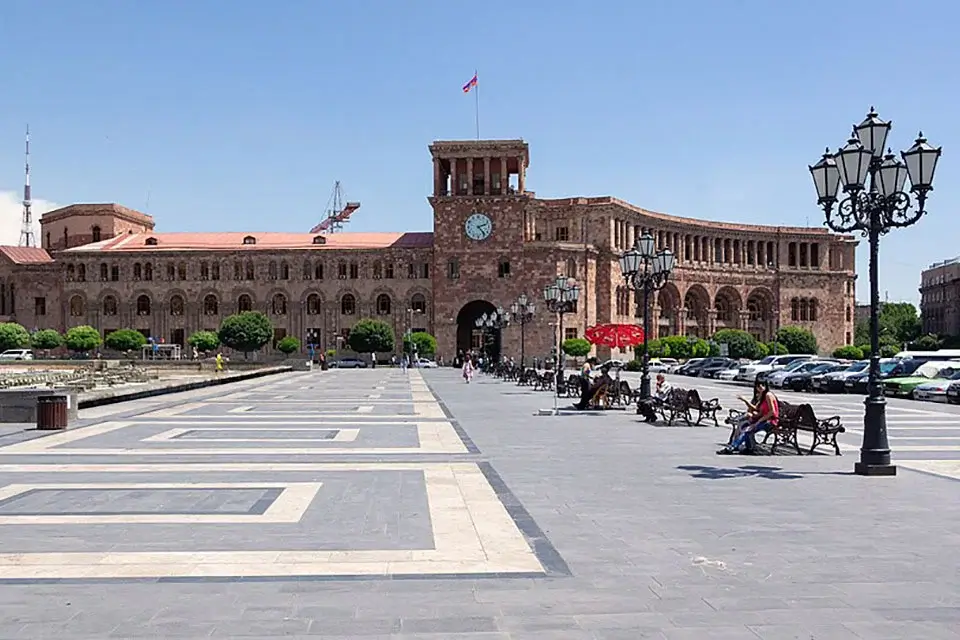
The square is enclosed by five buildings, all faced with pink and yellow tuff on a basalt base and built in a unified style that blends Soviet neoclassicism with Armenian medieval ornament:
- Government House of Armenia — the dominant building, with the country’s main clock and bells on the central tower;
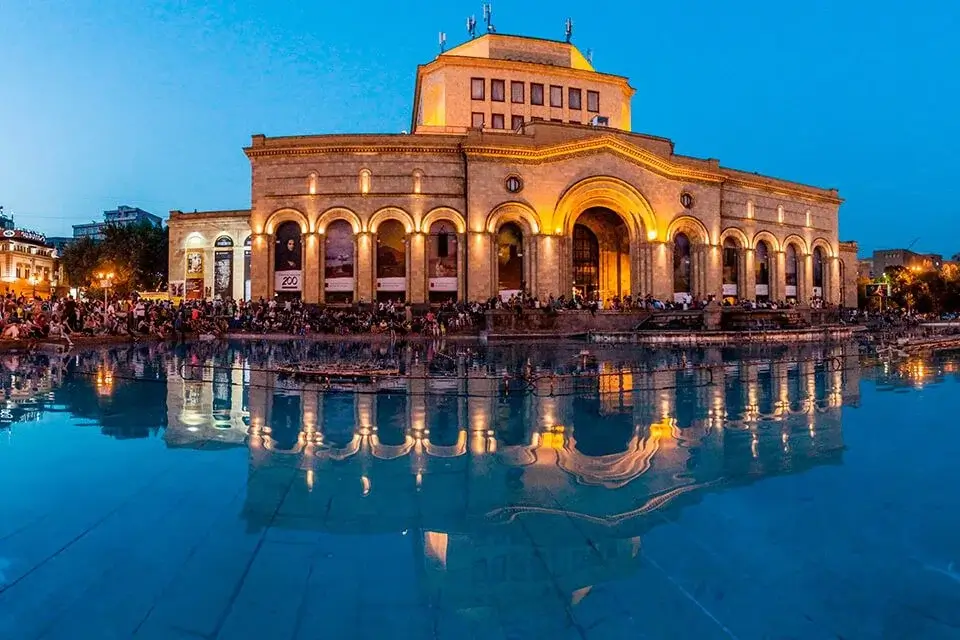
- History Museum of Armenia and National Gallery of Armenia — sharing a single building on the north side, with the musical fountains in front;
- Central Post Office of Armenia;
- Armenia Marriott Hotel (originally Hotel Armenia);
- the former Ministry of Foreign Affairs and Ministry of Transport and Communications buildings, completing the ring.
The Government House clock face is about four metres in diameter — for many years it has served as the country’s standard time reference. Together the buildings form one of the most coherent neoclassical ensembles built in the Soviet Union and are still considered Yerevan’s most outstanding architectural composition.
The stone carpet
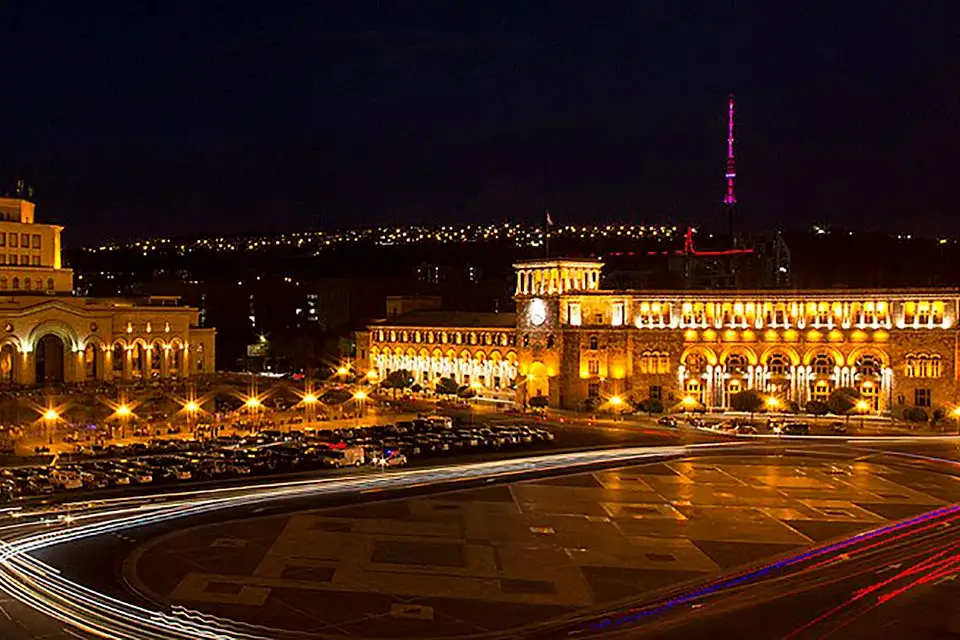
The square is divided into two parts. The southern part is an oval roundabout paved with a complex stone pattern that, seen from above, deliberately echoes the geometry of a traditional Armenian rug — locally it is simply called the stone carpet. The pattern is best appreciated either from a drone shot or from one of the upper floors of the surrounding buildings. The northern, trapezoid-shaped part of the square contains the musical fountain pool in front of the History Museum and the National Gallery.
History of Republic Square
Republic Square was built on the site of Yerevan’s old market square. The concept was drawn up by Alexander Tamanyan, the chief architect of Yerevan, as part of his 1924 master plan for the capital. Construction began in 1926 with the Government House and continued in phases: the main ensemble was largely complete by the late 1950s, and the National Gallery building on the north side was finished in 1977. Instead of the constructivist forms originally proposed in the 1920s, the buildings were realised in a heavier neoclassical idiom enriched with medieval Armenian motifs — arched façades, carved ornament and a strict symmetry that ties the whole composition together.
In Soviet times the square was named Lenin Square and was the main stage for military parades and state demonstrations. A monumental statue of Lenin stood in the southern part of the square. After Armenia declared independence in 1991 the statue was dismantled and the square was renamed Republic Square. The empty pedestal stood for years and was eventually removed.
The singing fountains
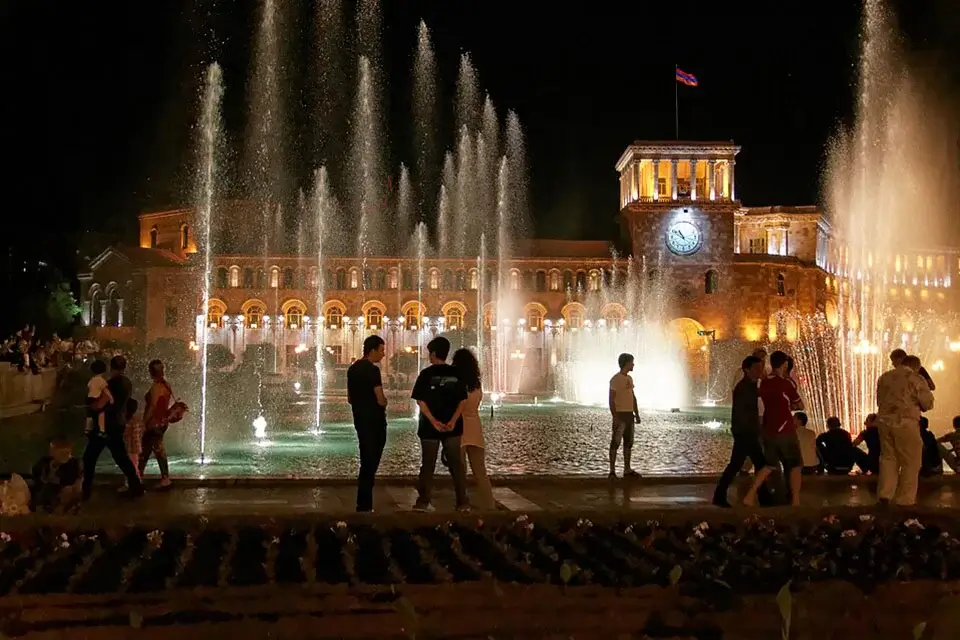
The musical fountains in front of the History Museum are the most famous part of the square. The fountain pool was built in the early 1950s by architects Mark Grigoryan and Eduard Sarapyan. In 1970 a team led by the Yerevan engineer Abraham Abrahamyan turned the pool into the Soviet Union’s first synchronised “singing fountains” — water jets choreographed to music and coloured light. The format was so successful that Abrahamyan’s team went on to build similar fountains in Moscow, Sochi, Batumi and other Soviet cities.
In 2007 the system was rebuilt from scratch by the French specialist company Aquatique Show International for around €1.4 million. Today the fountains run on a computer-controlled programme that includes classical, jazz, pop, rock and Armenian music. The shows usually take place every evening from around 21:00 to 23:00, with brief breaks between sets.
The fountains operate roughly from late March or early April through to early November — exact start and end dates shift from year to year with the weather, so it is best to check the current schedule before a visit.
How to get to Republic Square
Republic Square is in the very centre of Yerevan, in the Kentron district, and most central addresses in the city are within a short walk. The metro station Republic Square opened in 1981 and was deliberately built without a full surface-level vestibule so that the architectural ensemble would not be disturbed — the entrances are tucked into the adjoining streets.
If you would prefer to see the square together with other central landmarks at an unhurried pace, this is easy to arrange as part of an individual tour with a driver-guide.
What to see nearby
Republic Square is a natural starting point for a walk through central Yerevan. Within a few minutes on foot you can reach:
- the Yerevan Cascade — a giant stairway with terraces, sculpture gardens and panoramic views of Mount Ararat;
- the Matenadaran — Armenia’s institute of ancient manuscripts at the top of Mashtots Avenue;
- Northern Avenue — the pedestrian street running between Republic Square and the Yerevan Opera Theatre;
- the Vernissage open-air craft and souvenir market, held on weekends two blocks east of the square.
Practical information and tips
The square itself is open day and night and free to enter. The museums on its north side run to their own ticketed schedules. A few tips:
- Come in the evening. The buildings are floodlit after dark and the fountains run in the warm half of the year — the square is most photogenic between sunset and midnight.
- Time the fountain show. Most evenings the main programme starts around 21:00 and runs until about 23:00 with short pauses between sets.
- Visit the museums on the square. The History Museum of Armenia and the National Gallery of Armenia share the building on the north side; allow 1.5 to 2 hours each if you want to see them properly.
- Combine in one walk. The Cascade, Matenadaran and Northern Avenue are all within a 15–20 minute stroll, which makes for an easy half-day route through the centre.
Frequently asked questions
Republic Square is the easiest place in Yerevan to feel the city’s scale and character in one stop. Whether you come in the morning to see the architecture and the stone carpet in clear light or in the evening for the fountain show, it sits naturally at the start — or the end — of any walk through the capital.