Yerevan Opera Theatre
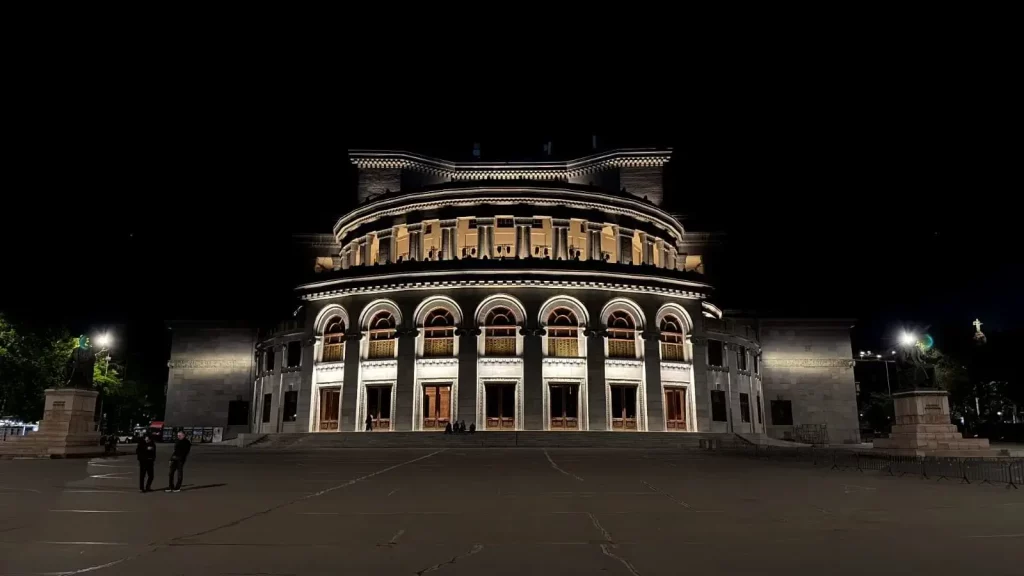
The Alexander Spendiaryan National Academic Theatre of Opera and Ballet — known to everyone in Yerevan simply as “the Opera” — is the principal music venue of Armenia and one of the architectural anchors of the city centre. It stands at the heart of Freedom Square in the Kentron district, a semicircular building of pink Armenian tuff designed by the city’s master architect, Alexander Tamanyan, whose plan won the Grand Prix at the 1937 Paris World Exposition while construction was still underway.
The theatre opened on 20 January 1933, with a performance of the Armenian opera Almast by Alexander Spendiaryan. Almost a century later, the same stage remains the country’s primary venue for opera, ballet, and symphonic music.
Quick Facts
- Built / Founded: 1930–1939 (winter section); 1953 (summer section); reopened 1980 after major reconstruction
- Architects: Alexander Tamanyan (1878–1936); Gevorg Tamanyan; Julius Tamanyan; Gayane Tamanyan
- Location: Yerevan
- Also known as: The Opera, Spendiaryan National Academic Theatre of Opera and Ballet, Yerevan Opera House, Ալեքսանդր Սպենդիարյանի անվան օպերայի և բալետի ազգային ակադեմիական թատրոն
- Entrance fee: Ticketed for performances; Freedom Square and Swan Lake
- Status: National Academic Theatre (since 1956); USSR State Prize 1941
History: From People’s House to the Opera
The idea of a major performance hall in Yerevan goes back to 1926, when the city’s central committee approved the construction of a “People’s House” and assigned the project to Alexander Tamanyan, who was already redrawing the whole city in his ambitious general plan. Tamanyan’s brief evolved over the next few years into something larger — a national opera and concert complex that would anchor a new central square.
Site preparation was substantial. Land was acquired from the Bashirov, Janibekov, and Petrosyan families. The Mamri irrigation canal had to be rerouted. The 17th-century Gethsemane Chapel that stood on the site was dismantled — its stones numbered for re-erection elsewhere, though the reassembly never happened and by 1932 the stones had been reused in other construction. In 1931 Tamanyan brought in the acoustics specialist Professor Lifshitz to consult on the interior; the original design pre-dated most modern concert-hall acoustic engineering.
Ground-breaking took place on 28 November 1930, timed to the 10th anniversary of Soviet Armenia. The theatre company itself was constituted in 1932 from the opera class of the Yerevan Conservatory, and on 20 January 1933 it opened to the public with the premiere of Spendiaryan’s Almast. In 1938 the theatre was officially named after Spendiaryan, the name it carries today. National Academic status followed in 1956.
Tamanyan’s Vision and the Building
Tamanyan’s plan for the Opera was uncommonly ambitious. He designed two halls — a winter (southern) hall and a summer (northern) hall — each with its own stage, parterre, and amphitheatre. The pair were intended to be transformable: when a central partition was removed, the two would unite into a single oval hall seating 3,000 spectators with one common stage. Due to engineering difficulties and Tamanyan’s death in 1936, this transformation was never realised, and the two halls have remained physically separate.
Tamanyan died with the project incomplete. His son, Gevorg Tamanyan (1910–1993), took over and saw the building through in two phase
- 1939 — the winter section was completed; the Spendiaryan Opera and Ballet Theatre began operating there from 1940
- 1953 — the summer section was finished and converted into the Aram Khachaturian Grand Concert Hall, home of the Armenian National Philharmonic Orchestra
The building was awarded the USSR State Prize in 1941, while construction was still continuing. A major interior reconstruction took place between 1978 and 1980 under Gevorg Tamanyan with the next generation of the family — Julius and Gayane Tamanyan — and the renovated theatre reopened on 28 November 1980, to the day of its 60th-anniversary symbolism.
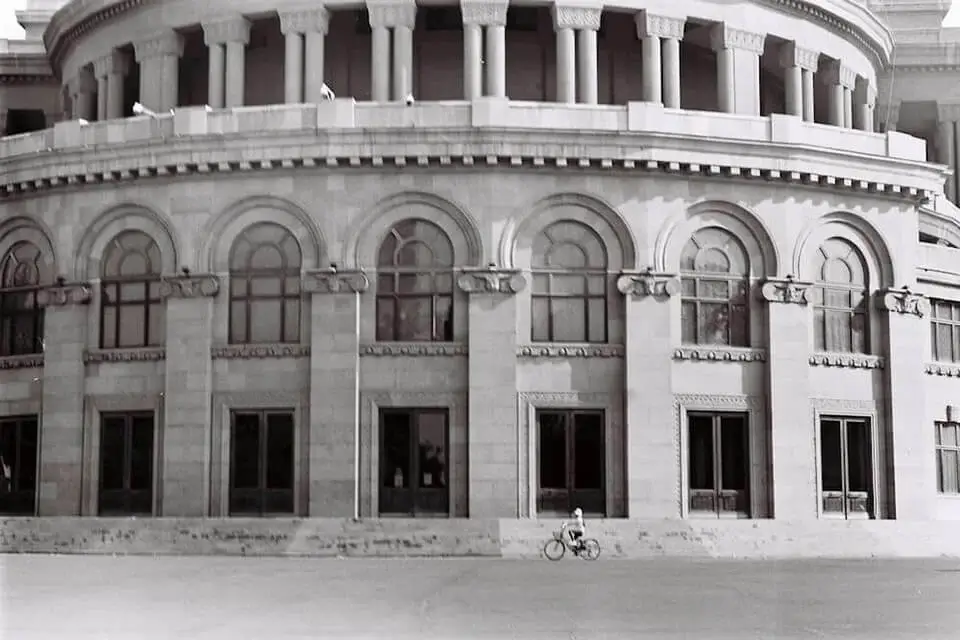
Architecturally, the Opera is a study in restraint. The semicircular outer wall of pink tuff carries a colonnade of slender arches, the proportions deliberately quieter than the more declarative ensembles Tamanyan built around Republic Square. The interiors lean into deep reds, gilded plasterwork, and brass — the warmth of a 1930s European opera house translated into Armenian material.
The Two Halls
The complex houses two performance spaces, both still in active use:
- Alexander Spendiaryan Opera and Ballet Hall — 1,200 seats. The southern (winter) section. Home to the Armenian National Opera and Ballet Theatre’s productions.
- Aram Khachaturian Concert Hall — 1,400 seats. The northern (summer) section, since 1953. Home of the Armenian National Philharmonic Orchestra. Named after the composer of Spartacus and the Sabre Dance — one of the most internationally recognised Armenian composers of the 20th century.
The acoustics of both halls are well regarded, particularly the Khachaturian Hall, which has hosted a long roster of international soloists and ensembles since 1963.
What’s On: The Repertoire
In its first ninety years the theatre has staged more than 200 operas and ballets by Armenian, Russian, and Western European composers, and its company has performed in over 20 countries — Russia, Spain, Lebanon, the United States, Greece, and Germany among them.
The repertoire today moves between three layers:
- The international classics — Verdi, Puccini, Bizet, Tchaikovsky, Mozart; the standard ballet canon from Swan Lake to The Nutcracker (the ballet company was formed in 1935 with Swan Lake as its first independent production).
- The Armenian opera tradition, anchored by the so-called “three A operas”
- Almast by Alexander Spendiaryan — the opening-night work, based on Hovhannes Tumanyan’s narrative poem The Siege of Tmbouk Castle. Spendiaryan (1871–1928) had trained with Nikolai Rimsky-Korsakov in St Petersburg.
- Anoush by Armen Tigranian — first premiered on this stage in 1935, the tragic story of a peasant girl in love with a shepherd who becomes her brother’s mortal enemy; still in the active repertoire.
- Arshak II by Tigran Chukhajian — historically considered the first Armenian opera (composed 1868), staged here after the theatre’s opening.
- Aram Khachaturian’s own works, especially Spartacus, frequently performed by the resident ballet company.
The full season is September through June, with summer largely reserved for touring engagements and gala concerts.
Visiting: Tickets, Tours, and Freedom Square
Tickets are sold at the theatre’s own box office (a small counter to the left of the main lobby) and online through the theatre’s official website. Prices range widely depending on the production and the seat — typical evening tickets fall around 2,000–8,000 AMD, with premieres and gala events priced higher. International ballets and visiting opera tours command top-tier prices; standard repertoire performances remain affordable by European standards.
A few practical notes:
- The lobby and exterior are public and worth a slow walk even without a ticket. The marble foyer with its cloakroom retains the unhurried theatre culture of an earlier era.
- Arrive early — half an hour before curtain — to take in Freedom Square itself. The square holds Tamanyan’s monuments to the poet Hovhannes Tumanyan (1957, sculptor Ara Sargsyan) and to Alexander Spendiaryan (1957). It was originally called Theatre Square and was renamed Freedom Square in 1991.
- Swan Lake — the artificial pond directly behind the Opera, lined with cafés. In winter it freezes over into an open-air ice rink, one of central Yerevan’s most photographed scenes.
- Underground parking under Freedom Square has been in operation since 2010.
The Opera sits in the most walkable cultural quarter of central Yerevan — within ten minutes on foot of Republic Square, the Northern Avenue pedestrian street, the Cafesjian Center for the Arts at the foot of the Yerevan Cascade, and the Matenadaran Institute of Ancient Manuscripts at the top of Mashtots Avenue. For most visitors, the natural plan is to take in all of these in a single day on foot.
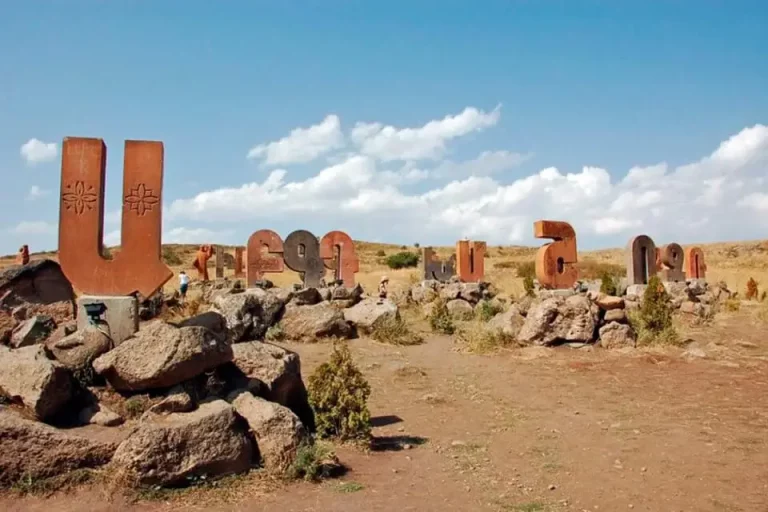
If you’d prefer to combine the Opera with sights outside the central core in the same day — Tsitsernakaberd, the Armenian Alphabet Monument, or the Aragatsotn landmarks — arranging a private car with driver in Yerevan keeps the day on schedule and ends it back in town in time for a 7 p.m. curtain.
Around Freedom Square
- Swan Lake & cafés — directly behind the building; winter ice rink
- Statues of Tumanyan and Spendiaryan — on the square itself, both installed 1957
- Northern Avenue — pedestrian boulevard running south to Republic Square
- Yerevan Cascade & Cafesjian Center — five minutes’ walk north, at the head of Tamanyan Street
- Republic Square — the other Tamanyan ensemble, ten minutes’ walk south
- Matenadaran — at the top of Mashtots Avenue, the institute of ancient Armenian manuscripts