
Yerevan Cascade
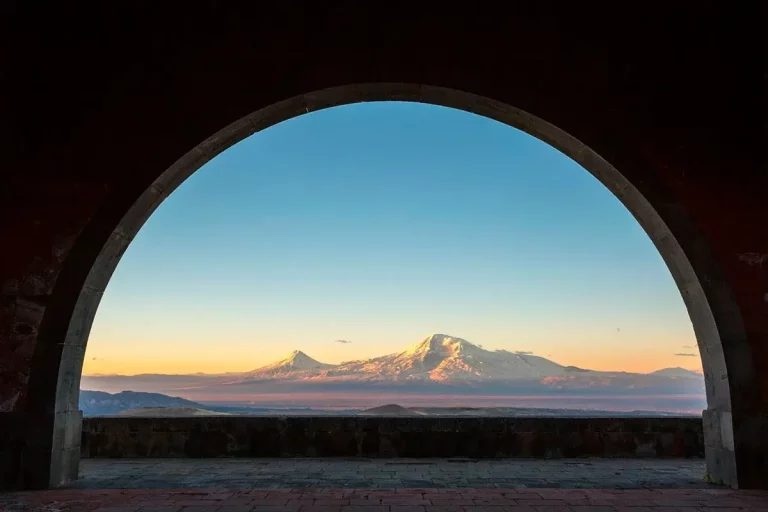
The Yerevan Cascade is a monumental staircase in the centre of Yerevan and one of the most recognisable landmarks of the Armenian capital. A multi-level complex of white travertine rises up a hillside, linking the lower city with the upper districts, and ends at terraces that open onto sweeping views of Yerevan and Mount Arara
Quick Facts
- Built / Founded: 1971; reconstruction 2002–2009
- Architects: Jim Torosyan, Sargis Gurzadyan, Aslan Mkhitaryan
- Location: Yerevan
- Also known as: Cascade, Կասկադ, Big Cascade, Cafesjian Center for the Arts
- Entrance fee: Outdoor sections free, open 24/7
- GPS coordinates:
40.1895, 44.5154
History of the Cascade
The idea for such a structure goes back to the master plan for Yerevan drawn up by Alexander Tamanyan in the 1920s. The Cascade was meant to complete the “northern axis” of the city, a continuous line of squares, parks and public buildings running from south to north. The plan, however, was considered too ambitious at the time, and the project stayed on paper for nearly fifty years.
In the 1970s the chief architect of Yerevan, Jim Torosyan, returned to Tamanyan’s idea together with Sargis Gurzadyan and Aslan Mkhitaryan. Construction began in 1980, but the 1988 Spitak earthquake, the collapse of the Soviet Union and the economic crisis of the 1990s left the upper section unfinished, and the rest of the complex slowly fell into disrepair.
The Cascade got a second life in the early 2000s. Armenian-American philanthropist Gerard Cafesjian financed a large-scale restoration from 2002 to 2009 and turned the interior into a modern art museum. The complex visitors see today — restored steps, working fountains, sculpture gardens and the Cafesjian Center for the Arts opened in November 2009 — is the result of that reconstruction.
How many steps does the Yerevan Cascade have?
The outdoor staircase of the Cascade has 572 steps, divided across five main terraces with fountains and sculptures. Climbing the full length covers about 302 metres horizontally and roughly 118 metres of elevation gain from the foot of the complex to the upper Monumental Terrace. Different sources occasionally cite slightly different counts (around 555–572) because the side flights and the central staircase are not identical, but 572 is the figure commonly given for the main route up.
If you do not feel like climbing, an interior escalator runs the full height of the complex and stops on every level — so reaching the top viewpoint is possible without walking a single step.
Architecture and materials
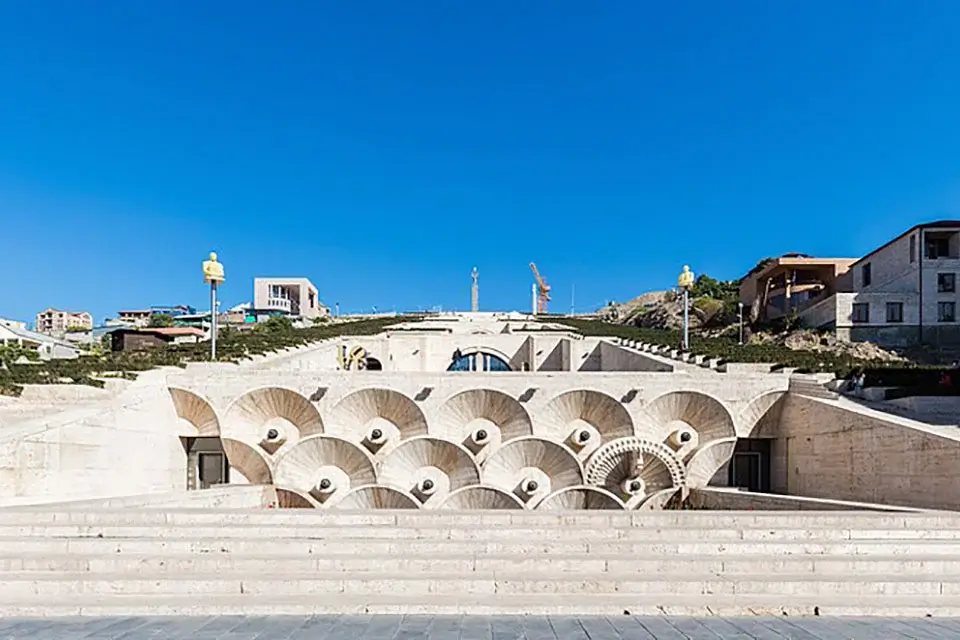
The Cascade is faced with white travertine and combines Soviet modernism with traditional Armenian stone decoration — carved ornaments, vine and pomegranate motifs and reliefs in the spirit of khachkars (Armenian cross-stones). Guidebooks sometimes describe its style as Art Deco, but it is more accurate to read it as a fusion of late Soviet modernism with the national tradition of architectural carving.
The complex stretches about 302 metres in length and 50 metres in width and is built into a steep hillside, which is what gives the staircase its characteristic terraced shape. At the foot of the Cascade stands a monument to Alexander Tamanyan himself — a 1974 work by sculptor Artashes Hovsepyan and architect Seda Petrosyan, showing the architect leaning over a stone slab.
Inside the Cascade: the Cafesjian Center for the Arts
Beneath the outdoor staircase, hidden inside the structure, is the Cafesjian Center for the Arts (CCA) — a contemporary art museum that opened in 2009 and is built around the personal collection of Gerard Cafesjian. The interior is laid out as a vertical sequence of halls connected by escalators, so visitors can move between levels without going outside.
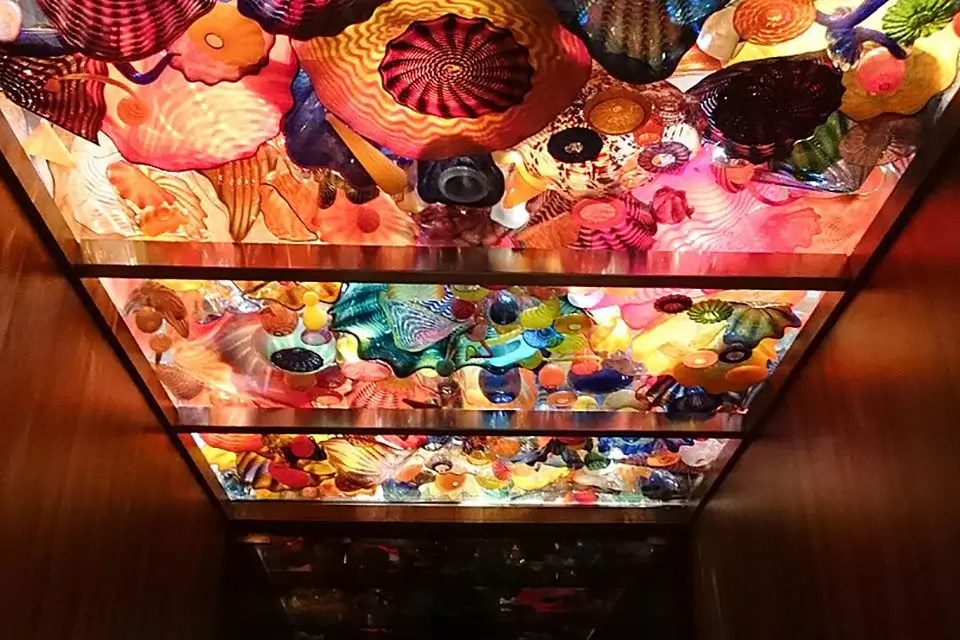
The collection includes one of the world’s largest holdings of contemporary glass art, with works by Czech masters Stanislav Libenský and Jaroslava Brychtová, as well as pieces by Dale Chihuly and other international artists. Recognisable individual works on the terraces and inside the galleries include the iconic red “Bocca” lips sofa and large bronze figures by Fernando Botero. In practice the whole complex functions as an open-air museum: even those who never enter the indoor halls pass dozens of sculptures on the way up.
Sculpture garden and Botero’s Cat
At the foot of the Cascade lies the Cafesjian Sculpture Garden, a long landscaped promenade with sculptures by internationally recognised artists — among them Fernando Botero, Lynn Chadwick, Jaume Plensa, Barry Flanagan and Joana Vasconcelos. The most photographed piece is Botero’s heavy bronze Cat, which has become an unofficial symbol of the Cascade and a near-mandatory stop for visitors with a camera. Around it stand other Botero works, including the “Roman Warrior” and “Woman Smoking a Cigarette”.
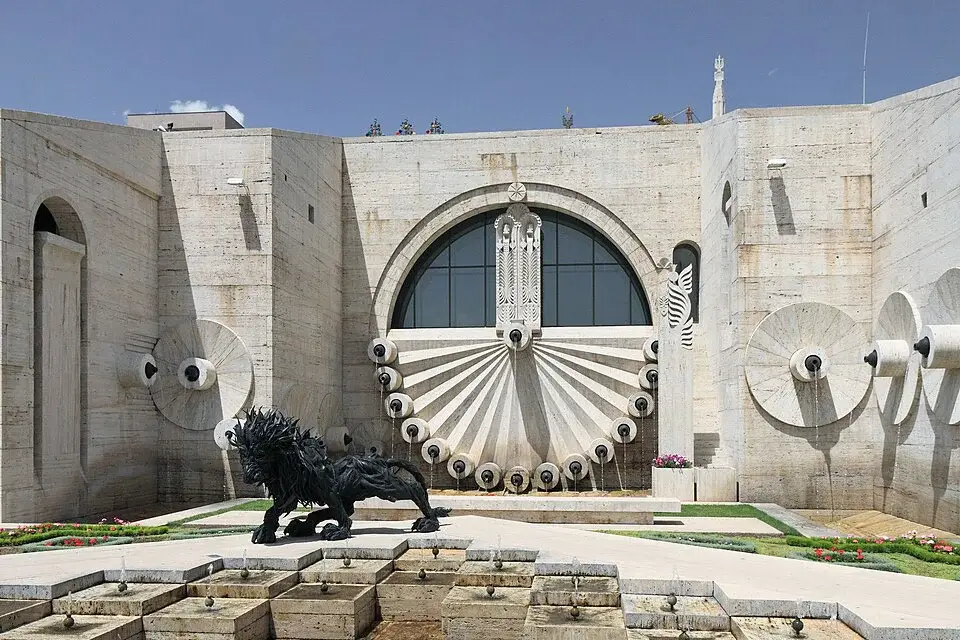
The garden is free, open day and night and lined with cafés and restaurants — a popular meeting point for locals in the evening.
Views from the top: Yerevan and Mount Ararat
The main reason most travellers climb the Cascade is the view. From the upper terraces a panorama opens over the centre of Yerevan, and in clear weather the snow-capped summit of Mount Ararat rises on the horizon to the south. The best light tends to fall at sunset and in the first hour after dark, when the city switches on its lights and the Cascade itself is illuminated.
Climbing the open staircase is free of charge, and many visitors come specifically for photographs at golden hour.
How to get to the Cascade
The Cascade sits in the very centre of Yerevan, on Tamanyan Street, just behind the Yerevan Opera Theatre. From Republic Square it is roughly a twenty-minute walk north through the city centre, passing the opera house on the way. The nearest metro station is Marshal Baghramyan.
If you would prefer to combine the Cascade with other central Yerevan landmarks without rushing, this is easy to arrange as part of an individual tour with a driver-guide who can also include the Garni Temple and Geghard Monastery day trip from the city.
Practical information
The outdoor staircase and the park at the foot of the complex are open around the clock and free of charge. A few details worth keeping in mind:
- The interior escalator gallery runs daily from 8:00 to 20:00.
- The indoor exhibition halls, museum shop and visitor centre of the Cafesjian Center are usually open Friday, Saturday and Sunday from 10:00 to 20:00; admission to the galleries is free. Hours are sometimes extended in spring and summer, and the centre may be closed on public holidays.
- For a relaxed visit, set aside roughly 1.5 to 2 hours, especially if you plan to go inside the galleries and walk up rather than take the escalator
Frequently asked questions
The Yerevan Cascade is a staircase, a viewpoint, a sculpture park and a museum all at once. It is worth the climb for the views of Yerevan and Mount Ararat — and just as much for the chance to see one of the most distinctive symbols of the modern Armenian capital up close.