
Tsitsernakaberd
Tsitsernakaberd is Armenia’s official memorial to the victims of the Armenian Genocide of 1915–1923, the systematic destruction of the Armenian population of the Ottoman Empire. The complex stands on the hill of the same name above the Hrazdan River gorge in western Yerevan, and its 44-metre stele is visible from many points across the city. The hill’s name, Tsitsernakaberd, translates from Armenian as “the Citadel of Swallows” — after an ancient fortress that once stood here, and the swallows associated with it in pre-Christian Armenian folklore.
The memorial is widely recognised as one of the most important monumental works of late-Soviet Armenian architecture. In 2014 Forbes magazine included the Armenian Genocide Museum-Institute, which adjoins it, on a list of nine memorial museums everyone should visit.
Quick Facts
- Built / Founded: 1967 (memorial); 1995 (Museum-Institute)
- Architects: Artur Tarkhanyan, Sashur Kalashyan, artist Hovhannes Khachatryan
- Location: Yerevan
- Also known as: Ծիծեռնակաբերդ, Armenian Genocide Memorial Complex, Memorial of Armenian Genocide victims
- Entrance fee: Free
- GPS coordinates:
40.1857877, 44.4904934
The Hill: “Citadel of Swallows”
The name predates the memorial by centuries. Tsitsernakaberd (“citadel of swallows”) was an Iron-Age fortress on this hill, fragments of which can still be traced. Local tradition connects the name to a legend from Armenian pre-Christian mythology, in which the swallows of the hill carried messages between the pagan gods Vahagn and Astghik — deities of fire and beauty who reappear at several other sites in Armenia, including the waterfalls of Khosrov Forest Reserve.
The 1967 architects chose the site deliberately. The hill rises above the Hrazdan gorge on the western edge of Yerevan, isolated from the city’s everyday street life — a place the visitor reaches by setting time aside. The approach is a long landscaped alley; the memorial only becomes fully visible at the end of the walk.
The Architecture: A Three-Part Memorial
The 4,500-square-metre complex is composed of three distinct architectural elements, designed as a single sequence to be walked through rather than viewed from one point.
The “Reborn Armenia” memorial column is the 44-metre stele that dominates the skyline. It is split vertically along its length into two unequal sections — a deliberate architectural statement. The smaller, separated portion stands for the part of historic Armenia lost in 1915; the larger, taller portion stands for the surviving Armenian nation, rising again.
The Sanctuary of Eternity is the heart of the complex: a circle of twelve inclined basalt slabs, each about 9 metres tall on the inside and 7 metres on the outside, leaning inward to form a partial cone over a single eternal flame in the centre. The number twelve is read by most visitors as a reference to the twelve historic provinces of Western Armenia that were lost; the architects themselves spoke about it in terms of geometric proportion, but the popular reading has long since become canonical. The descent into the sanctuary requires visitors to lower their heads — a physical act of bowing.
The Memorial Wall is a 100-metre stone wall running along the alley to the memorial. Along its face are carved the names of cities, towns, and villages of the Ottoman Empire where massacres and deportations of Armenians took place — from Trebizond on the Black Sea to Diyarbakır in the southeast.
Since 1996, the rear face of the Memorial Wall has been used to honour those who spoke out against the Genocide while it was happening or in its immediate aftermath. Soil from their graves is interred in plates set into the wall: among them the German Protestant theologian Johannes Lepsius, the Austrian writer Franz Werfel (author of The Forty Days of Musa Dagh), the German poet and photographer Armin T. Wegner, the American ambassador to the Ottoman Empire Henry Morgenthau Sr., the Norwegian explorer Fridtjof Nansen (later the League of Nations’ High Commissioner for Refugees), and the French novelist and Nobel laureate Anatole France, along with several missionaries who worked with Armenian orphans.
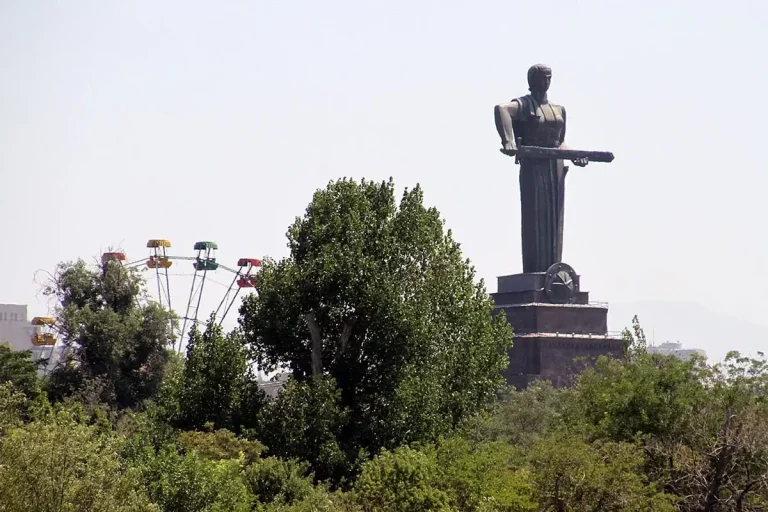
The complex was further enlarged in 2002 with a separate memorial column commemorating France’s parliamentary recognition of the Armenian Genocide, and with the sculpture “Mother Rising from the Ashes” by Rustam Avetisyan.
From Demonstrations to Monument: 1965–1967
The official Soviet line for most of the 20th century treated the events of 1915 as a forbidden subject. The memorial exists because of an unusual moment of public pressure during the Soviet period — and a measured Soviet response that itself surprised contemporaries.
On 24 April 1965, the 50th anniversary of the start of the deportations, around 100,000 Armenians demonstrated in Yerevan. Banners called for international recognition and for a permanent memorial. The demonstration was the largest unsanctioned political gathering in the Soviet Union since the Stalin era, and the Armenian Communist Party leadership — under First Secretary Yakov Zarobyan — chose to acknowledge it rather than suppress it. A formal request was submitted to Moscow, which approved the project.
A design competition followed. The winning entry came from architects Artur Tarkhanyan and Sashur Kalashyan, working with the artist Hovhannes Khachatryan. Construction was carried out over 1966–1967 on the previously undeveloped Tsitsernakaberd hill. The complex was inaugurated on 29 November 1967, the 47th anniversary of Soviet Armenia.
Since 1968, 24 April has been observed annually as Armenian Genocide Remembrance Day. Tens of thousands gather at the memorial each year — from across Armenia and from the Armenian diaspora — to lay flowers at the eternal flame.
The Genocide Museum-Institute
In 1995, on the 80th anniversary of the events of 1915, the Armenian Genocide Museum-Institute opened in a separate building at the southern end of the complex. The architects — Sashur Kalashyan, Lyudmila Mkrtchyan, and sculptor Ferdinand Arakelyan — placed almost the entire structure underground: the visitor descends into the museum, a deliberate symbolic act mirroring the descent into the Sanctuary of Eternity.
The museum covers about 2,000 m² across two levels. The lower (subterranean) level houses a library, document archive, conference hall, and the institute’s research centre; the upper level holds the permanent exhibition — documents, maps, photographs, eyewitness testimony, and personal effects. Among the photographic material are the famous images by Armin T. Wegner, the German officer who documented the deportations at personal risk and whose archive remains one of the most important visual records of the events.
The Museum-Institute is not only a memorial space but also an active research centre. It publishes the academic International Journal of Armenian Genocide Studies and is closely connected with the historiography of the term genocide itself — coined in 1944 by the Polish-Jewish lawyer Raphael Lemkin, who explicitly cited the Armenian case as the primary inspiration for the concept.
The museum is open Tuesday through Sunday (typically closed Mondays); entry is free. Opening hours and any temporary closures are best confirmed on the day of visit.
Visiting the Complex
Tsitsernakaberd is a place of mourning. Most international visitors find that 30–40 minutes on the memorial itself, followed by about 90 minutes at the museum, is the right rhythm — about two hours in total.
A few things to know before you go:
- The site is solemn. Visitors are expected to keep their voices low, particularly inside the Sanctuary of Eternity around the eternal flame.
- Photographs are permitted outdoors. Inside the museum, photography rules are signposted at the entrance; certain exhibits may not be photographed.
- 24 April brings tens of thousands of pilgrims to the site. The complex remains accessible to international visitors that day, but the area is extremely crowded and access roads are tightly controlled. Most visitors choose a different day if their schedule allows.
- Dress is informal but respectful — shoulders covered, no swimwear or beachwear; the same standards that apply at any major Armenian church or monument.
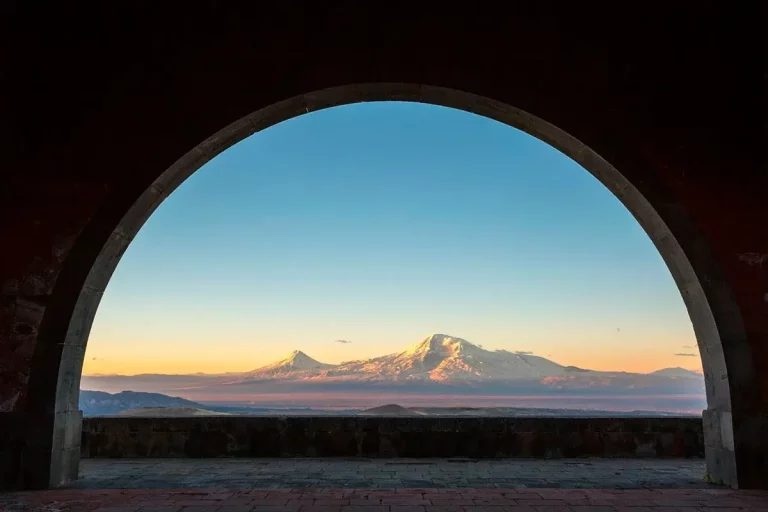
- Views. From the platform around the stele, much of central Yerevan and the Hrazdan gorge is visible, with Mount Ararat on the southern horizon on clear days.
How to Get There
Tsitsernakaberd stands on a hill in western Yerevan, on the far side of the Hrazdan River gorge from the city centre, beside the Karen Demirchyan Sports and Concerts Complex. The drive from the central Republic Square takes about 15 minutes by car.
There is no direct public-transport route to the top of the hill. From the city centre, the practical options are a taxi (a short ride, typically 1,500–2,500 AMD) or a private car with driver in Yerevan if Tsitsernakaberd is part of a longer Yerevan day. A long landscaped alley leads from the parking area up to the memorial — walkable in 5–10 minutes, gentle gradient.
The complex itself sits within the broader category of architectural landmarks in Yerevan, which most visitors combine in a single full day.