

Tatev Monastery
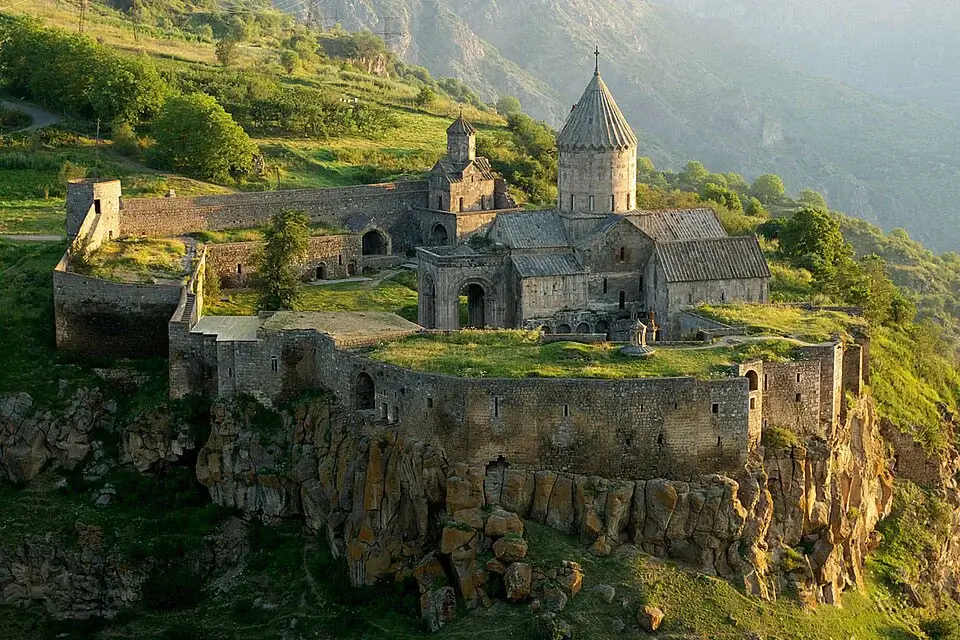
Tatev Monastery is one of the most spectacular sites in Armenia — a 9th-century fortified monastic complex perched on the edge of a sheer cliff above the Vorotan Gorge, in the country’s far southern Syunik Province. Founded in 895 AD, Tatev rose to become the seat of the medieval Tatev University, one of the most important centres of theology and manuscript art in the Armenian world. Today it is best known for two things: its dramatic clifftop location, and the Wings of Tatev — a 5.7-kilometre cable car that holds the Guinness World Record as the longest reversible aerial tramway built in a single section. Tatev is about 250 km from Yerevan and is generally visited as an overnight trip via the town of Goris rather than a same-day excursion.
Quick Facts
- Built / Founded: 895 AD (main church consecrated 906)
- Location: Tatev village, Syunik Province
- Also known as: Tatev, Tatevi Vank, Apostolic Tatev Monastery, Տաթևի վանք
- From Yerevan: About 250 km / 4 hours (overnight in Goris recommended)
- Entrance fee: Free (monastery); Wings of Tatev cable car ~6,500 AMD one-way / 9,000 AMD round-trip
- Time needed: 2–3 hours at monastery (full day trip from Yerevan; overnight recommended)
- Best time to visit: April–October; avoid Mondays (cable car closed)
- Status: Medieval Armenian monastic complex
- GPS coordinates:
39.378889, 46.250556
History — From the 9th Century to Today
A monastic community has existed on the Tatev plateau since at least the 4th century, but the present complex dates from the late 9th. The main church, Surb Poghos-Petros (Holy Apostles Peter and Paul), was begun in 895 AD and consecrated in 906, with the dedication attended by King Smbat I Bagratuni and several catholicoses of the Armenian Church. The completed monastery quickly became the religious and administrative centre of the Syunik principality.
In 1170, Seljuk Turkish forces raided Syunik. The attack devastated Tatev: the library was burned, more than 10,000 manuscripts were lost, and many monks were killed. The monastery entered a century of decline.
Revival came under the Orbelian princes. From 1261, princes Smbat and Tarsaich Orbelian rebuilt the complex, reorganised the monastic community, and re-established Tatev as a regional powerhouse. By the early 14th century the monastery was wealthier and more influential than at any earlier point in its history.
The next major blow was a 1931 earthquake, which collapsed the bell tower and damaged several structures. Restoration work has been ongoing ever since, with major investment from the Tatev Revival programme launched in 2008 by the philanthropist Ruben Vardanyan, which also built the cable car.
The Wings of Tatev — World’s Longest Reversible Cable Car
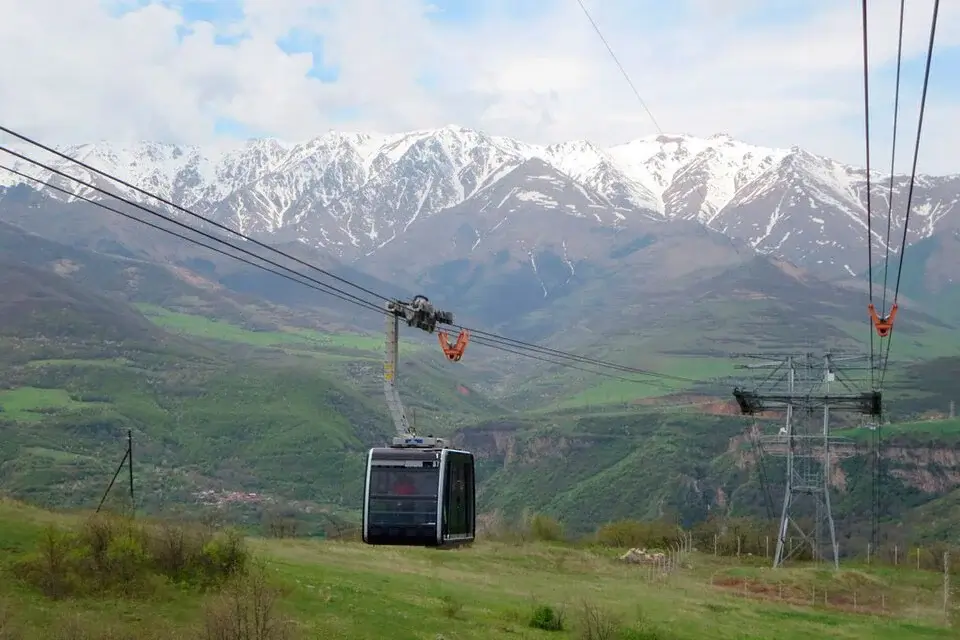
For most modern visitors, the experience of reaching Tatev begins with the Wings of Tatev (Tatevi Tever) — a 5,752-metre aerial tramway connecting the village of Halidzor with the monastery plateau across the Vorotan Gorge. It opened on 16 October 2010 and was entered into the Guinness World Records just a week later as the longest reversible aerial tramway built in a single section, with no intermediate stops.
A few key numbers:
- Length: 5,752 m (3.57 miles)
- One-way ride: 12 minutes
- Maximum height above the gorge: 320 m
- Cabin capacity: 30 passengers per cabin, 240 per hour total
- Speed: up to 37 km/h
- Built by: Doppelmayr/Garaventa (Austria/Switzerland)
- Awards: “World’s Leading Cable Car” at the World Travel Awards in 2021, 2023 and 2024
The cable car operates as a non-profit project: all revenue funds the ongoing restoration of Tatev Monastery and economic development programmes in the surrounding villages of Syunik.
The ride itself is the main attraction. The final 2.7 km of the line crosses high above the Vorotan River, with the monastery appearing on its cliff edge as the cabin approaches. The same trip by road takes about 40 minutes over hairpin turns; the cable car covers it in 12 minutes with one of the most dramatic views in the country.
Operating hours: typically 09:00 or 10:00 to 18:00, with the last cabins running back from Tatev around an hour before closing. Important: the cable car does not run on Mondays for maintenance. If you only have a Monday available, plan to drive the longer mountain road from Halidzor to Tatev. Tickets: roughly 6,500 AMD one-way and 9,000 AMD round-trip in current pricing. Online purchase is available at the official site.
Architecture and the Swinging Pillar (Gavazan)
The monastery complex is built on a triangular plateau at the edge of the cliff, surrounded by fortified walls that integrate seamlessly with the natural rock face. The most important structures are:
- Surb Poghos-Petros Church (906 AD) — the central and largest building, a cruciform plan with a tall dome drum. Inside, fragments of medieval frescoes survive.
- Surb Astvatsatsin Church (11th century) — a smaller church to the north, partly damaged in the 1931 earthquake and since reconstructed.
- Surb Grigor Lusavorich Chapel (1138) — a small chapel rebuilt several times.
- Library and scriptorium — where the manuscript work of the medieval university was carried out.
- Medieval oil press — an underground workshop with a stone wheel and basin system, where olive and linseed oil were produced. Now displayed as a small museum.
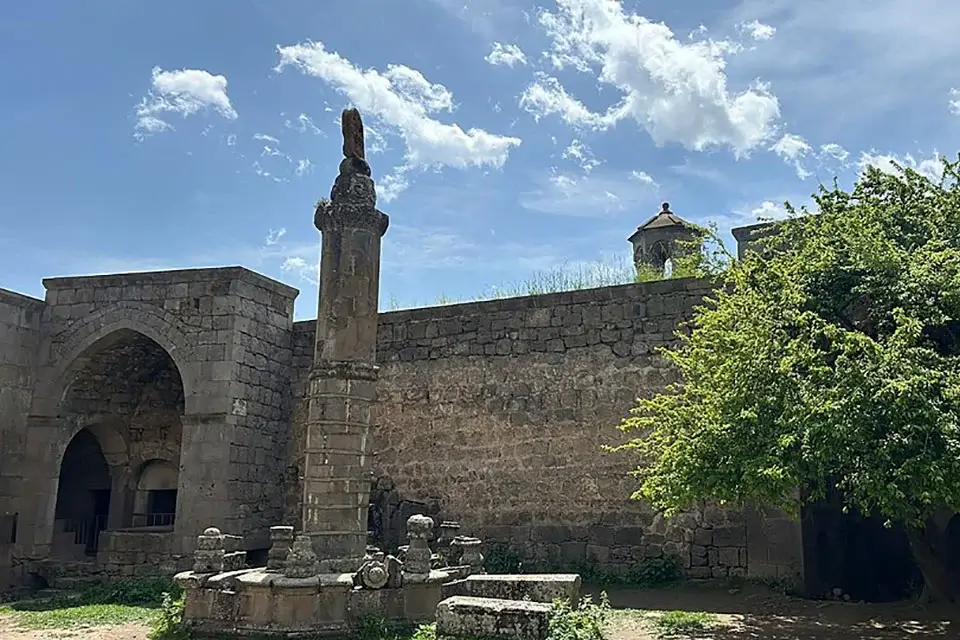
The most remarkable single feature is the Gavazan (“pillar”) — an 8-metre stone column erected in 906 AD in the courtyard, dedicated to the Holy Trinity. The Gavazan stands on a flexible stone hinge that allows it to sway during earthquakes instead of collapsing. Centuries before modern earthquake engineering, Armenian builders solved a structural problem using mechanical empathy with the rock itself. The pillar still stands today.
Medieval Learning at Tatev — The Lost University
In the 14th and 15th centuries, Tatev became the home of the most important university in medieval Armenia. Tatev University was led by two of the great Armenian scholars of the period:
- Hovhan Vorotnetsi (1315–1386) — theologian, manuscript illuminator, founder.
- Grigor Tatevatsi (1346–1409) — his successor, philosopher and saint of the Armenian Church.
The university trained generations of theologians, philosophers, manuscript painters and scribes. It was closely linked to other Armenian centres of learning, including Gladzor University and Noravank’s Upper Noravank School. At its peak in the late 14th century, the community at Tatev included around 500 monks and lay scholars.
The university declined under the Timurid invasions at the end of the 14th century and ended in the 15th, but its scholarly output — manuscripts, theological treatises, illuminated gospels — shaped Armenian intellectual life for centuries afterward.
How to Get to Tatev from Yerevan
Tatev is about 250 km south of Yerevan in Syunik Province, near the town of Goris. There are several practical options, but be realistic about timing: a day trip from Yerevan means at least 8 hours on the road plus the visit itself.
By private car with driver (overnight recommended). The most flexible option, especially for the southern Armenia route. We provide private cars and drivers in Yerevan for multi-day southern itineraries, typically combining Tatev with Khor Virap, Noravank, Areni, Goris and Khndzoresk on a 2-day route with an overnight in Goris.
By private car with driver (one-day marathon). Possible but long: leave Yerevan by 06:00, arrive at Halidzor around 10:00, take the cable car to Tatev, spend 2–3 hours on site, return to Halidzor and drive back to Yerevan, arriving around 21:00. Tiring but doable.
By marshrutka and local driver. Take a marshrutka from Yerevan’s Sasuntsi Davit area to Goris (4–5 hours, around 3,500 AMD). Stay overnight in Goris. From Goris, hire a local driver to take you to Halidzor cable car station (about 25 km, 3,000–5,000 AMD), wait while you visit, and return.
By organised tour. Group tours from Yerevan to Tatev are widely available as either 1-day marathons or 2-day overnight tours via Goris. Multi-day southern tours often include Khor Virap, Noravank, Areni, Tatev and Khndzoresk in one itinerary.
Practical Tips for Visiting
- Opening hours: the monastery grounds are generally open daily from 09:00 to 18:00. There is no formal access control.
- Entrance fee: free for the monastery itself. The cable car is the main cost.
- Cable car: roughly 6,500 AMD one-way / 9,000 AMD round-trip. Closed on Mondays. Book online during high season — the last cabins fill quickly.
- Time needed: plan 2–3 hours on the monastery plateau, plus 12 minutes each way on the cable car, plus driving.
- Dress code: modest dress for the churches — cover shoulders and knees.
- Weather: Tatev sits at around 1,500 m elevation. Even in summer the wind on the plateau can be sharp. Bring a layer.
- Food: the Tatevatun restaurant near Halidzor station and small food stands near the Tatev station offer simple Armenian dishes. For better food, eat in Goris.
- Best time of day: mornings have clearer light and shorter cable-car queues. Late afternoon is dramatic for photography but the queue going back can get long in summer.
- Best season: April–October. November–March is possible but expect cold winds on the plateau and occasional service interruptions.
FAQ
See more places in our full guide to things to do in Armenia — including Khor Virap, Noravank, Garni Temple, Geghard Monastery, Lake Sevan and other top destinations.


