

Yerevan
Yerevan is the capital and largest city of Armenia, with a history that begins with the Urartian fortress of Erebuni, founded in 782 BC. Today it is the country’s main cultural and travel hub, home to Republic Square, the Cascade, Matenadaran, Tsitsernakaberd, Erebuni Fortress, museums, markets and lively pedestrian streets.
Most attractions in central Yerevan can be explored on foot, while more distant sights are easy to reach by car or taxi. The city is also the main base for trips around Armenia, with Garni, Lake Sevan, Mount Aragats, Dilijan and many other destinations accessible on day trips from the capital.
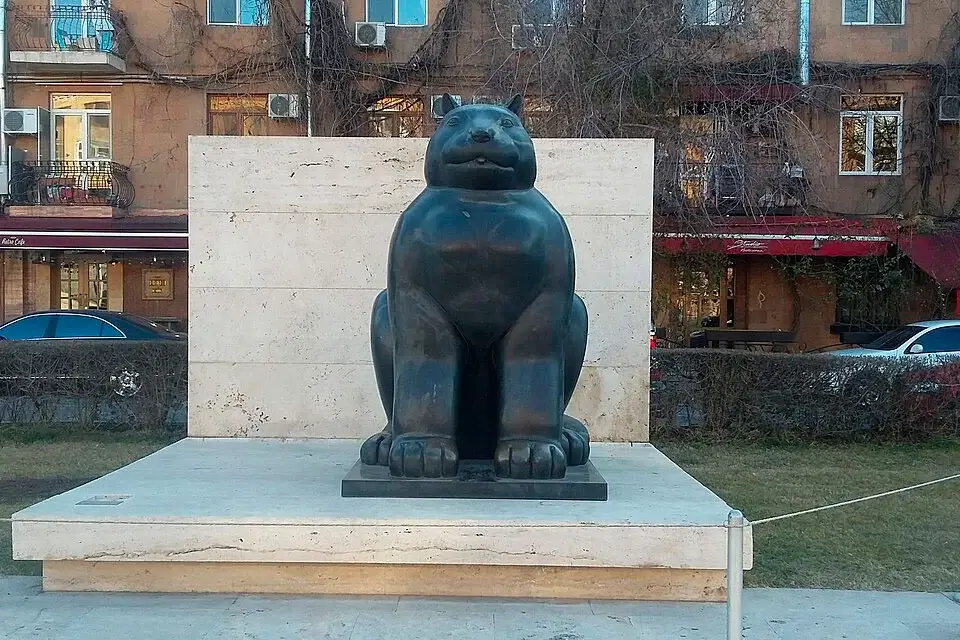
- 📍 Location: Ararat Valley, Armenia
- 🏛 Status: Capital of Armenia since 1918
- 📅 Founded: 782 BC — Erebuni Fortress
- 👥 Population: about 1.1 million
- ⛰ Elevation: roughly 900–1,300 m
- ✈ Airport: Zvartnots International Airport (EVN)
- ⏱ Time needed: 1–3 days
- 🌸 Best time: April–June and September–October
What to See in Yerevan
Yerevan combines ancient history, museums, monumental architecture, parks, viewpoints and lively public spaces. The guides below cover the main attractions to include in a first visit to Armenia’s capital.
 Blue Mosque in Yerevan
 Erebuni Fortress
 Kond District in Yerevan
 Matenadaran
 Northern Avenue in Yerevan
 Republic Square
 Tsitsernakaberd
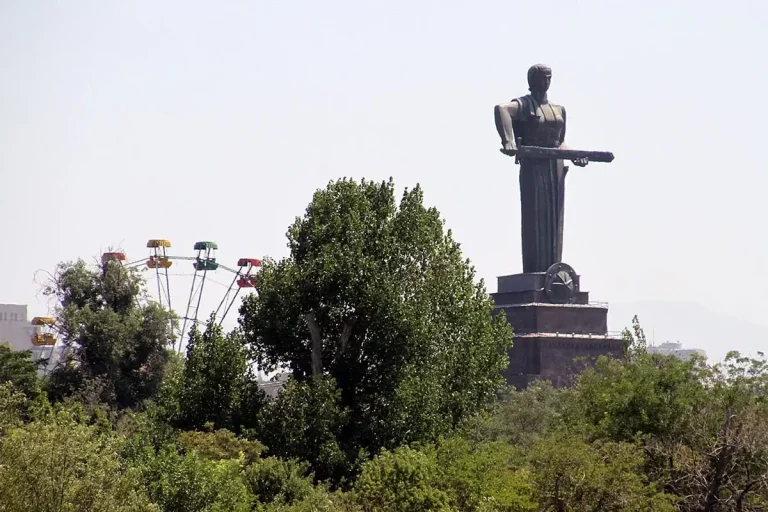 Victory Park in Yerevan
 Yerevan Cascade
 Yerevan Opera Theatre
Geography and climate
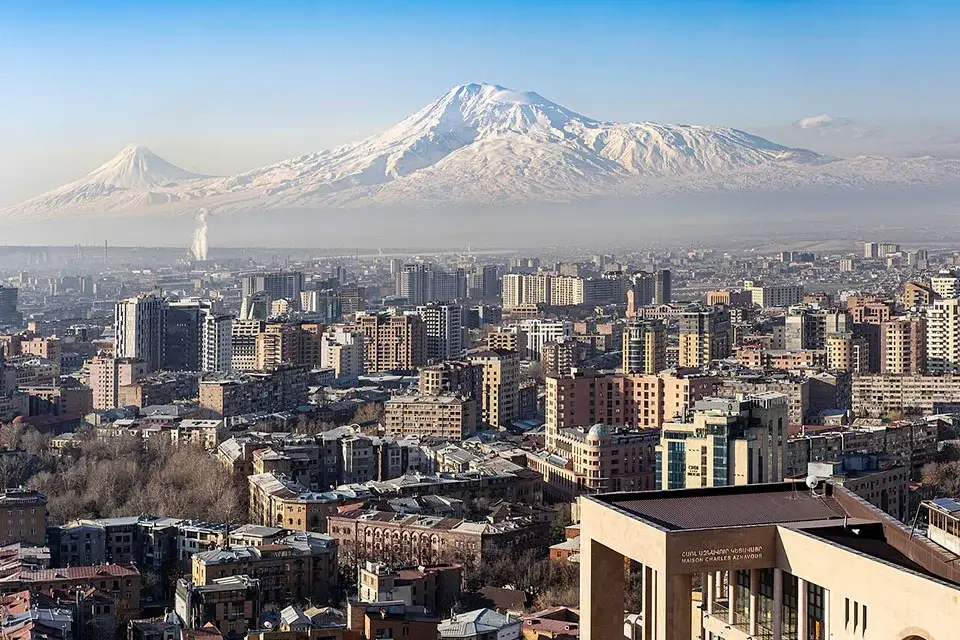
Yerevan lies in the northeastern Ararat Valley — a fertile plain enclosed by mountains. Volcanic uplands rise to the north, the Geghama Range to the east, and Mount Ararat (5,137 m) dominates the western horizon across the Turkish border. The Hrazdan River cuts through the city in a picturesque gorge, and the elevation change within municipal limits reaches 400 metres — some neighbourhoods sit in the valley floor, others on hillsides.
The climate is sharply continental. Summers are hot and dry (average July around +26 °C, peaks touching +40 °C); winters are relatively mild (average January –4 to –5 °C). Precipitation is modest at roughly 350 mm per year, and Yerevan enjoys more than 325 sunny days — one of the sunniest capitals in the region. That same climate is why the Ararat Valley grows the apricots, grapes, and peaches that end up in Armenian brandy and fruit wines.
From Erebuni to Yerevan — a brief history
In 782 BC, King Argishti I of Urartu ordered a fortress built on the hill of Arin Berd in the southeastern edge of what is now Yerevan. He named it Erebuni. A cuneiform inscription on basalt — often called the city’s “birth certificate” — records the founding: “By the greatness of the god Khaldi, Argishti, son of Menua, built this mighty stronghold and called it Erebuni…” The tablet is displayed in the Erebuni Museum, and it makes Yerevan one of the very few world cities with an exact recorded founding date.
The name Erebuni shifted gradually through Erevuni to Erevan and finally Yerevan — the Urartian b transitioning to Armenian v. In Russian and European sources up to 1936, the city was called Erivan.
Over the following two millennia Yerevan passed through Persian, Arab, Mongol, Safavid, and Ottoman hands. Between the 16th and 18th centuries the Erivan Fortress changed rulers 14 times during the Persian-Turkish wars. In 1828, following the Treaty of Turkmenchay, it entered the Russian Empire, and at the start of the 20th century it was still a quiet provincial town of about 30,000 people.
Everything changed in 1918, when Yerevan became the capital of the First Republic of Armenia. In the 1920s the visionary architect Alexander Tamanyan designed a radial-ring master plan — the Yerevan you see today, with Republic Square at its heart and boulevards fanning outward, follows his blueprint. Under Soviet Armenia the city grew explosively, and by the late 1980s it had passed a million residents.
More Places to Explore in Yerevan
Beyond the main landmarks, Yerevan has several places worth adding if you have more time. Kond preserves narrow lanes and fragments of the city’s older urban fabric, while the Blue Mosque offers a very different architectural atmosphere in the centre.
Other worthwhile stops include Saint Gregory the Illuminator Cathedral, the Ararat Brandy Factory and smaller museums and galleries scattered around Kentron.
Yerevan in One Day
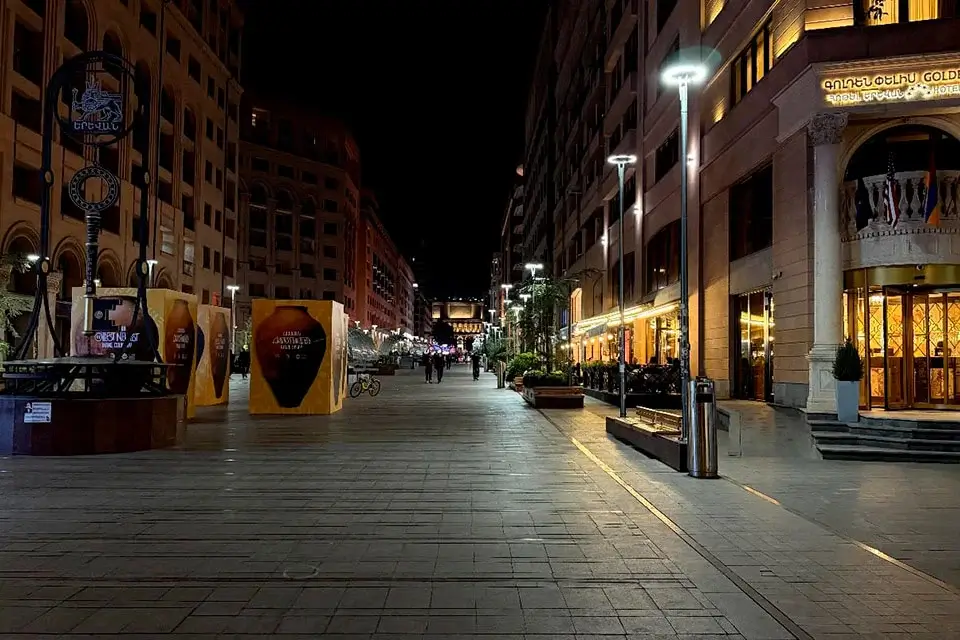
For a first introduction to the city, start at Republic Square and walk along Northern Avenue to the Yerevan Opera Theatre. From there, continue to the Cascade and Matenadaran.
In the afternoon, choose one of the more distant sights such as Victory Park, Tsitsernakaberd or Erebuni Fortress. In the evening, return to the city centre for Republic Square, cafés and a walk through the illuminated streets of Kentron.
If you prefer to cover the main sights without arranging transport between the more distant locations, a private Yerevan city tour combines driving with short walks through the centre.
How to Get from Zvartnots Airport to Yerevan
Zvartnots International Airport (EVN) is about 12 km from central Yerevan. You can reach the city by public transport, taxi or a pre-booked private vehicle.
If you prefer a driver waiting for you on arrival, a confirmed price and direct transport to your hotel or apartment, you can book a Yerevan airport transfer. In normal traffic, the drive to central Yerevan usually takes around 20–30 minutes.
Markets and Shopping in Yerevan
For Armenian crafts, ceramics, jewellery and souvenirs, visit the Vernissage Market near Republic Square. For dried fruit, spices, cheeses, sweets and seasonal produce, GUM Market on Khorenatsi Street is one of the best-known food markets in the city.

Yerevan Vernissage Market
An open-air market in central Yerevan offering Armenian souvenirs, carpets, ceramics, jewellery and handmade crafts.

GUM Market in Yerevan
A covered food market known for dried fruit, spices, Armenian cheeses, sweets and colourful seasonal produce.
Day trips from Yerevan
Yerevan is the natural base for radial trips: every top attraction in Armenia sits within a 2–3-hour drive. The most-booked routes on our roster are all covered as day tours from Yerevan with a private car and English-speaking driver.
Garni Temple + Geghard Monastery + Symphony of Stones — 40 minutes east. Armenia’s only surviving pagan temple (1st century), a UNESCO-listed rock-hewn monastery, and a canyon of natural basalt columns. The most popular half-day route.
Echmiadzin + Zvartnots — 20 minutes west. The spiritual seat of the Armenian Apostolic Church and the ruined 7th-century UNESCO cathedral of Zvartnots. Often paired with the airport on arrival or departure day.
Khor Virap + Noravank + Areni-1 Cave — 1.5 hours south. The monastery with the postcard view of Ararat, a red-cliff canyon monastery, and the cave that holds the world’s oldest known winery (~6,100 years old).
Lake Sevan + Dilijan — 1.5–2 hours north. The largest lake in the Caucasus and Armenia’s forested “Little Switzerland.”
Tatev Monastery via the Wings of Tatev — 4 hours south, a long day but one of the great drives of the Caucasus, riding the world’s longest reversible aerial tramway to a cliff-edge medieval monastery.
For anything more ambitious — Lori’s UNESCO monasteries, the Debed Canyon, or multi-day loops — see private tours across Armenia.
When to visit
Spring (April–May) is the best window. Apricot trees blossom, Ararat still wears its snow cap against green foothills, and daytime temperatures sit comfortably at +15 to +25 °C. Peak wildflower season across the country.
Summer (June–August) is hot: +35 to +40 °C by midday. The city empties as locals head to Sevan, Dilijan, and Tsaghkadzor. If you come now, front-load mornings and evenings with sightseeing and use midday for the air-conditioned museums.
Autumn (September–October) is the second-best window: warm but not scorching (+20 to +28 °C), grape harvest, food festivals, and the golden light that photographers hope for.
Winter (December–February) is cool (–5 to +5 °C) but sunny, and Yerevan looks its best under a snow-capped Ararat. Tourist numbers drop, hotel rates soften, and the city feels particularly local.
Getting Around Yerevan
Central Yerevan is compact and many of the main sights can be reached on foot. Republic Square, Northern Avenue, the Opera Theatre, the Cascade and Matenadaran are all within a walkable part of the city centre.
The Yerevan Metro is useful for several districts, although it does not cover all major tourist attractions. City buses and minibuses operate throughout the capital, while taxis are convenient for places farther from the centre, such as Erebuni Fortress, Tsitsernakaberd and Victory Park.
For a first visit, a combination of walking and short taxi rides is usually the simplest way to explore the city.
Frequently Asked Questions
Yerevan is the launch pad; the country opens out from here. Browse the rest of the cities of Armenia — Dilijan, Gyumri, Vanadzor, Echmiadzin, Goris, Sisian, Stepanavan, Ijevan — or step further afield with things to do in Armenia covering monasteries, lakes, waterfalls, mountains, and canyons.