

Echmiadzin
Echmiadzin (officially Vagharshapat; Armenian: Վաղարշապատ) is Armenia’s spiritual heart — the seat of the Catholicos of All Armenians and the site of the oldest state-built cathedral in the Christian world. It sits on the Ararat Plain in Armavir Province at 853 metres, home to about 57,000 people on 40 km². The town was founded in the 2nd century AD by King Vagharsh I — from whom it took its official name, Vagharshapat, “the city of Vagharsh” — and served as the capital of Greater Armenia from the 2nd to 4th centuries. It has been the country’s religious anchor for the 1,700 years since. From Yerevan it is only 20 kilometres west, a comfortable half-hour drive.
Echmiadzin is Armenia’s Vatican. The Mother Cathedral, built in 303 AD at the request of Gregory the Illuminator, is the oldest cathedral built by any state — predating even the original St. Peter’s basilica in Rome. Around it stand two more 7th-century churches — St. Hripsime and St. Gayane — and, five kilometres east, the remarkable ruins of the Zvartnots rotunda. All four monuments are inscribed together on the UNESCO World Heritage list. The name Echmiadzin means “the Only-Begotten descended” — a reference to the vision in which, tradition says, Christ appeared to Gregory and struck the ground with a golden hammer to mark the site.
What to See in Echmiadzin and Around
Echmiadzin and its surroundings are home to some of Armenia’s most important early Christian monuments. The main places to visit are collected below, with separate detailed guides for planning each stop.
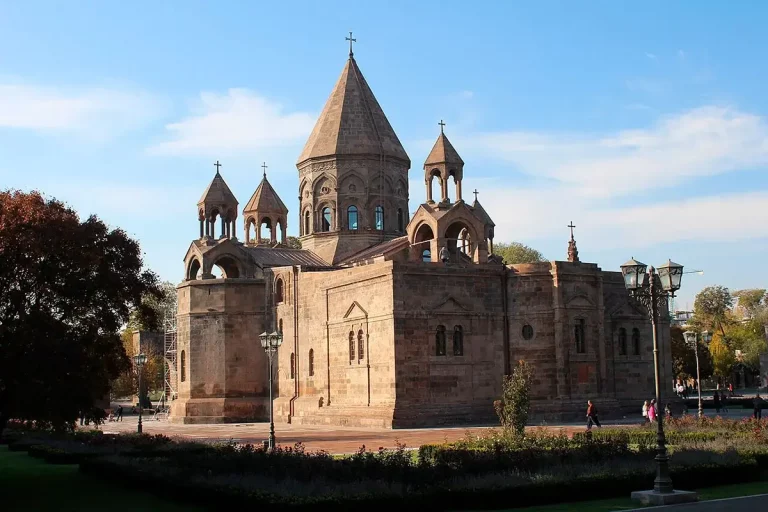


What to see
St. Gayane Church (630 AD, UNESCO) — Just south of the Mother Cathedral. Built in 630 AD on the site of the martyrdom of Saint Gayane, the abbess who led the Christian virgins to Armenia. A three-nave domed basilica, later given a gavit (narthex) in 1683. Below the altar lies a crypt with Gayane’s relics.
St. Hripsime Church (618 AD, UNESCO) — 1.5 km northeast of the Mother Cathedral. Built in 618 AD on the site where Saint Hripsime was martyred — one of a group of Christian virgins who fled Roman persecution and were killed by King Trdat III’s soldiers after refusing to renounce their faith. Their martyrdom is credited with triggering the king’s own later conversion. Hripsime is considered a masterpiece of early Christian Armenian architecture: its cross-in-square composition became the template for centuries of Armenian church-building that followed.
A comfortable half-day route from Yerevan: Yerevan → Echmiadzin (cathedral + Hripsime + Gayane) → Zvartnots → Yerevan. Adding Khor Virap turns it into a full day. Easiest with a car with driver from Yerevan or as a private day tour.
Geography and climate
Echmiadzin sits in the middle of the Ararat Plain, the fertile lowland stretching along the Araks River between the Aragats massif to the north and Mount Ararat (across the Turkish border) to the south. At 853 metres it is significantly lower than Yerevan (990 m) and much lower than the mountain cities of Lori or Syunik. This makes the summer climate genuinely hot — July can exceed +40 °C on the plain. Winters are mild by Armenian standards, with occasional light snow.
The town lies 20 km west of Yerevan on the M-5 highway toward Armavir. Zvartnots International Airport sits roughly halfway between the two — 12 km from Echmiadzin — which makes the town a natural first or last stop for travellers arriving or departing Yerevan by air.
From Vardkesavan to the spiritual capital
Before the 2nd century AD, the site was a small settlement called Vardkesavan. In the 140s AD, King Vagharsh I of the Arsacid dynasty walled it and gave it his name — Vagharshapat. From the 2nd to 4th centuries, the town was the political capital of Greater Armenia.
In 301 AD, Armenia became the first state in the world to adopt Christianity as its official religion — an act driven by King Trdat III and Gregory the Illuminator. Two years later, in 303 AD, the Mother Cathedral was built at Vagharshapat, first as a wooden structure and later rebuilt in stone across the 5th and 7th centuries. According to church tradition, Gregory saw Christ descend in a vision and strike the earth with a golden hammer to mark the site. The cathedral took the name Echmiadzin — “the Only-Begotten descended” — and the name gradually passed to the town itself.
Archaeologists have found a striking detail beneath the cathedral altar: a small crypt containing a ceramic hearth used by fire-worshippers. Before Christianity arrived, a Zoroastrian sanctuary stood on this exact spot. The cathedral, quite literally, was built over the old faith.
The political capital shifted to Dvin in 484 AD, but Echmiadzin remained Armenia’s spiritual centre. The seat of the Catholicos wandered for centuries — moving to Sis in Cilicia during the medieval period — but in 1441 it returned to Echmiadzin, and it has stayed here ever since. During the Soviet period the town was officially renamed Echmiadzin (1945–1995); in 1995 the historic name Vagharshapat was restored, though residents still call it Echmiadzin. The composer Komitas (Soghomon Soghomonyan), the founder of modern Armenian music, was born here in 1869.
Who Echmiadzin suits
- Pilgrims and religious travellers — the Mother See of the Armenian Apostolic Church, the seat of the Catholicos, and reliquaries that (according to tradition) include a fragment of the Holy Lance itself.
- Travellers interested in early Christian architecture — four UNESCO monuments in a small area, ranging from the 4th to 7th centuries, including the prototype for centuries of Armenian church design.
- Anyone based in Yerevan — only 20 minutes from the capital, easily done in half a day. Pair with Zvartnots on the way back.
- Travellers arriving or leaving Yerevan by air — Zvartnots International Airport is 12 km from Echmiadzin. A visit works naturally on the first or last day of a trip, with no detour required.
Best time to visit
Echmiadzin is accessible year-round. The best windows are April–June and September–October, when temperatures on the Ararat Plain are mild.
Summer heat can be intense — July and August often push past +35 °C, occasionally +40 °C — so go early in the morning if you visit in high summer.
24 April (Armenian Genocide Remembrance Day) and major church feast days — especially Easter, Vardavar (Transfiguration, mid-July) and Christmas (6 January in the Armenian calendar) — are special dates when the town fills with pilgrims. Services on these days are worth planning around if you can.
How to get there
Echmiadzin is 20 km from Yerevan, a drive of 20–30 minutes on the M-5 highway toward Armavir. It is one of the most accessible day trips from the capital.
Marshrutkas leave every 10–15 minutes from Kilikia Bus Station on Admiral Isakov Square, cost around 300 AMD, and drop passengers near the cathedral.
Taxis cost around 3,000–4,000 AMD one way. A ride-hail app (Yandex Go, GG) is usually the cheapest option.
Because Zvartnots International Airport lies almost exactly halfway to Yerevan, Echmiadzin is often visited on the first or last day of a trip. The airport transfer requires no detour, and the Zvartnots ruins are directly on the same road.
Frequently Asked Questions
See more on Armenia’s cities or plan the trip with a car with driver from Yerevan.