

Stepanavan Dendropark
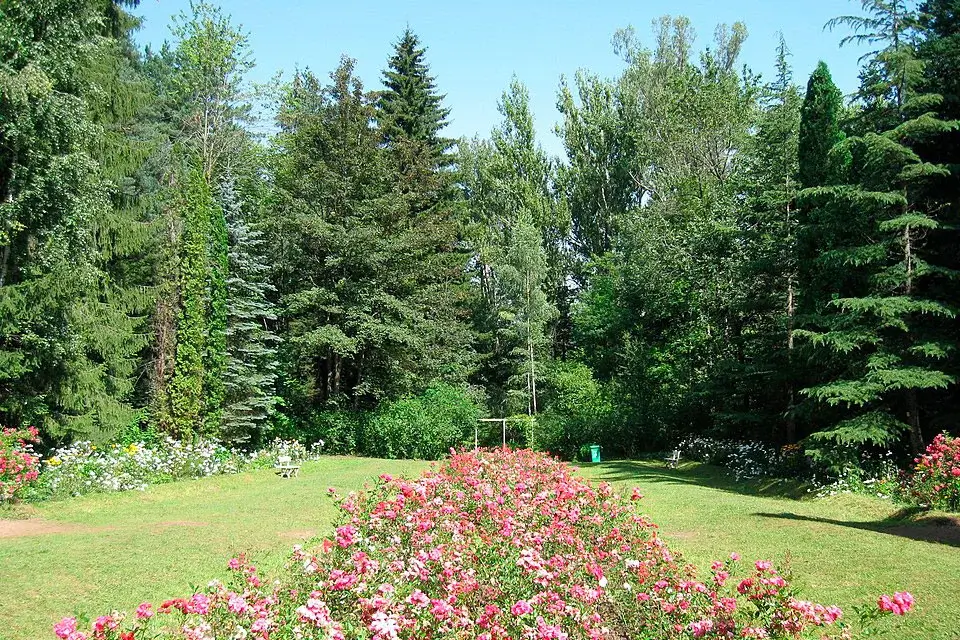
The Stepanavan Dendropark — officially the Sochut Arboretum, named after its founder Edmund Leonowicz — is the oldest and most famous botanical garden in Armenia. Set on the northwest slope of Mount Argasar in Lori Province at 1,450 metres, it’s a living tree collection of around 500 species from across the world, spread over 35 hectares of a Caucasian highland forest. California redwoods stand next to Lebanon cedars, Japanese cryptomerias share a slope with native Caucasian beech, and a Polish forester rests in a grave among the trees he planted ninety years ago. It is, according to its own description, the first place in the Transcaucasus where a natural forest landscape was deliberately reshaped into a forest park — and it remains the best-loved single nature site in Lori.
Quick Facts
- Built / Founded: 1931 (Polish engineer-forester Edmund Leonowicz)
- Location: Gyulagarak village, 12 km from Stepanavan, Lori Province
- Also known as: Sochut Dendropark, Sochut Arboretum, Stepanavan Arboretum, Stepanavan Botanical Garden, Ստեփանավանի դենդրոպարկ
- From Yerevan: 155 km / 2.5–3 hours
- Elevation: 1450 m
- Entrance fee: 500 AMD
- Time needed: 1.5–4 hours on site; pairs with Lori Berd + Armenian Alphabet Monument
- Best time to visit: Late May–early June (pine pollen); September–October (autumn colours)
- Status: Protected area since 1998; arboretum and research site
- GPS coordinates:
40.9374250, 44.4800556
A Note on the Names
The park has several names that are used more or less interchangeably:
- Stepanavan Dendropark — the most common name, used on road signs and most maps. “Dendropark” is a calque of the Russian dendropark — broadly equivalent to “arboretum” in English.
- Sochut Arboretum — the official Armenian name. Sochut (Armenian Սոճուտ) means “pine grove” — a reference to the natural pine forest at the core of the property.
- Sochut Dendropark named after Edmund Leonowicz — the full ceremonial name on the gate.
The park is in Gyulagarak village, 12 kilometres east of the town of Stepanavan, so the “Stepanavan” name technically refers to the nearest town, not the village itself. Don’t confuse it with Ijevan Dendropark — a much smaller forest park in Tavush Province.
History — A Polish Forester’s Century-Long Project
The park was founded in 1931 by Edmund Leonowicz, a Polish engineer-forester who had come to Armenia from interwar Poland and was struck by the country’s flora and forestry potential. What started as a personal experiment in acclimatising trees from around the world to the cool, humid Lori highlands soon became a state-supported scientific project. Leonowicz ran the park for more than fifty years — until 1984, when his son Vitaly took over as director.
When Edmund Leonowicz died in 1986, the Armenian government granted permission for him to be buried inside the park, among the trees he had spent his life raising. His grave is still on the grounds and is one of the visit’s quiet stops.
The site received the status of a reserve in 1958, and a specially protected natural area in 1998. Today the arboretum operates as both a public park and an active research and teaching site — biology students do internships here, and the park is regularly cited as a unique acclimatisation laboratory for the South Caucasus.
What Grows Here — 500 Species Across 35 Hectares
The arboretum’s 35 hectares break down roughly in half: 17.5 hectares of natural Caucasian forest plus 15 hectares of ornamental plantings, with the remainder occupied by lime-tree avenues and wild understory.
Over the past century the park has tested the suitability of approximately 2,500 plant taxa for the local climate. About 500 species survived and now form the living collection — a remarkable hit rate, given the altitude and the harsh Lori winters.
The exotic headliners
- Giant sequoia (Sequoiadendron giganteum) — a small grove of five young trees from California. Considered the park’s prize specimens; the trees will gain serious height over the next two or three centuries.
- Lebanon cedar (Cedrus libani) — the famous Mediterranean conifer
- Himalayan cedar (Cedrus deodara)
- Japanese cryptomeria (Cryptomeria japonica)
- Eastern hemlock (Tsuga canadensis) and Common yew (Taxus baccata)
- European larch (Larix decidua), Algerian fir, Siberian pine (Pinus sibirica)
- Magnolia species, Chinese catalpa, Adam’s needle yucca
The natives
The natural-forest part of the property carries the standard Caucasian highland species: Oriental beech (Fagus orientalis), Caucasian hornbeam (Carpinus caucasica), several oaks (Quercus macranthera, Q. iberica, Q. longipes), three elms (Ulmus elliptica, U. scabra, U. foliacea), and the local Scots pine variant (Pinus sylvestris var. hamata).
Avenues of small-leaved lime (Tilia cordata) cross the grounds, with wild-sourced specimens of walnut (Juglans), apple (Malus), poplar (Populus) and pear (Pyrus). On pears in particular: Armenia is one of the world’s centres of pear diversity, with over 20 known species — several represented in the park.
Most introduced specimens came from the Yerevan Botanical Garden, with later exchanges from the botanic gardens of Tbilisi, Kyiv, Nikitski (Crimea), Leningrad and Moscow — and a few from China, France, Germany and the US.
“The First Forest Park of the Transcaucasus”
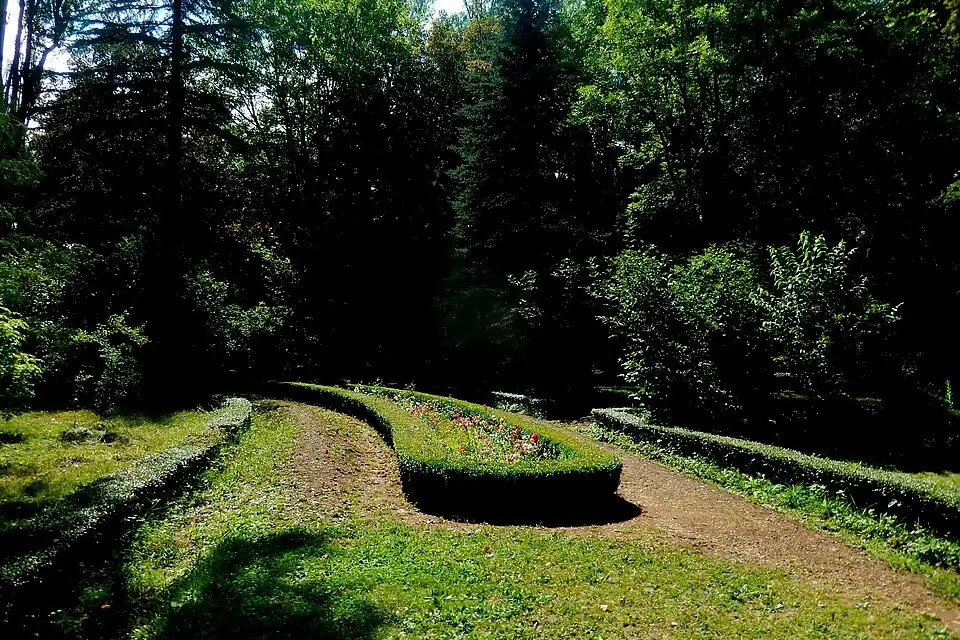
Beyond the species count, Sochut has a quiet historical claim that’s worth dwelling on. According to its own published history (and Wikipedia), the arboretum is regarded as the first place in the South Caucasus where a natural forest landscape was deliberately reshaped into a forest park — paths laid out, vistas opened, species introduced in patterns rather than randomly.
That distinction matters because most other arboretums and botanic gardens of the Soviet era — Tbilisi, Yerevan, Nikitski in Crimea — were laid out on land that wasn’t forest to begin with. Sochut started in an existing pine grove (the “sochut” of the name) and grew outward into it, blending the cultivated collection with the wild stand. The result is a place that genuinely feels like a forest rather than a city park.
When to Visit — The Pine Pollen Season
The park is worth visiting in any season, but each has its own character.
Late May to early June — the headline window. This is the pine pollen season: the resident Pinus sylvestris and other conifers release clouds of pollen that fill the air with the scent of pine resin. The combination of pollen and conifer phytoncides has long been considered therapeutic for the respiratory system — a reason the park has been used as a climate-therapy zone since the Soviet era. (If you’re sensitive to airborne pollen, give the last week of May a pass — the concentration is high.)
Summer (June–August) sits at +18 to +22 °C in Stepanavan — about 10 degrees cooler than Yerevan. The single best escape from the capital’s August heat.
Autumn (September–October) brings yellow-orange beech and lime canopies and crisp air without pollen. Possibly the most photogenic time of year.
Winter (December–March) turns the park into a quiet conifer forest under snow. Atmospheric but you’ll want winter tyres on the road.
How to Get to Stepanavan Dendropark
By car or with a driver from Yerevan — about 155 km, 2.5 to 3 hours on the M-3 highway via Spitak, then a turn east toward Stepanavan and another 12 km on to Gyulagarak. The road climbs the Pushkin Pass (Spitak’s old route), which gives broad views of the Lori plateau.
For most travellers the cleanest option is a car with driver from Yerevan — the day works as Yerevan → Armenian Alphabet Monument (on the way north) → Stepanavan Dendropark → Lori Berd fortress → Yerevan, all of it manageable as a single long day or more comfortably with an overnight in Stepanavan. A guided day tour from Yerevan follows the same itinerary with explanation included. For groups, a minivan with driver handles the route comfortably.
By marshrutka — direct services from Yerevan’s Northern Bus Station to Stepanavan. From Stepanavan to Gyulagarak you’ll need a taxi (around 1,500 AMD, 15 minutes). It’s possible but inefficient as a day trip — better as part of an overnight in Stepanavan.
Practical Notes
- Opening hours: Daily 10:00–19:00. After closing, guard dogs patrol the grounds — don’t try to enter before 10 or after 19.
- Entrance fee: 500 AMD per person. Donations to the foundation are also accepted at the gate.
- Accessibility: Most of the main paths are wheelchair-friendly. The natural-forest section is less so.
- Photography: unrestricted. The pine grove and the lime avenues are the photographers’ main spots.
- Time on site: 1.5 to 2 hours for the main avenues, 3 to 4 hours for a full walk of all 35 hectares.
- Food and drink: there is no café in the park. A restaurant called Restaurant Dendropark sits about 1 km away. Bring water for the walk itself.
- The wishing bridge: a small wooden footbridge over a stream inside the park is regarded locally as a wishing bridge — by tradition, a wish made on your first crossing will come true.
- Overnight nearby: the Sochut Pansionat rest house is about 1 km from the gate, the standard accommodation for visitors who want to wake up next to the park.
What to See Nearby
- Lori Berd Fortress — the medieval Kiurikian capital perched above the Dzoraget and Tashir river gorges, about 25 minutes from the park. The natural day-pairing.
- Armenian Alphabet Monument — 39 carved letters on the slopes of Mount Aragats, on the M-3 highway between Yerevan and Stepanavan. Almost always combined with a Sochut visit.
- Stepanavan town — a quiet hill-station and old Soviet-era resort, 12 km away. Cool summers, pine-forest air, modest guesthouses.
- Tormak Church (6th century) — modest ruins of an early medieval church 1.5 km from the park entrance, easy to fold into the visit.
- Haghpat and Sanahin monasteries (UNESCO World Heritage) — about an hour east in the Debed canyon. Best handled as an overnight Lori loop with the Dendropark on day one and the monasteries on day two.
- Odzun Monastery — about 40 minutes east of the park. A 6th-century basilica with one of Armenia’s oldest church plans.
The standard Lori day trip from Yerevan: Armenian Alphabet Monument → Stepanavan Dendropark → Lori Berd → back. The two-day version adds Odzun, Haghpat and Sanahin with an overnight in Stepanavan or Alaverdi.


