
Kobayr Monastery
Kobayr Monastery (Armenian: Քոբայր) is a partly preserved 12th–13th-century monastic complex clinging to a vertical cliff above the Debed river canyon, in the Lori Province of northern Armenia. Founded in 1171 by Princess Mariam of the Kyurikian dynasty, a junior branch of the Bagratunis, Kobayr is best known for its medieval frescoes in the Byzantine-Georgian style — a rarity in Armenian church painting, where the interiors of churches are almost always left bare. The combination of a half-ruined wall, painted apse, bell-tower mausoleum, and a balcony view over one of the deepest canyons in the Caucasus makes Kobayr one of the most atmospheric monastic sites in the country.
Quick Facts
- Built / Founded: 1171
- Location: Kobayr village (opposite Tumanyan), Lori Province
- Also known as: Kobayr Monastery, Քոբայր, Kober, Khober, Mariamashen
- From Yerevan: 165 km from Yerevan
- Entrance fee: Free
- Time needed: 45–60 minutes (plus 10–15 min climb each way)
- Best time to visit: May–October; autumn for canyon colour, summer afternoons for fresco light
- Status: Partly preserved; Armenian–Italian restoration ongoing since 2006
- GPS coordinates:
41.0250, 44.6586
Where Kobayr is
The monastery stands on a sheer rock above the deep gorge of the Debed river, on the western edge of Kobayr village (also written Kober or Khober). The town of Tumanyan sits directly opposite, across the canyon — named for Hovhannes Tumanyan, Armenia’s greatest poet, who grew up in the neighbouring village of Dsegh and wrote the tragic Lori romance Anush in this landscape. The monastery’s name itself is built from two roots that both mean “cave” — kob in Georgian and ayr in Armenian — and the surrounding cliffs do hold several natural caves.
From the monastery balcony the canyon opens in a single sweep: the Debed below, the wooded slopes of the Lori range opposite, and a thin waterfall that drops down the cliff behind the buildings. The best angles for photographs are from the approach path just before the complex and from the platform of the bell-tower mausoleum, which looks straight along the curve of the gorge.
How to get to Kobayr from Yerevan
Kobayr is about 165 km north of Yerevan along the M-3 highway, via Spitak and Vanadzor — roughly a 2-hour-20-minute drive. The turn-off for Kobayr village sits about 6 km north of the Avan Dzoraget Hotel restaurant and is marked by a small sign that is easy to miss; navigate by GPS. Park near the railway crossing at the village — the road ends there.
From the car park, a steep footpath climbs to the monastery in 10–15 minutes. The trail passes directly through the courtyards and outbuildings of local houses, between chickens and washing lines, and is unmarked. This is part of the visit: Kobayr is not approached like a museum, which is exactly why it still feels like a ruin in nature rather than a managed site. Sturdy shoes with grip are essential — the path is slippery after rain.
Without a car, the practical options are an organised day trip or a hired driver. Marshrutkas from Yerevan to Alaverdi stop on the highway at the turn-off on request, but the timetable rarely supports a same-day return. The most common format is a day trip from Yerevan around the Lori UNESCO monasteries, with Kobayr added to a Sanahin–Haghpat route.
History: from Princess Mariam to the Zakarians
The main church — Surb Astvatsatsin (Holy Mother of God), also known as Katoghike and locally as Mariamashen (“built by Mariam”) — was raised in 1171 by Princess Mariam, daughter of King Kyurike II of the Kyurikian dynasty (a junior branch of the Bagratunis). By the end of the 12th century the site was expanding fast into one of the largest spiritual and cultural centres of northern Armenia. The chronicler David Kobayretsi (“David of Kobayr”) worked here, and 13th-century historian Vardan Areveltsi recorded Kobayr as a major scriptorium.
In the mid-13th century the monastery passed to the Zakarian dynasty — Armenian princes serving the Georgian crown. Crucially, the senior Zakarian line under Prince Shahnshah (son of the great Armenian general Zakare II) did not follow the Armenian Apostolic confession but the Chalcedonian church, the doctrine accepted by Greek and Georgian Orthodoxy. Under the Zakarians, Kobayr became a Chalcedonian monastery — the reason for two features rare anywhere else in Armenia: Georgian inscriptions carved on the walls alongside Armenian ones, and frescoes in the Byzantine-Georgian tradition.
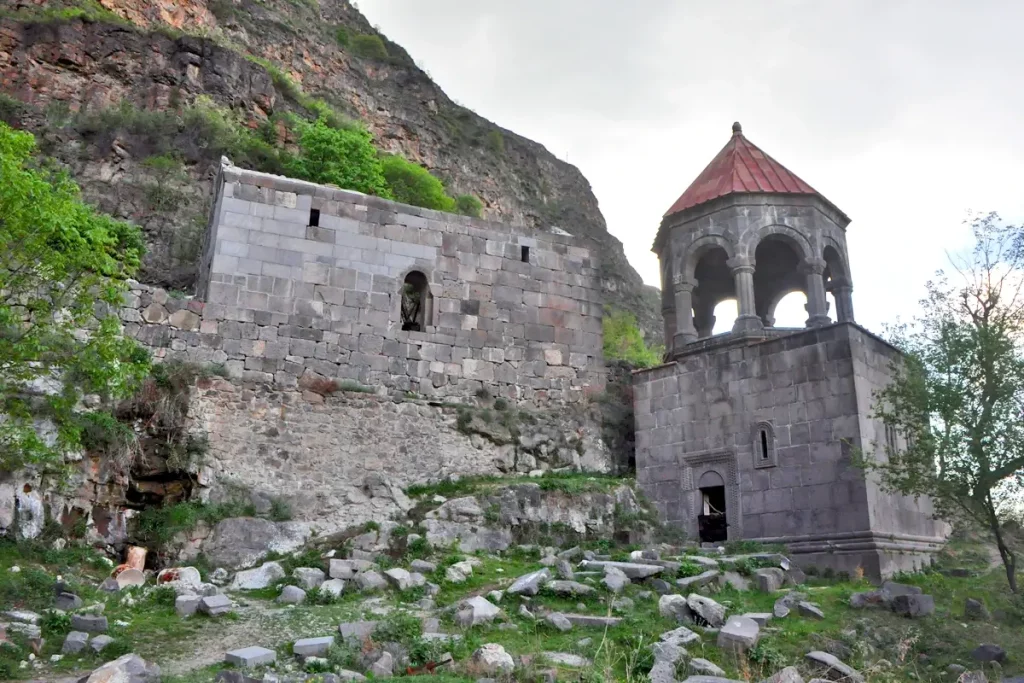
Between 1276 and 1282 the local monk Grigor (Gregory) oversaw extensions and the painting of the main church apse. In 1279 the Zakarians built the bell tower with a family mausoleum — an unusual combination of belfry and dynastic tomb in a single building. Prince Shahnshah Zakarian was buried here after his death in 1261, following the killing of his eldest son by the Mongols; the bell tower also houses the tombs of his relatives.
Architecture and frescoes
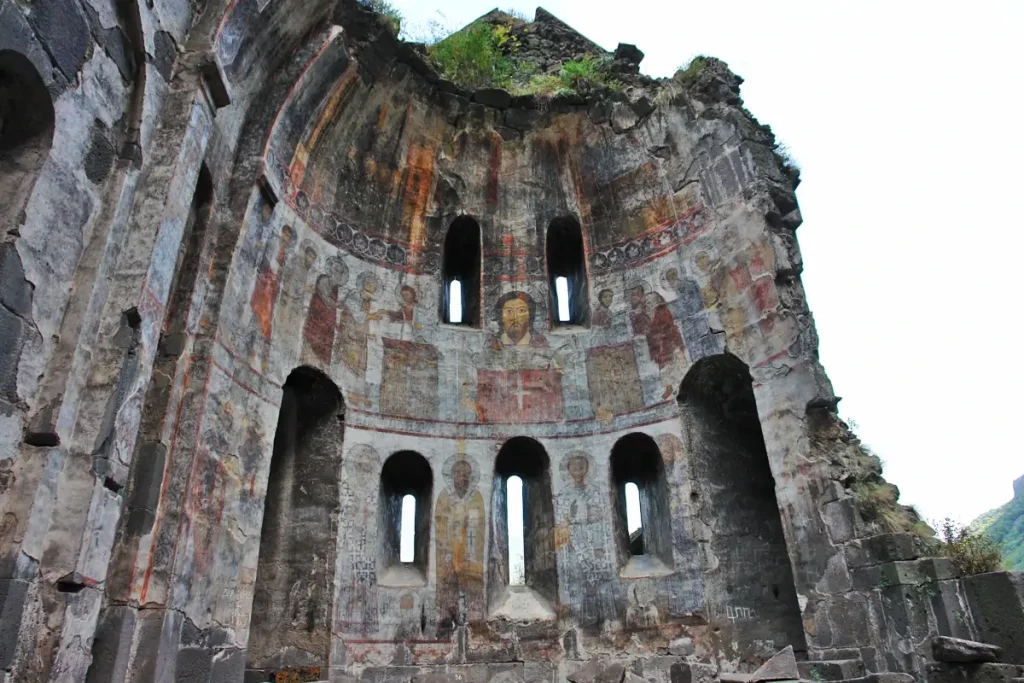
The complex is built into the cliff and divided into several structures. The main church Surb Astvatsatsin is a single-nave basilica with a vaulted ceiling, now partly collapsed. The painted decoration occupies the apse in three registers: at the top the Mother of God with archangels, in the middle the Communion of the Apostles, and at the bottom Church Fathers and prophets. Portraits of donors and fragments of the Dormition of the Virgin survive on the western and northern walls. These are some of the best-preserved Armenian frescoes of the 13th century — most comparable paintings elsewhere in Armenia have been lost. Frescoes survive in four parts of the complex: the apse of the main church, a chapel-vestry, the open columned hall, and the first floor of the bell tower.
Beyond the main church, the complex includes a second single-nave church with a vaulted chapel, the 1279 bell-tower mausoleum, a refectory (a large rectangular hall), and the ruins of the fortress wall. About 500 m southeast stands the small separate church of Chitakhants, with an underground family vault.
The 14th–16th centuries saw the Chalcedonian community leave; the monastery returned to the Armenian Apostolic Church in the 17th–18th centuries as a parish church. Soviet conservation work in 1971 stabilised and partly restored the frescoes. Since 2006 a joint Armenian–Italian restoration programme has continued the work — at times scaffolding stands above the altar and the frescoes are covered, but the complex is open to visitors year-round.
The Tumanyan and “Anush” connection
In Anush, Hovhannes Tumanyan’s most famous narrative poem, the heroine throws herself into a gorge in despair — and in one local tradition, the window she jumps from is at Kobayr church, with the Debed canyon below. Tumanyan grew up in Dsegh, directly across the canyon, and knew these cliffs from childhood. For the Lori region, Kobayr is as much a literary landmark as a religious one — and many Armenian readers come here partly for the Anush atmosphere.
What to know before visiting
The walk up takes 10–15 minutes on an unmarked footpath through village courtyards; bring shoes with grip and a small bottle of water. There is no entrance fee and no fixed visiting hours — the complex is open during daylight. Restoration work continues, so depending on the season you may find scaffolding over the apse; the bell tower and the surrounding views are not affected. Children are welcome but should be kept close on the steeper sections of the climb. There is no café on site; the nearest options are in Alaverdi or Vanadzor on the way back.
What else to see in Lori
- Sanahin Monastery (~15 km) — a UNESCO World Heritage site, one of the largest spiritual centres of medieval Armenia.
- Haghpat Monastery (~20 km) — Sanahin’s UNESCO twin, equally important to the period.
- Akhtala Monastery (~25 km north) — a fortress-monastery with rare Byzantine-Georgian frescoes, the stylistic counterpart to Kobayr.
- Alaverdi (~18 km) — the canyon town with a working cable car and Soviet-industrial architecture, set deep in the Debed gorge.
- Dsegh and the Tumanyan House Museum — opposite the canyon, the poet’s birthplace.
A practical day from Yerevan: Sanahin → Haghpat → Kobayr → Alaverdi, around 10 hours all in including the drive.
FAQ
Kobayr is the kind of monastery where the half-ruined wall is part of the experience — a 12th-century cliff-edge church above the Debed canyon, with one of the few surviving fresco cycles in Armenia and a literary backdrop from Tumanyan. For more sites across the country, see our guide to things to do in Armenia.