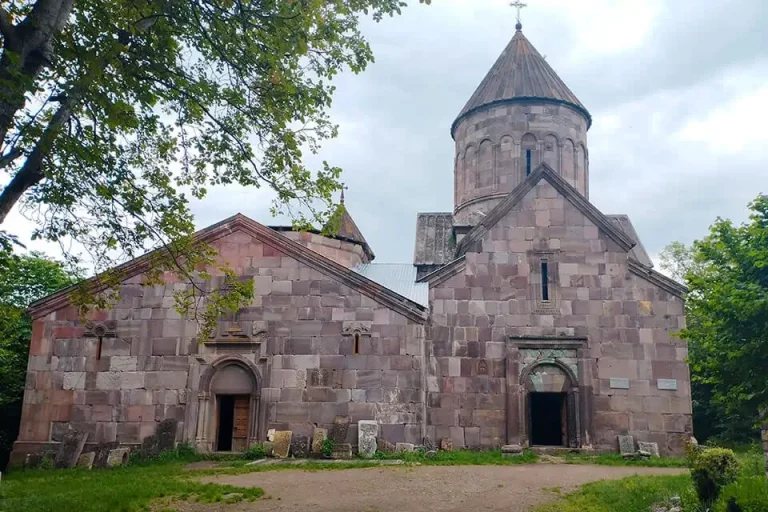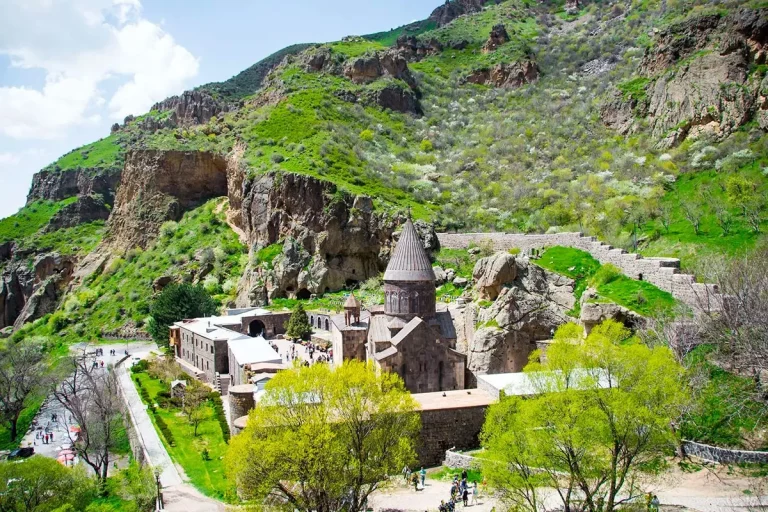
Goshavank Monastery

Goshavank Monastery (Armenian: Գոշավանք — “the Monastery of Gosh”) is a 12th–13th-century complex in the forested valley of Tavush, founded by the great Armenian scholar and legal scholar Mkhitar Gosh. Set in the village of Gosh, about 15 km east of Dilijan, the monastery was one of the largest medieval universities of Armenia, teaching theology, philosophy, law, music, and calligraphy. Today, Goshavank draws visitors both as an architectural ensemble and as the home of one of the finest khachkars in the world — a masterpiece of “lace carving” in stone by the 13th-century master Poghos.
Quick Facts
- Built / Founded: 12th–13th centuries
- Location: Gosh village, Tavush Province
- Also known as: Goshavank Monastery, Գոշավանք, Nor Getik, New Getik
- From Yerevan: 120 km from Yerevan
- Entrance fee: Free (parking ~200 AMD)
- Time needed: 30–60 minutes
- Best time to visit: May–October; September for autumn forest colour
- Status: Open to visitors (Armenian Apostolic site)
- GPS coordinates:
40.7297, 45.0011
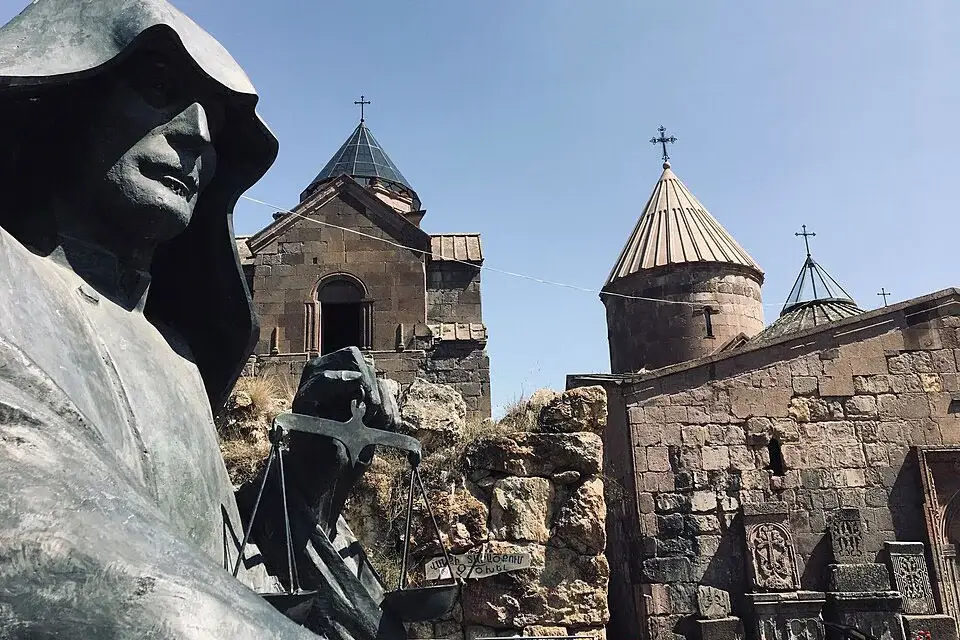
History: Mkhitar Gosh and the founding of the monastery
Before Goshavank, the site held an older monastery called Getik, which was completely destroyed by an earthquake in 1188. Mkhitar Gosh — a leading Armenian thinker, jurist, theologian, and fabulist — petitioned the Zakarid princes Ivane and Zakare for land to build a new monastery. With their support, he founded the complex, originally named Nor Getik (“New Getik”).
Mkhitar Gosh (c. 1130–1213) composed the Datastanagirk (Book of Judgement), the first Armenian legal code, which remained the foundation of Armenian civil law for several centuries. He was also the author of dozens of fables and parables in the style of Aesop. Mkhitar Gosh is buried just outside the main monastery walls, in a small chapel-mausoleum on the opposite hillside. After his death in 1213, the monastery was renamed Goshavank — “the Monastery of Gosh” — and the surrounding village took the name Gosh.
The architect Mkhitar Hyusn (Mkhitar the Carpenter) and his disciple Hovhannes carried out much of the construction, with the master carver Poghos responsible for the famous khachkars.
The medieval academy of Goshavank
Goshavank was more than a monastery — it functioned as a full academy (vardapetaran), one of the most important educational centres of medieval Armenia. The curriculum covered theology, philosophy, jurisprudence, history, architecture, miniature painting, music, and calligraphy.
Among its alumni were Vanakan Vardapet, one of the leading Armenian scholars and teachers of the 13th century, and Kirakos Gandzaketsi, the historian whose History of Armenia remains a key primary source on the Mongol invasions. Graduates of Goshavank went on to found monastic schools across the country, extending its intellectual influence well beyond Tavush. The monastery’s scriptorium produced and illuminated manuscripts; the school continued to operate until the end of the 17th century.
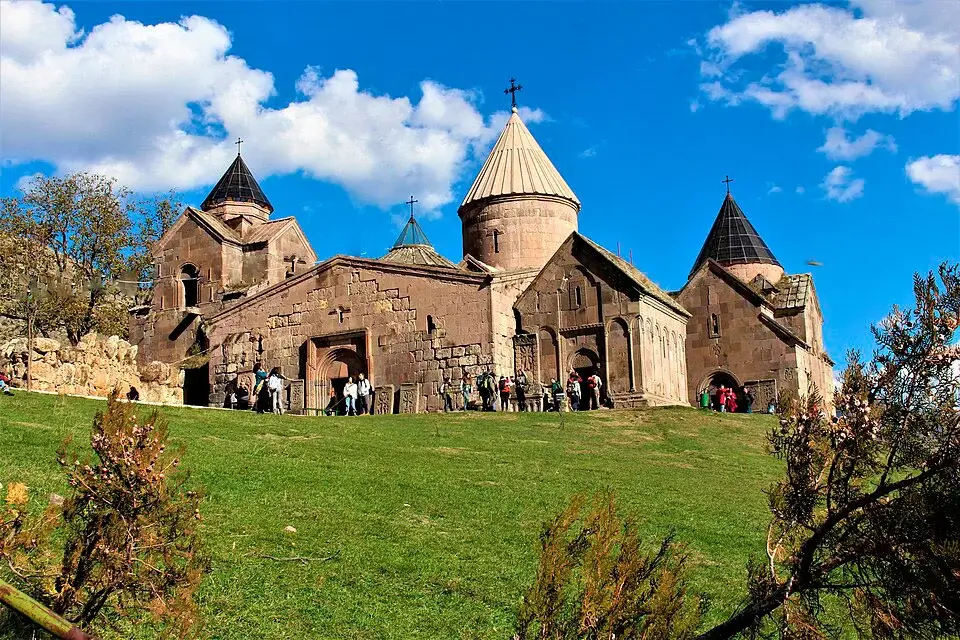
Architecture: stone and forest in harmony
The monastery sits on a hilltop in the gorge of the Getik river, a tributary of the Aghstev. Unusually for an Armenian monastery, Goshavank has no defensive walls — it is set among village houses and the forests of Dilijan National Park, and all the buildings of the main group abut one another to form a compact ensemble.
Church of St. Astvatsatsin (1191–1196) is the first and largest building of the complex, a cross-domed church with two-storey side chambers. It was built by the architect Mkhitar Hyusn with the support of Princes Kurd and Vakhtang of Khachen. The interior is deliberately austere, while the facades carry profiled portals and window frames with multifoil arches — a motif also seen on the main church at Geghard.
The gavit (1197–1203) adjoins the western facade of the main church and was used for assemblies, ceremonies, and as a teaching hall. Its corner sections are built on the false-vault principle: triangles of varying size form a pattern of eight-pointed stars across the ceiling.
Church of St. Grigor (1231) is a smaller domed hall to the southeast of the main church.
Church of St. Grigor Lusavorich (1237–1241) is a single-nave basilica — a rare plan for its period. The exterior is exceptionally decorated, with refined ornament, blind arcades, half-arches, and richly framed portal and windows. The wealth of its decoration earned it the local nickname zarmanakert (“astonishing”).
The library and bell tower (built before 1241; belfry added in 1291) is a two-storey building of unusual composition. The ground floor was the book depository, with wall niches for manuscripts; above it, a two-tier rotunda belfry rose higher than the Church of St. Grigor and dominated the whole ensemble. The composition influenced the design of the two-storey sepulchral churches at Yeghvard and at Noravank in the 14th century.
Chapel of St. Hripsime (1254) stands on its own, on the opposite slope of the gorge, with a view across the entire complex.
The Khachkars of Goshavank: lace in stone
The treasure of Goshavank is the khachkar at the entrance to the Church of St. Grigor Lusavorich, carved by master Poghos in 1291. The work is so precise and layered that the stone surface reads as needle lace rather than carving — the local nickname for these stones is aseghnagorts, “needle-worked.” The Poghos khachkars are considered among the finest examples ever carved.
Originally, two of the master’s khachkars flanked the entrance to St. Grigor Lusavorich; one of them is now displayed at the National History Museum of Armenia in Yerevan, with a copy left in its place. Another Poghos khachkar stands by the tomb of Mkhitar Gosh on the opposite hillside. Beyond these, dozens of 12th–13th-century khachkars are placed on pedestals across the grounds and built into the walls of the gavit.
How to get to Goshavank Monastery
Goshavank sits in the village of Gosh, about 15 km east of Dilijan and roughly 120 km from Yerevan — a 1.5–2 hour drive over the Sevan Pass and through the Dilijan Tunnel. From Dilijan the final leg is a 20-minute drive along a forested mountain road. Marshrutkas from Yerevan’s Northern Bus Station reach Dilijan, from where a taxi to Gosh village is the next step.
The most practical option is to hire a car with driver in Yerevan and combine Goshavank with Haghartsin Monastery and Lake Parz in a single day. Parking at the monastery costs around 200 AMD; the village has a few small cafés.
Hours and admission
Goshavank is open daily and admission is free. There are no fixed opening hours in the strict sense — the gates are open during daylight, with the most reliable window being roughly 9:00–18:00. The monastery is no longer a fully active religious community, but liturgy is held on major Armenian Apostolic feast days. A focused visit takes 30–45 minutes; with the walk up to Mkhitar Gosh’s tomb and the chapel of St. Hripsime on the opposite hillside, allow about an hour.
Practical tips for visiting
The Poghos khachkar at the entrance to St. Grigor Lusavorich is the first thing to look for — it sits right of the doorway and is easy to walk past without noticing the depth of the carving. Inside the gavit, look up: the eight-pointed star pattern across the ceiling is one of the most striking interiors in Armenian medieval architecture. On the southern facade of one of the churches you can find an unusual carved sundial with an ornamental frame — easy to overlook.
The forest setting keeps the site noticeably cooler than Yerevan in summer, which makes it a pleasant midday stop. The 15-minute walk up to Mkhitar Gosh’s mausoleum is also the best vantage for a photograph of the whole complex. Goshavank pairs naturally with Haghartsin (~10 km), Lake Parz (~5 km), and a walk through the restored Sharambeyan quarter of Dilijan; a standard day from Yerevan runs Sevan → Dilijan → Haghartsin → Goshavank → Lake Parz.
What else to see nearby
- Haghartsin Monastery (~10 km) — a 10th–13th-century complex hidden deep in the forest, with a two-naved refectory unique in Armenia.
- Lake Parz (~5 km) — a small, clear forest lake at 1,334 m, with rowboats, zipline, and easy walking trails.
- Dilijan (~15 km) — the “Armenian Switzerland”: a resort town with the restored Sharambeyan craft quarter, workshops, and the UWC Dilijan international school.
- Dilijan National Park — the protected forest landscape that surrounds both Goshavank and Haghartsin.
FAQ
Goshavank is one of the places where medieval Armenian law, theology, and stone carving meet in a single setting, set quietly into the forests of Tavush. For more sites across the country, see our guide to things to do in Armenia.