
Charents Arch
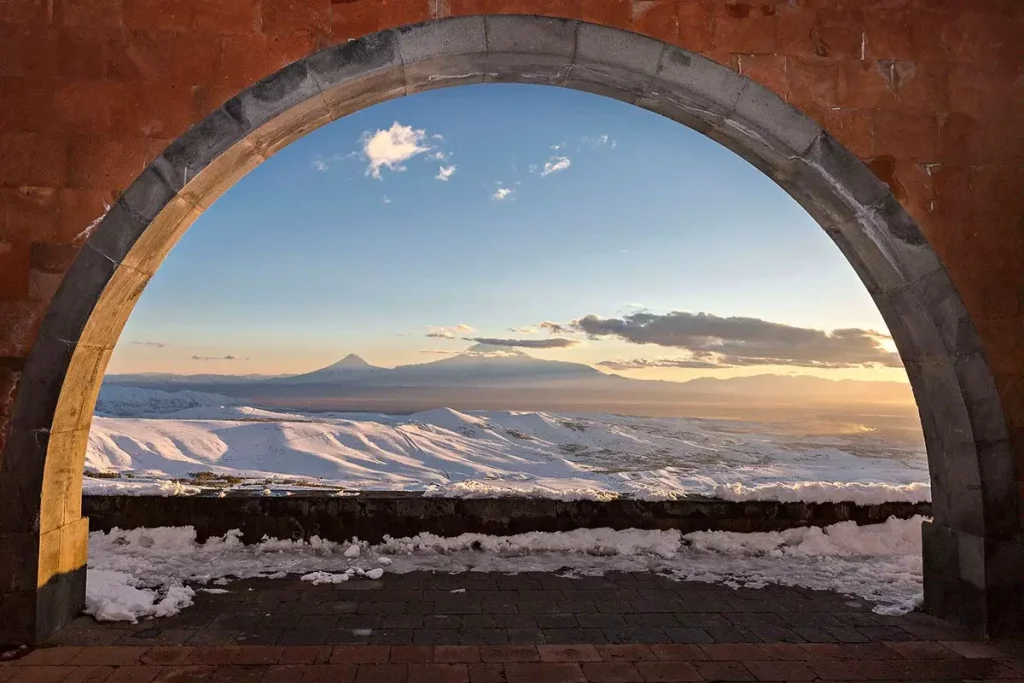
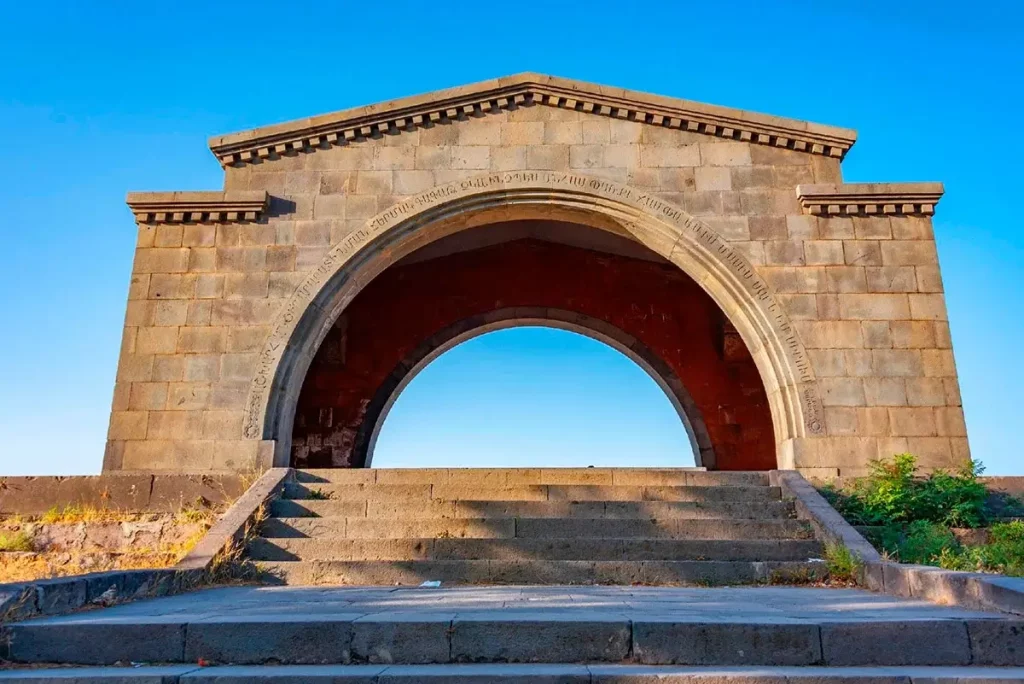
Charents Arch is a small stone monument on a hill above the Yerevan–Garni road, dedicated to the Armenian poet Yeghishe Charents and best known for one thing: the view it frames of Mount Ararat. On a clear day, the snow-capped twin peaks of Ararat appear perfectly centred within the arch’s opening, creating one of the most photographed scenes in the country. The arch was built in 1957, sits about 15 km east of Yerevan in the village of Voghjaberd, and is almost always a brief but worthwhile stop on the way to Garni Temple and Geghard Monastery.
Quick Facts
- Built / Founded: 1957
- Architects: Rafael Israelyan
- Location: Voghjaberd village, Kotayk Province
- Also known as: Arch of Charents, Charents' Arch, Arch of Ararat, Temple of Ararat
- From Yerevan: About 15 km / 25 minutes
- Entrance fee: Free entrance
- Time needed: 10–15 minutes
- Best time to visit: Clear days; mid-morning to early afternoon for Ararat visibility
- Status: Cultural monument
- GPS coordinates:
40.1736505, 44.6366073
The Arch and Its Poet
The monument was designed by Armenian architect Rafayel Israyelian in 1957. While driving along the Yerevan–Garni road, Israyelian stopped at a hilltop in Voghjaberd and was struck by the panoramic view of Mount Ararat. He decided to build an arch on the spot — a symbolic gateway, or what he originally called a “Temple of Ararat.”
The arch itself is a modest structure: a rectangular plan of 10 × 5.5 metres, about 5 metres high, faced with basalt on the outside and lined with orange tuff inside. Its simplicity is intentional — the arch is meant to frame the landscape, not compete with it.
Over time, the monument was renamed after Yeghishe Charents (1897–1937), one of the most important Armenian poets of the 20th century. Charents wrote frequently about Mount Ararat and the Armenian homeland, and the hill at Voghjaberd was reportedly one of his favourite places for reflection. Lines from his poem “I love my sweet Armenia” are engraved along the arch:
“Go around the world — there is no white peak like Ararat. Like a path to unreachable glory, I love my Mount Masis.”
Charents lived through World War I, the Armenian Genocide, and the Soviet purges. He was arrested by the NKVD in 1937 and died in prison the same year. His poetry was banned for years, but later became a foundational part of modern Armenian literature.
A year after the arch was built, the painter Martiros Saryan — Israyelian’s close friend and neighbour — created his well-known canvas “The Arch of Charents” (1958), which helped cement the monument’s place in Armenian cultural memory.
The View of Mount Ararat
The reason most visitors come is the view. Standing under the arch on a clear day, Mount Ararat — the biblical mountain and national symbol of Armenia — appears perfectly framed by the stone opening. The arch sits at about 1,500 metres elevation, well above the Ararat Plain, with an unobstructed line of sight south across the Armenian–Turkish border to the mountain itself.
Ararat is a stratovolcano with two peaks: Greater Ararat (5,136 m) and Lesser Ararat (3,896 m). From Charents Arch you see both, with Greater Ararat dominating the frame. The mountain is geographically inside modern Turkey but remains the most important national and spiritual symbol of Armenia, appearing on the country’s coat of arms.
On hazy or cloudy days the view is obscured — Ararat is famously shy and visibility from the Yerevan area is unpredictable. Locals often check the weather specifically for Ararat visibility before driving out.
How to Visit Charents Arch
The arch sits directly on the Yerevan–Garni road, about 15 km east of central Yerevan, at the entrance to Voghjaberd village. The site is open 24/7, free of charge, with a small parking area and a few souvenir stalls in summer.
By private car with driver. Most visitors stop here as part of the Garni–Geghard day trip from Yerevan, often combined with the Symphony of Stones. The arch adds about 15 minutes to the route. We provide private cars and drivers in Yerevan for the full route at your own pace.
By taxi or marshrutka. Marshrutkas 266 and 284 from Gai Bus Station in Yerevan pass right by the arch on the way to Garni. Ask the driver to stop briefly — most are happy to. A taxi from Yerevan to the arch alone costs around 2,500–3,500 AMD.
On foot. Not practical from Yerevan. From Voghjaberd village it is a short walk up a paved path to the arch.
Practical Tips
- Best time of day: mid-morning or early afternoon, when Ararat is most often visible and the sun lights the southern face of the mountain. Mornings can be hazier; late afternoons can have backlight.
- Best season: spring (April–May) and autumn (September–October) offer the clearest weather. Winter visibility is variable but snow cover on Ararat is dramatic.
- Time needed: 10–15 minutes is usually enough. Some visitors stay 30 minutes for photography and the surrounding views over the Ararat Plain.
- What to bring: a wide-angle camera lens helps capture the arch and Ararat in one frame. The site is exposed — bring water and sunscreen in summer, a windbreaker in cooler months.
- Facilities: small parking area, a few seasonal souvenir and snack vendors. No restrooms.
- Note: the arch has occasionally been marked by graffiti. It’s a working public monument, not a fenced museum site.
FAQ
See more places in our full guide to things to do in Armenia — including Garni Temple, Geghard Monastery, Symphony of Stones, Khor Virap and other top day trips from Yerevan.