

Black Fortress (Sev Berd)
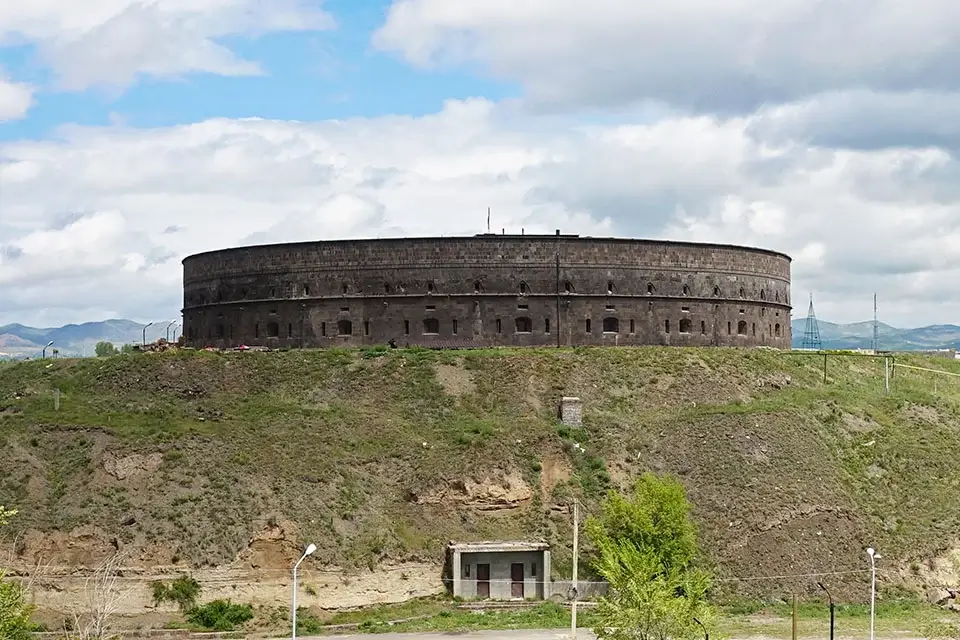
The Black Fortress (Armenian: Սև բերդ — Sev Berd; Russian: Чёрная Крепость) is a Russian Imperial fortress built between 1834 and 1847 on a hill on the western edge of Gyumri in Shirak Province, just 8 km from the Turkish border. It is a perfectly circular, 360-degree fortification built of dark volcanic stone, designed for artillery defence after the Russo-Turkish War of 1828–1829. Sev Berd was never besieged, but it was strategically important to Russia’s military operations in the Caucasus through 1878 and is today one of the principal landmarks of Armenia’s second city. It lies about 123 km from Yerevan (1.5–2 hours by road or train) and is the only fortress on this site that belongs to a 19th-century imperial defensive system rather than to medieval Armenia.
Quick Facts
- Built / Founded: 1834–1847
- Location: Gyumri, Shirak Province
- Also known as: Black Fortress, Sev Berd, Black Fort, Black Castle of Gyumri, Чёрная крепость, Սև բերդ
- From Yerevan: 123 km / about 1.5–2 hours by car via the M1
- Elevation: 1,535 m
- Entrance fee: Free
- Time needed: 30–60 minutes
- Best time to visit: May–October
- Status: National cultural heritage monument
- GPS coordinates:
40.7824713, 43.8253236
From the Treaty of Gulistan to Nicholas I’s Decree
The Russo-Persian war of 1804–1813 closed with the Treaty of Gulistan, after which Gyumri — a town only a short ride from the Ottoman border — became part of the Russian Empire. Less than two decades later, after the Russo-Turkish War of 1828–1829, the Russian commander-in-chief in the Caucasus, Hans Karl von Diebitsch, wrote a recommendation that has become the founding quotation of the site: “As we are under threat of a possible war with the Turks, it is necessary to build a fortress and to strengthen it as our most important military outpost.”
In 1834 the first stones were laid on a hilltop on the western side of the town; construction continued for over a decade and was completed around 1847. In 1837 Tsar Nicholas I himself visited Gyumri and renamed the city Alexandropol in honour of his wife, Empress Alexandra Fyodorovna. Gyumri kept that name until 1924 (then Leninakan, then Kumayri, returning to Gyumri in 1992).
After Russia’s loss in the Crimean War (1853–1856), Sev Berd was upgraded and given “first-class” status — one of the most important garrisons on the empire’s southern frontier. It was never besieged, but it served as a stable rear position through the Russo-Turkish War of 1877–1878. When Russia gained the stronghold cities of Kars and Batumi, the immediate threat to the border receded; the fortress was downgraded to “second-class” in 1887.
In the 1940s the 102nd Russian Military Base was established next to Sev Berd; it remains active today. The fortress itself was used for storage and at one point as a military prison. Excavations under and around the fort have revealed pre-Christian burials and Bronze Age finds — the hill was inhabited long before any Russian general arrived.
The fortress entered private hands in 2005 (purchased from the Armenian Ministry of Defence) and was bought by the Balasanyan family in 2012, which restored it between 2013 and 2016. Today Sev Berd hosts concerts, art exhibitions, public forums, and a small museum in its central hall.
Architecture — A Round Fort in Volcanic Stone
Sev Berd is not a medieval castle. It is a 19th-century artillery fortification whose architecture follows the engineering logic of the Napoleonic era: thick masonry walls, low silhouette, and an unbroken circle of fire arcs.
Key elements:
- Round plan (360°) — provides all-round artillery coverage without dead angles.
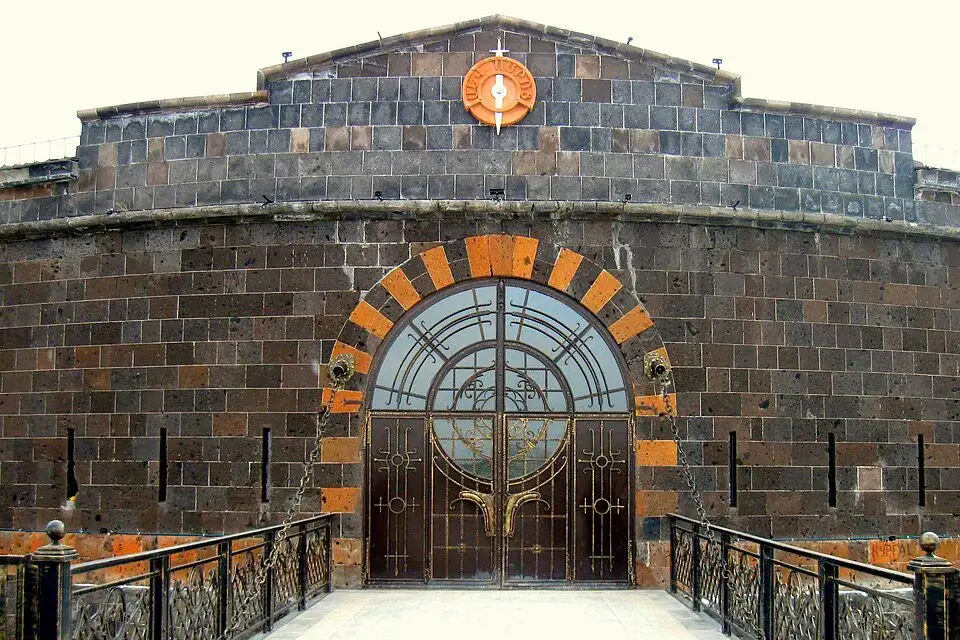
- Walls of dark volcanic stone — locally called black tuff in most published sources, though the same material is sometimes described as basalt. Gyumri’s traditional architecture is famous for pairing this dark stone with the warmer red and orange tuff of its 19th-century town houses.
- Loopholes — narrow vertical slits in the curtain wall for musket and rifle fire.
- Artillery emplacements — small reinforced positions for cannons; two of these are still displayed at the entrance.
- Underground passages — connected the fortress to what is now the Mother Armenia Memorial on the same hill and (according to local accounts) to the smaller companion fort, the Red Fortress (Karmir Berd). The system also functioned as drainage to keep the walls dry.
- Deep well — a stone-lined well inside the central hall, variously cited as 15–30 m deep, which once supplied water to the garrison.
- Hilltop position — open views over Gyumri, the Shirak plain, and the Turkish border 8 km away.
A famous detail are the engravings carved by the Russian soldiers themselves — names, ranks, and home cities scratched into the dark stone of the inner walls. They are easy to miss but unmistakable once you start looking.
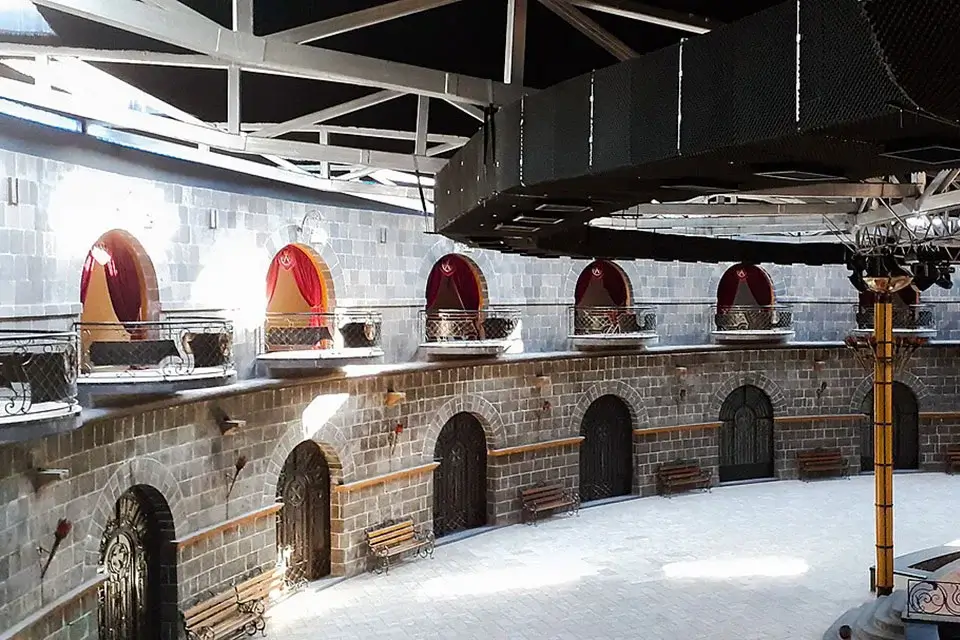
After restoration, the central hall now houses a stepped amphitheatre used for concerts and public events. Beneath the stage is a small museum with archaeological finds and historical photographs of the city.
Sev Berd’s Companion — the Red Fortress
Sev Berd was not built alone. A second, smaller fortification — the Red Fortress (Karmir Berd) — was built in the same campaign from the warmer red tuff of the region. The two forts together made up the Alexandropol fortified complex: at its peak, the wider complex housed barracks, gunpowder magazines, warehouses, and a three-storey hospital for the garrison. The 360-degree round towers — black and red — survive as the visible heart of that system.
The pairing is the easiest visual shorthand for Gyumri itself: a city whose old quarter is built almost entirely in alternating courses of black and red volcanic stone.
Gyumri Around the Fortress
To understand Sev Berd is to understand Gyumri. Renamed Alexandropol in 1837, the city was a key Russian Imperial military, trading, and cultural centre in the South Caucasus throughout the 19th century. Its old quarter — the Kumayri Historic District — survived both Soviet planning and the catastrophic 1988 Spitak earthquake; the carved wooden balconies, ornate doors, and dark-and-red stonework on Vardanants Square are an essential pair with the fortress on the hill above.
Gyumri is also Armenia’s traditional centre of crafts and humour. Most visitors who come for the Black Fortress end up staying for the city.
How to Get to the Black Fortress from Yerevan
The fortress is on the western edge of Gyumri, about 123 km from Yerevan by the M1 highway (around 1.5–2 hours by road).
- By car: Yerevan → M1 → Gyumri (~1.5–2 hours). From central Gyumri it is a 5-minute drive or a 15-minute uphill walk to the fortress, next to the Mother Armenia memorial.
- By marshrutka: Regular minibuses run from Yerevan’s Kilikia Bus Station (~2–2.5 hours).
- By train: The Yerevan–Gyumri rail line runs daily; the trip takes about 3 hours and follows a scenic route through the highlands.
- With a driver: A car with driver in Yerevan lets you combine the Black Fortress with the Kumayri Historic District, Marmashen Monastery (10–15 km north of Gyumri), and the early-Christian Yereruyk Basilica (~45 km) in a single day from Yerevan.
Visiting Sev Berd — What to Know
The fortress sits on open hill ground and is generally free to enter (some restored areas inside may charge during ticketed events).
- Walk the full circle of the wall to appreciate the all-round defensive geometry.
- Look for the soldiers’ inscriptions carved into the inner walls — names of men and their home cities from across the Russian Empire.
- Step into the central amphitheatre and the small museum beneath the stage; the deep stone well is the most photographed feature inside.
- Climb to the top of the hill for panoramic views of Gyumri, the Shirak plain, and the Turkish border 8 km to the west.
- Combine the visit with a walk down into the Kumayri Historic District (about 15 minutes downhill) — the most architecturally intact 19th-century Armenian quarter.
- Restoration work is ongoing as of 2026; the program of concerts and events at Sev Berd is worth checking before you visit.
The best months are May to October. Gyumri sits on a windy plateau at about 1,500 m and is significantly cooler than Yerevan; bring a light jacket even in summer.
What to See Nearby
- Kumayri Historic District — the 19th-century centre of Gyumri, with the Cathedral of the Holy Saviour (Surb Amenaprkich) on Vardanants Square and craft museums in the surrounding streets.
- Mother Armenia Memorial — on the same hill, linked to Sev Berd by the old underground passages. Panoramic viewpoint over the city.
- Dzitoghtsyan Museum of National Architecture and Urban Life of Gyumri — domestic life in 19th–20th century Alexandropol, in a beautifully preserved merchant mansion.
- Marmashen Monastery — about 12 km north of Gyumri, founded in 988 by Vahram Pahlavuni; one of the great Ani-school monasteries of the region.
- Yereruyk Basilica — about 45 km away, on a bluff above the Akhuryan gorge; one of the earliest Christian basilicas in Armenia (4th–6th c.).
- Harichavank Monastery — about 50 km away, the architectural prototype later echoed at Hovhannavank and Saghmosavank.
- Trchkan Waterfall — about 50 km away on the Shirak–Lori border; Armenia’s tallest free-falling waterfall at 23 m.
Frequently Asked Questions
The Black Fortress is the place where black volcanic stone holds an order from Nicholas I, where the names of 19th-century Russian soldiers are still scratched into the inner walls, and where the Turkish border lies eight kilometres away across an open plain — a round, low, severe building that says more about what the South Caucasus looked like in the imperial 19th century than any monument in Yerevan does.
To explore the Black Fortress together with the Kumayri historic district and Marmashen Monastery in a single day from Yerevan, consider a private car with driver in Yerevan tailored to the Shirak cluster.


