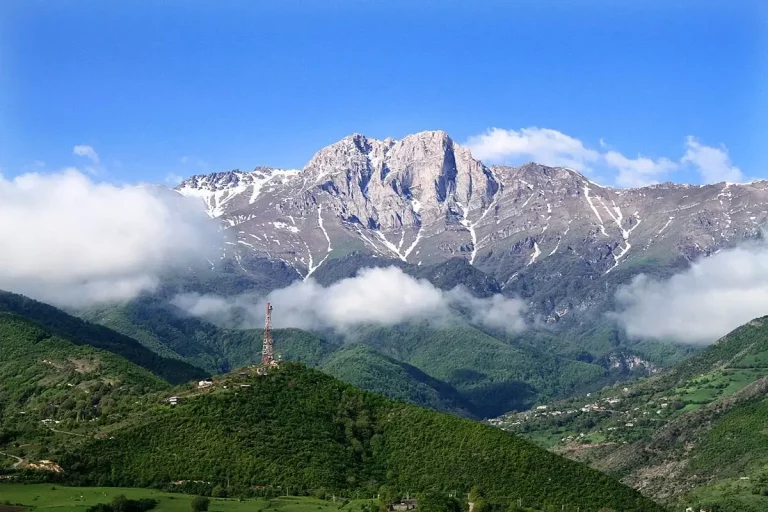

Halidzor Fortress
Halidzor Fortress (Armenian: Հալիձորի բերդ) is a 17th–18th-century Armenian architectural complex on a hill overlooking the Voghji river, one kilometre west of the town of Kapan in Armenia’s southernmost Syunik Province, 316 km from Yerevan. Built originally in the first half of the 17th century as a nunnery dedicated to the Holy Mother of God, it briefly served as the family seat of the Melik-Parsadanian princes of Kapan before being transformed into a fortress in the 1720s by the Armenian commander David Bek — and entering history as the headquarters of one of the most remarkable episodes of pre-modern Armenian military history.
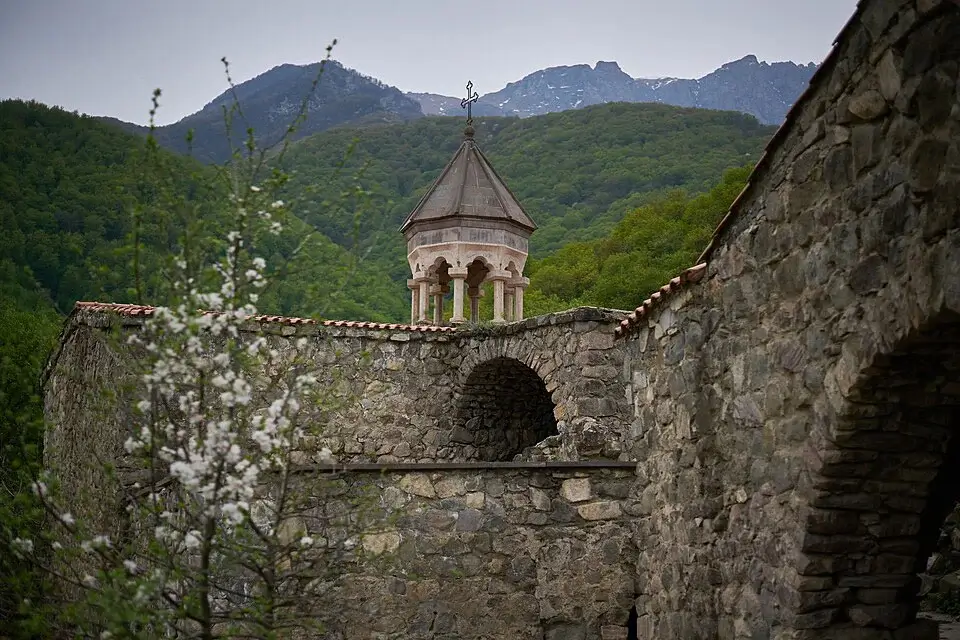
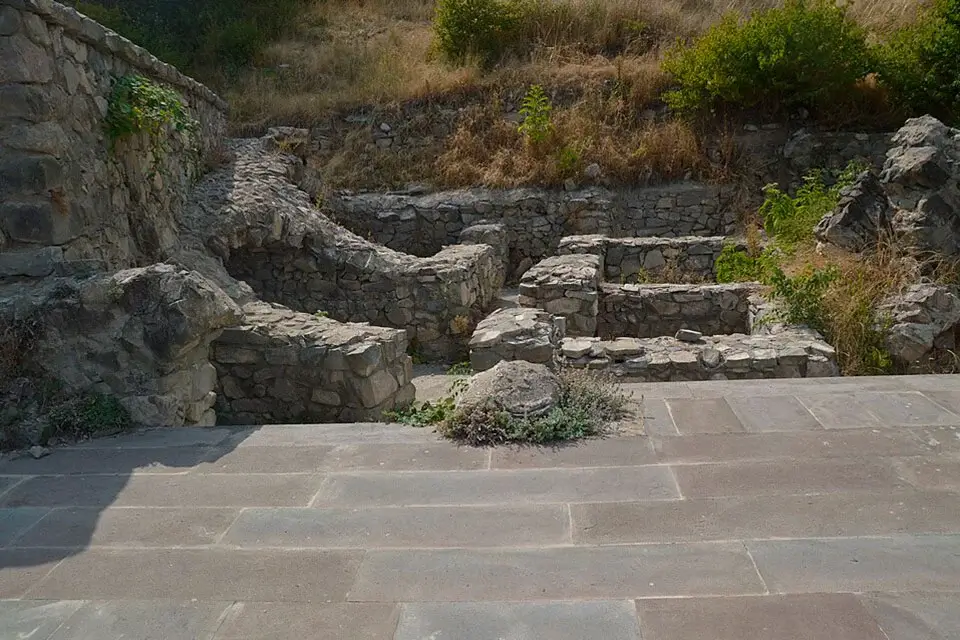
In February–March 1727, Halidzor was besieged for seven days by an Ottoman force that medieval Armenian chronicles put at 70,000 men. Bek’s defenders — around 300 soldiers, 13 bishops, three priests, and the nuns of the convent — held out, then broke the siege with a downhill charge that scattered the besieging army. The victory turned the rebellion’s tide. Bek died inside these walls the following year; the fortress fell to the Ottomans a year later in a ruse of negotiation. Today the partially restored complex stands above the Voghji gorge with the walls of the convent church of St. Minas, the Astvatsatsin chapel, the south-western round tower, and a fragment of the 500-metre secret tunnel that ran down to the river. By tradition, David Bek is buried somewhere on the grounds beneath a tombstone carved with a single flower turned to face the earth, so that enemies could never identify the grave.
Quick Facts
- Built / Founded: 17th c.; fortified in the 1720s
- Location: Kapan, Syunik Province
- Also known as: Halidzor Fortress, Halidzor Castle, Halidzor Berd, Հալիձորի բերդ
- From Yerevan: 316 km from Yerevan (≈5–6 h via Goris)
- Entrance fee: Free
- Time needed: 30–60 minutes
- Best time to visit: May–October
- Status: partially restored fortress-monastery
- GPS coordinates:
39.2181056, 46.3519292
A short history: nunnery, family seat, military headquarters
The name Halidzor is thought to derive from two older settlements in the area, Ale and Alis. In the 10th century, the local princess Hamazaspuhi donated the site to the great Tatev Monastery to the north, which used it as one of its dependencies until the 14th century.
The structure that became Halidzor Fortress was raised in the first half of the 17th century as a women’s monastery — the Kusanats Anapat (Nunnery of the Holy Mother of God). Within a few decades it had been claimed by the most powerful princely family of the Kapan region, the Melik-Parsadanians of the village of Bekh, as their family residence. The first Parsadanian, tradition holds, was the Syunik prince Dzagik; below the family chapel stood the copper smelter that funded their estate.
In 1711, the abbot of Tatev Monastery, Bishop Arakel, was murdered inside the walls of the nunnery — a foreshadowing of the violence to come.
The Halidzor that survives in cultural memory is the work of David Bek, who reached the site in the 1720s. Born of the Melik-Parsadanian line and a veteran officer of the Georgian king Vakhtang VI, Bek led an Armenian uprising against the disintegrating Safavid Persian empire and the encroaching Ottoman Turks, and turned the family monastery into a properly fortified citadel: stone walls in an irregular quadrangle, a round tower at the south-western corner, two arched gates (north and south), a long secret tunnel down to the Voghji river. He rebuilt the small Astvatsatsin chapel on the east side in 1723. He united eight Armenian melikates of Syunik under his banner, drove the Ottomans out of Kapan after a victory at Chavndur in 1723, and made Halidzor his administrative centre — the only Armenian-controlled centre of government in the South Caucasus of its time.
Within the fortress, Bek also minted his own coinage — on one side the name of the Persian Shah Tahmasp II, on the reverse the words “Servant of Christ David.”
After the Battle of Halidzor (see below), Bek died of illness inside the fortress in mid-1728. His lieutenant Mkhitar Sparapet (“the General”) inherited the command. A year later, in 1729, a new Ottoman force besieged Halidzor again; this time Mkhitar and the priest Ter Avetis came out to negotiate, and the Ottomans broke the truce — slaying many of the defenders and seizing the fortress.
Through the rest of the 18th, 19th and 20th centuries Halidzor stood largely abandoned. Restoration and partial reconstruction work was carried out between 2006 and 2010.
David Bek and the Syunik liberation movement
Few medieval or early-modern Armenian figures occupy the place in national memory that David Bek does. Born to the Melik-Parsadanian family of Kapan, he served at the Georgian court of Vakhtang VI before returning to Syunik in 1722 at the head of the Armenian liberation movement. His base of operations was first the village of Shinuhayr, then Halidzor — converted into a fortress for the purpose. By 1725 he had united the noble families of Syunik (the meliks) into a single coordinated resistance and had begun to expel both Persian and Ottoman forces from the region
Father Hovakim of Tatev Monastery declared the full support of the Armenian clergy for Bek’s revolt. In 1724, Bek sent a letter to the Russian court — signed by eight Armenian meliks — requesting protection; no reply came. He then turned to the Persian Shah Tahmasp II, who recognised him formally as “prince, head of all the khans” of the territory and granted him command of Safavid forces in Syunik.
When David Bek fell ill and died in mid-1728, the rebellion lost its political head. Mkhitar Sparapet continued the struggle from Halidzor for another year, defeated an Ottoman force at Ordubad in 1730 — and then, in the same year, was murdered at Khndzoresk by villagers who feared Ottoman reprisals against their own settlement. His head was sent to the Ottoman pasha at Tabriz. The eight-year liberation movement of Syunik ended with him.
The Battle of Halidzor (1727)
In late February 1727, an Ottoman force — joined by the khans of Bargushat and Karadagh and various Turkic and Kurdish cavalry — encircled Halidzor and laid siege to the fortress. David Bek, Mkhitar Sparapet and the priest Ter Avetis held the walls together with about 300 soldiers, 13 bishops, three priests, and the nuns of the original convent — even the nuns took up arms in the defence.
The principal Armenian source for the battle, the 18th-century chronicle Patmutiun Ghapantsvots by Ghukas Sebastatsi, gives the Ottoman force as 70,000 men. Modern historians treat the number as an exaggeration in the medieval tradition, but agree that the disparity in numbers was overwhelming. The fortress’s high ground, narrow approaches, and the secret tunnel that ensured a steady supply of fresh water gave the defenders advantages that the Ottoman besiegers’ numbers could not negate. Initial Ottoman probing assaults were repulsed; siege machines and ladders followed.
On the seventh day, with food running short and the assaults intensifying, Bek made the decisive call: a suicidal downhill charge out of the fortress, led by Ter Avetis and Mkhitar. The proclamation Mkhitar shouted as they went out is preserved in Sebastatsi’s chronicle: “Take heart, do not be afraid, follow us — and if our end has arrived, let us die bravely; because for us it is better to die with courage outside the walls than to see before our eyes the death of our families and friends inside.”
The Ottomans, taken by surprise, broke in disorder. The forested terrain of the Voghji gorge hindered their flight; according to Armenian sources up to 12,000 Ottoman casualties fell on the day of the charge and the pursuit. The Ottoman army withdrew from Syunik. Halidzor became a symbol of Armenian resilience and a turning point of the eight-year liberation movement.
The Soviet director Edmond Keosayan dramatised the siege in the 1978 film Star of Hope, one of the best-known Armenian films of the Soviet era.
Architecture: the monastery-fortress
Halidzor sits on a hilltop above the right bank of the Voghji river, with a commanding view of Kapan in the valley and the road below. The site plan reads more like a fortified monastery than a purpose-built castle — every defensive element grew around the original religious buildings.
- The outer walls form an irregular quadrangle of local stone, up to 2 metres thick, with the main defensive section approximately 50 m long. The eastern, north-eastern, south-eastern walls and the southern gate were rebuilt in the 2006–2010 restoration.
- Two arched portals lead into the fortress — one on the north side, one on the south.
- A round tower stands at the south-western corner of the wall, with arrow slits commanding the approach road and the valley below.
- A terrace runs along the inside of the wall from north to east.
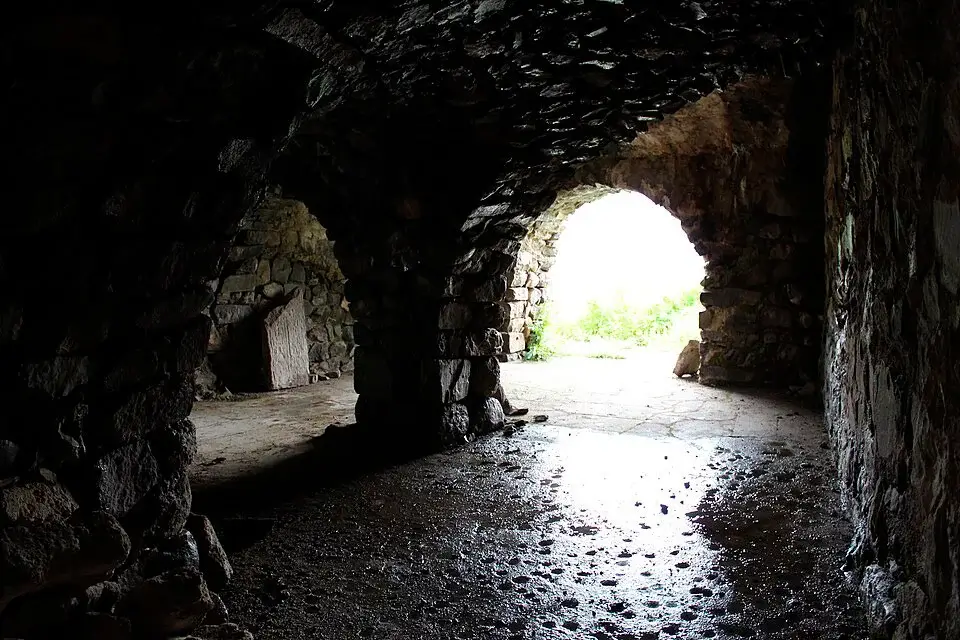
- The 500-metre secret tunnel descended from the fortress down to the Voghji river, allowing the defenders access to fresh water during the 1727 siege. Most of the tunnel is now collapsed or filled in, but the entrance is still visible inside the walls.
- The Church of St. Minas — the main church, a vaulted hall-type structure of large unworked basalt blocks in rubble masonry. Sacristies flank the apse on both sides. The remains of two-storey porticos at the north and south walls served as firing platforms during the 1727 siege.
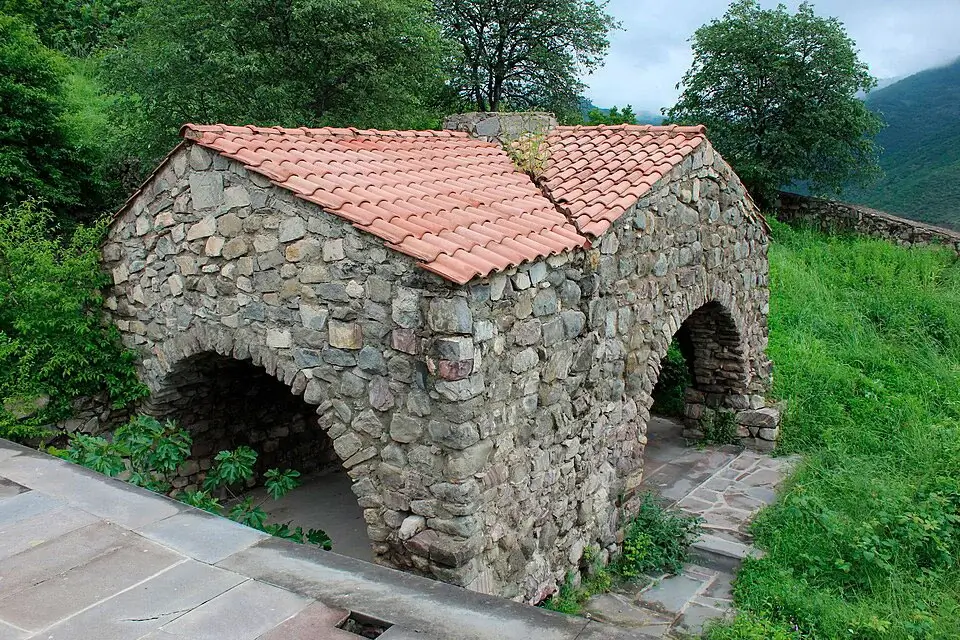
- The Astvatsatsin Chapel (Holy Mother of God) — on the eastern side of the fortress, rebuilt by David Bek in 1723 as a small church of similar dimensions to St. Minas.
- The Church of Surb Grigor Lusavorich — a 17th-century structure within the complex.
- A refectory along the northern side, and the traces of monastic cells along the western wall.
- A cemetery outside the citadel, with old tombstones — including, by tradition, the grave of David Bek himself.
Inside a building adjoining the Astvatsatsin chapel are four tombstones. Local tradition holds that one of them covers the remains of the commander.
The grave of David Bek
Few medieval Armenian leaders have left a grave as quietly tended as David Bek’s. He died of illness inside the fortress in mid-1728 — not from a wound, not in battle, just exhausted by the years of campaign. His soldiers, knowing that any marked grave would be desecrated by the Ottomans, are said to have buried him somewhere on the fortress grounds beneath a tombstone carved with a single flower facing downwards, into the earth — so that enemies could not recognise the stone of a commander.
The exact site has never been confirmed. The most widely cited candidates are the four anonymous tombstones inside the building next to the Astvatsatsin chapel.
How to get to Halidzor Fortress from Yerevan
Halidzor sits in the deep south of Armenia. From Yerevan it is 316 km by road through Goris — typically 5 to 6 hours by car. Marshrutkas from Yerevan’s Kilikia bus station reach Kapan in 5–6 hours. From the centre of Kapan, the fortress is a 20–30-minute walk uphill — taxi is also possible, but the last stretch is on a dirt road where a high-clearance vehicle helps.
On the way up to the fortress the path passes two small natural waypoints: a mineral spring directly on the road, and a small cascade locally known as the “Dog Waterfall.”
Most travellers do not visit Halidzor alone. The standard Syunik day or two-day route runs:
- Goris → Khndzoresk → Kapan (Halidzor) → Tatev (cable car) → Goris, or
- Yerevan → Tatev → Halidzor (Kapan) → Khndzoresk → Goris → Yerevan.
The simplest way to fit either route into a long single day or a comfortable two-day trip is a private car with driver in Yerevan or one of our day tours from Yerevan — the long distances south make self-organised public transport impractical.
Practical tips on site
- The fortress is an open site with no ticket office, no fences, no facilities. Bring everything you need.
- Plan 30–60 minutes for the fortress walls and the churches; 1 hour with a walk around the cemetery and the cliff viewpoints.
- The best time to visit is May to October; winter is doable but the dirt approach can ice over.
- Sturdy walking shoes — the approach is on loose dirt and there is uneven ground inside.
- Mobile reception is reliable on the major Armenian networks (Team, Ucom, MTS Armenia).
- Emergency number: Armenia uses 112.
- The closest cafés, restaurants and hotels are in Kapan, 1 km away.
What to see nearby
- Kapan (~1 km) — the capital of Syunik Province, with its monument to David Bek, a regional ethnographic museum, and the Voghji river gorge.
- Vahanavank Monastery (~5 km from Kapan) — a 10th–11th-century monastic complex on a mountain slope, with the Surb Grigor and Surb Stepanos churches.
- Tatev Monastery (~30 km) — the great 9th–13th-century monastic centre of medieval Armenia, with the same Father Hovakim who declared the clergy’s support for David Bek.
- Wings of Tatev (~25 km) — the world’s longest reversible aerial tramway, 5.7 km long.
- Khndzoresk Cave Village (~35 km) — the medieval cave settlement with its 160-m swinging bridge — and the place where Mkhitar Sparapet was killed in 1730.
- Goris (~65 km) — the regional centre, with the distinctive grey-stone architecture of Old Goris and the Aksel Bakunts museum.
- Vorotnavank Monastery (~50 km) — a 10th–15th-century monastery above the Vorotan gorge.
Frequently asked questions
Halidzor is the rare fortress in Armenia whose significance is not measured in centuries of slow accretion but in seven days. A 17th-century nunnery turned into a fortified citadel by a single commander, the place where 300 Armenian soldiers and 13 bishops broke an Ottoman army, and where the commander who unified the south is buried under a stone with a single flower carved facing the earth — Halidzor is the centrepiece of any Syunik route. The simplest way to take it in alongside Tatev, Wings of Tatev, and Khndzoresk is on a long single-day or two-day trip with a private car and driver from Yerevan.