

Odzun Monastery
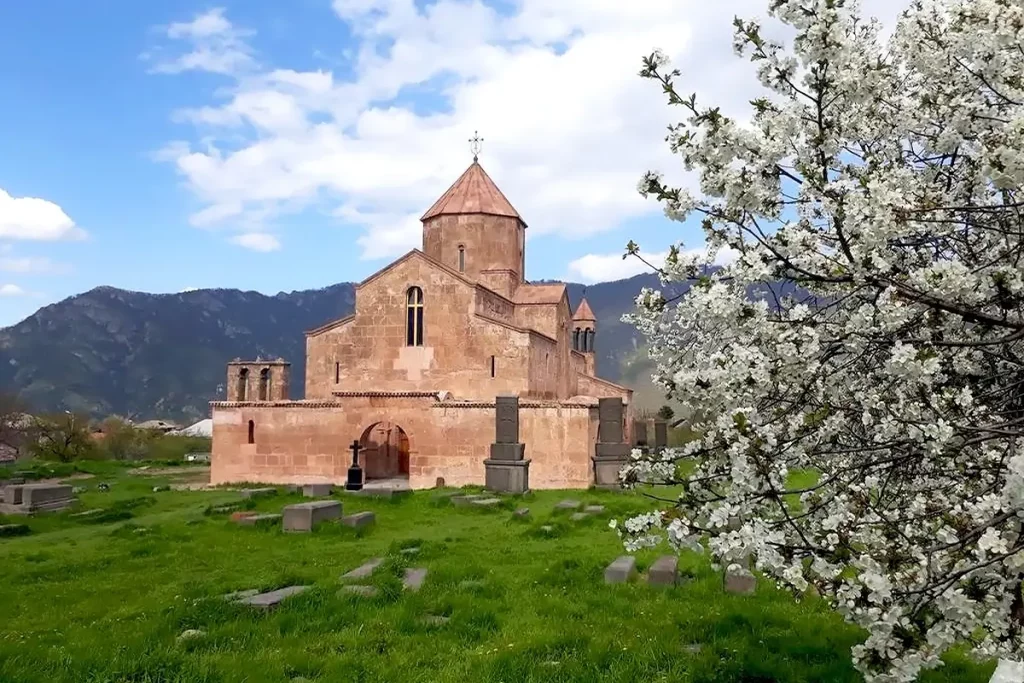
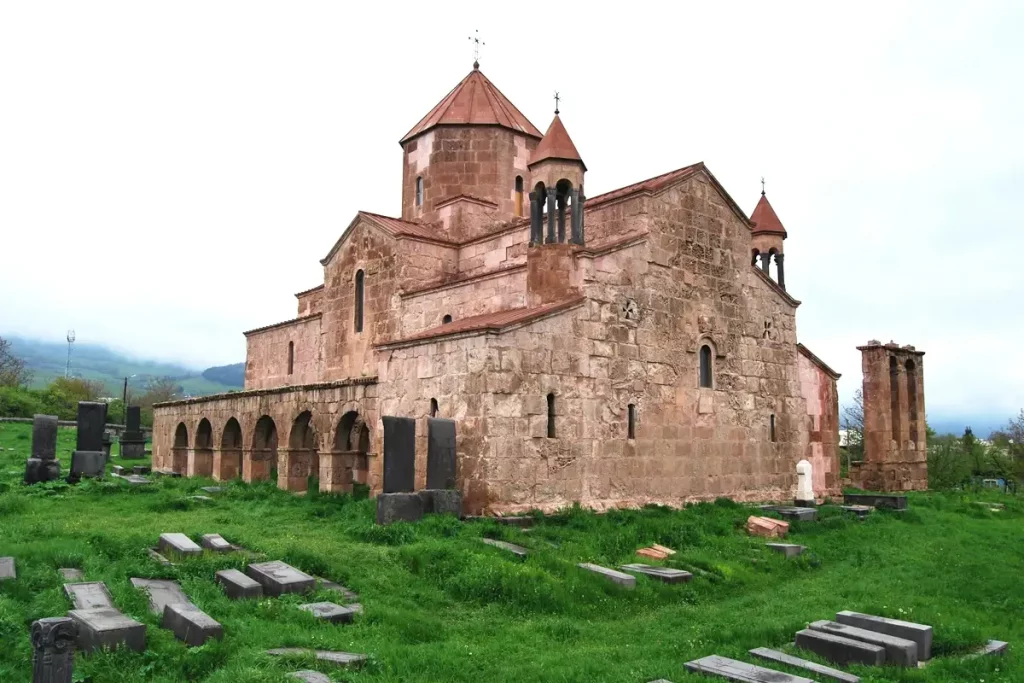
Odzun Monastery (Armenian: Օձունի վանք; also Odzun Church, Օձունի եկեղեցի) is one of the oldest active churches in Armenia, built between the 6th and 8th centuries on a high plateau above the Debed river gorge in the Lori Province. It is also one of the rarest types of medieval Armenian church: a three-nave domed basilica in pink felsite, with arcaded cloister galleries running along the south and west facades — an architectural form that has only a small handful of surviving siblings in the broader Armenian world, including the 7th-century cathedral of Mren in historical Armenia (now in Turkey).
The church’s current shape comes from a major 8th-century reconstruction carried out by Catholicos Hovhannes III Odznetsi (“John of Odzun”), the most important Armenian churchman of his age, who was born in this very village. A few steps to the north of the basilica stands an even rarer monument: a stepped platform supporting two carved stelae depicting the Twelve Apostles, the Annunciation, the Baptism — and the conversion of King Tiridates III by Gregory the Illuminator. Only two such monuments survive in all of Armenia; the other is at Aghudi in Syunik. Together, the basilica and the stelae make Odzun one of the most concentrated single sites of early Armenian Christian art.
Quick Facts
- Built / Founded: 6th c.; rebuilt 717–728
- Location: Odzun village, Lori Province
- Also known as: Odzun Church, Odzun Basilica, Odzun Monastery, Holy Mother of God Church in Odzun, Օձունի եկեղեցի, Օձունի վանք
- From Yerevan: 165 km / about 2.5 hours by car
- Entrance fee: Free
- Time needed: 30–45 minutes on site
- Best time to visit: April–June and September–October
- Status: Active Armenian Apostolic church
- GPS coordinates:
41.0508405, 44.6165052
A short history: from Apostle Thomas to the 2014 restoration
Local tradition places the foundation of Odzun in the first century of Christianity: the Apostle Thomas (in Armenian T’ovmas, “the Doubting Thomas”) is said to have visited the village, ordained the local clergy, and buried Christ’s swaddling clothes at the site of the future church. The Armenian verb otsel (օծել), “to anoint,” is the most widely accepted etymology of Odzun — and the legend connects the place name to that act of consecration. A competing etymology connects Odzun to the Armenian odz, “snake,” reflecting an older pre-Christian layer and the dragon-fighting reputation of the 8th-century catholicos.
The first stone church is widely held to have been founded in the early 4th century under King Tiridates III and Gregory the Illuminator, around the time of Armenia’s adoption of Christianity in 301 AD; it was a simple single-nave basilica without a dome. An earthquake in the 5th century damaged the original; about twenty of its carved relief blocks were reused in the rebuild, and traces of them are still embedded in the present walls. A more substantial 6th-century church rose on the same spot in the form of a three-nave basilica.
The Odzun we see today is the work of one man: Catholicos Hovhannes III Odznetsi (John of Odzun), who served as head of the Armenian Apostolic Church between 717 and 728 AD and was born in this village. Catholicos Hovhannes — nicknamed the Philosopher — rebuilt the church of his birthplace at the start of his catholicate, giving it the domed basilica form that still defines the building today. Folk tradition adds another nickname, fighter with snakes, which casts him as a dragon-slayer; in historical fact he was the diplomat who secured Armenian religious autonomy from the Umayyad Caliph Hisham, compiled the first canon of Armenian ecclesiastical law, and steered the church through the most fragile century of its history.
Through the medieval period Odzun was both a parish and a school. The village was the centre of the medieval Tashir district in Gugark; the 13th-century historian Vardan Areveltsi described it as a “large village or small town.”
In the 19th century the original tile roof was replaced with tufa, paid for by the local Abovyan family; two small belfries were added on the east. Soviet-era restoration plans of the 1980s were interrupted by the collapse of the USSR. The most recent restoration — and the most significant since Hovhannes Odznetsi’s — was carried out between 2012 and 2014 by an Armenian–Italian engineering team. The structure was reinforced, the facades cleaned, and fragments of 6th-century relief sculpture and household items were uncovered. One unexpected find: when workers opened the dome, they discovered a wine bottle sealed there in 1889 containing a note from the previous generation of restorers, marking the completion of their own work.
Catholicos Hovhannes III Odznetsi
Hovhannes III (Hovhan Odznetsi) — John of Odzun in English sources — was one of the defining figures of medieval Armenian Christianity. Born in Odzun around 650, he took the catholicosate in 717 at a moment of enormous pressure: the Umayyad Caliphate had recently conquered the southern Caucasus, Byzantium was pressing in from the west, and the Armenian Church needed to secure its autonomy from both. He answered with two great works.
First, he codified Armenian church law for the first time in the Kanonagirk Hayots (“Book of Armenian Canons”), gathering more than a thousand years of conciliar and canonical material into a single corpus that still anchors the Armenian Apostolic legal tradition.
Second, he negotiated directly with the Umayyad Caliph Hisham, securing religious freedom for Armenians and protecting them from forced conversion — a settlement that bought the Armenian Church the room it needed to remain doctrinally non-Chalcedonian and institutionally independent of both Constantinople and the caliphate.
His monastery in Ardvi (10 km south of Odzun) became his last home and burial place, and a memorial church there — Hnevank — preserves the memory of his retirement. The funerary monument at Odzun itself was long believed to mark his grave, though art historians today date its sculpture style to the 6th century — a century before his death.
Architecture: a domed basilica in pink felsite
Odzun is built of pink felsite blocks — a volcanic stone unusual in Armenian church architecture, which more typically uses tufa or basalt — with dark basalt slabs inside. The building measures 21 × 32 metres and unites two architectural traditions:
- The basilica plan inherited from Roman and early Christian architecture: three naves separated by columns, the central nave wider than the two narrow side aisles.
- The central dome that defines Armenian medieval architecture: a four-pillared central crossing carrying a cupola on a faceted drum, with two further columns supporting the western end.
What makes Odzun unusual even within this hybrid type is the arcaded cloister galleries running along the south facade (the northern one is no longer preserved) and the blank west facade with its single arched entrance. The roof is barrel-vaulted in stone.
The most photographed external feature is the Christ relief carved over the central east window: Christ holds the Gospel of John open in his left hand, and is flanked by two angels carrying palm branches. It is one of the earliest figural carvings of its kind on an Armenian church facade.
A second curious external feature: on a number of the wall blocks, sculptors carved a crescent above a cross — a symbol that has been read as everything from an apotropaic device against Muslim invaders (who would supposedly leave a building marked with a crescent untouched) to a survival of a pre-Christian solar-lunar tradition. Even the village’s name odz (“snake”) seems to gesture at this older layer.
A medieval underground passage is said to have linked the basilica to a small Tsiranavor chapel on a nearby cliff. The passage still exists, but the stairs at the church end have long been filled with soil.
The funerary stelae: only two in Armenia
A few metres north of the basilica stands a small stepped platform with two double arches, and within each arch a 2.4-metre-high carved stele. This is one of only two such funerary monuments in all of Armenia — the other is at Aghudi in Syunik Province.
The east and west faces of the stelae are carved with biblical scenes and with iconography of the introduction of Christianity in Armenia: the Twelve Apostles, the Annunciation, the Baptism, and — most strikingly — King Tiridates III with a boar’s head, punished for the martyrdom of the virgins of Hripsime, later healed and baptised by Gregory the Illuminator. The north and south faces carry geometric and floral ornament, with every panel unique.
By tradition the monument was held to commemorate Hovhannes Odznetsi — though scholars date its carving style to the 6th century, suggesting it was already an old monument when the catholicos was buried elsewhere. A separate, late tradition claims the monument was a gift from an Indian king in the 8th century: there is no documentary basis for this, but the story is repeated in many guides.
The cemetery around the basilica contains medieval khachkars and clerical tombstones from the 7th to the 13th centuries, including a 1291 khachkar over the grave of the priest Khachgund.
The etymology of “Odzun”
Two main theories compete:
- From otsel (օծել), “to anoint.” In the legend of the Apostle Thomas, the village was the place where Thomas anointed the local clergy in the 1st century. In several medieval manuscripts the church is in fact spelled Otsun, supporting this reading.
- From odz (օձ), “snake.” Wikipedia favours this etymology, glossing the name as “place of snakes.” The 8th-century catholicos’s nickname fighter with snakes — and the dragon-slayer folklore around him — both echo this older layer, which may itself preserve a pre-Christian sanctuary.
In Soviet times (and from the early 19th century) the village was officially called Uzunlar, a Turkic etymological reinterpretation in which the Armenian root was reshaped into the Turkic uzun (“tall, long”). The original name was restored in 1967.
How to get to Odzun Monastery from Yerevan
From Yerevan, Odzun is about 165 km — typically 2.5 hours by car on the M3 highway through Spitak and Vanadzor, then a turn onto the M6 toward Alaverdi and a short climb up onto the plateau into Odzun village. The road is paved all the way to the church door, and a free parking area sits directly in front of the gate — a welcome contrast to nearby Kobayr, which requires a steep walk.
By public transport, marshrutkas from Yerevan’s Kilikia bus station run to Alaverdi (about 4 hours, ~1,500 AMD); from Alaverdi a local taxi covers the 8 km up to Odzun in 10–15 minutes. The Yerevan–Tbilisi train also stops at Alaverdi station.
Most visitors combine Odzun with the two UNESCO monasteries in the same canyon. The standard full-day Lori loop is Yerevan → Odzun → Sanahin Monastery → Haghpat Monastery → Yerevan, about 380 km total and 10 hours door-to-door. The most flexible way to do it is with a private car and driver from Yerevan.
Practical tips on site
- Plan 30–45 minutes for the church and the funerary monument; add 15–20 minutes to walk around the cemetery and the canyon viewpoint.
- The basilica is active — modest dress is expected inside, and during services access to the altar area is limited.
- The cliff edge has no guard rails; the canyon below is deep.
- The best photographs of the Christ relief on the east facade are taken at sunrise, when the pink felsite is at its warmest colour.
- The carved face of King Tiridates III with the boar’s head is on the east side of the stelae — easy to miss; look for the standing figure with an animal head.
- No cafés or shops are on site. Bring water and snacks from Alaverdi or Yerevan.
What to see nearby
- Sanahin Monastery (~12 km) — UNESCO World Heritage Site, with the academy of Grigor Magistros Pahlavuni and the medieval matenadaran.
- Haghpat Monastery (~18 km) — Armenia’s first UNESCO listing (1996), with the 1245 free-standing bell tower and the 1273 Amenaprkich khachkar.
- Kobayr Monastery (~15 km) — a half-ruined 12th–13th-century cliff monastery with fragments of Byzantine-style frescoes, reached by a steep climb.
- Akhtala Monastery-Fortress (~25 km) — a 10th–13th-century monastery-fortress known for the only large Armenian–Chalcedonian fresco cycle in Armenia.
- Alaverdi (~8 km) — the regional centre in the canyon below, with a Soviet-era ropeway and the small canyon-floor neighbourhoods.
- Ardvi and Hnevank (~10 km) — the village and small monastery where Catholicos Hovhannes III Odznetsi spent his last years and where, by tradition, he is buried.
Frequently asked questions
Odzun is the kind of medieval site that condenses an unusual amount of Armenian history into a single courtyard: a 6th-century pink felsite basilica founded after the country adopted Christianity; a Christ relief on the east wall carved a century before the great Carolingian renaissance; a stepped funerary monument with the conversion of King Tiridates carved into its stones; and the architecture of a catholicos who, sitting here in his birthplace, would soon write Armenia’s first book of canon law. With Sanahin and Haghpat in the same canyon, Odzun is one of the three indispensable stops of a Lori day from Yerevan — best taken in with a private car and driver from Yerevan.


