Harichavank Monastery
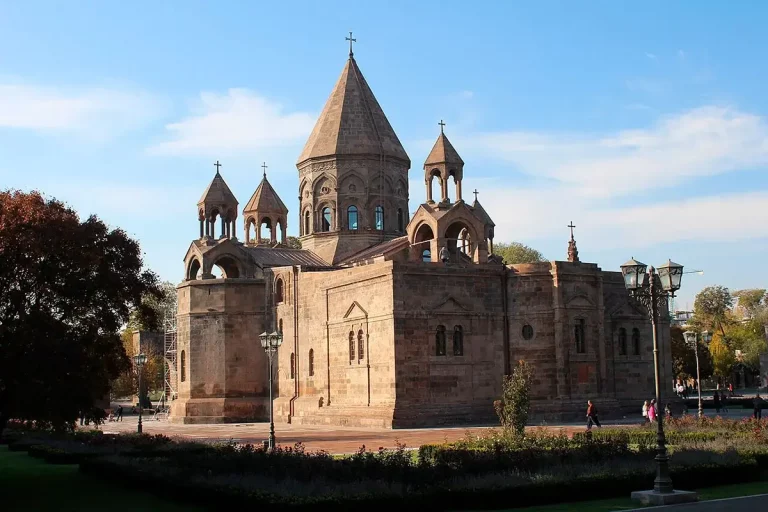
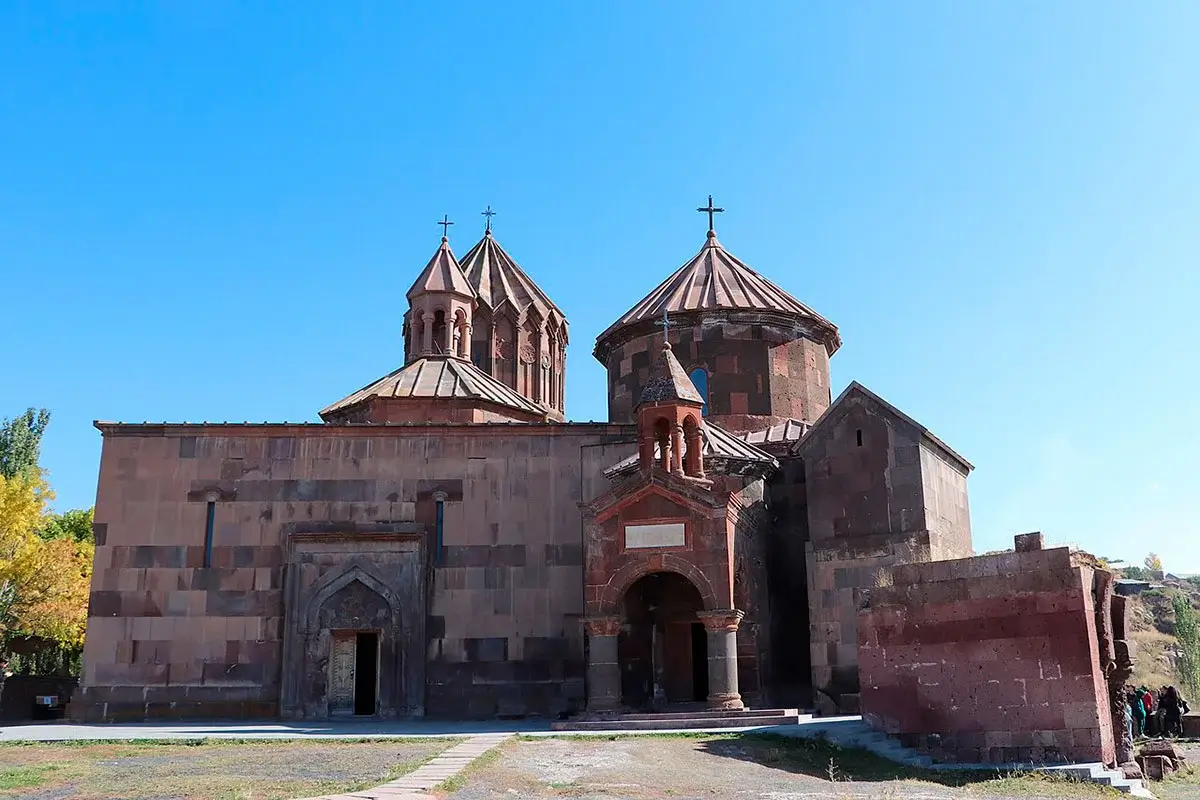
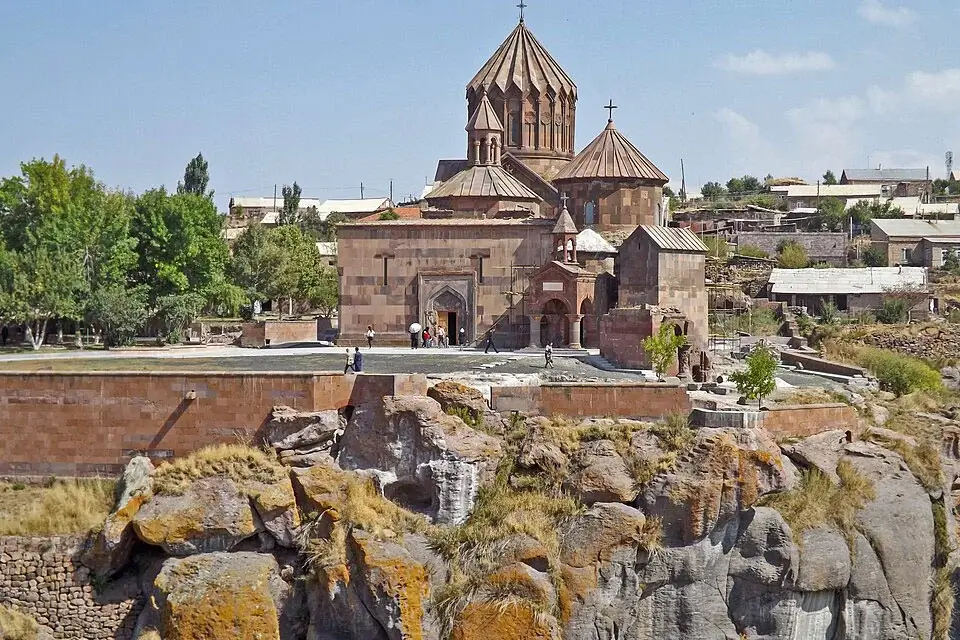
Harichavank Monastery (Armenian: Հառիճավանք) is a 7th–13th-century Armenian monastic complex built on a rocky promontory between two canyons at the southern edge of Harich village, in the Shirak Province of north-western Armenia. It is, at the same time, one of the oldest and one of the most architecturally influential monasteries in the country: the small 7th-century Church of St. Gregory the Illuminator at its centre is a classic of the Mastara school, while the great cathedral of Surb Astvatsatsin, built in 1201 by the Zakarian brothers, became the template for the better-known Gandzasar Cathedral and for the cathedral at Hovhannavank Monastery.
The monastery’s outer walls are built of huge stone blocks of contrasting colours laid in a checkerboard pattern — a signature that makes Harichavank instantly recognisable. Since 1850 it has been the summer residence of the Catholicos of All Armenians, and today an active theological seminary occupies the 19th-century outbuildings around the medieval core. Despite its rank — Wikipedia lists it among the most famous monastic centres in medieval Armenia — Harichavank still receives a fraction of the visitors who fill Geghard or Tatev.
Quick Facts
- Built / Founded: 7th c. (Surb Grigor); 1201 (Surb Astvatsatsin Cathedral)
- Location: Harich village, Shirak Province
- Also known as: Harichavank, Harichavank Monastery, Arichavank, Aritchavank, Haritchavank, Հառիճավանք
- From Yerevan: 115 km / 1.5–2 hours
- Entrance fee: Free
- Time needed: 40–60 minutes
- Best time to visit: May to October
- Status: Active monastery / theological seminary
- GPS coordinates:
40.6063309, 43.999588
A short history: from a fortress town to the Catholicos’s summer seat
Harich is one of the oldest continuously inhabited places in Shirak. Archaeological excavations carried out in 1966 showed a fortified settlement here as early as the 2nd century BC — one of the better-known fortress towns of ancient Armenia. In the monastery’s cemetery, the ruins of a small single-nave 5th-century basilica survive, together with carved tombstones of the 5th–6th centuries (now in the State Historical Museum of Armenia in Yerevan): the Christian tradition on this site is older than the monastery itself.
The founding date of Harichavank proper is unknown, but the oldest standing building — the Church of St. Gregory the Illuminator — is dated to no later than the 7th century. The monastery was severely damaged during the Seljuk raids of the 11th century, and between 1120 and 1191 Harich was occupied by Kipchaks. Restoration started in the 12th century under Father Grigor “the Preceptor.”
The monastery’s golden age began at the very end of the 12th century, when the great Armenian feudal house of Zakarian — represented by brothers Zakare and Ivane — purchased Harich from the older Pahlavuni clan. Zakare, who as amirspasalar (commander-in-chief) ruled all of Eastern Armenia together with his brother in the early 13th century, commissioned the great cathedral of Surb Astvatsatsin in 1201. A monumental gavit was added soon after, before 1219, by Prince Vahram Hetschup, linking the two churches into a single ensemble.
Harichavank’s scriptorium and school grew into one of the principal centres of learning in medieval Armenia. A single surviving page of a Bible copied here in 1209 by the scribe Margare reaches us today as one of many manuscripts produced in the monastery through the 13th century.
The next great chapter of the monastery’s history opened in 1850, when Catholicos Nerses V designated Harich the summer residence of the Catholicos of All Armenians. New monastic cells, a seminary building, a refectory, guest rooms, a bell tower and service buildings rose around the medieval core; a “Harichavank Company” of young Armenian scholars formed in Gyumri in the same year, with the explicit goal of restoring the monastery and reopening its school. Between 1887 and 1889, a teenage student from Alexandropol named Avetik Isahakyan — who would become one of the great Armenian poets of the 20th century — studied at the Harich seminary. The Company stopped its activities in 1915; the seminary tradition continued and is active again today
Surb Grigor (7th c.): a Mastara-style church
The oldest building in the complex is the small Church of St. Gregory the Illuminator — a 7th-century domed church of the so-called “Mastara style”, named after the slightly older 5th-century church of St. Hovhannes in the village of Mastara further south. Two later chapels were appended to it: a single-storey one on the south-east side in the 10th century, and a two-storey chapel on the south-west in the 13th. Its compact shape and bare stone interior provide a deliberate contrast to the grander cathedral built beside it eight hundred years later.
Surb Astvatsatsin Cathedral (1201): the template for Gandzasar
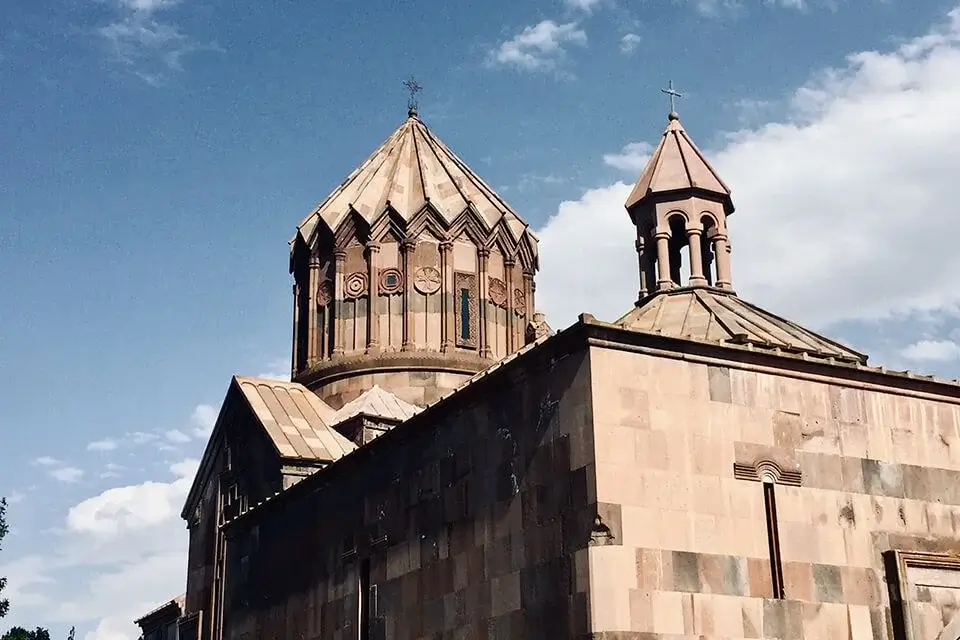
The dominant building of Harichavank, Surb Astvatsatsin (“Holy Mother of God”), was completed in 1201 under Zakare Zakarian’s direct patronage. It is a cross-domed church with two-storey annexes in all four corners, a high cylindrical drum, and a magnificent umbrella-shaped dome decorated on the outside with a band of paired triple columns alternating with large carved rosettes — every rosette different.
Art historians place Surb Astvatsatsin at the head of the so-called “Gandzasar style” of 13th-century Armenian cathedrals — a family of buildings sharing the same cruciform plan, the same umbrella dome, the same triple-column-and-rosette drum, the same narthex with stalactite-ornamented ceilings, and the same large carved cross on one of the walls. The cathedral of Hovhannavank Monastery, built in 1216–1221, belongs to the same family. The most famous of the Gandzasar-style churches, the Gandzasar Cathedral itself, was completed in 1238 — meaning Harichavank’s 1201 cathedral is the earliest surviving example of a style that would shape Armenian church architecture for the next century.
The east facade carries a sculpted high-relief of the two Zakarian brothers holding a model of the cathedral between them — a donor portrait device that also appears at Sanahin, Haghartsin, and the Memorial Cathedral of Dadivank. In 1895 the relief was covered with a marble plaque depicting the Madonna; when the plaque was later removed, the medieval original re-emerged underneath, partly damaged but intact.
The most striking interior feature lies in the west annexes of the cathedral: three-arched stone colonnades with console-supported stone staircases, an architectural device that does not appear in any other Armenian medieval church. The exterior is also rich with surface decoration — rosettes, a stone sundial, the bird-with-a-woman’s-face sirin relief, dove sculptures — assembled together into one of the densest sculptural ensembles in medieval Armenian church architecture.
The scriptorium and the seminary
Harichavank’s reputation among medieval Armenian monasteries rested less on its architecture than on its library and scriptorium. The school operated from the time of the 7th-century Surb Grigor and continued through the centuries; in 1850 it was reopened as a full theological seminary, on a footing that placed it together with the Vazgenian Theological Academy and the Gevorgian Seminary at Etchmiadzin as one of the three principal training schools of the Armenian Apostolic Church. Beyond Avetik Isahakyan, generations of Armenian clergy and writers passed through Harich. An active seminary continues today in the 19th-century buildings around the old monastery.
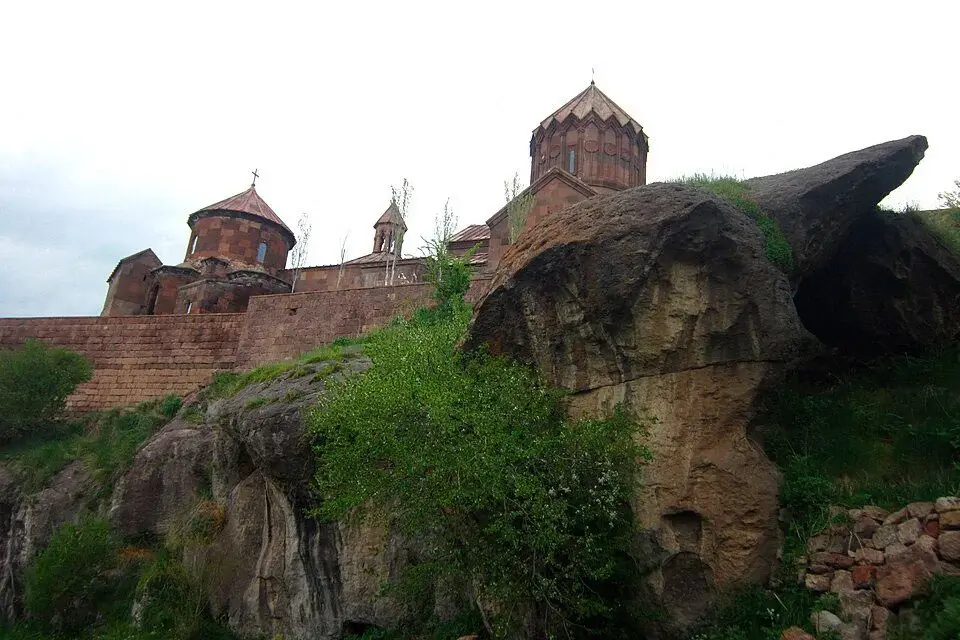
The hermitage on the “swinging rock”
To the south of the main complex, on a separate cliff above the canyon, stands a small 12th-century vaulted chapel — the Hermitage Chapel. At some point in the past an earthquake fractured the cliff and split the small rock outcrop on which the chapel sits from the rest of the monastery’s promontory; today it can only be reached with climbing gear. Locals sometimes call it the “swinging rock,” and there is a folk tradition that anyone who throws a small stone into a hole in the chapel’s wall from across the gap will have a wish granted.
It is one of the most photogenic single details of any Armenian monastery — a small medieval chapel apparently floating on its own crag against the deep gorge below.
The legends of Harichavank
Two folk stories have grown up around the building’s resilience.
The doves of the Seljuk raid. During an early Seljuk raid villagers are said to have hidden inside the church. When the attackers broke in they found the church empty — its inhabitants, the legend goes, had been miraculously turned into doves and flown out through the windows. The story is told at several Armenian monasteries; at Harichavank it appears tied to the 11th-century invasions.
The floating columns of the Mongol raid. A second story describes a Mongol attempt to demolish the great gavit. The attackers tied ropes around the gavit’s columns and harnessed them to oxen and horses, pulling until the columns broke loose from their stone bases — but did not fall. The columns remained suspended in mid-air; the Mongols, terrified, abandoned the monastery in panic. The columns stayed “floating” for several months until the monks fixed them back into place with mortar. Traces of that medieval mortar are reportedly still visible at the base of the columns.
How to get to Harichavank Monastery from Yerevan
Harichavank is 115 km from Yerevan — about 1.5–2 hours by car on the M1 highway towards Gyumri. The monastery sits 5 minutes off the main road, just past Artik (3 km south-east of the village). From Gyumri the drive is short — about 25 km, 30 minutes — and a one-way taxi via GG Taxi typically costs 3,000–4,000 AMD.
By public transport, marshrutkas from Yerevan’s Kilikia bus station run to Artik several times a day; from Artik it is a 3 km hop by taxi or a 30-minute walk to the monastery. For a comfortable day combining Harichavank with Hovhannavank, Saghmosavank and Amberd Fortress, the simplest option is to hire a car with driver in Yerevan.
A classic full-day Shirak loop runs Yerevan → Hovhannavank → Saghmosavank → Harichavank → Gyumri → Yerevan — about 250 km total, with the monasteries linked by short side-trips off the main highway.
Practical tips on site
- Plan 40–60 minutes for the monastery itself; add 20–30 minutes for the canyon and the Hermitage Chapel view.
- Harichavank is an active religious site — modest dress is expected inside the church, and during liturgies access may be briefly restricted.
- The complex stands on an open plateau where the wind is almost always present; even in midsummer a windbreaker pays off.
- There are no cafés or shops at the monastery — bring water and food from Artik or Gyumri.
- The Hermitage Chapel cannot be approached on foot from the monastery side; the best view is from the south edge of the main terrace.
- A small parking area on packed gravel sits at the foot of the access road.
What to see nearby
- Gyumri (~25 km) — Armenia’s second city, with the historic Kumayri district of black-tuff 19th-century architecture and several museums.
- Hovhannavank Monastery and Saghmosavank Monastery (~50 km) — the twin monasteries on the Kasagh canyon, on the standard Shirak/Aragatsotn day loop from Yerevan.
- Yereruyk Basilica (~60 km) — 4th–6th-century paleo-Christian basilica near the Turkish border, on UNESCO’s Tentative List.
- Marmashen Monastery (~30 km) — a 10th-century Bagratid monastic complex on the Akhurian river.
- Lmbatavank (~5 km, near Artik) — a small but architecturally refined 6th–7th-century church with rare medieval frescoes.
- Amberd Fortress (~40 km on the return route) — a 10th–13th-century fortress on the southern slope of Mount Aragats at 2,300 m.
- Byurakan Observatory (~35 km) — one of the leading astrophysical observatories of the 20th century.
Frequently asked questions
Harichavank is the kind of medieval monastery where the architecture quietly tells a much bigger story than the visitor numbers suggest: a 7th-century church in the Mastara style; a 1201 cathedral that gave the rest of medieval Armenia a template; a Zakarian donor portrait, a small chapel suspended on its own cliff; and 175 years of continuous service as the Catholicos’s summer seat. With Hovhannavank and Saghmosavank on the same Aragatsotn–Shirak day, the easiest way to take in the cluster is with a private car and driver from Yerevan.