Etchmiadzin Cathedral
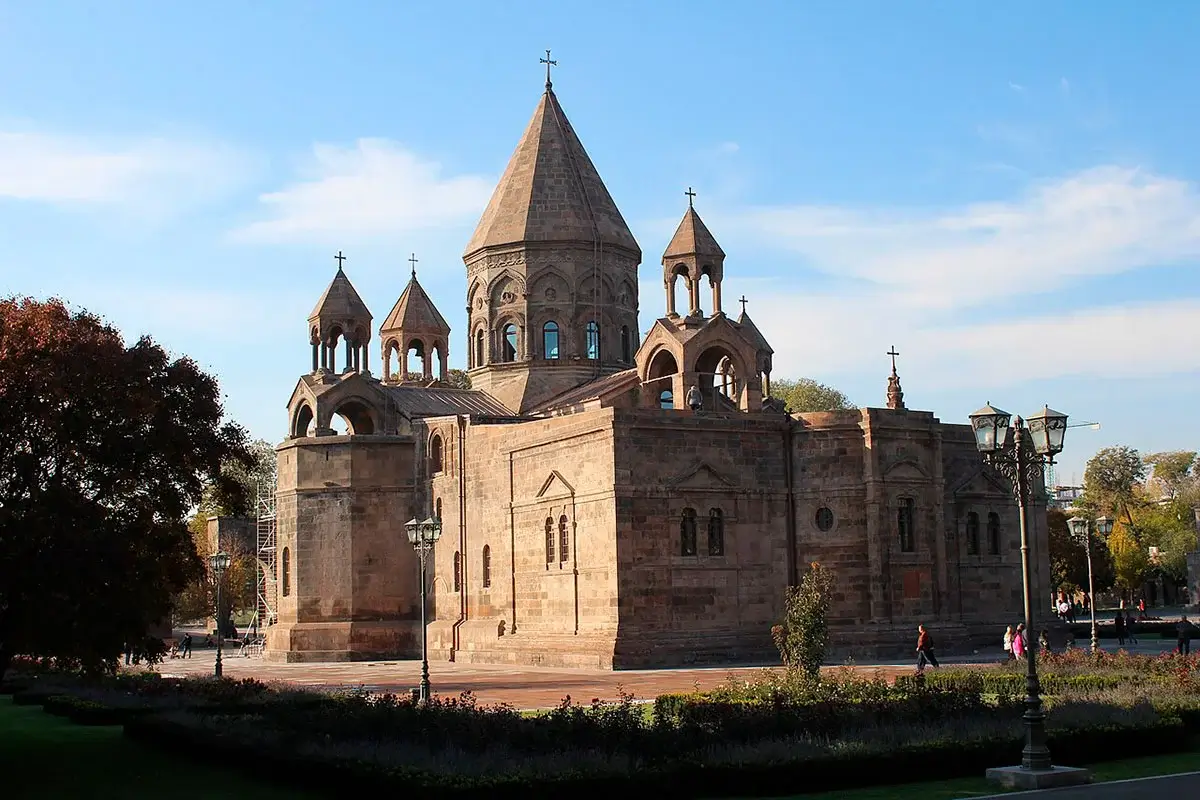
Etchmiadzin Cathedral (Armenian: Մայր Տաճար, Mayr Tachar — “Mother Cathedral”) is the principal church of the Armenian Apostolic Church and one of the oldest Christian cathedrals in the world, built in 301–303 AD. It stands at the centre of the Mother See of Holy Etchmiadzin in the town of Vagharshapat, 20 km west of Yerevan in Armavir Province. The cathedral is the seat of the Supreme Patriarch and Catholicos of All Armenians; its treasury preserves the Holy Lance that pierced the side of Christ and a fragment believed to be from Noah’s Ark. In 2000 the cathedral was inscribed on the UNESCO World Heritage List together with the nearby churches of St. Hripsime, St. Gayane, and the ruins of Zvartnots Cathedral.
Quick Facts
- Built / Founded: 301–303 AD
- Location: Vagharshapat (Etchmiadzin), Armavir Province
- Contained in: Mother See of Holy Etchmiadzin
- Also known as: Mother Cathedral of Holy Etchmiadzin, Mayr Tachar, Etchmiadzin Mother Cathedral, Echmiadzin Cathedral, Էջմիածնի Մայր Տաճար, Մայր Տաճար
- From Yerevan: ~20 km (25–30 min by car)
- Entrance fee: Free
- Time needed: 1–1.5 hours
- Status: Active; Mother See of the Armenian Apostolic Church
- GPS coordinates:
40.1619, 44.2915
A short history: from Gregory the Illuminator to today
In 301 AD Armenia became the first state in the world to adopt Christianity as its state religion. According to tradition recorded by the 5th-century historian Agathangelos, St. Gregory the Illuminator had a vision in which Christ descended from heaven and struck the ground with a golden hammer, showing where the cathedral should rise. The name Etchmiadzin — “the Descent of the Only-Begotten” — refers to that vision. The first church was built in 301–303 by St. Gregory and King Tiridates III on the site of a pagan temple, near the royal palace of Vagharshapat. (The name “Etchmiadzin” itself only came into common use in the 15th century; earlier sources call it the Cathedral of Vagharshapat.)
The original structure was a basilica. By the late 5th century it had fallen into disrepair, and around 483/4 the Persian-appointed governor Vahan Mamikonian rebuilt it from the foundations as a cruciform domed church with four apses and a central dome on four pillars — the floor plan that survives to this day. This invention of Armenian architects, a central-domed cross-hall church, later spread to Byzantium and then to Central and Western Europe.
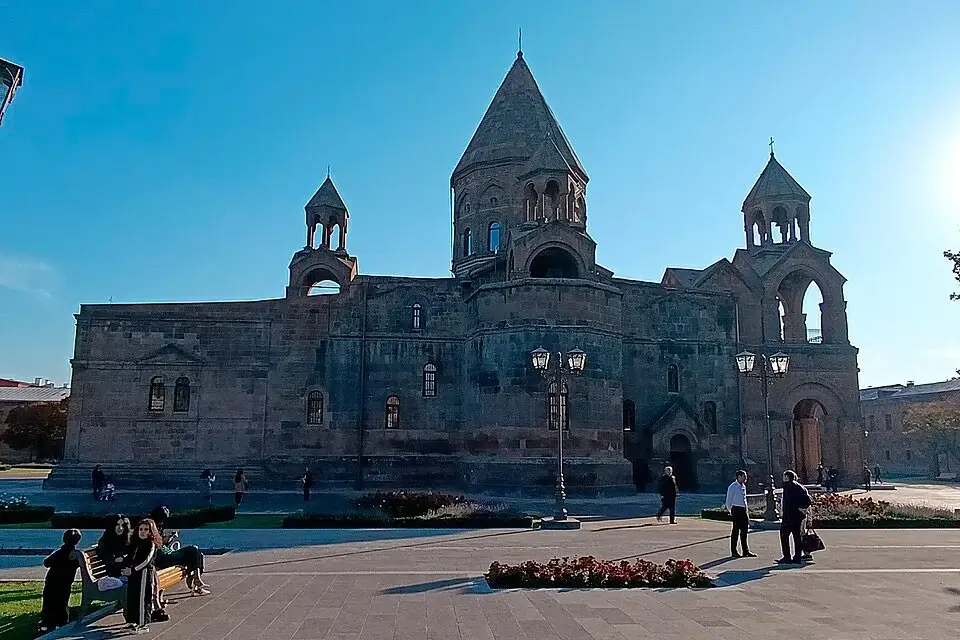
The catholicosate moved away from Etchmiadzin for centuries during foreign rule and was based in Dvin, Ani, and finally Sis in Cilician Armenia. After the fall of the Armenian Kingdom of Cilicia, a council of clergy met in 1441 and voted to return the catholicosate to Etchmiadzin, where it has remained ever since. In 1604 Shah Abbas I of Safavid Iran plundered the cathedral during his scorched-earth campaign and deported much of the Armenian population to Isfahan; some of the relics were later returned. The three-tiered bell tower at the western entrance was added in 1653–1658, the six-column rotundas on three sides in the 18th century, and the sacristy (treasury museum) on the east end in 1869 under Catholicos Gevorg IV.
The most recent restoration began in 2012 and entered an intensive phase in 2018, when the cathedral closed to the public. After more than six years of work — reinforcing the structure, renewing the dome and roof, and conserving the interior frescoes — the cathedral was re-consecrated and reopened on 29 September 2024.
Architecture: from basilica to cross-domed cathedral
The Etchmiadzin Cathedral you see today is a compact cruciform church measuring roughly 33 × 30 m, with a central dome about 34 m high crowned by the conical drum so characteristic of Armenian church architecture. Four massive pillars inside the church carry the dome, and the four apses on each side form the cruciform plan. Beneath the main altar a stone slab marks the spot where, according to legend, Christ struck the ground with his golden hammer.
The cathedral has three altars — a central marble one and two flanking apses on the north and south. Excavations under the floor in the 1950s uncovered an 8th–6th-century BC Urartian stele and, above it, the pyre of a Sasanian fire temple built inside the cathedral in 450 AD during a brief attempt to impose Zoroastrianism — physical traces of the building’s layered past.
Just outside the cathedral stand Trdat’s Gate — the only surviving fragment of the royal palace of the Arsacid kings of Armenia that once stood next to the church.
The Hovnatanyan frescoes
The interior of the cathedral is famous for its painted ceiling and walls, the work of four generations of the Hovnatanyan family — an extraordinary Armenian dynasty of artists. The patriarch, Naghash Hovnatan, painted the cathedral between roughly 1710 and 1721; his work in the upper part of the dome and the image of the Virgin Mary in the main apse still survive. His sons Hakob and Harutyun Hovnatanyan continued the work in the mid-18th century, and his grandson Hovnatan Hovnatanyan added more than a hundred new compositions of Christ, the Virgin, and the saints between 1782 and 1786. In the 19th century, Mkrtum and Hakob Hovnatanyan painted further scenes. The 2018–2024 restoration cleaned centuries of candle soot from these frescoes and brought their gold and deep colours back to life.
The Treasury Museum: Holy Lance and the relics
The sacristy on the east side of the cathedral, built in 1869, houses the principal relics of the Armenian Apostolic Church:
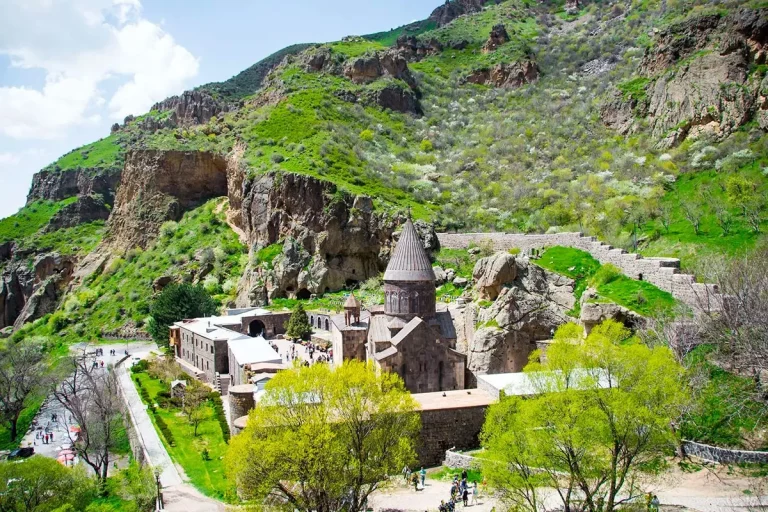
- The Holy Lance (Sourb Geghard) — the spearhead said to have pierced the side of Christ on the cross. Brought to Armenia by the Apostle Thaddeus, it was kept for centuries at Geghard Monastery — which takes its name from the relic — and later moved here to Etchmiadzin, where it is displayed in a finely worked silver reliquary.
- A fragment of Noah’s Ark, set in a 1698 reliquary. According to legend the piece was given to St. Jacob of Nisibis, who tried to climb Mount Ararat in search of the Ark itself.
- Particles of the True Cross.
- Relics of saints, the right hands of the apostles Thaddeus and Bartholomew, vestments of Catholicoi, illuminated manuscripts, and medieval decorative art.
The museum complex has grown beyond the 1869 sacristy and today includes several galleries within the cathedral grounds.
The Mother See complex: what else to see on the grounds
Beyond the cathedral itself, the walled monastic enclosure — often described as the “Armenian Vatican” — contains:
- The residence of the Catholicos of All Armenians, the supreme head of the Armenian Apostolic Church.
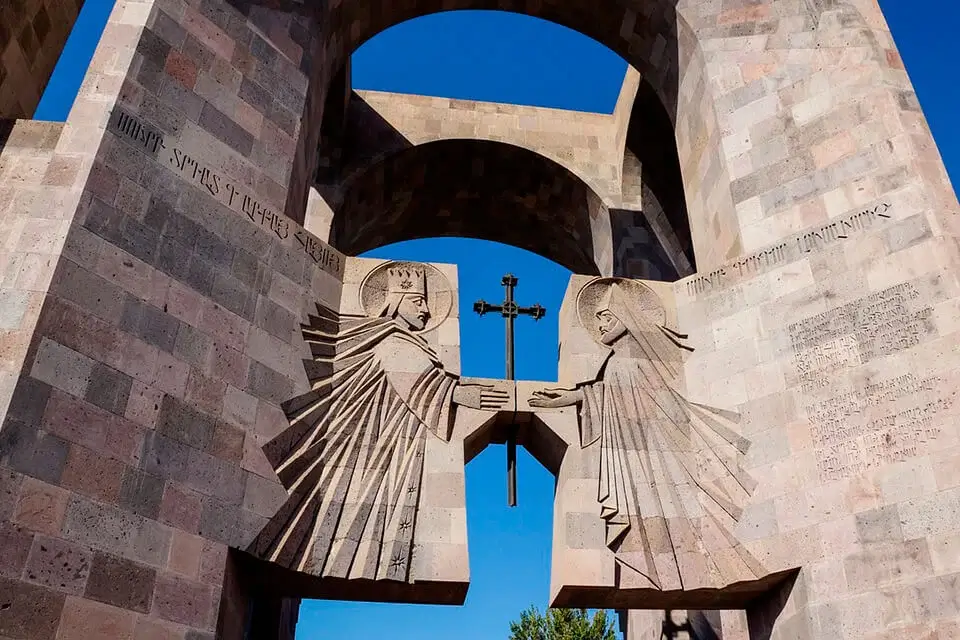
- Trdat’s Gate — a surviving portal from the 4th-century royal palace.
- The Gevorkian Theological Seminary, founded in 1874 by Catholicos Gevorg IV — the oldest active theological school in Armenia.
- A historic printing press, established in 1772 — one of the earliest Armenian presses.
- Khachkars — a collection of medieval cross-stones placed throughout the grounds.
- Monastic cells, gardens, and chapels.
How to get to Etchmiadzin Cathedral from Yerevan
The cathedral is about 20 km west of Yerevan, in the town of Vagharshapat (still widely called Etchmiadzin). By car the drive takes 25–30 minutes; the Zvartnots ruins lie roughly halfway between the two and are easy to combine in one trip. Public minibuses (marshrutkas) leave regularly from Yerevan’s Kilikia bus station and reach Vagharshapat in 30–40 minutes; from the central stop in town it is a 10-minute walk to the cathedral.
A convenient alternative — especially if you want to add Zvartnots, St. Hripsime, and St. Gayane to the same trip — is to hire a car with driver in Yerevan and let the driver wait at each stop.
Opening hours, dress code and practical tips
- Cathedral: daily, approximately 07:00–20:00. Free entrance.
- Treasury Museum: open daily except Mondays; hours vary seasonally (typically around 10:30–17:00). Paid ticket — check the current price on arrival.
- Plan 1–1.5 hours for the cathedral, the museum, and a walk through the complex.
- Dress code: shoulders and knees covered. Women are not required to cover their hair, but headscarves are available at the entrance.
- The complex remains an active religious site and the residence of the Catholicos. During liturgies access to the altar area is restricted — Sunday morning service brings the largest crowds.
- A car park is available next to the complex, and there are cafés and small restaurants in the surrounding town.
What else to see nearby
- St. Hripsime Church (~1 km) — built in 618. One of the masterpieces of Armenian early-medieval architecture and part of the same UNESCO listing.
- St. Gayane Church (~500 m) — built in 630, with a three-arched gavit added in 1683. Also UNESCO.
- Shoghakat Church (~300 m) — a small, elegant church built in 1694.
- Zvartnots Cathedral ruins (~5 km) — a remarkable 7th-century round church destroyed by an earthquake around the 10th century, now an archaeological park and UNESCO site.
- Yerevan (~20 km) — the capital, with its museums, the Cascade, and Republic Square.
A classic half-day route is Etchmiadzin → St. Hripsime → St. Gayane → Zvartnots. For a full day, you can extend the trip eastwards to Garni Temple and Geghard Monastery — combining Armenia’s early Christian heritage with one of its most famous pre-Christian monuments in a single day with private cars and drivers in Yerevan.
Frequently asked questions
Etchmiadzin Cathedral is where the story of Christian Armenia began in 301 AD and where it is still lived today. The four central pillars of its dome carry an architectural idea that Armenian builders gave to the rest of the Christian world; the walls inside hold frescoes painted by four generations of one family; and in the sacristy nearby, the Holy Lance and a fragment of Noah’s Ark connect this corner of Armavir to the oldest stories of the faith. To visit Etchmiadzin together with Zvartnots, St. Hripsime, and St. Gayane, consider private cars and drivers in Yerevan — all four UNESCO sites fit comfortably into a half-day trip.