

Areni-1 Cave
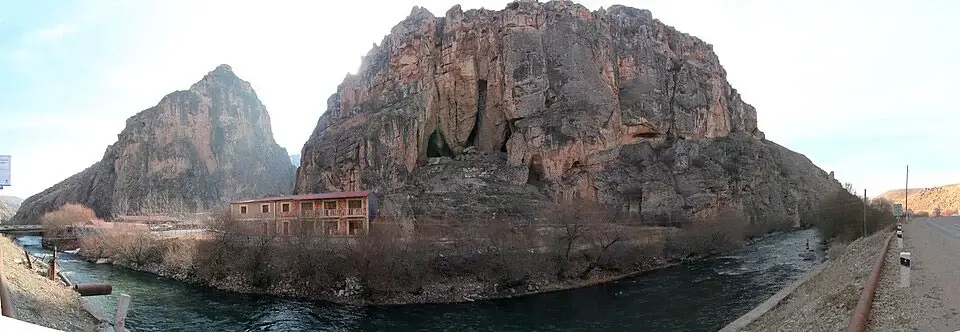
This cave near the village of Areni in southern Armenia holds two of the most remarkable archaeological discoveries of the 21st century. The world’s oldest leather shoe — about 5,500 years old — was pulled from a pit here in 2008. The world’s oldest known winery — fermentation vat, press, storage jars, the lot — was unearthed a year earlier, dated to about 6,100 years ago. The shoe is older than Stonehenge by 400 years and the pyramids of Giza by almost 1,000. The winery is more than 1,000 years older than the next-oldest discovered, in the West Bank in 1963. Both finds came out of the same modest three-chambered limestone cave, locally known as the Bird Cave for the nests in its vaulted ceiling, and excavation is still in progress — most of the cave’s 500 square metres remain unexplored.
Quick Facts
- Built / Founded: Chalcolithic occupation 4300–3400 BCE; excavations since 2007
- Location: Areni village, Vayots Dzor, Vayots Dzor Province
- Also known as: Bird Cave, Birds' Cave, Trchuneri, Areni 1 Cave, Արենի-1 քարանձավ
- From Yerevan: 120 km / 1.5–2 hours
- Elevation: 1080 m
- Entrance fee: 2000 AMD
- Time needed: 30–50 minutes on site; pairs with Noravank + Areni wine
- Best time to visit: April–October; mornings for the caretaker
- Status: Archaeological monument; active excavation site
- GPS coordinates:
39.7304,45.2037
Two World Records in One Cave
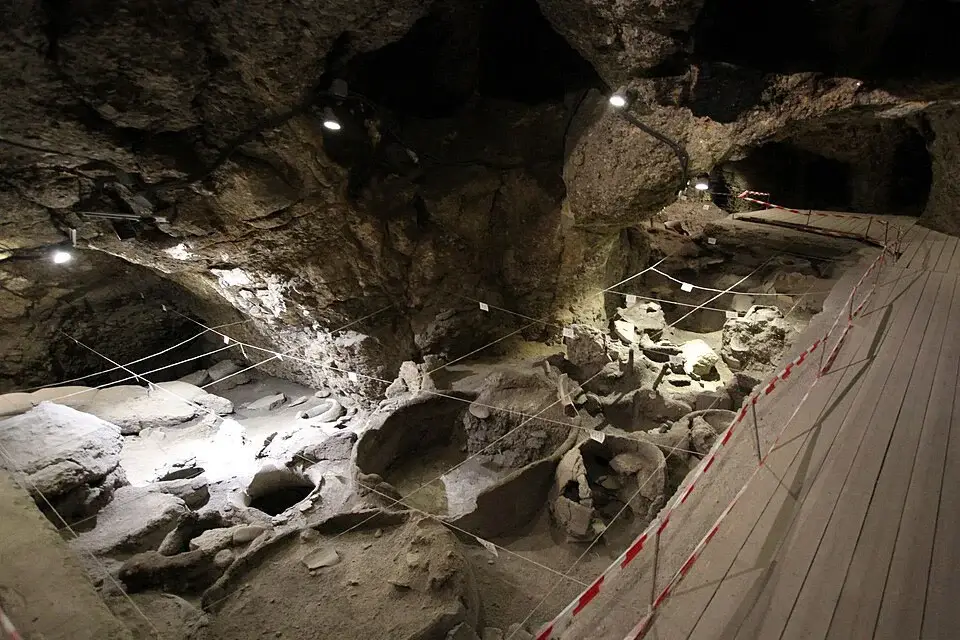
Areni-1 isn’t visually spectacular. It’s a working archaeological site, not a museum. What makes it one of Armenia’s most important destinations is what came out of it, why it survived, and what’s still in the ground.
The reason these finds exist at all is the microclimate. The cave is cut into Cretaceous-era limestone conglomerate (a karstic formation), and inside it the temperature stays low and humidity stays consistent. That combination is what preserves organic material — leather, plant fibres, brain tissue — that would have rotted away anywhere else within a few centuries. The Areni-1 finds are a window into the Late Chalcolithic (“Copper Age”, 4300–3400 BCE) — the era when farming, metalworking, weaving and viticulture were converging across the Near East — preserved with a clarity that no other site in the region matches.
The World’s Oldest Leather Shoe
In 2008 a young Armenian archaeologist, Diana Zardaryan, was working in Trench 3 — outside the main cave entrance — when she lifted a fragment of pottery and found, underneath it, a complete leather shoe.
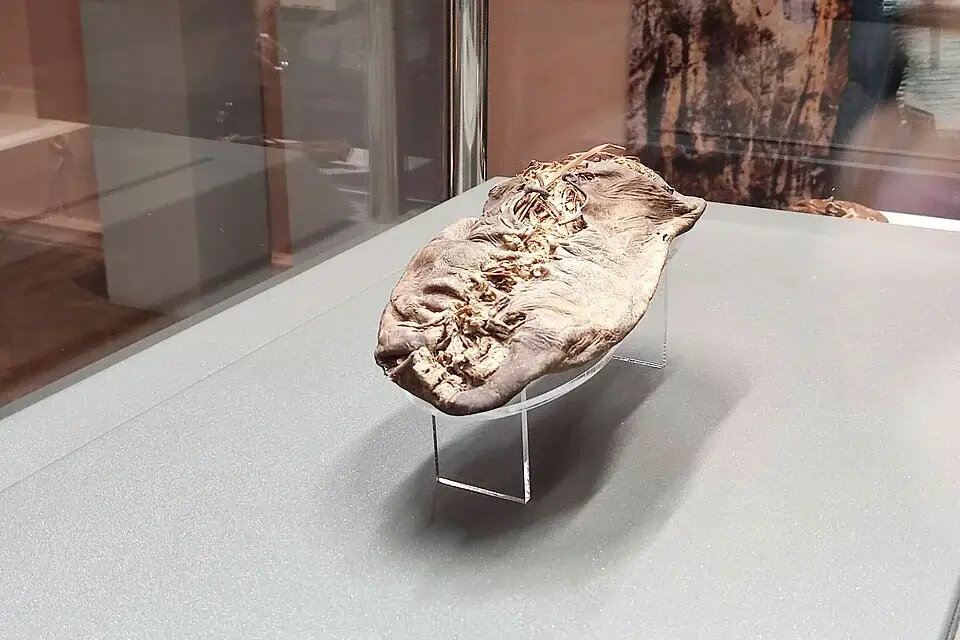
The shoe sat upside down in a shallow plastered pit (45 cm deep, about 45 cm across), tucked between goat horns and the inverted ceramic bowl. It was packed with loose grass — either to keep its shape or for storage. The team initially assumed it was 600 to 700 years old. Radiocarbon dating by two independent laboratories in Oxford and California came back with a result no one expected: 3,627 to 3,377 BCE (5,637 to 5,387 years before present), with 95.4% confidence.
The shoe is a single piece of tanned cowhide cut to fit the wearer’s right foot, 24.5 cm long and 7.6 to 10 cm wide — modern European size 37 / UK 5 / US women’s 7. The leather was tanned, which Ron Pinhasi (one of the lead archaeologists) noted was probably a new technology at the time. The construction is uncannily similar to two folk shoe styles that survived into the 20th century: the Irish pampootie, worn on the Aran Islands until the 1950s, and the Balkan opanki, still seen at festivals today. The continuity is striking — a piece of footwear engineering that lasted, broadly unchanged, for fifty-five centuries.
The shoemaker Manolo Blahnik, asked by National Geographic for a comment in 2010, said simply: “It is astonishing how much this shoe resembles a modern shoe!”
The results were published in PLoS ONE in June 2010 (Pinhasi et al., “First Direct Evidence of Chalcolithic Footwear from the Near Eastern Highlands”). The shoe is now in the History Museum of Armenia in Yerevan, on permanent display. What you see in the cave is the trench where it was excavated.
The World’s Oldest Winery
The shoe gets more press, but the winery is arguably the more important find.
The previous year — 2007 — the joint Armenian-Irish team led by Boris Gasparyan and Ron Pinhasi opened a trench in the first gallery of the cave and found, embedded in the floor, a complete Chalcolithic wine-production facility: a clay treading basin one metre across, a fermentation vat 60 cm deep dug into the floor beside it, storage jars lined up against the wall, pottery sherds, drinking cups, and a row of small shallow pits that may have served as a press.
Surrounding the equipment were grape pips (identified as Vitis vinifera — the same species used for almost all modern wine), pressed-grape skins, dried vines, walnuts and prunes. Chemical analysis of one of the storage jars detected malvidin — the red pigment that gives red wine its colour and one of the most reliable molecular markers of grape fermentation.
Carbon dating placed the entire complex at 4,100 to 4,000 BCE, around 6,100 years old — more than 1,000 years older than the next-oldest winery known (a site in the West Bank discovered in 1963).
Gregory Areshian, the project’s UCLA co-director, summarised the significance:
“For the first time, we have a complete archaeological picture of wine production dating back 6,100 years.”
One striking detail: human burials, including pots containing children’s skulls, were found in the same chamber as the winery. The team’s interpretation is that the wine was made for funerary rituals — the dead were buried with vessels of wine, and the burial pottery and the winery seem to have functioned as a single complex. The pattern echoes a passage in Xenophon’s Anabasis (4th century BCE) describing Armenians drinking wine from buried jars through reed straws — a description Gasparyan said reminded him directly of what they were finding.
The results were published in the Journal of Archaeological Science (2011).
The Oldest Preserved Human Brain — And the Other Finds
The shoe and the winery are the headline discoveries, but the cave has produced an extraordinary list of other firsts and rarities.
In 2009 the team excavated three burial pots, each containing the skull of a child between 12 and 14 years old. One of those skulls still held preserved brain tissue with visible blood vessels — believed to be the oldest preserved human brain ever found. The preservation again came down to the cave’s microclimate.
Other finds from the same Chalcolithic layer include:
- A straw skirt (~3,900 BCE) — among the world’s oldest surviving items of clothing
- Seeds from nearly 40 species of fruits including apricot and grape
- Metal knives
- Textiles including reed-fibre cloth and basketry
- Women’s jewellery
- Part of a mummified goat
- Four types of pottery — only one of which is local; the other three signal active trade networks across the Near East
Areshian, asked about the mobility of the people who used the cave, told National Geographic: “These people were walking long distances. We have found obsidian” from sources tens or hundreds of kilometres away.
The picture that emerges is of a community far more connected, technologically capable and ritually sophisticated than the standard “stone-age village” image of the period.
How the Cave Has Been Excavated
Boris Gasparyan first investigated the cave in 1997. Systematic excavations began in 2007 under a partnership between the Institute of Archaeology and Ethnography of the Armenian National Academy of Sciences and the University College Cork team led by Pinhasi. In 2008 the Cotsen Institute of Archaeology at UCLA joined as the third lead institution under Gregory Areshian, providing US funding and personnel.
Today more than twelve institutions from nine countries participate. The excavation is divided into three trenches:
- Trench 1 in the first gallery (where the winery was found)
- Trench 2 in the centre of the cave (1.85 m deep, layered Bronze Age and Medieval material above Chalcolithic burial pots)
- Trench 3 at the cave’s main entrance (where the shoe was found)
The dig is still active. The team’s standard line — and there’s good reason to believe them — is that the most important finds are probably still ahead. About 80 percent of the cave’s volume has not yet been excavated.
The most important academic publication so far is Areshian et al. 2012, “The Chalcolithic of the Near East and southeastern Europe: discoveries and new perspectives from the cave complex Areni-1, Armenia” (Antiquity, vol. 86, pp. 115–130).
A Note on the Name
The official name is Areni-1 Cave — “1” because more than one cave in the area has been catalogued under the Areni numbering. Locally and in older literature, the cave is the Bird Cave (Armenian Trchuneri) because of the swallows and other birds nesting in its vaulted ceilings. The birds have nothing to do with the archaeological finds — it’s just what the cave was called before anyone knew what was in it.
Why the Site Matters
Areni-1 didn’t just deliver two world-record artefacts. It rewrote part of the timeline.
Before these discoveries, scholars dated the beginnings of urban-scale, technologically complex society in Armenia to around the late 4th millennium BCE. The Areni-1 finds — winery, shoe, textile, metal knives — push that origin back by roughly 800 years, making the southern Armenian Highland a centre of Chalcolithic civilisation comparable to, and roughly contemporary with, sites in southern Iran. The cave is now central to academic discussions about how complex societies emerged across the Near East.
And of course there’s a more direct legacy: the modern Areni wine region sits on the same valley, growing the same indigenous Areni grape, just a few kilometres downhill from where the world’s first known winery used to operate. The chain of cultural continuity from 4100 BCE to today is one of the longest in viticulture anywhere on Earth.
How to Get to Areni-1 Cave
By car or with a driver from Yerevan — about 120 km, 1.5 to 2 hours on the M-2 highway south through Khor Virap and the Areni Valley. The cave is directly at the turn-off to Noravank Monastery on the right side of the main road — impossible to miss once you know to look for the signpost.
For most travellers the most practical option is a car with driver from Yerevan on the standard Vayots Dzor day route, combining the cave with Noravank Monastery (7 km up the canyon), an Areni wine tasting, and ideally Khor Virap on the way down. A guided day tour from Yerevan keeps the logistics off your hands and includes the entrance explanation.
By marshrutka — Yerevan to Yeghegnadzor (about 2 hours from Kilikia bus station). From Yeghegnadzor to the cave is about 12 km — a taxi ride. There is no direct public transport to the site.
Entry to the cave is informal. There’s a fence at the path, and the keys are held by a caretaker who is usually waiting at the Noravank turn-off or in the nearby restaurant. He opens the gate, gives a short walking explanation, and waits while you look. The fee is around 2,000 AMD per person (≈ $5) — though reports from 2025 cite 1,000 AMD, so the price may have shifted. Cash only, small bills.
If the caretaker is not on site, ask at the restaurant or wine shop near the turn-off; they will usually call him.
When to Visit
April to October is the comfortable window. Inside the cave the temperature is stable year-round at about +10 to +13 °C — pleasantly cool in summer, but cold if you’re underdressed.
Early October is special: the Areni Wine Festival is the first weekend of October, drawing crowds to the village and turning the whole valley into a wine tasting. Pair the cave with the festival for an exceptional day, but expect heavier traffic on the road from Yerevan.
Winter the cave itself stays accessible, but the road from Yerevan can be slow in snow, and the caretaker is harder to track down.
The best time of day to arrive is morning to early afternoon — the caretaker is reliably around during those hours.
Practical Notes
- No interior lighting. Bring a phone torch or proper flashlight; some of the chambers are dark.
- Photography is technically restricted, but the caretaker generally allows it. Don’t use flash close to the trench walls.
- Footwear — closed shoes with grip. The floor is uneven, in places earthen and damp.
- This is not a museum. There are no display panels or signage. The interpretation is the caretaker’s walk-through, and what’s in your head before you arrive.
- The originals are in Yerevan. The shoe, the brain, the straw skirt and the small winery artefacts are at the History Museum of Armenia in Yerevan. The cave shows you where they were found, the active trenches, and the cave structure itself. Plan both visits: the cave for context and atmosphere, the museum for the artefacts up close.
- Time on site — 30 to 50 minutes is plenty. The cave is small.
What to See Nearby
- Noravank Monastery (~7 km up the canyon from the cave) — a 13th-century monastery set in dramatic red cliffs. The single most-visited stop in Vayots Dzor and the natural pairing with Areni-1.
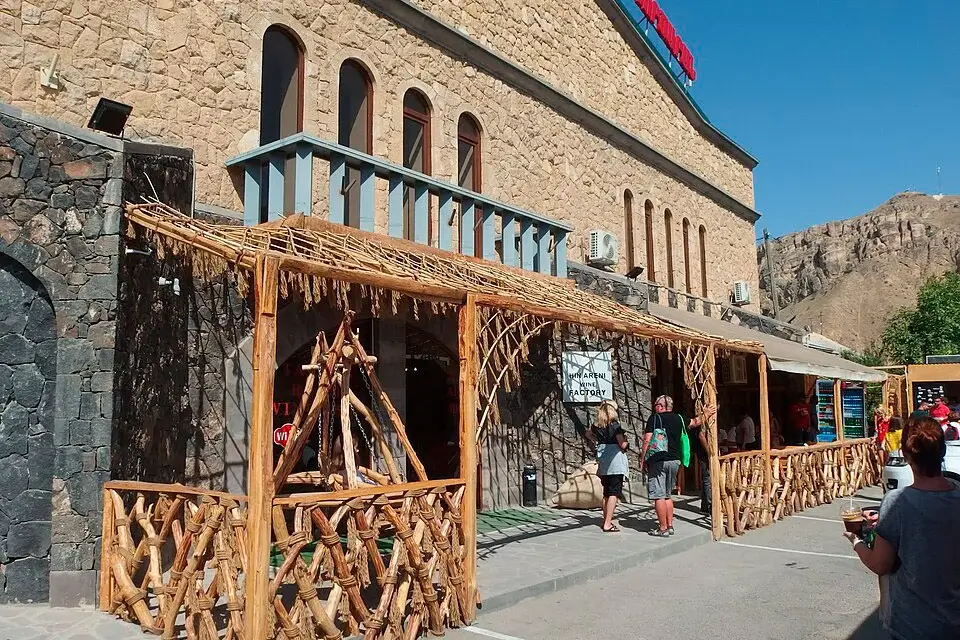
- Areni village wineries — at least half a dozen tasting rooms within a 5 km radius. The Areni Wine Festival runs the first weekend of October.
- Jermuk Waterfall and the Jermuk spa town (~60 km east) — easy extension on a multi-stop day or overnight.
- Kechut Reservoir with its star-shaped spillway (~65 km east, near Jermuk) — engineering curiosity if you’re going that way.
- Khor Virap Monastery (~70 km back toward Yerevan) — the iconic Mount Ararat viewpoint, usually combined with Areni-1 on a southern day-trip loop.
The standard one-day Vayots Dzor route from Yerevan: Khor Virap → Areni-1 Cave → Noravank → Areni wine tasting → back to Yerevan, often with Jermuk Waterfall added in a 1-day-and-a-half version with an overnight in Jermuk.


